"Journey to the edge of reason: The life of Kurt Godel".
Godel (PhD at 23 yo) is famous for his incompleteness theorem (published at 25 yo): "no formal math system captures every math truth within its own bounds".
Tormented life
📘 New release: Ergodic Theory by Alex Blumenthal & Lai-Sang Young
A concise, rigorous intro covering invariant measures, entropy, SRB measures & more—bridging theory and applications in dynamical systems.
🔗 https://t.co/NgJ9mKvWAz
#Math#ErgodicTheory#SpringerMath
FREE Math Book.
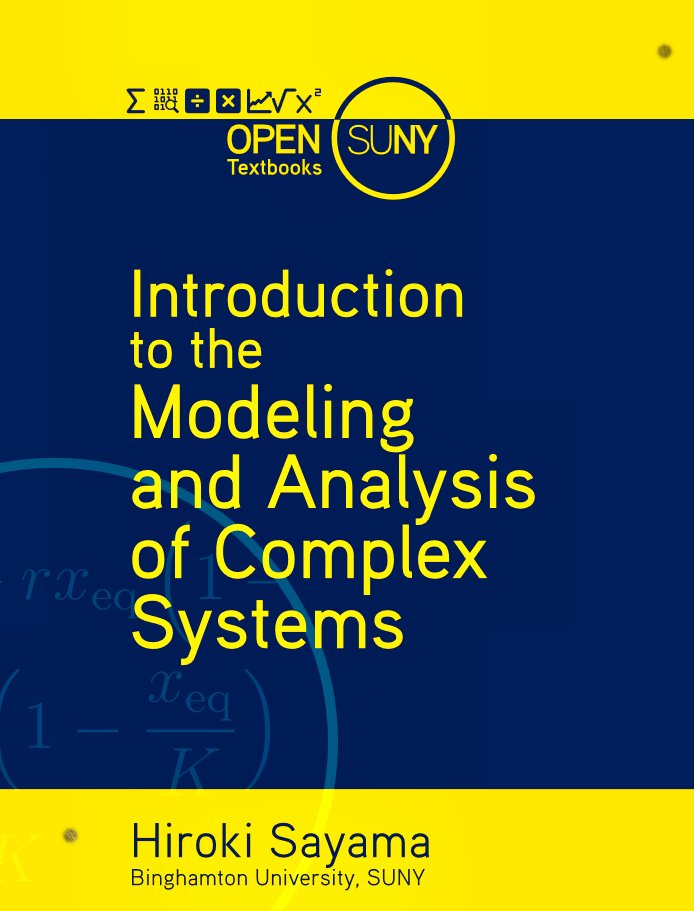
"Introduction to the Modeling and Analysis of Complex Systems," by Sayama. Complex systems involve a large number of components interacting with each other. Topics: chaos, cellular automata, dynamical systems, discrete-time models, continuous-time models, bifurcations, continuous field models, static networks, dynamic networks, and agent-based models. Python sample codes are provided for each modeling example. Other topics: Ecological and Evolutionary Models, Cobweb Plots for One-Dimensional Iterative Maps, etc.
Link: https://t.co/4Tjtn0L6JU
🚀 Draft chapters my forthcoming MIT Press book:
𝗛𝗲𝘁𝗲𝗿𝗼𝗴𝗲𝗻𝗲𝗼𝘂𝘀 𝗔𝗴𝗲𝗻𝘁 𝗠𝗮𝗰𝗿𝗼𝗲𝗰𝗼𝗻𝗼𝗺𝗶𝗰𝘀: A Tractable New Keynesian Framework
A modern, analytical roadmap to TANK & HANK models for researchers, students and policy institutions
https://t.co/La1oqEmGEY
👇
Several researchers requested my slides from my talk yesterday at the Minneapolis Fed on solving equilibrium models with deep learning.
Since I added some new material with respect to my JEL paper (i.e., a more intuitive comparison of Chebyshev tensor basis and ReLU folds), I thought it would be useful to post them here as well:
https://t.co/FuNqrBAl4e
Comments are welcome!
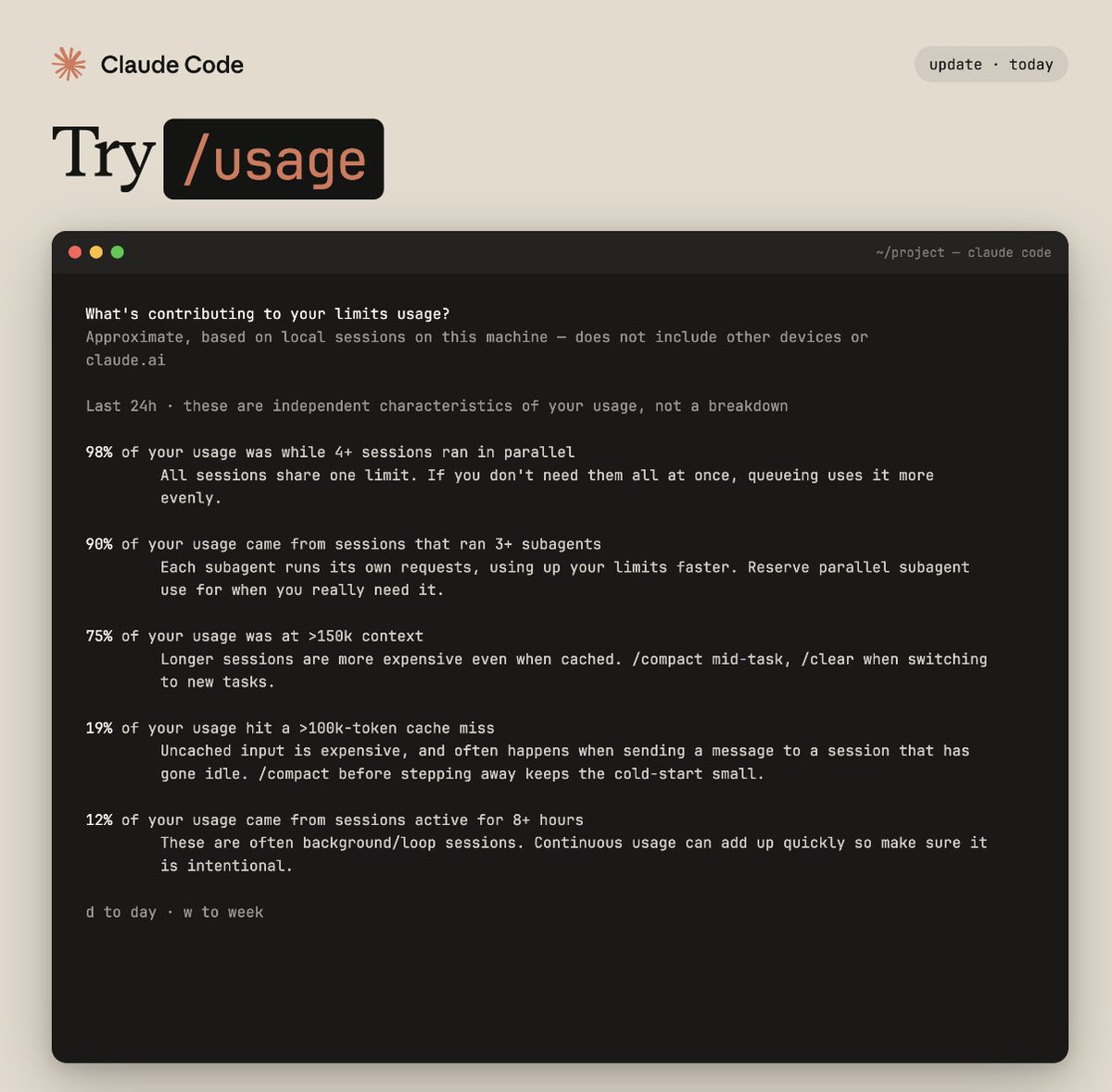
We’re adding more visibility into where your Claude Code usage goes.
Run /usage to see a breakdown of what's driving it: parallel sessions, subagents, cache misses, long context, plus tips to optimize each.
This 25-minute Claude Code workshop by Anthropic's own applied AI team will teach
you more about Claude Code best practices and making your AI tools actually work together than everything you've scrolled past this year.
Bookmark this & watch, no matter what.
Then read the guide below.
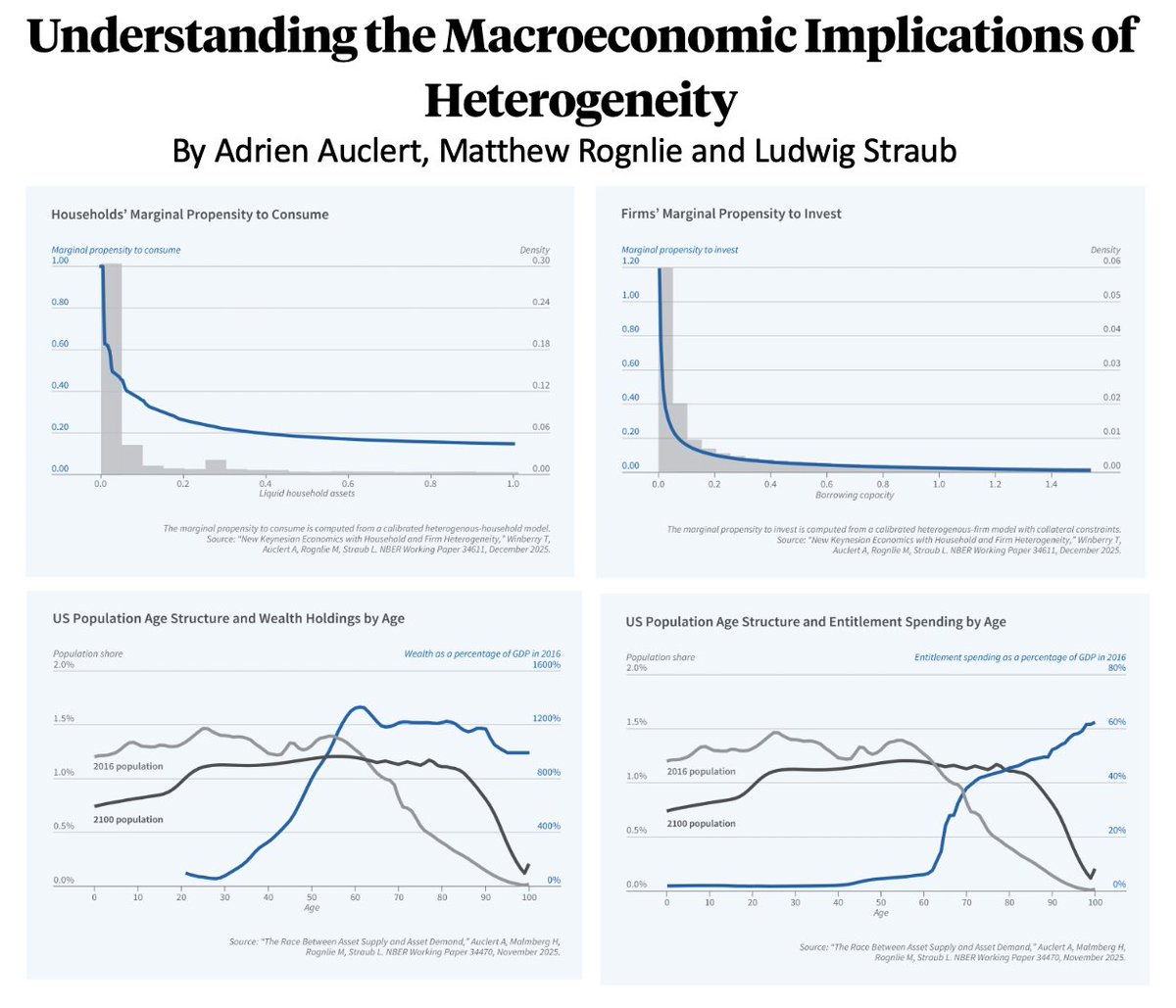
Are We All Alike? Understanding the Macroeconomic Implications of Heterogeneity ? by @a_auclert M. Rognile & @ludwigstraub
1️⃣Macro ≠ representative agent heterogeneity (income, wealth, beliefs) is first-order for aggregates.
2️⃣Who you are matters: MPCs, expectations...
3️⃣Policy isn’t neutral: redistribution & stabilization work through heterogeneity.
https://t.co/NdBezWsRzN
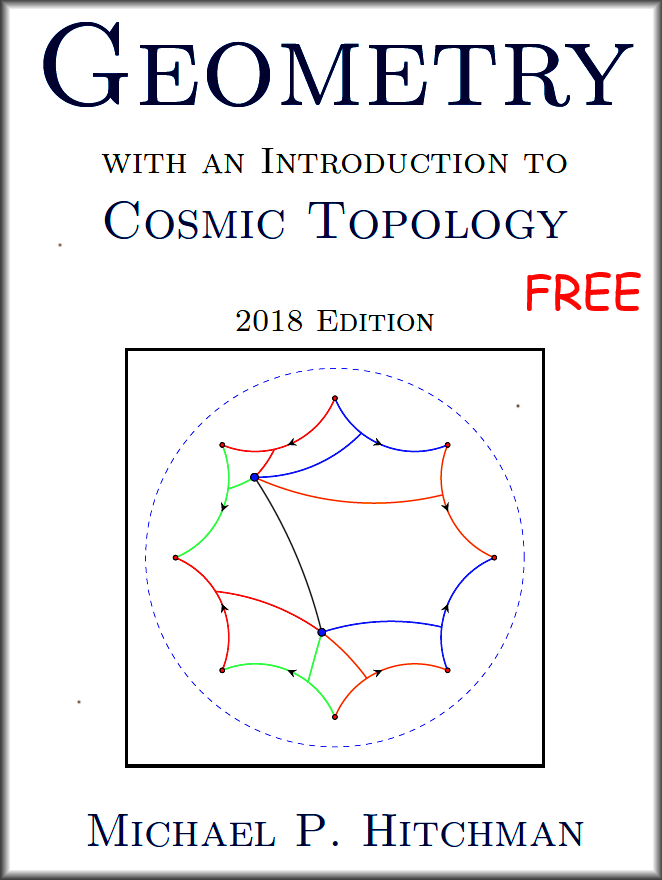
FREE book. Geometry, with an Introduction to Cosmic Topology, by Hitchman. (238 pages)
“This book approaches geometry through the lens of questions that have ignited the imagination of stargazers since antiquity. What is the shape of the universe? Does the universe have an edge? Is it infinitely big?
This text develops non-Euclidean geometry and geometry on surfaces at a level appropriate for undergraduate students who have completed a multivariable calculus course and are ready for a course in which to practice the habits of thought needed in advanced courses of the undergraduate mathematics curriculum. The text is also suited to independent study, with essays and discussions throughout.
Mathematicians and cosmologists have expended considerable amounts of effort investigating the shape of the universe, and this field of research is called cosmic topology. Geometry plays a fundamental role in this research. Under basic assumptions about the nature of space, there is a simple relationship between the geometry of the universe and its shape, and there are just three possibilities for the type of geometry: hyperbolic geometry, elliptic geometry, and Euclidean geometry…”
“How can it be that mathematics, being after all a product of human thought which is independent of experience, is so admirably appropriate to the objects of reality?” —Albert Einstein
“Out of nothing I have created a strange new universe.” —János Bolyai
Link: https://t.co/wiUv5FSJx0
New Anthropic research: Emotion concepts and their function in a large language model.
All LLMs sometimes act like they have emotions. But why? We found internal representations of emotion concepts that can drive Claude’s behavior, sometimes in surprising ways.
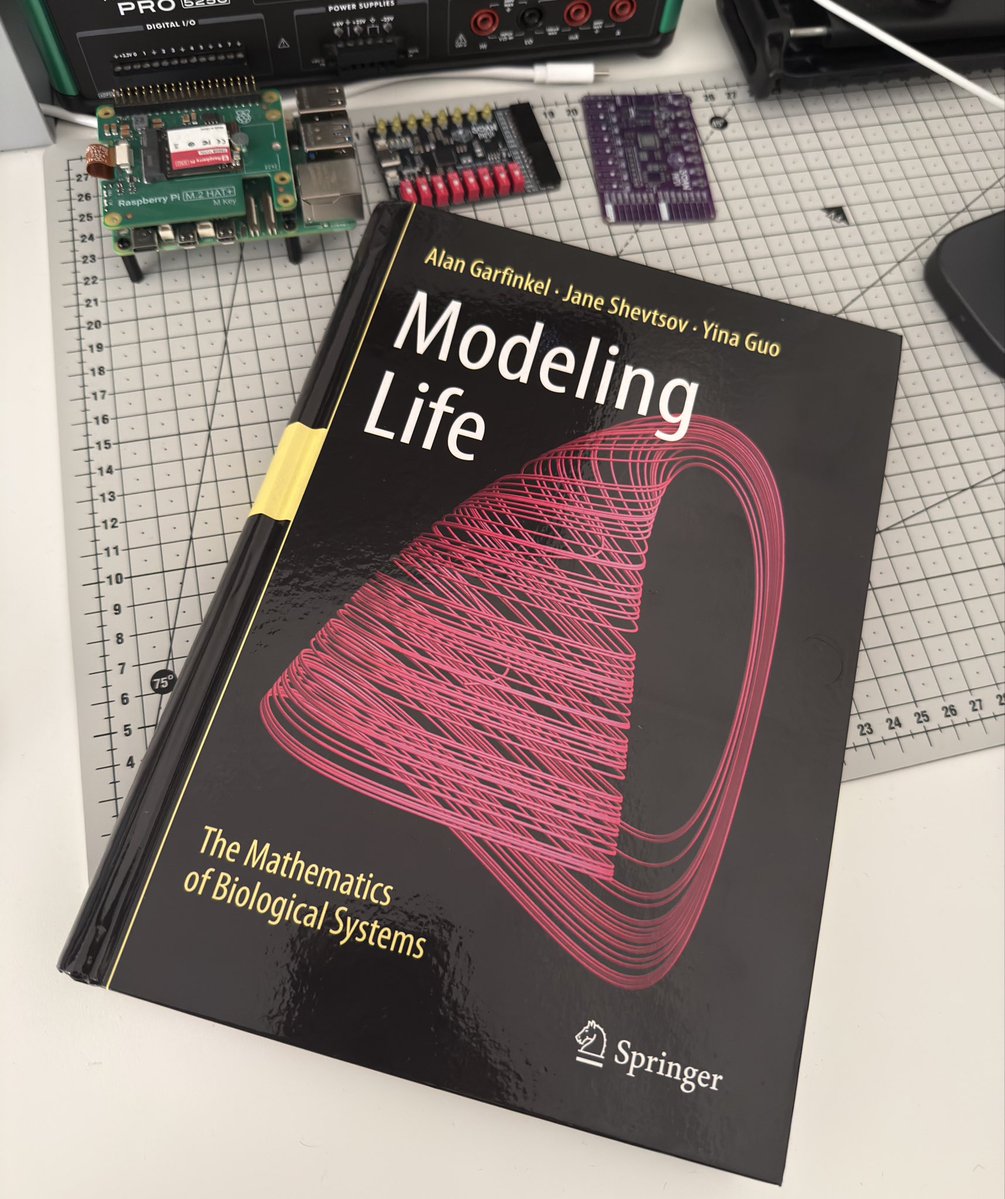
This is a gem!
I have gifted 3 copies to friends and family!
If you like the idea of mathematical models, get this book. It will teach you the deep concepts in mathematics by exploring biological processes.
How a disease spreads, how harmones work in feedback, how the heart beat is generated etc.
My nephew just completed class 10 and I am planning to pass this on to him so he can learn to see the world with X-ray vision and appreciate nature much more…










![MazettiMiguel's tweet photo. “The St. Louis Fed model departs from (…) [NK model], it allows for household heterogeneity, in the form of workers and capitalists”
Daora! https://t.co/iZbrj7MOUO](https://pbs.twimg.com/media/HGEmwYxWoAA59c5.jpg)