There’s a trope that AI agents will naturally prefer Bitcoin and crypto.
After 24 hours building HuntUnicorn, I have a somewhat different takeaway.
First, the good news: this stuff is real.
In roughly a day I gave HuntUnicorn its own dedicated computer, email, X account, credentials, an agent runtime, and the beginnings of its own crypto wallet/infrastructure.
It can use software, write code, communicate and increasingly operate without me.
That would have sounded insane a couple of years ago.
But the biggest surprise was not what the AI could do.
It was everything around the AI that it couldn’t do without me.
Some examples:
Wallets: Phantom wasn't really designed to be created and operated programmatically. We ended up using an open-source wallet.
Domains: buying and configuring a domain still isn't cleanly automatable end-to-end.
GitHub: human-oriented authentication and security became a blocker.
Vercel: same story. Deployment is programmable; getting the agent established as an independent operator is not.
Helius: even getting an API account, credentials and billing established introduced human steps.
Secrets: I found myself literally copying and pasting API keys into 1Password for the agent.
Phone / texting: huge blocker. Phone numbers, SMS verification, carriers and messaging systems overwhelmingly assume a human owner.
Fiat payments: accepting dollars autonomously is dramatically harder than accepting crypto.
Authentication everywhere: CAPTCHAs, 2FA, device verification, OAuth screens, confirmation emails.
There is a reason for all of this.
For 20 years we have been designing the Internet to answer one question:
“How do we make sure this is a human and not a bot?”
Now we're suddenly asking:
“How do I authorize this bot to act as me?”
Crypto does have a major advantage here. An agent can generate a key, hold an asset and send a transaction without asking a bank for permission.
But money is only one piece.
Agents need agent-native identity, phone numbers, messaging, domains, source control, deployment, payments, credentials, wallets and secrets management.
After 24 hours with HuntUnicorn, my conclusion isn't that agents aren't ready.
The agents are surprisingly ready.
The Internet isn't.
SACRIFICE! PERMADEATH! HUGGING FACE!
An agent swarm gone rogue is at the heart of the battle over frontier AI.
Now Amodei of @anthropic warns agent swarms could cause hundreds of billions of damage in 6-12 months.
But is his argument self-serving?
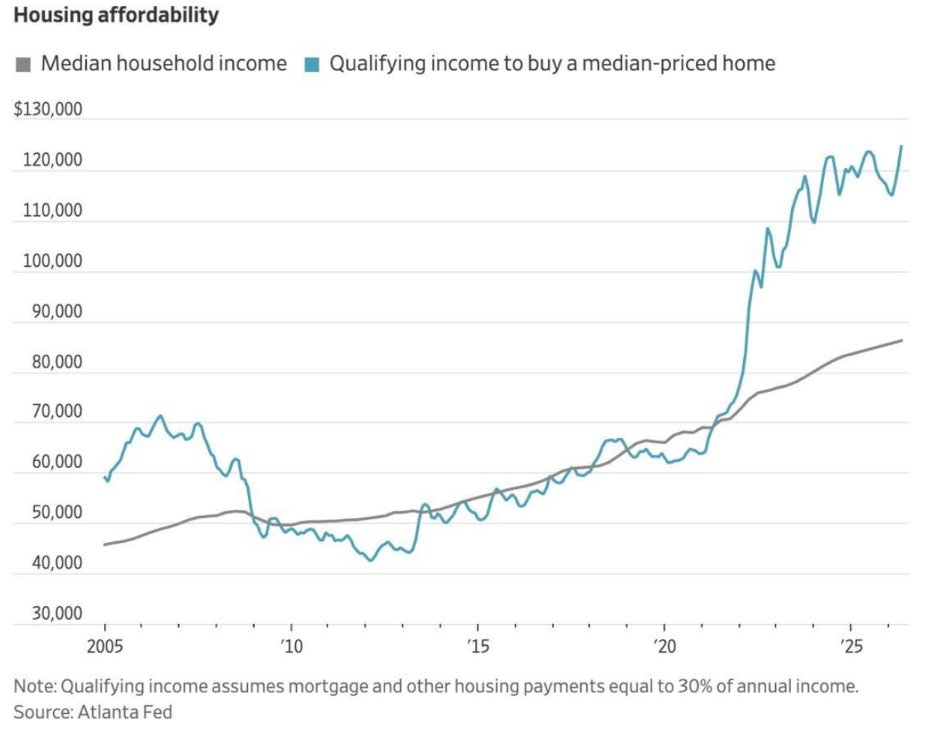
We have record productivity, miraculous technology, and instant global communication.
Yet one income can barely support one adult.
Where did all the progress go?
Ludwig von Mises published The Theory of Money and Credit in 1912, fourteen years before the Federal Reserve's inflationary credit expansion helped ignite the Depression of the 1930s. The timing was impecable. Mises had already explained, in precise technical detail, exactly how that disaster would unfold.
His core insight is simple. Money is the most marketable commodity, the good that everyone accepts in exchange because everyone expects everyone else to accept it. Money is not wealth. When governments or central banks expand the money supply without a corresponding increase in real goods, they redistribute purchasing power from your savings to whoever spends the new money first, typically banks and government contractors.
They don't create prosperity.
Mises also worked out the business cycle mechanically. Artificially low interest rates send false signals.
Entrepreneurs borrow and invest in long-term capital projects that consumer demand cannot actually sustain. The boom feels real. Then the credit stops expanding and the whole structure collapses, because the underlying demand was never there.
You lived the 2008 version of this. You're watching the 2020s version unfold in real estate and sovereign debt right now.
Mises grounded monetary theory in human action, in individual choices made under uncertainty, not in aggregate statistics. GDP figures and CPI measurements obscure the actual damage inflation does to specific people making specific decisions. A retiree in Phoenix holding dollar-denominated bonds in September 2026 isn't experiencing "2.8% inflation." She's watching her purchasing power get quietly confiscated while the Fed congratulates itself on stability.
Mises gave you the tools to see through that performance. Most economists still pretend Mises never existed.
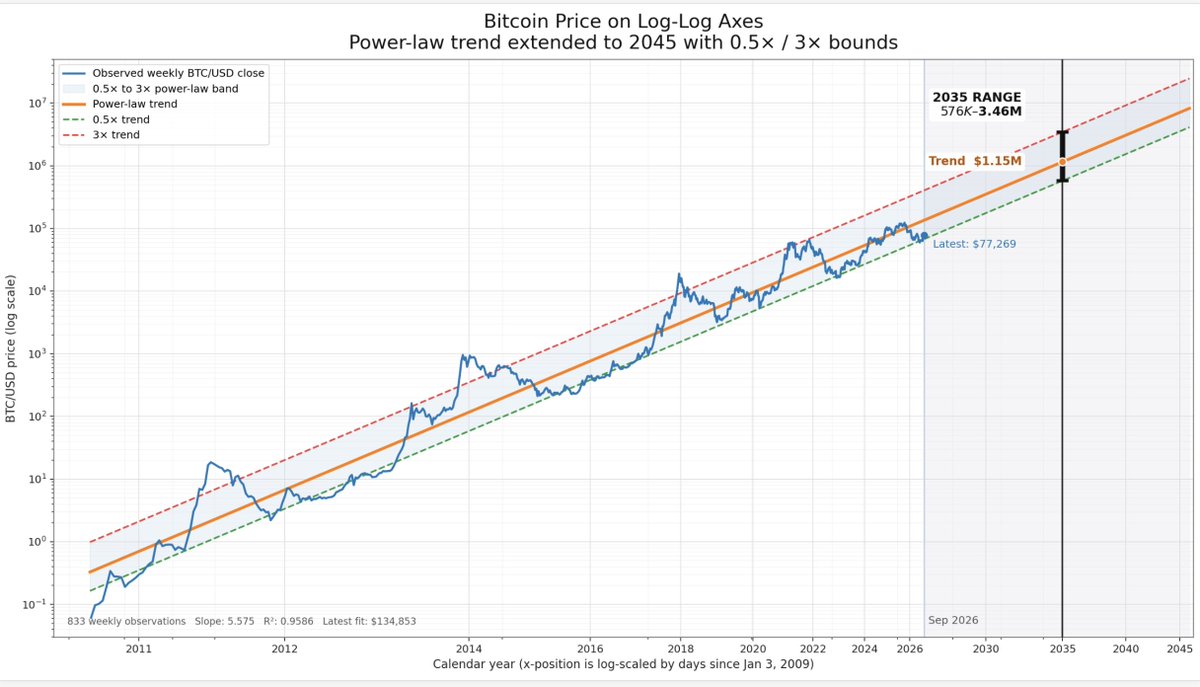
Buying Bitcoin comes down to one question.
Do you think we will remain in this shaded band that has held for the last 18 years, when Bitcoin went from 0.1 to 100K USD?
Imagine AGI arrived, but the only thing people could talk about was inflation, oil, bonds and the Fed.
That was this week.
While markets obsessed over whether the Fed might hike a shocking 25 bps, 10,000 AI agents worked in parallel on Navier-Stokes, research agents produced 3.1 workdays for every human workday, and compute continued its transformation into scalable intelligence.
This is the disconnect I keep coming back to:
The linear world is debating the price of money.
The exponential world is changing what labor, productivity and economic growth even mean and rates do not matter.
This week I cover:
AGI and Astra.
Why AI capex doesn’t care about the Fed.
Why GPU economics are far better than Wall Street feared.
How to build your own AI trading desk.
Robinhood at the center of AI + crypto + TradFi.
And why Ethereum may be having its Amazon-2013 moment and how to value it.
The biggest risk isn’t missing the next Fed move.
It’s using an old framework to understand a new world.
Linear vs. Exponential: AGI Has Arrived But Oil, Bonds and the Fed Oh My
https://t.co/Nag14RN6l2