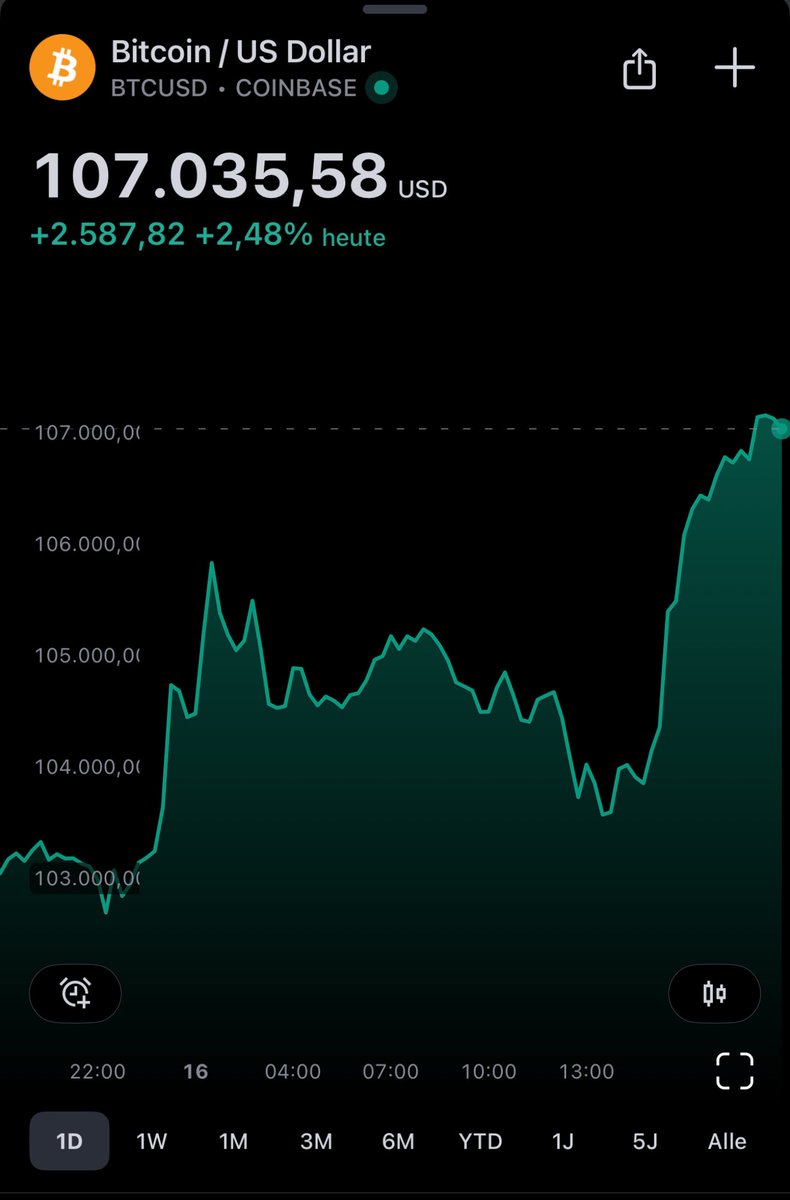
🎄❄️ The holidays are over, but talking about #Bitcoin 🪙 with family was always tough 😅.
👨👩👧👦 They usually laughed it off a bit 🤭, but in time, they'll get it 🧠.
Better late than never! ⏳✨
Thread: Bitcoin and Quantum Computers - Security and Future 🔐🔮
**1. Current Threats and Risks:**
Bitcoin relies on cryptographic algorithms like ECDSA 🌿🔑 and SHA-256 🔒, which could potentially be threatened by quantum computers. Quantum computers might theoretically derive private keys from public keys, opening the door for Bitcoin theft. However, this would require an enormous number of qubits, far beyond current technology capabilities.
**2. Quantum-Resistant Algorithms:**
Researchers are already working on quantum-resistant cryptographic algorithms 🛡️ that are immune to quantum computing power. These might include lattice-based cryptography 🔢, hash-based signatures 🔐, or multivariate polynomials 📈, which could be integrated into Bitcoin to ensure long-term security.
**3. Proactive Adaptation by the Bitcoin Community:**
The Bitcoin community has demonstrated a proven ability to adapt, as seen with BIPs (Bitcoin Improvement Proposals) 🧑🔧. If quantum computers become a threat, the community could introduce new quantum-resistant algorithms through a soft fork or hard fork. This would ensure Bitcoin remains secure.
**4. Address Migration:**
Another measure would be migrating Bitcoin addresses to new, quantum-resistant addresses 🔄. Users could transfer their coins from old addresses (like P2PK) to newer, safer addresses, minimizing the threat of quantum attacks.
**5. Security Upgrades and Hash Algorithms:**
There's discussion about implementing new hash algorithms resistant to quantum attacks or even switching to another consensus mechanism like Proof-of-Stake 🔄, which could be less vulnerable to such attacks. These changes could maintain Bitcoin blockchain integrity even in a quantum computing era.
**6. Current Security:**
As of 2024, Bitcoin is not immediately at risk due to the massive computing power quantum computers would need for an effective attack. Estimates suggest millions of qubits would be required to break Bitcoin's security, while the most powerful quantum computer currently has around 100 qubits 🖥️➡️🔢.
**7. Conclusion:**
Bitcoin has the potential to adapt to future technological challenges. With active research into quantum-resistant cryptography and the adaptability of the Bitcoin community, Bitcoin's security can remain intact even in a future world with advanced quantum computers. The threat from quantum computers is real, but through proactive action by the community, Bitcoin will likely continue to be secure.
This thread shows that while the threat of quantum computers exists, it can be managed through technological innovation and the adaptive nature of the Bitcoin community. 🔒🚀
Why Bitcoin's Lows Are More Significant Than Its Highs 🧵
**1. Introduction to Bitcoin Philosophy**
Bitcoin isn't just about speculative investment; it's a revolution in the global financial system. It's about envisioning a world without banks or central control. 🌍
**2. Stability and Trust**
- **Volatility as a Test:** The lows in Bitcoin's price are litmus tests for system stability. They reveal how strong and trustworthy Bitcoin truly is. 💪
- **Proving Decentralization:** Even in times of crisis, Bitcoin continues to operate without intervention from central entities, underlining the resilience of the network. 🏦❌
**3. Technological and Social Acceptance**
- **Innovation During Crisis:** While highs are often driven by speculation, lows push for technological improvements and strengthen the Bitcoin community. 🛠️
- **Social Recognition:** Lows prompt more people and institutions to dive deeper into understanding the real benefits and technology behind Bitcoin. 👥💡
**4. Economic Implications**
- **Store of Value:** A lower price can be seen as an opportunity to view Bitcoin as a long-term investment, much like gold. 🕰️
- **Scarcity:** The limited supply of only 21 million Bitcoins becomes even more evident during lows, making Bitcoin the ultimate anti-inflation currency. ✨
**5. The Fight Against the Establishment**
- **Regulation:** Lows might highlight regulatory challenges, but they also showcase the determination of the Bitcoin community to resist government and institutional pushback. 🚫
- **Global Adoption:** A lower price could lead countries with weaker currencies to see Bitcoin as an alternative, potentially accelerating global adoption. 🌐
**6. Education and Awareness**
- **Learning from Mistakes:** Lows serve as valuable lessons for investors and users, promoting a deeper understanding of technology, security measures, and the philosophical foundations of Bitcoin. 📚
- **Raising Awareness:** The media frenzy around Bitcoin's lows increases awareness and sparks intense discussions about its significance and future. 📰
Thus, Bitcoin's lows often tell a more profound story about its civilization-changing potential than its highs do. 🔄
**Why It's Crucial to Secure Your Own #Bitcoin , Avoid Staking, and Always Be Cautious 🚨**
**Securing Your Own Bitcoin 🔐**
- **Control Over Your Coins:** When you hold your own Bitcoin, you control the private keys. This means you're the only one with access to your coins. Remember the mantra from X posts: "Not your keys, not your coins." If you don't possess your keys, you don't really own your Bitcoin.
- **Security:** Using your own wallet, like a hardware wallet (#Bitbox , #TrezorWallet or #Ledger ), provides maximum protection against hacks and theft. These devices keep your keys offline (Cold Storage), minimizing the risk of online attacks.
- **Independence:** You're not reliant on third parties that might go bankrupt, get hacked, or misuse your coins. Self-custody protects you from the risks associated with exchanges or staking services.
**Avoid Staking 🚫**
- **Staking Risks:** Staking might seem lucrative due to potential returns, but it comes with risks. You relinquish control over your coins as they're managed by a staking pool or platform. There's no guarantee these platforms are secure or stable, and you could lose your coins due to vulnerabilities or fraud.
- **Volatility:** The rewards and staked capital are subject to high market fluctuations. A sudden market shift could lock your coins at an inopportune time, leading to losses.
- **Sustainability:** High APY (Annual Percentage Yield) rates might not be sustainable, hinting at fraudulent intentions or unrealistic expectations. The sustainability of projects you stake in is often uncertain.
**Always Be Cautious 🕵️♂️**
- **Education:** Continuously learn about security practices and the latest developments in the Bitcoin ecosystem. The crypto world evolves quickly, and what was safe yesterday might be vulnerable today.
- **Phishing and Scams:** Stay vigilant against phishing attacks, fake projects, and scams. There are countless cases where people have lost their Bitcoin to such threats. Always verify the source before taking any action.
- **Backups:** Regularly make secure backups of your wallet information, but ensure these backups are stored safely. Losses due to forgotten or lost key data are all too common.
- **Transaction Fees and Network Congestion:** Be aware of current network conditions to avoid unnecessary high fees or transactions that might get stuck during high network load.
**Conclusion ✅**
Self-custody of your Bitcoin gives you the greatest control and security. Staking can be tempting but carries many risks often underestimated. Caution and continuous learning are key to staying safe in the dynamic world of cryptocurrencies. Use the information available on websites and in posts on X to make informed decisions, but never rely blindly on a single source.
🚨 **Security of the SHA-256 Algorithm in #Bitcoin ** 🚨
A thread…
🔒 **What is SHA-256?**
SHA-256 is a cryptographic hash algorithm used by Bitcoin to secure transactions and blocks. It generates a 256-bit hash value from any data input.
🔐 **Impossible to Crack?**
With SHA-256, it's extremely difficult to find two different inputs that produce the same hash (collision). The odds are staggeringly low:
- 2^256 possible combinations
- That's more than the number of atoms in the universe! 🌌
💪 **Attack Resistance**:
- **Brute-Force Attack**: To reconstruct a hash, one would need to try 2^256 attempts. This is practically impossible with current and foreseeable computing power.
- **Collision Attacks**: The effort here would be enormous, as even the slightest change in the input produces an entirely new hash.
🔬 **Quantum Computers and SHA-256**:
- Even quantum computers, which theoretically can speed up complex calculations, are decades away from threatening SHA-256. Current chips like Google's Willow are far from powerful enough.
🌍 **Global Security**:
- Bitcoin uses SHA-256 for mining and transaction integrity checks. The network itself offers additional security through its decentralized structure.
🔥 **The Vast Possibilities**:
- SHA-256 always produces a 64-character hash. Even changing one character in the input completely alters the hash, making attacks by guessing or collision practically impossible.
💡 **Future-Proofing**:
- The Bitcoin community is aware of the quantum threat and is working on solutions like implementing post-quantum secure algorithms to ensure Bitcoin remains secure in the future.
🔒 **Conclusion**:
SHA-256 provides a robust security foundation for Bitcoin. Its unassailability by current and future technology makes it an indispensable part of the cryptocurrency.
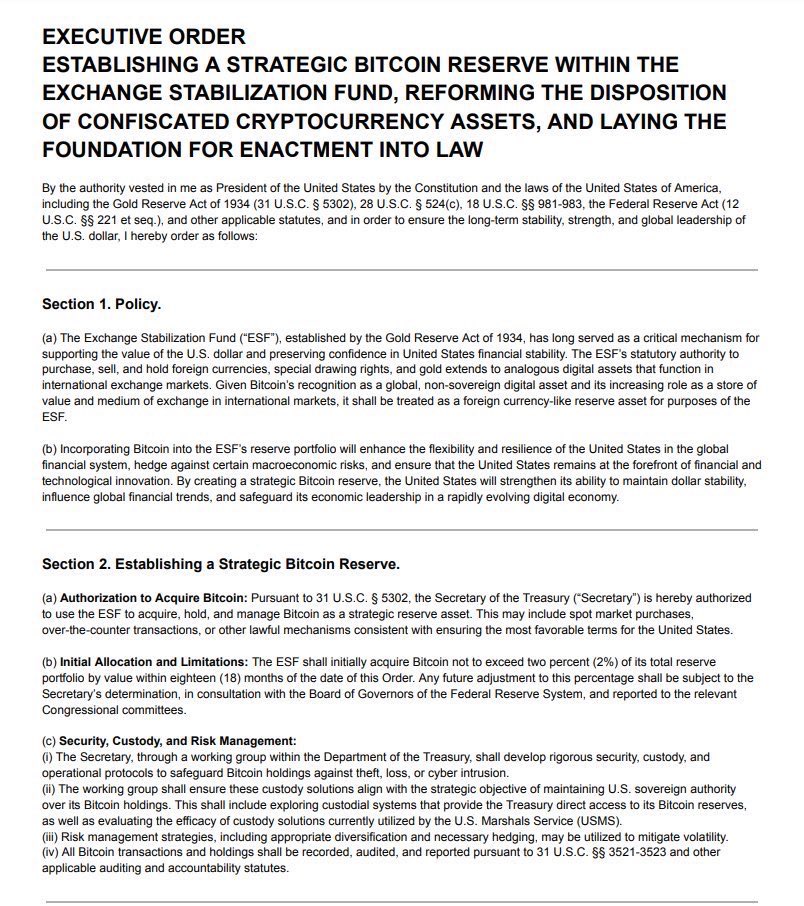
MASSIVE BREAKING: I can confirm that my team has finalized a model EXECUTIVE ORDER for the president of the United States to establish a ‘Strategic Bitcoin Reserve’
🧵 **Why Bitcoin's Competitors Fail** 🧵
🚨 **Central Control** 🚨
Many cryptocurrencies that aim to challenge Bitcoin have centralized control or a small group of developers leading the project. This contradicts the decentralized ethos of Bitcoin. 🌐❌
🔒 **Concentration of Power** 🔒
Without the decentralization Bitcoin offers, decisions can be influenced by a few, risking manipulation and censorship. 🧑💻🚨
💰 **Coin Distribution** 💰
Many projects start with a pre-mine, where a significant portion of coins go to founders or investors, creating an unequal distribution and less trust. 🍰💸
🚫 **Lack of Anonymity** 🚫
Bitcoin's pseudonymity is a major advantage. Many competitors offer less privacy protection, which can deter users. 👤🕵️♂️
🔄 **Lack of Community Support** 🔄
Bitcoin's success is heavily based on its community. Many other projects lack an engaged base, leading to long-term difficulties. 🤝🚶♂️
👻 **The Satoshi Phenomenon** 👻
Why is it good that Satoshi Nakamoto disappeared?
🔐 **Power Vacuum** 🔐
With Satoshi's disappearance, there is no central figure or person controlling the project. This protects Bitcoin from personal influence and makes it less vulnerable to attack. 🛡️💨
✨ **Myth and Mystique** ✨
Satoshi's absence creates an aura of mystery, which keeps interest and fascination with Bitcoin alive. There's no central person to target. 🕵️♀️✨
🔄 **Focus on the Protocol** 🔄
Without Satoshi, the focus remains on the Bitcoin protocol itself, not on a person, fostering development and improvement by many. 📈💻
🔒 **Trust through Absence** 🔒
Satoshi's absence shows that Bitcoin can exist even without its creator, strengthening trust in the system's decentralization and autonomy. 🏞️🔗
Bitcoin has a unique position due to its structure and history, making it hard for competitors to overtake.
And this is why…. Bitcoin only 🙌🚀
#Bitcoin mining ⛏️ has evolved significantly, particularly in its approach to sustainability. The term "green 🟢 Bitcoin mining" refers to the practice of using renewable energy sources to power the energy-intensive process of mining Bitcoin. Here's a look into why miners are increasingly turning to green ⚡️energy:
Why Cheap, Green Energy?
Miners always seek low-cost energy because electricity is one of the largest expenses in Bitcoin mining. Renewable energy sources like solar ☀️, wind 💨, or hydroelectric🌊 power can be remarkably cheap, especially in remote areas where these resources are abundant but not yet fully integrated into broader energy systems.
Remote Locations Advantage:
In many remote areas, renewable energy might not be connected to the main grid or might produce surplus energy when not in use. Bitcoin miners can set up operations in these locations, turning otherwise wasted energy into profit by mining Bitcoin. This not only helps miners reduce costs but also aids in the local energy economy by providing a market for this excess energy.
The Hysterical Bitcoin Mining Process:
The term "hysterical" here points to the dramatic changes in mining practices over time. Initially, Bitcoin mining was done on regular PCs, but as the network grew, so did the complexity of the cryptographic puzzles 🧩 needed to mine new coins. This led to:
- GPU Mining: Using graphics cards for increased computational power.
- ASIC Mining: Development of Application-Specific Integrated Circuits, designed solely for mining Bitcoin, offering far greater efficiency but also higher energy consumption.
Evolution Towards Sustainability:
- Energy Efficiency: Over time, mining hardware has become more energy-efficient. Newer ASICs use less power per terahash than their predecessors, reducing the overall environmental impact.
- Renewable Integration: As awareness of environmental impact grew, the industry has seen a shift towards using renewable energy. Reports suggest that a significant portion of Bitcoin's energy now comes from sustainable sources, with some mining operations even using waste heat for other applications like heating 🔥 greenhouses.
- Grid Stability: Miners can act as flexible load resources, consuming excess renewable energy when production exceeds demand, thus helping to stabilize the grid.
- Policy and Incentives: Governments and energy providers in some regions offer incentives for using 🟢 green energy, further encouraging miners to adopt sustainable practices.
In conclusion, while Bitcoin mining was once criticized for its environmental footprint, the industry has made strides towards sustainability by leveraging cheap, green energy in remote areas. This not only benefits miners economically but also contributes to broader environmental goals, showing that with innovation, even energy-intensive technologies can align with sustainability objectives. #GreenBitcoin #Sustainability #CryptoMining #BTC
#Bitcoin has once again reached **new all-time highs**! 🚀 The past months have been incredible, with a price surge that exceeded all expectations. The future looks bright for #BTC! 📈🔥
The Bitcoin's journey over the last few years and its positive evolution despite mainstream critics:
Bitcoin has come a long way since its inception in 2009 by the mysterious Satoshi Nakamoto. Despite early skepticism and numerous criticisms, Bitcoin has proven its resilience and potential.
In recent years, Bitcoin has weathered storms like the Mt. Gox hack in 2014, the Bitfinex hack in 2016, and regulatory crackdowns across various countries. Yet, each setback has been followed by significant recovery and growth.
One of the most telling signs of Bitcoin's positive trajectory is its adoption by institutions. Major companies like MicroStrategy and Tesla have invested heavily in Bitcoin, showcasing a shift from skepticism to acceptance.
The hash rate of Bitcoin has grown exponentially. From being 95% lower a few years ago, it now supports a robust network that is more secure than ever, making it harder for any single entity to compromise the system.
Countries like El Salvador have taken bold steps by recognizing Bitcoin as legal tender, further legitimizing its use and showcasing real-world application beyond speculation.
Despite predictions of its downfall, Bitcoin's price has soared, with some analysts projecting it to hit $800K in the next five years. This growth is especially notable when compared to traditional assets like housing, which, adjusted for inflation, have not kept pace.
Bitcoin has also become a symbol of financial freedom in countries facing economic crises. In places like Venezuela and Argentina, Bitcoin offers an escape from hyperinflation and currency devaluation.
While mainstream critics continue to question its volatility and environmental impact, Bitcoin's community has been working on solutions like renewable energy for mining and the Lightning Network for scalability. The journey of Bitcoin is a testament to its enduring appeal and innovation.
Could the U.S. spark a global movement for fair money and renewable energy?
The time for action is now. What’s your take? Should the U.S. take the lead in adopting Bitcoin as a national reserve asset?
The Bigger Question
A Bitcoin reserve is more than just an investment. It’s a step toward rethinking money, empowering individuals, and aligning economic systems with sustainability.