Resist the fatalism.
An Omicron infection is NOT inevitable.
It has a weakness: it needs to travel on an air bridge.
We have the technology to break that air bridge, through filtering, cleaning and changing the air.
🧵 on some Omicron avoidance SUCCESS stories!
1/
@VoidSurf1@wigglin@NateSilver538@toad_spotted i think people fail to grasp the implications of a seasonal sars. it means the greatest cause of death will shift to complications of sarscov2 and the life expectancy will drop significantly. I'm not saying it's an inevitability, we can still have immune systems from a jar.
Right. Mutated a great deal. But I followed a vaccinologist working on one of the mRNA vaccines during the animal trials in 2020.
Disappointing news was soon given that upon viral (SARS2) challenge, the vaccinated animals developed replicating virus inside their nasal cavities. This was not what people were hoping for. It did not shut replication therefore would never shut down transmission.
This was known since 2020.
But of course, mutations are a real issue.
'Worst cold ever' has no flooded my feed....🤦🏼♂️
1 in 20 in many parts of the country are actively infected with Covid. That's over 1 million infections a day. During Covid is now.
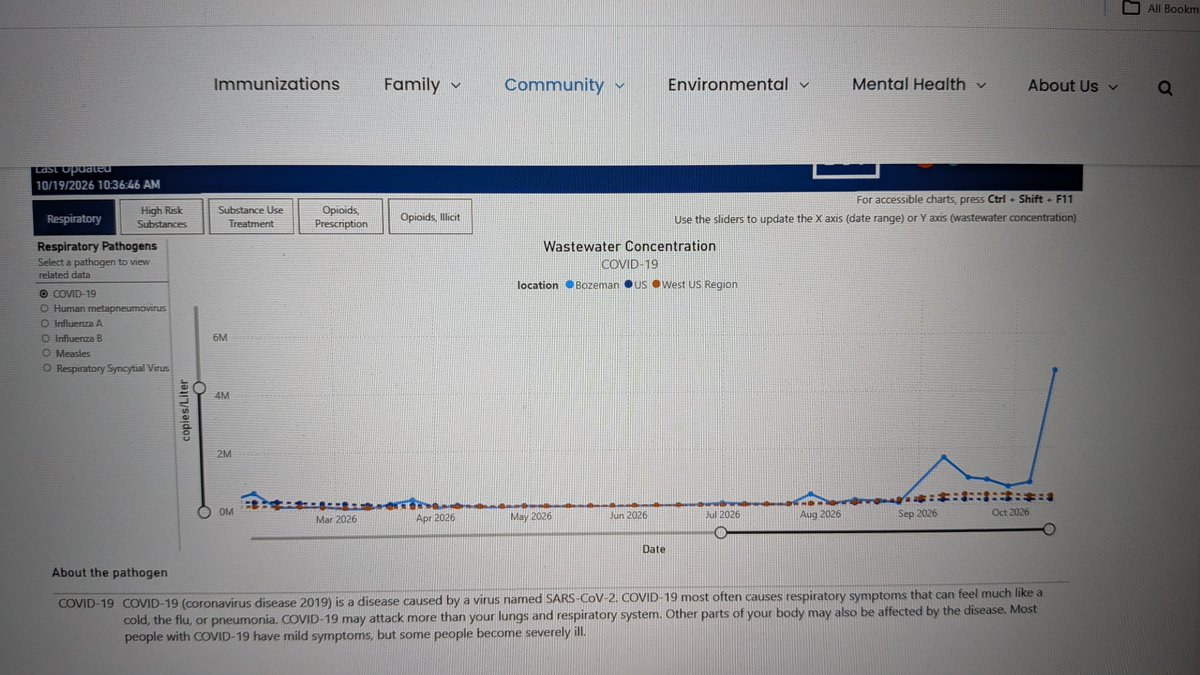
I tried to post this local wastewater graph showing wastewater through the roof on a local forum to explain why everyone is sick in their town. (Lots of people complaining about the 'flu' hitting them hard). However, the post was DENIED because it was Covid related. Idiots.
We have normalized neonatal/pediatric sepsis.
Society has already collapsed, but people can’t see it until they are directly affected. There is no accountability & no recourse. No one understands what is happening.
We are the Walking Dead.
In 2020, 4.4 billion people stayed home at the same time. Within weeks, GPS-collared wild mammals around the world were traveling 73% farther than they had the year before.
173 scientists had already been tracking 2,300 animals across 43 species when the lockdowns hit. The collars kept recording while the researchers sat at home, which turned COVID into the largest accidental wildlife experiment ever run. The study landed in Science, and the period got its own name, the anthropause.
The distance number wasn't even the surprising part. During strict lockdowns, animals also moved 36% closer to roads.
A highway with no cars on it stopped working as a wall. Animals figured that out in days, not generations.
Those flamingos in the clip are a real count, by the way. The Bombay Natural History Society estimated over 150,000 in Navi Mumbai that April, 25% more than the year before. One reason is almost too fitting. With industry shut and everyone home, domestic sewage fed the algae blooms flamingos feed on.
Here's what stuck with me from the research. For decades, scientists assumed the infrastructure itself was what pushed wildlife out, the buildings and highways. The lockdown finally separated the two variables. All the concrete stayed exactly where it was. Only the people disappeared, and the animals came out anyway.
They'd been there the whole time, waiting for us to sit still.
@lsthart@1goodtern Some protein based vaccine (not MRNA) for SARS2 did indeed use only a portion of the spike protein but those vaccines are not available in the US