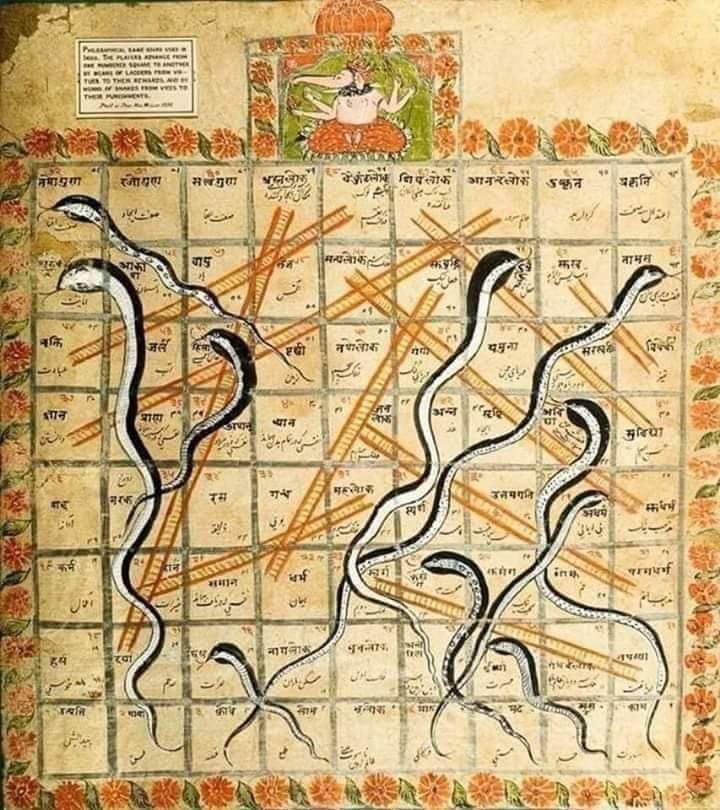
22. The 13th Century CE, Indian poet and saint Gyandev created a children's game called Moksha Patam. The British later named it as Snakes and Ladders instead of retaining the original Moksha Patam.
Originally, the game was used as a part of moral instruction to children. The squares in which ladders start were each supposed to stand for a virtue, and those housing the head of a snake were supposed to stand for an evil. The snakes outnumbered the ladders in the original Hindu game. The game was transported to England by the colonial rulers in the latter part of the 19th Century CE, with some modifications.
In the original one, a ‘hundred squares game board’, the 12th square was faith, the 51st square was reliability, the 57th square was generosity, the 76th square was knowledge, and the 78th square was asceticism. These were the squares where the ladders were found and one could move ahead faster.
The 41st square was for disobedience, the 44th square for arrogance, the 49th square for vulgarity, the 52nd square for theft, the 58th square for lying, the 62nd square for drunkenness, the 69th square for debt, the 84th square for anger, the 92nd square for greed, the 95th square for pride, the 73rd square for murder and the 99th square for lust. These were the squares where the snake waited with their mouth open.
The 100th square represented Nirvana or Moksha.The tops of each ladder depicted a God, or one of the various heavens (Kailash, Vaikunth , Brahmalok) and so on. As the game progressed various actions were supposed to take you up and down the board as in life..The game had been interpreted and used as a tool for teaching the effects of good deeds versus bad ones.
The game was popular in ancient India. It was also associated with traditional Sanatan philosophy contrasting karma and kama, or destiny and desire. It emphasized destiny, as opposed to games such as pachisi, which focused on life as a mixture of skill and luck. The underlying ideals of the game inspired a version introduced in Victorian England in 1892.
The modified game was named Snakes and Ladders and stripped of its moral and religious aspects and the number of ladders and snakes were equalized. In 1943, the game was introduced in the US under the name Chutes and Ladders.
Mega swords, super swords and all other fantasy swords belong where they rightly exist--in fantasy, not reality!
This is because there is a SECRET GEOMETRY behind real medieval swords that fantasy rarely considers.
Real swords look the same for very important reasons.🧵
I'm 26.
I used to be stressed out of my mind and wasted years of my life making the wrong decisions...
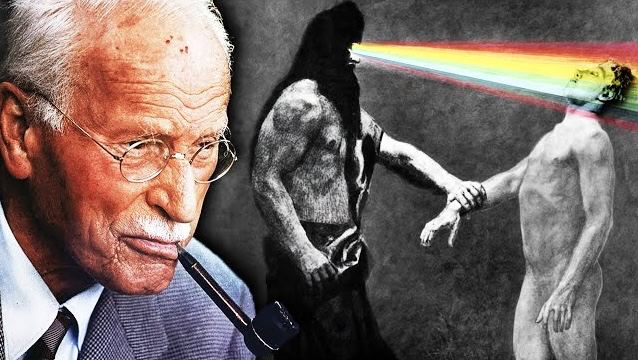
Then I found Carl Jung’s 7 Laws for Finding your Life’s Purpose.
Here's how to use your dark side to find your Lost Potential: 🧵
What did Jesus of Nazareth look like?
The 6th century Christ Pantocrator is the most recognized image of Jesus — but what about before then?
Well, that's where things get weird... (thread) 🧵
You might recognize this as a movie set — it's actually a real place near Paris.
In the 1970s, one man had enough of modern architecture and did something radical.
He went back to Ancient Greece for inspiration... (thread) 🧵
You can learn a lot about history just by looking at the words we use.
Like algorithm, which is descended from the name of a 9th century Persian polymath called al-Khwarizmi.
So, from romantic to cynical, here are the strange stories behind 12 incredibly normal words...
I departed the courtroom feeling empty, trying to process the gravity of what I had just experienced.
1. Crypto has very real and colossal consequences. Judge Kaplan had also adjudicated cases involving: Trump, Prince Andrew/Epstein, and Al Queda terrorists. We’ve hit a scale where people’s life savings are on the line. It’s not just memecoins, fun, and games. Normalizing negligence out of ‘degen’ culture is reckless. If we want to power a global financial system bigger than the current day crypto-native casino, we cannot lose sight again this cycle.
2. Seeing the jury made me realize how far we have to go in educating and onboarding normal individuals. Blockchain UX is still a joke.
3. It’s unintuitive for humans to grapple with the true magnitude of finance at scale. Small % errors can lead to hundreds of millions in accounting discrepancies.
4. Bring business back on-shore through sensible regulation. Coinbase is a trailblazer in long-term thinking.
5. DeFi is the answer. Build trustless systems where accounting is open, transparent, and verifiable by external parties.
🧵THREAD🧵
“15 days to slow the spread” kicked off four years ago Saturday, sending the media into perhaps its most deranged cycle of my lifetime.
I dove back into some of the worst lockdown media coverage from those early days.
Buckle in, this one’s long. ⤵️