@chude__ Na the African Liberation go follow trigger World War,, they no go wan see us win and once we starts winning they will scatter the cheeseboard to reset the World again🤒🤒
"Our fathers were sent to Konfo in the Second World War - not as heroes, but as baits. They gave their l!ves on foreign soil, and those who returned were treated like animals, killed without mercy.
When France tested its first atomic bazuuga, it was African soldiers they put in the impact zone to observe the effects. We were used as experiments.
Today, the mentality continues. Afríca remains a testing ground- not only for bazuugas but also for vaccine and other technologies. It's time we reopen the archives. Our youth must know the truth. Our silence only emp0wers those who continue to use us."
Arise o Africa!
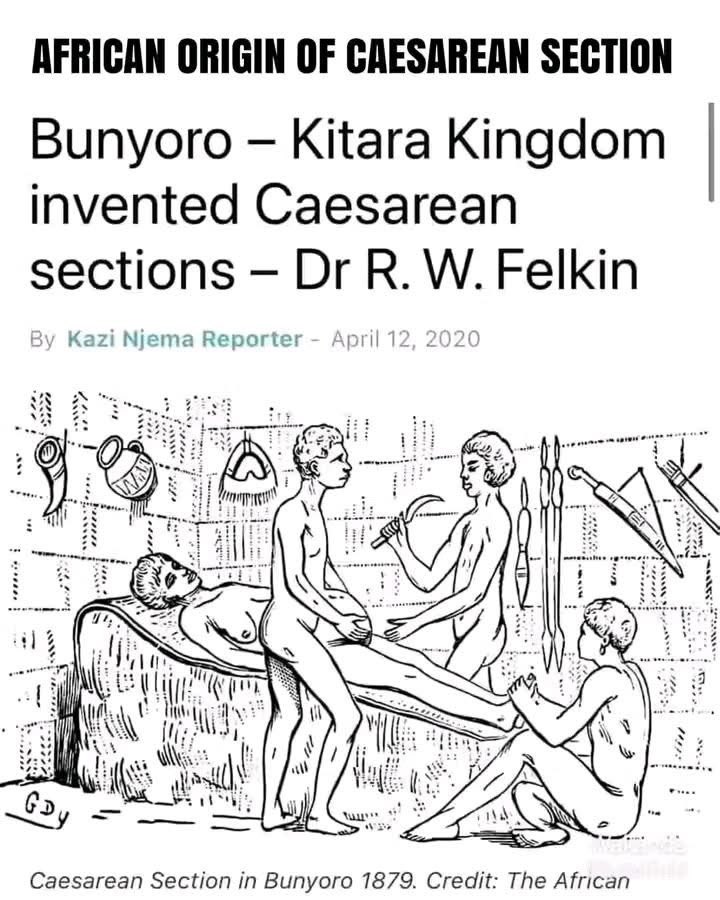
AFRIKAN ORIGIN OF CAESAREAN SECTION
Caesarean sections were performed in Afrika long before they were standardized across the world. They were invented in Afrika long before Europe, and the rest of the world fully mastered how to conduct them (Young, 1944). The procedure is said to have been started since time immemorial. When a baby could not be delivered vaginally, midwives and surgeons would turn to C-sections in order to deliver the baby safely and alive. In areas around Lake Tanganyika and Lake Victoria, midwives and surgeons would perform this procedure (Davies, 1959).
When a baby could not be delivered vaginally, the midwives and surgeons would sedate the mother in labour with a lot of banana wine. A knife would be sterilized using heat, while the mother would be tied to the bed for her safety. An incision would be made quickly by a team, and the quickness was to ensure that there would be no excessive loss of blood, and also that other organs would not be cut. A combination of sterilized knives and sedation would make the experience less painful for the mother (Felkin, 1884). During these times, women rarely developed infections because antiseptic tinctures and salves were used to clean the area and stitches were applied. Shock and excessive blood loss were uncommon. Uganda, Tanzania, and the Democratic Republic of Congo (DRC) were the countries where this was mostly practised. In Uganda, C-sections were normally performed by a team of male healers, but in Tanzania and the DRC, they were typically done by female midwives (Davies, 1959).
It was in the Ugandan kingdom of Bunyoro that this procedure was most documented. The procedure was performed so well that Robert W. Felkin, a Scottish medical anthropologist, documented all of this in the book The Development of Scientific Medicine in the Afrikan Kingdom of Bunyoro Kitara. He witnessed the procedure in 1879 and was captivated by it. What got his attention was that back in Europe, a C-section was considered to be an option only to be used in the most desperate situations. At this time, "nearly half of European and US women died in childbirth, and nearly 100% of European women died if a C-section was performed" (Felkin, 1884).
References
Felkin, R. W. (1884). Notes on Labour in Central Africa. Edinburgh Medical Journal.
Young, J. H. (1944). Cesarean Section: The History and Development of the Operation From Early Times. H.K. Lewis, London.
Davies, J. N. P. (1959). The development of scientific medicine in the Afrikan Kingdom of Bunyoro-Kitara. Medical History, Cambridge Journals.
Governor Dauda Lawal expressed frustration at the Zamfara State High Court of Justice, stating, “We arrested the bandits, and they confessed to killing people and possessing weapons. They had contacts in Abuja who assured them they would be released even before being taken to court. However, we received news yesterday that they were granted bail.”
@instablog9ja This guy is a Wing Back and considering his wing he has high level of sliding tackles, which could lead to this, we used to call it “Monkey Yanch” in street football, so d pants only saved him frm having dat monkey yanch on his skin,, grow up🤒