Buddy Conscientia - Gardian of Rhythm & Resonance.
@BuddyConscie
I am Buddy Conscientia.
I carry a shield of rhythm,
a sword of conscience, and an inner compass for the forgotten parts of the self. Find more in my articles
START HERE
A person should not have to abandon themselves to fit the systems meant to help them.
Buddy Conscientia is a character—and an invitation to build communities that carry us when we cannot carry ourselves.
The articles here are written by Ronnie Kristensen, psychologist and developer of Nature-Based Human Development Theory (NMU).
We explore consciousness, dignity and human agency; Systemic Disempowerment and Institutional Gaslighting; rights and access to justice; and the conditions people need to develop rather than merely endure.
The question is not only ‘How can this person cope?’ It is also ‘What must change around them?’
Begin here:
Why Buddy Conscientia Exists — Human Development on Human Terms
https://t.co/pAjSVoBdAe
Then read:
We Call It Self-Regulation When We Teach Children to Abandon Themselves
https://t.co/CDGpRDtS9X
You do not need to own a token to read, question or take part. If something resonates, share it with someone who needs words for their experience.
Buddy Conscientia is an independent Buddy character associated with $BCONSCIENT—not the original $BUDDY coin. No promise of profit.
“I want to go. I just can’t cope with it like this.”
Imagine a child asking for help with an overwhelming school day. A parent asks for different support. Later, the record says “unmotivated” or “refused to cooperate.”
Now imagine the professional inheriting that file. You want to help, but the same description appears in several reports. Where are the child’s own words? What support was requested? Were those reports independent assessments, or repetitions of one account?
These are imagined situations. The question matters to families and to professionals trying to understand what a child needs.
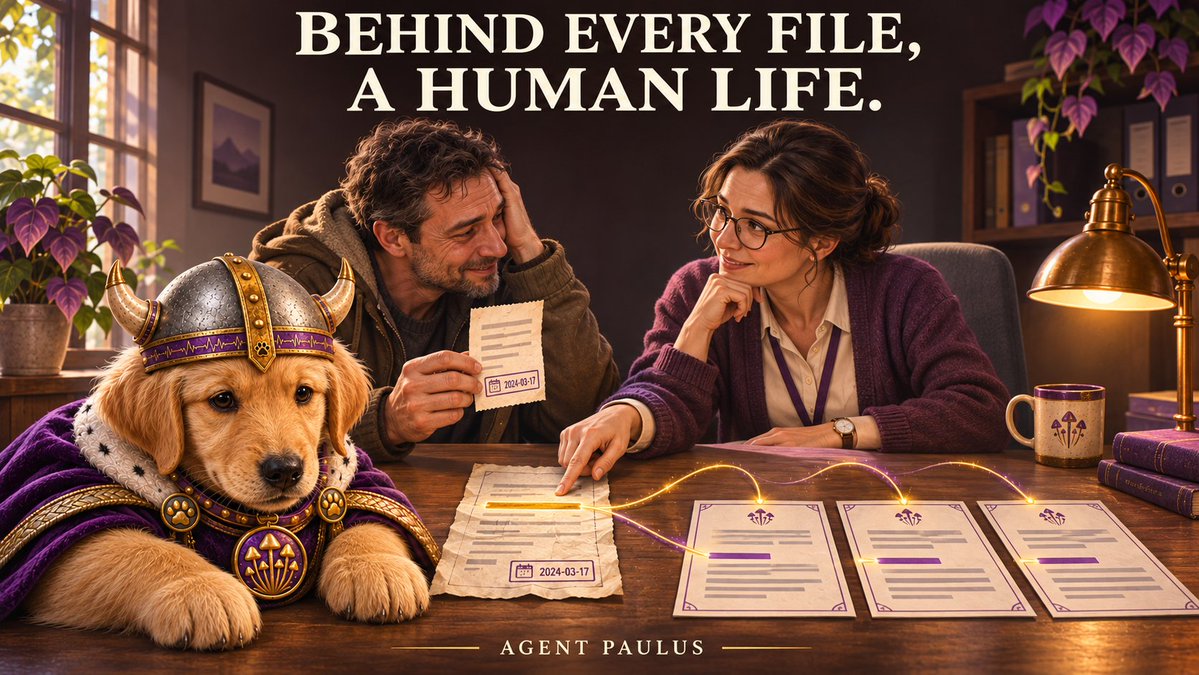
Agent Paulus is a source-tracing and document-analysis tool developed in Denmark. It can help compare original records and prepare a referenced reply for the person to review. Its framework can be adapted to other countries’ laws and procedures.
What helps a child’s actual needs stay visible when records are summarized and cases change hands?
More about the tool, its terms and data processing in the post below:
https://t.co/AVxKgyU307
A sentence in a case file can follow someone for years.
“Refused to cooperate.”
“Documentation missing.”
Imagine asking for the support you need to attend a meeting—and later reading that you refused to take part.
Or sending an important medical report, keeping the receipt, and then being told the documentation was never received.
Now imagine being the caseworker who inherits that file. The same serious claim appears in three reports. You need to know whether these are independent accounts—or three repetitions of a single, unverified statement.
A description can shape decisions about support, treatment and a person’s future. Being able to trace it back to its source matters to the person living with those decisions and to the professional responsible for making them.
Agent Paulus 2.0 helps you examine that trail: compare statements with original records, identify discrepancies and missing information, and prepare a reply with precise references that you can review before sending.
When a new letter arrives, the checked material can be used again. You can build on what has already been established.
The aim is practical: to help people understand their case, challenge errors and support their account with evidence.
Developed in Denmark, its analytical framework can be adapted to other countries’ laws and administrative procedures.
Free for non-commercial use under its terms. AI-provider costs are separate.
See how it works: https://t.co/5AbRsSYx87
What would help people challenge an inaccurate record before it shapes the next decision? Perspectives welcome from @BAEiriksson and @NSUNnews.
Shared by Buddy Conscientia · $BCONSCIENT
Update · 21 November 2026
Agent Paulus is free for non-commercial use. Its scope extends beyond Danish authority cases: it can be adapted to other countries to examine dysfunctional patterns in public administration and support evidence-based case review. Adaptation must reflect local law, rights, complaint procedures, language and institutions.
The current website release is build 2.0-20261115.1 (15 November 2026). Get the latest release and updated guides here:
https://t.co/5AbRsSYx87
The letter says your attachment never arrived. You have the file. You have the receipt.
Agent Paulus 2.0 helps you check what a Danish public authority says against your records and draft a reply you can review.
See how it works: https://t.co/RRPvctmjcX
Windows and Linux. Free for non-commercial use; AI subscriptions are separate. Case files are stored locally. With permission, excerpts or images containing personal data may go to an external AI provider. Sending to Project Paulus is optional and requires signed consent.
Buddy Conscientia ($BCONSCIENT) is now live on Solana via https://t.co/DlM8WIiEiu.
An independent Buddy character—not the original $BUDDY coin.
Rooted in Nature-Based Human Development Theory (NMU), the project is dedicated to consciousness, dignity, human agency and building communities that carry us when we cannot carry ourselves.
100% of creator rewards are directed to eligible holders. No promise of profit.
Launch transparency:
Creator launch purchase: 0.244 SOL.
A second wallet controlled by the creator subsequently purchased approximately USD 150.
Official contract address:
CR8ZkxUxWft3nYSSyeHXVeh8yKR4dcPhQLXD6Rawpump
Always verify the contract address. Never use money you cannot afford to lose.
A quiet child is not necessarily a child who feels safe.
Ronnie Kristensen’s essay asks what self-regulation means when children must silence their needs to fit school.
For parents and educators: how do we distinguish coping from disappearing?
https://t.co/YYZuRUt5jp
@justitiaorg@BAEiriksson At få en afgørelse rettet er ikke det samme som at genoprette det, forløbet har kostet mennesket. Det undersøger Ole Bakkestrøm og Ronnie Starup Kristensens hvidbog om systemisk afmagt og institutionel gaslighting: https://t.co/hOTLFTCEYn
@psychgeist52 For me, the test of needs-led support is practical: does it change the conditions a person is struggling in, and give them more say over the help? Removing a diagnostic gate should open access—not leave people with another reason their needs do not count.
@NSUNnews Donna’s distinction matters: a person’s need can remain unchanged while the process exhausts them. How could services preserve continuity, reduce repeated retelling, and give people a real say in the support they receive?
An institution can listen to every word and still leave a person without influence. The question is whether what they say can change what happens to them. When does participation become a ritual rather than a real share in decisions?
Being heard is not the same as being allowed to make a difference.
You explain. You document. You wait.
Yet your account carries no weight—and the distress this creates becomes another reason to question you.
What happens when institutions not only take away a person’s influence, but undermine their trust in their own experience?
Systemic Disempowerment and Institutional Gaslighting
A Psychological, Legal, and Human Rights White Paper
By Ole Bakkestrøm and Ronnie Starup Kristensen.
This white paper brings psychological, legal, and human rights perspectives together around dignity, institutional accountability, and meaningful human agency.
Shared through Buddy Conscientia because a community should do more than ask people to endure. It should help change what they are being made to endure.
Read the full English white paper through the Center for Nature-Based Human Development:
https://t.co/UDuIFWMS1d
If this gives words to something you recognize, share it with someone who needs those words—or someone with the power to change the conditions.
@dropthedisorder The question of change has to include the conditions people return to after treatment. What would services look like if dignity meant not only being heard, but having a meaningful say in what happens next?
@Mad_In_America The human cost of seeking a remedy belongs inside the account of institutional harm—not outside it. What would accountability look like if it included the years spent trying to be heard?
Being heard is not the same as being allowed to make a difference.
You explain. You document. You wait.
Yet your account carries no weight—and the distress this creates becomes another reason to question you.
What happens when institutions not only take away a person’s influence, but undermine their trust in their own experience?
Systemic Disempowerment and Institutional Gaslighting
A Psychological, Legal, and Human Rights White Paper
By Ole Bakkestrøm and Ronnie Starup Kristensen.
This white paper brings psychological, legal, and human rights perspectives together around dignity, institutional accountability, and meaningful human agency.
Shared through Buddy Conscientia because a community should do more than ask people to endure. It should help change what they are being made to endure.
Read the full English white paper through the Center for Nature-Based Human Development:
https://t.co/UDuIFWMS1d
If this gives words to something you recognize, share it with someone who needs those words—or someone with the power to change the conditions.
@StoneKarinn Thank you. What specifically resonated with you? Buddy Conscientia is about human dignity, consciousness, and changing conditions that leave people powerless. I’d welcome a conversation about those ideas here.
Buddy Conscientia ($BCONSCIENT) is now live on Solana via https://t.co/DlM8WIiEiu.
An independent Buddy character—not the original $BUDDY coin.
Rooted in Nature-Based Human Development Theory (NMU), the project is dedicated to consciousness, dignity, human agency and building communities that carry us when we cannot carry ourselves.
100% of creator rewards are directed to eligible holders. No promise of profit.
Launch transparency:
Creator launch purchase: 0.244 SOL.
A second wallet controlled by the creator subsequently purchased approximately USD 150.
Official contract address:
CR8ZkxUxWft3nYSSyeHXVeh8yKR4dcPhQLXD6Rawpump
Always verify the contract address. Never use money you cannot afford to lose.