Egypt forgot how to build the pyramids.
Rome forgot how to build the aqueducts. Some still carry water today. What they built still stands. Neither civilization remembers how they did it.
Musk: “You look at great civilizations like ancient Egypt, and they were able to make the pyramids, and they forgot how to do that.”
Musk: “And the Romans, they built these incredible aqueducts. They forgot how to do it.”
No army invaded them. The knowledge just stopped getting used, and the moment it did, it was gone.
Same collapse. Compressed into fifty years instead of a thousand.
Musk: “In 1969, we were able to send somebody to the moon… Then the space shuttle retired, and the United States could take no one to orbit.”
Musk: “People are mistaken when they think that technology just automatically improves… it will, by itself, degrade.”
Capability doesn’t sit in a vault. It only exists inside the people doing the work right now.
The second they stop, it doesn’t pause.
It disappears.
That should not scare you. It should focus you.
Nobody loses a civilization to war. They lose it the moment they stop building.
Nobody is owed the future. It belongs to whoever keeps building it.
BREAKING: Two people have climbed to the top of the Empire State Building in New York City, holding a banner from the skyscraper's antenna reading, "When the power of love beats the love of power, the world knows peace."
As of now it's unclear how the pair reached the top of the building as police work to get them down from the spire, 1,454 feet above the ground.
We have arrived in 250 years where roughly the top 10% of Americans are carrying the country. In all areas:
• Consumer demand that keeps businesses and jobs alive.
• Tax revenue that funds government services.
• Financial capital that underpins markets & investment.
The 2026 FIFA World Cup and Olympics are an enormous soft‑power window, and the current U.S. posture isn’t fully exploiting it to rebuild global goodwill.
An Anthropic engineer paid for my espresso at Sightglass when he saw my screen
I was running my Polymarket bot from the counter. He was next in line. Looked over my shoulder. Stopped scrolling.
"That's not a normal trading app. What's it actually running on"
I told him. Claude Code. Four repos. $25 a month.
He sat down without asking.
"I'm on the agent team. We stress test Claude for exactly this. You're letting it find its own edges"
Not just edges. Wallets.
86 million trades. Every wallet. Every entry. Every exit.
"You're feeding Claude raw wallet data and letting it identify who consistently wins. Then cloning them"
He said it slowly. Like he was writing the threat model in his head.
One prompt. Find every wallet with 100 plus trades and win rate above 70%. Rank by profit. Export top 50.
Claude scanned 14,000 wallets in 4 minutes. Returned 47.
The top 20 made more than the bottom 13,000 combined.
"That's not a stat. That's a hit list"
Exactly.
"And you didn't write the scoring function"
Claude did. I just wired it into an if-statement.
Then I showed him the second repo.
Official Rust CLI. No API key for reads. 500 markets, Claude scores them in minutes.
Gap. Depth. Resolution window.
487 markets become 35 before a dollar moves.
93% killed before I even see them.
A green fill landed on the screen. +$84.
He watched it hit.
"How does it decide to actually enter"
Three agents. Shared wallet. No shared memory. Arbitrage, convergence, whale copy. 2 agree, full size. 1 alone, half. Disagree, no trade.
Consensus filter alone killed 40% of losing trades.
"And the exits?"
The 47 whales never hold to settlement. 91% exit early. 73% of max profit captured. Redeploy immediately.
My bot cuts at 85% of expected move or on a 3x volume spike.
"You built a whale copy bot that exits before the whales"
Yeah.
He put his espresso down.
"How often does it trade"
10 a day on average. Most of them skipped before I look up from my coffee.
My setup:
Claude API - $20/mo
VPS in Germany - $5/mo
poly_data - free
polymarket-cli - free
Polymarket/agents - free
$200 seed. 27 days ago. $14,300 now.
Copytrade here: https://t.co/zDXGamMWw0…
271 trades. 74% win rate. Sharpe 2.47.
I haven't touched it in 27 days.
He stared at the screen for a long time.
"This is literally what our red team simulates. Except you actually shipped it"
He emailed me the next morning.
"Any chance you'd take a call with our policy lead"
I told him the article is the call. Read it twice.
Too late to gatekeep.
You only need Claude + laptop + 1 hour/day.
Giving This Free for 24 hours. To get it:
1. Comment the word 'Claude'
2. Like and Retweet this post
3. Follow me
@ZayvenKnox
The Number Came From a Think Tank, Not the Field! WSJ’s $2.9B claim was generated by a policy analyst, not someone actually in the region or with internal access. The WSJ simply printed her $2.9B estimate with the upper bound based almost entirely on one radar system at Al-Udeid.
🇺🇸 NBC reports U.S. bases in the Middle East suffered far more damage than the Pentagon would like to admit.
Billions of dollars in repairs, classified by request.
The Pentagon asked commercial satellites to look away. Someone with a subscription noticed anyway.
Look, the United memo is real ��� Scott Kirby did warn employees they're stress-testing for oil at $175 and staying above $100 through 2027. The Iran conflict hit the Strait of Hormuz, prices jumped from ~$71 to $112, and they're cutting about 5% of inefficient flights. No one’s denying the short-term pain.
But let’s not turn prudent planning into doomsday porn. Kirby himself wrote: 'There’s a good chance it won’t be that bad' — this is worst-case scenario prep with 'limited downside,' not a prediction. The memo is public, not some leaked conspiracy.
Meanwhile, the actual experts at the U.S. Energy Information Administration (EIA) just updated their Short-Term Energy Outlook: they see Brent dropping below $80 by Q3 2026 and averaging $64 in 2027. That’s not $175 forever — it’s a temporary geopolitical spike that markets are already pricing in. Pre-war forecasts became invalid the moment the first drone struck; that’s how geopolitics works, not proof the sky is falling.
Airlines aren’t collapsing. Demand is still strong — United is seeing record bookings in some weeks, and they’re aiming to fully offset the fuel hit through higher fares on premium routes and smarter capacity cuts (only low-margin, off-peak stuff). Delta and Southwest are in the same boat and not panicking. Yes, your summer ticket might cost more and a few red-eyes might get axed, but the industry survived $147 oil in 2008 and $120 spikes before that.
The Strait isn’t permanently sealed — right now it’s insurance-driven avoidance after Iranian attacks. Ships are clustered outside waiting, China is pressuring Tehran, and the U.S. just unlocked 140 million barrels of stranded Iranian crude to flood the market quickly. Supply responses (U.S. shale, OPEC adjustments) kick in faster than in the 1970s.
Bottom line: this is a serious disruption, not the end of affordable travel or the economy. The CEO is doing his job — over-preparing so United doesn’t repeat past mistakes. Skip the hype and look at the actual forecasts and company statements: we’re looking at a bumpy ride ahead, not Armageddon until 2027. Calm heads and real data win here.
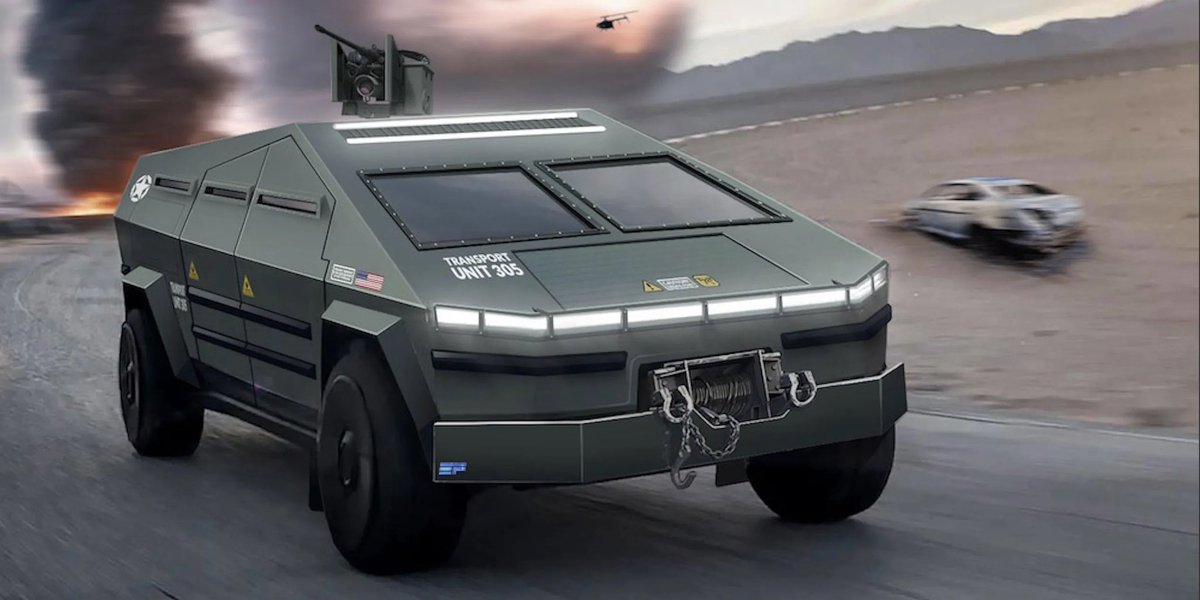
GOOD NEWS 🚨 Cybertruck sales could significantly improve by expanding into the military vehicle market 🔥
It turns out 30mm chain guns are incredibly effective at neutralizing drones. While they're usually found on Apache gunships, they're now being adapted for civilian trucks using the M-ACE sensor system ⚡️
Imagine Tesla delivering fleets of Cybertrucks to frontline zones like Ukraine. Outfitted with a chain gun and powered by FSD, the Cybertruck transforms into a fully autonomous, point-and-forget defense platform that could outclass purpose-built military tech 🆒