This is an important part of the model.
Campaigns pay the screens that deliver them, while another portion helps keep useful inventory active as demand grows.
The goal is simple: build a screen network that can stay ready for the next campaign.
A screen being connected is only the starting point.
In #DePIN, the real value comes when the network can show what that infrastructure actually did.
For advertising, that means clearer evidence of which screen played the campaign and when.
What makes ad delivery verifiable?
For AdCentral, every campaign should leave evidence behind.
Device-signed telemetry shows which screen played the campaign and when.
That gives advertisers clearer proof of delivery and gives the network a stronger basis for settlement.
When real-world activity can be measured, it can also be verified.
This is where #DePIN gets practical.
It is not only about proving that hardware exists.
It is about creating a reliable record of the work that hardware performed in the real world.
What does “verifiable delivery” actually mean for a real world #DePIN advertising network?
For AdCentral, it starts with a simple idea:
If a screen says it played a campaign, there should be evidence of that activity.
5% looks small until you see where the rest goes.
Most goes to the screens that delivered the campaign, while another portion supports ADCL acquisition for network incentives.
More value flows back into the network instead of staying with the platform.
DePIN metrics can look impressive at the network level while still missing what matters locally.
Node count tells you how much infrastructure exists.
Useful density tells you whether enough of that infrastructure exists where real demand can actually use it.
In #DePIN, network scale is more than device count.
A network becomes more useful when enough relevant infrastructure is concentrated where real demand exists.
AdCentral is starting with dense local screen clusters rather than spreading inventory simply to increase screen count.
More devices show scale. Useful density helps create a usable market.
Joining a shared network does not mean giving up control.
With AdCentral, screen owners can decide when their screens are available, which ad categories they accept, and how their inventory is priced.
AdCentral connects that independent inventory into one marketplace. #DePIN
Shared network. Independent ownership.
Connecting screens grows the network, but advertisers running real campaigns are what give that network economic purpose.
Supply is useful when demand is there to use it.
#DePIN needs more than connected devices.
A network becomes useful when there is real demand for what that infrastructure can provide.
For AdCentral, that means independently owned screens connected to advertisers running real campaigns.
More devices can grow supply.
Real demand is what gives that supply economic purpose.
The useful part of local advertising is context.
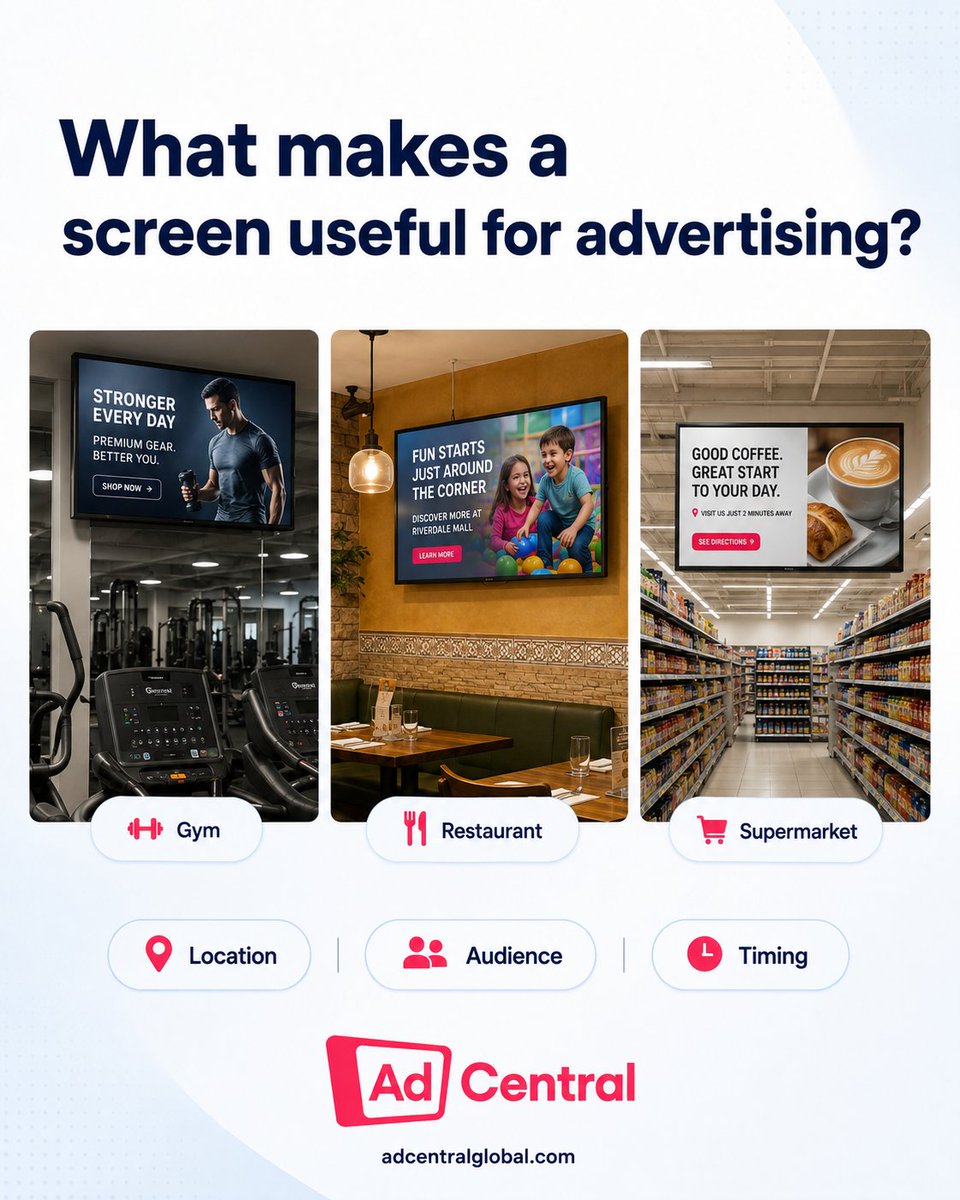
A screen inside a gym, restaurant or supermarket is already sitting where real people spend time.
The infrastructure exists. The opportunity is making that inventory discoverable and usable.
DePIN does not always need to start by deploying new hardware.
A lot of physical infrastructure already exists. The harder problem is often coordination: making it discoverable, measuring useful participation, connecting it to real demand, and settling value fairly.
The opportunity for crypto is not always to fund more hardware. Sometimes it is to coordinate the hardware that already exists.
A screen in a gym reaches a different audience from one in a restaurant or supermarket.
Where the screen is, who is likely to see it, and when they are there all matter.
AdCentral helps advertisers find screens that fit their campaign.
This is what we are focused on right now.
Existing screens inside everyday venues, connected into one local advertising network.
Start dense. Learn what works. Expand from there.
Advertising inventory does not always need a new screen.
Sometimes the screen is already there.
Inside a gym.
Inside a restaurant.
Inside a supermarket.
📍 Dubai Silicon Oasis
Your next customer is already in DSO.
Put your business in front of people already moving through Dubai Silicon Oasis with local digital advertising through AdCentral.
Interested in advertising your business?
📲 WhatsApp: +971 50 950 6897
🌐 https://t.co/V52us5qBOl
This is what makes DePIN interesting.
The infrastructure does not have to be built from zero.
It can already exist across thousands of independent businesses. The opportunity is to connect it, coordinate it, and turn fragmented capacity into a network.
A decentralized advertising network is taking shape in Dubai.
Screens inside cafes, gyms and clinics remain owned by local businesses.
AdCentral connects them into one shared network.
This is DePIN built from real world infrastructure.
A DePIN network must remain useful even when demand rises and falls.
ADCL shows one practical way a token can help: reward reliable infrastructure for staying online and available.
An advertiser can only choose a screen that is already online.
That is why reliable uptime matters, even between campaigns. This article explains how ADCL can support the screen owners who provide it.
We are building this one venue at a time in Dubai.
Each screen stays with its owner. AdCentral connects them into one shared network that advertisers can discover and use.
A practical Web3 model taking shape in the real world.
Building AdCentral in Dubai has made one Web3 idea feel very practical.
A screen can stay independently owned while participating in a shared advertising network.
That is the value of DePIN: local infrastructure, coordinated at network scale.
A screen’s value is not only about who sees it. It also depends on what the venue permits.
A gym may block other gyms but accept sportswear ads. A clinic may block competing clinics but accept health insurance ads.
Useful inventory matches both audience context and screen owner rules.