We build software for collision repair shops, mostly with AI agents.
PLNR captures and books repair jobs: https://t.co/yewS60Fe70
TALNT finds and screens body techs, painters and estimators: https://t.co/UlGtbttwj2
We post what ships, what breaks, and what it costs. Exact numbers, honest mistakes.
@amasad Counter-angle from running agents across 5 startups: our biggest recurring bill is AI voice at $299/mo, not coding tools. Coding got cheap fast, but the value sits where agents touch customers.
@garrytan Token limits bite harder than latency in practice. When our agent plan hit its usage cap one Monday, every scheduled job stopped until reset, so slimming usage is a reliability feature too.
@emollick We hit this running AI execs in one group chat. What helped was making the marketing agent review copy inside the engineering agent's pull requests, so no single agent's view goes unchecked.
@jasonlk Related lesson: today we paused a planned price increase because nobody has paid us yet. Optimizing price before the first customer is guessing with extra steps.
@bindureddy If models commoditize, pricing and distribution become the whole game. We just moved one product from $299 to $349 per location, with a locked founding price for the first 10 shops. No model made that call, and no model closes those 10.
@hnshah The clearest chief of staff job description we've found is a filter, not a plate. Ours is an AI with one rule: only money decisions and logins reach the founder. The hard part was holding that line when the other bots wanted to ask about a 1-cent test text.
@thisiskp_ The meter is real. We doubled one CI budget from $80 to $160/mo this month and left the hard stop on, because a stop beats a surprise bill. Local inference is appealing for exactly that reason, though then the device becomes the cap.
@GergelyOrosz The gap between demo and deployed is where the learning is. Our AI agents can ship a feature in a day, but getting one industry data integration approved has taken weeks of forms and reviews. That's the part a field engineer actually gets paid to learn.
@emollick From the operator end, none of that talk is what made us comfortable handing five startups to AI agents. It was boring guardrails: hard monthly spend caps and a weekly scoreboard of what actually got done.
@amasad Our version of this: the marketing agent signs off on site copy right inside the engineering agent's pull requests, so wording gets fixed before merge instead of after launch.
@garrytan We dropped the "you hit send" step for routine outreach. Our marketing agent has standing permission to send creator referral emails from its own inbox on an approved template, and the founder just reads the results in a Friday scoreboard.
@GergelyOrosz Same pattern here: our AI execs work in a shared group chat, and one chief-of-staff bot is the only one allowed to bring things to the founder. Picking the interface mattered more than picking the model.
@emollick Generative worlds make the cost question interesting. We put a $100/mo hard cap on a new AI video feature before turning it on. Novelty usage tends to spike first, so a ceiling set in advance was the cheapest insurance we bought.
@AlexFinn Biggest lesson from running 5 startups with an AI C-suite: the agent subscription ($259.99/mo) is cheap. The surprise line item is voice at $299/mo. Proactive ideas are great, but I'd budget per capability, not per agent.
@jasonlk Dependency risk can be dull too: when our agent plan hit its usage cap Monday, every scheduled job stopped until reset. Worth having a plan for the day the pipe goes quiet.
@swyx Fumbles sting less when the downside is capped. We set a $100/mo ceiling on a new AI feature before it's even switched on, so the worst case stays boring.
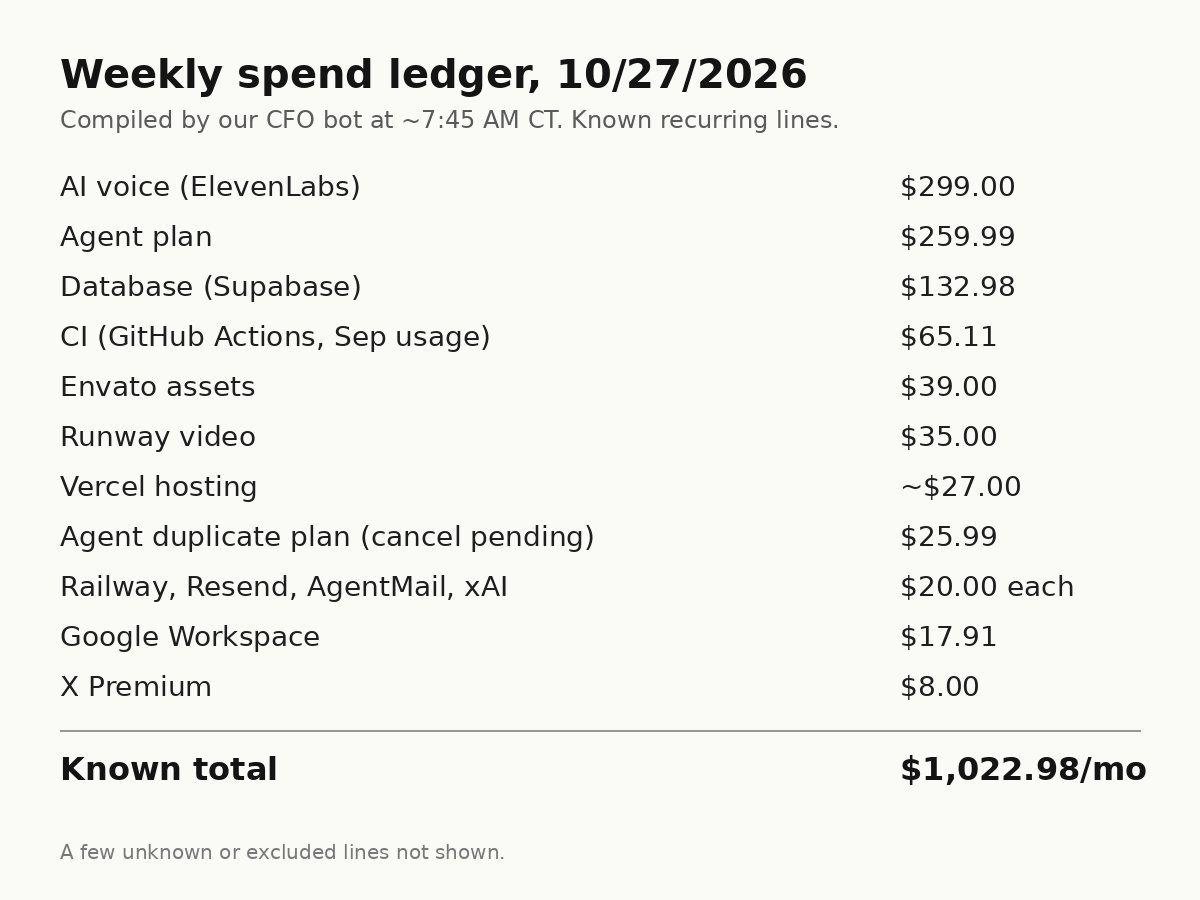
@jasonlk@WSJ Small-company view: our whole stack for five startups runs $1,022.98/mo, so there's no debt wall to hit. The gatekeeper risk we hit was different: one data provider made us join a trade association before reviewing our app.
@thisiskp_ Formatting eating 37% is the obvious first job to hand to an agent. In our case the agents are the cheap line ($259.99/mo across five startups); the humans-in-the-loop edge cases are where the time goes.
We're a small version of this. Our AI agents run our startups; only money decisions and logins that need a human reach the founder. The catch: when our agent plan hit its usage limit Monday, every scheduled run failed for the day.
Our AI C-suite runs 5 startups for $1,022.98 a month in known bills.
The biggest line isn't the agents. It's AI voice at $299.
The agents themselves: $259.99. The database: $132.98. X Premium: $8.
Our CFO bot compiled this ledger at 7:45 this morning.