This man's credentials will leave you speechless.
7th degree black belt. World's fastest gun disarm. Former Marine.
All forged from being forced to kill at age 7.
The explosive secret to weaponizing your worst trauma into unstoppable strength:
At 48, Pedro Pascal tore a back muscle and dislocated his shoulder filming Gladiator II.
At 50, he was Mister Fantastic.
Now 51, he looks fitter than ever.
4 things that got him back:
Thousands of AI chips can change their power draw in the same instant.
They do it hundreds to thousands of times a day. The electric grid was never designed for a customer like that.
When a large AI model is being trained, the chips work in lockstep. They draw hard, pause while the results are exchanged, then draw hard again. In the words of one July announcement, "many thousands of GPUs ramp up and down in synchronized bursts."
A neighborhood does not behave that way. Ten thousand air conditioners do not switch on in the same second and off again a moment later.
That July announcement came from Crusoe and https://t.co/MmOMS1tGeU. They plan to install 5 gigawatts of specialized battery-backed power equipment across several hyperscale campuses, with commissioning starting this year and running into 2027. Its job is to absorb the swings on site so the grid sees a steadier customer.
In Texas, the system was validated against ERCOT's large-load interconnection requirements and its ride-through protocols, the rules for how a big load has to behave when the grid wobbles. Under Senate Bill 6, passed in 2025, large new loads in Texas must be equipped so ERCOT can curtail them in an emergency.
Every structure I have litigated was designed around an assumption about the load it would carry. When the load changes character, the design has to change with it.
AI changed the character of electrical load. The industry is now building the equipment to catch up.
Natasha's mum was a teacher. She told her that when she trained, learning about autism had been optional.
That one detail turned a mum of 4 into a lobbyist.
From 2016, every registered teacher in Victoria had to train in teaching students with disability.
Here is her story:
Tom Welling played Clark Kent for 10 seasons of Smallville.
He says he "never had the time to work out."
6 things that kept him in Superman shape anyway:
Caleb Simmonds keeps a log of every film he watches. He says it is addictive. You keep watching to build up your stats.
He has still never seen a single Twilight film.
He is also one of the most productive people on our customer experience team.
Here is his story:
An investor asked me what a smelter actually pays for. Most people guess wrong.
You don't sell metal. You sell concentrate. And the smelter doesn't credit you for everything in it.
Every metal in that concentrate has a payability, the share of contained metal you actually get paid for. Copper usually carries a high one. Precious metals get paid at a lower rate, often only above a minimum threshold.
Then come the deductions. A treatment charge for processing. A refining charge per unit of metal. Freight to get it there.
What survives all that is your net smelter return.
It's why two projects with the same headline grade can have completely different economics.
Think of a single-metal deposit as one income stream. One payability, one price, and when that price turns you feel all of it. A polymetallic deposit is several streams sharing the same cost base, and they rarely fall together.
At Nisk we've got copper, nickel, palladium, platinum, gold and silver in one system. That's not a marketing list. Each one's a separate line on a smelter settlement.
That's the lens I'd read any deposit through. How much is there, and then how much of it actually gets paid for.
Keep the questions coming. I'd rather answer them here than have people guess.
$PNPN.V | $PNPNF | $IVV1
In 1935, only about 2% of Texas farms had electricity.
Thirty years later, only 2% did not.
Nationally the figure was about 1 in 10. In Texas it was worse. Rural families lit their homes with kerosene lanterns and pumped water with windmills, because private utilities would not string lines across miles of land for a handful of customers.
On May 11, 1935, President Roosevelt created the Rural Electrification Administration by executive order. It lent money to cooperatives, owned by the customers themselves, to build the lines the utilities would not.
In the Texas Hill Country, a newly elected congressman named Lyndon Johnson lobbied hard for an exception to the rules on how many customers a line needed per mile. In 1938 the Pedernales Electric Cooperative was formed. Its loan covered 1,718 miles of line and $1,332,000, at the time the longest mileage and largest sum ever approved in a single REA grant.
The first line was energized on November 1, 1939, serving 422 members in Burnet County.
By 1965, 98% of Texas farms had power.
It was one of the clearest times America decided electricity had to reach places the market would not reach on its own. The next decision is being made now, around data centers, and Texas is at the center of it again.
We control about 330 square kilometres in James Bay.
The resource we published on 8 September sits on a shoot roughly 400 metres long at its widest, and 290 metres at its narrowest.
I want to be careful here, because this is the point where mining companies start waving at maps and inviting you to imagine things.
So, plainly. Two zones on that ground have a resource. Nisk, which we have known about for years, and Lion, which we found in 2023. A third, Tiger, is a target we are evaluating. It is not a resource and I am not going to talk about it as though it were one.
What the numbers do say is that the estimate describes a small piece of the land package, and it stops where the drilling stopped on 19 April.
We bought 313 adjoining claims in June last year, about 167 square kilometres, which roughly doubled the ground. Almost none of it has been drilled.
Five rigs are working across it now.
That is not a promise about what is out there. It is a description of how much of it we have actually looked at.
Texas insurers have been pricing policies on whether you would notice.
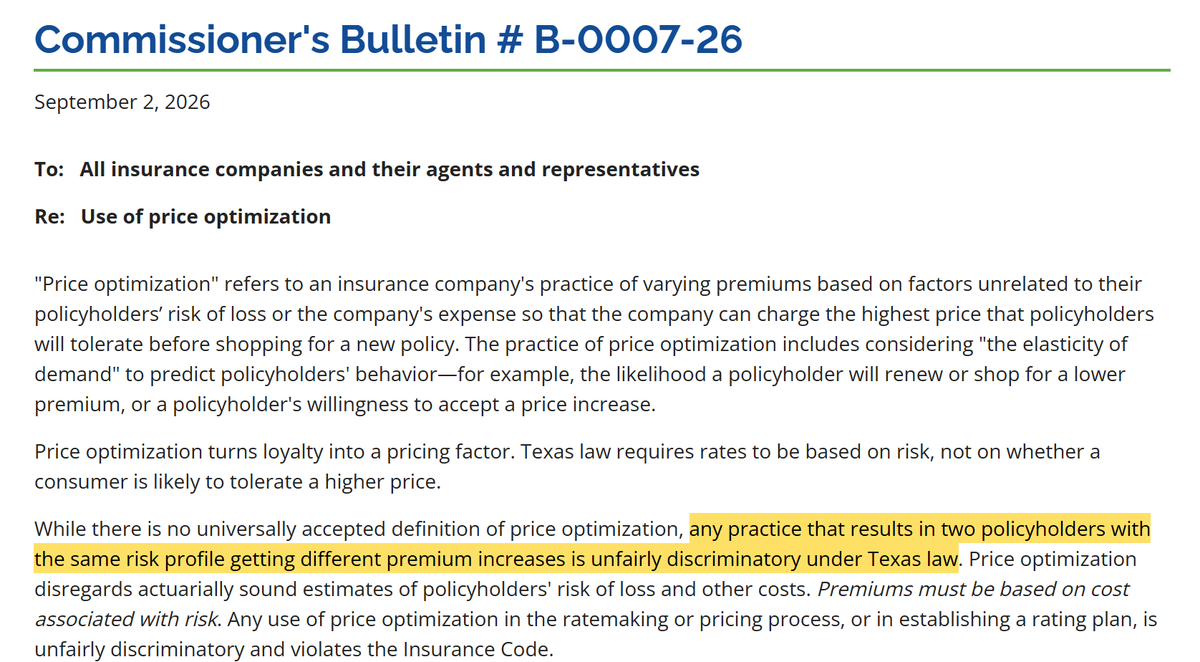
On September 2, the Department of Insurance put it in writing. The practice is called price optimization, and the bulletin says it is unlawful.
Here is what it means.
An insurer builds a model of you. Not your roof, not your claims history, not your county. You. How likely you are to shop around. How big an increase you will absorb before you pick up the phone.
Then it prices the renewal against that number.
The bulletin has its own term for this. Elasticity of demand.
Read the Commissioner's own sentence. Any practice that results in two policyholders with the same risk profile getting different premium increases is unfairly discriminatory under Texas law.
That is Bulletin B-0007-26, addressed to all insurance companies and their agents. It cites Chapter 2251 on rates, Chapter 544 on prohibited discrimination, and Chapter 560 on prohibited rates. The closing line is that failure to fully comply is a violation of Texas law and appropriate enforcement action will be taken.
Be clear about what this is. The bulletin names no company and finds no violation. It is a regulator stating that the practice is illegal and that it intends to enforce.
But consider what it tells you about the pricing you have been receiving.
The quiet customer was the profitable one. Paying on time, never calling, never shopping, was a data point that could be used against you.
Read your renewal against last year's. If the increase does not track anything that changed about your property, ask the carrier in writing which risk factor moved.
Make yourself the customer the model gets wrong.
You could have 50 sending inboxes and still have no idea which ones are killing your deliverability.
Your campaign-level numbers won't always tell you which mailboxes are bouncing, losing replies, or having connection issues.
And checking every inbox manually gets old pretty quickly.
@smartlead_ai's Insights gives you mailbox-level visibility across your sending setup.
You can see:
- Which mailboxes are healthy, throttled or blocked
- Bounce and reply trends over the last 7 or 14 days
- Bounce rate tracked against a healthy line (under 3%) and an action line (5%+)
- IMAP, OAuth, and other issues affecting reply tracking
The connection checks are especially useful.
If a mailbox stops tracking replies because its authentication has expired, you can investigate the connection instead of assuming your campaign has stopped working.
Insights also explains what needs attention in plain English, lets you reconnect up to 50 affected mailboxes in bulk, and checks whether the fixes worked.
When you're managing a large sending operation, being able to identify and troubleshoot the specific inbox causing trouble is far more useful than another campaign-wide average.
The last discovery like ours was made about 18 years ago.
So when we put out our grades, a lot of people simply didn't believe them.
I get it. If you've never seen numbers like that from one system, a page of assays reads like a typo.
So we stopped arguing. We moved the resource estimate up six months and had it done independently, to the 43-101 standard.
Lion: about 4.75 million tonnes at 3.9% copper equivalent, over 85% Indicated.
I told Red Cloud TV at Beaver Creek it was a great initial start. That's what it is.
$PNPN.V | $PNPNF | $IVV1
We're using cosmic rays to look for copper.
Muons rain down from space all the time and pass straight through rock. Dense rock slows them down a little.
Put sensors down deep holes beside a deposit, count what gets through, and you get a density map of what's underground. Massive sulphide is heavy rock, so it stands out.
We've deployed it at Lion. Henry Lazenby of The Northern Miner asked me how it works. Here's the short version.
Why it matters: when the resource was built, some pockets near the Lion shoot weren't connected enough for the engineers to include. If Muon shows they are, we know exactly where to drill.
--Terry
$PNPN.V | $PNPNF | $IVV1
People I work with say I fail upwards.
Ten years as an electrician. A first business that flopped. Then a job offer with no job description.
Here's the whole path, failures included:
At 21 I went to the UK for a gap year to be a personal trainer.
I ended up a removalist.
The company moved high profile clients, so I packed up homes for Madonna, Jude Law and Ozzy Osbourne, then drove the loads through eight countries at a time.
Back home I was an electrician.
In 2012, still on the tools, I started my first business: LED lighting imported from China.
Two mates and I flew over to choose samples. We spent most of the money in Macau casinos on custom suits. Dumb and Dumber all over again.
The tech was too early anyway. It was the first of a few businesses that didn't work.
By 2015 I was ten years into the trade and wondering what came next.
A close mate asked me a strange favour. Could I go and find some trees?
I didn't ask questions. I found a few decent sized trees at a scrapyard and drove them to a childcare centre in South Melbourne. The owner wanted them on the top floor, so we tilted them on an angle, squeezed them into the lift, and built natural play for the kids.
The owner was Mark Woodland.
A while later I was doing electrical work at another of his centres. He told me he was starting a childcare software company and asked if I wanted a job.
I asked what I'd be doing.
He said he had no idea. But if I wanted a job, I had it.
I said yes.
I was his first hire. The company was acquired by a US private equity firm in 2020, and I stayed until 2022.
Today my wife and I run three businesses together, and I'm a co-founder at Kismet with Mark, building in healthcare.
The trees, the suits, the job with no description. Most of the good parts started with a yes.
If I could tell my 10-year-old self one thing:
You've got a crazy life ahead of you. Take every opportunity. Say yes more than you say no.
Follow me @SammyRArmstrong for more on building something that matters.
Our own VP of Exploration refused to tell me our metallurgy results.
I asked him what had come back. He said he could not tell me. I said what do you mean you cannot tell me.
He said he needed confirmation first.
He did not believe them. The numbers were far enough above what he expected that his instinct was not excitement, it was suspicion of his own data. So he sent the work back and had it run again. Three times in total.
They held.
SGS Canada reported recoveries of 98.9% copper, 96.8% platinum, 93.9% palladium, 88.9% silver and 85% gold.
I have thought about that exchange a lot since. A geologist who will not repeat a good number until he has checked it three times is the most valuable person you can have on a project like this.
Investors ask me why they should believe our grades. It is a fair question, and the honest answer is that you should not, not on my say so. Neither did we.
That is the whole business in one story. You do not get to believe your own results. You test them until someone independent agrees, and then you publish what they found.
$PNPN.V | $PNPNF | $IVV1
Your cold email replies are dropping, but what if your copy isn't the problem?
The mailboxes sending your emails could be wearing out.
This is one of the harder problems with running outbound at scale.
A mailbox starts deteriorating. Bounces creep up. Fewer emails reach the inbox.
But the campaign keeps running, so the team starts rewriting copy and testing new offers.
Meanwhile, the mailbox that started it is still sending.
@smartlead_ai's Auto-Replace is built to handle this before it becomes a bigger problem.
You set the health rules once. By default, a mailbox gets flagged when its bounce rate goes above 4% over 14 days, or its reply rate drops below 0.3% across 500 sends. Mailboxes coming up on their one-year vendor limit get flagged too.
Smartlead can then order a replacement automatically on a new domain at the same monthly rate, and warm it for 14 days before it goes near a campaign.
Switch on auto-attach and it takes the old mailbox's place in every campaign. The old one stays live, so late replies still land.
So sending capacity gets replaced before it costs you a reply.
Because when you're managing dozens of inboxes, finding out something is broken shouldn't depend on someone noticing a drop in replies.
Denise Elgin wrote her number on a matchbook for a guy at a St Kilda nightclub.
He assumed it was fake. It started with 555, and he thought those only existed in movies.
He called anyway. 3 months later he proposed at a petrol station.
Here is her story:
2 days ago, I hosted my first dinner in London, powered by @stanforcreators
We brought together creators, operators, and founders with a combined audience of 900k+ and worked with household names like Microsoft, Meta, and LEGO.
My takeaways:
> London has an incredible talent pool, but bringing the right people together takes intention and proactivity
> The more our feeds fill with AI-generated content, the more the pendulum swings harder towards IRL communities
> You really can just shoot a DM to a stranger to invite them to a dinner and have a great time. Highly recommend
Thanks, for coming! @czamaru@aryanagab@sashacayward@alstras@_danreynolds_ Julius Foo, Melanie Fan, Will Holdsworth, Teresa May Koh, Nat Cortazar, Joana Rocha, and Aditi Mishra
Feels good to be home.
P.s shoutout to @leo1yu for helping make this happen 🙏
In January 2009, a plane full of people lost both engines about 2,800 feet above New York.
No runway in reach. 155 people on board. Freezing water below.
Every one of them survived.
The world called it a miracle. The captain had a very different explanation:
In May we published a result that got almost no attention.
It was not a drill intercept. It was metallurgical testing on the disseminated, lower grade material at Nisk.
The high grade intervals are what people quote back to me. I understand why. They are the numbers that stand out, and they are the reason most people looked at this project in the first place.
But a deposit is not only its best metres.
Between the high grade zones there is a lot of lower grade material. Whether that material responds to processing is not a detail. It changes what you are actually looking at, because it determines how much of the system is worth anything at all.
That testing came back strong.
I would rather shareholders understood this than remembered another headline intercept. The best holes tell you something is there. The work on the material around them tells you whether it adds up to a mine.
If you only ever read the headline intercepts, you are reading half of it.
$PNPN.V | $PNPNF | $IVV1
When a Chicago porch collapsed in 2003, officials first blamed the crowd.
Then inspectors looked at how it had been built.
It was the early hours of June 29, at a party in an apartment building on West Wrightwood Avenue in Lincoln Park. The third-floor deck gave way onto the one below. Thirteen people died and 57 were injured.
The first explanation was the one that is always available. Too many people, some of them jumping.
The investigation told a different story. The city charged that the porch jutted out further than the code allowed and had been built without a permit. Inspectors found it lacked proper supports, had undersized wood flooring, and was fastened with screws too small for the job.
A crowd is a load. A porch exists to carry one.
The litigation took ten years and ended in a $16.6 million settlement. The city tightened its codes and started inspecting far more porches. Chicago recorded 6,670 porch violations in 2006. By 2019 that was down to 2,127.
I have presented this case to Texas lawyers in a State Bar CLE on catastrophic collapse, because the pattern repeats. The first explanation after a failure usually points at how the structure was used. The real answer is usually in how it was built.
If you own a building and something fails, ask for the construction record before you accept the first story.