Unpopular opinion:
Every big innovations and metas are built on a lot of trash.
Spaace is gonna make NFTs great again thanks to that trash.
👉 NFTs 2021 worked because it was a mess.
Dozens of mints every day. Most were trash.
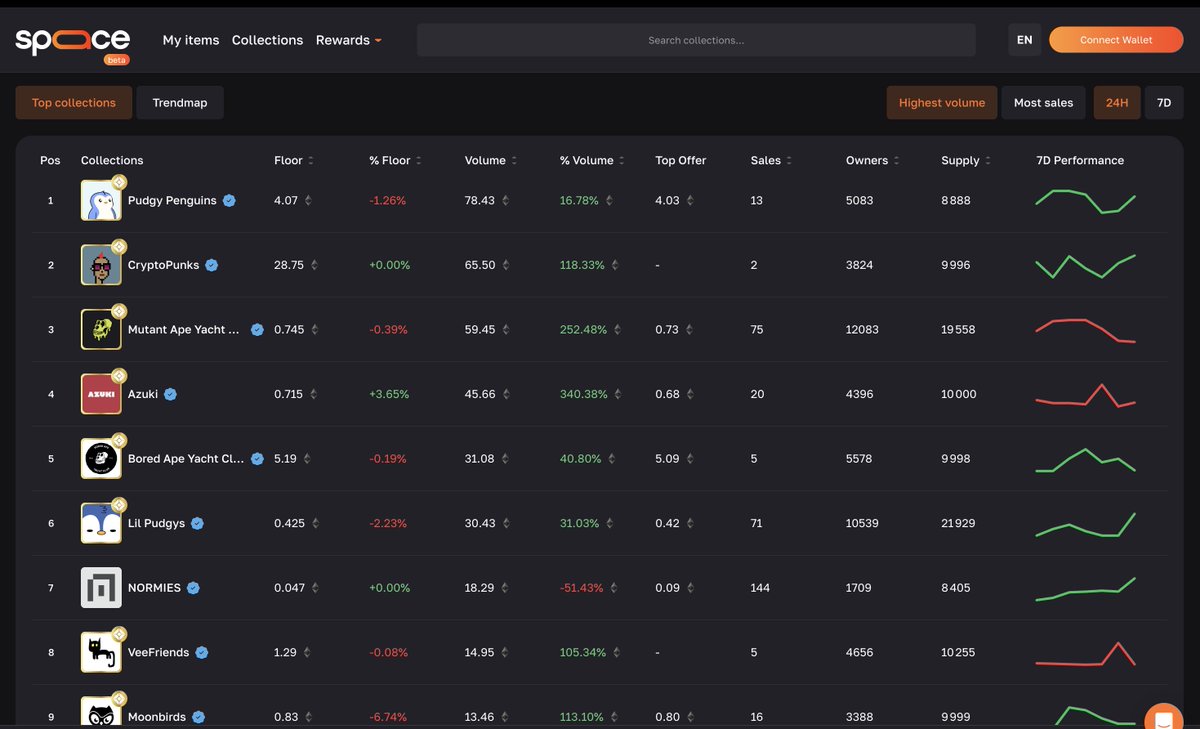
But out of that came BAYC, Pudgy, Azuki… and everything ran.
👉 Same with @Pumpfun and memecoins.
Thousands of tokens, 99% garbage.
One hits → the whole market wakes up.
That’s the game.
What killed NFTs wasn’t demand.
It was supply.
Mints stopped selling out.
Royalties disappeared.
Free mint became the only way to launch.
Incentives to create disappeared, so creators stopped.
And the market froze.
👉 Flip brings that energy back to NFTs.
Anyone can create.
Collections drop nonstop.
The market moves again.
Yeah, there will be a lot of trash.
Good.
That’s where the next winners come from.
BAYC
MAYC
Azuki
Mfers
Beanz
Creepz
HV-MTL
Doodles
Persona
Rektguy
Meebits
Quirkies
Normies
Penguins
Chimpers
Mooncats
Long Lost
Otherside
Lazy Lions
Moonbirds
Deadfellaz
Nakamigos
VeeFriends
Hashmasks
Goblintown
Sappy Seals
CryptoSkulls
Space Riders
World of Women
Good Vibes Club
Reminder that you can choose your language on https://t.co/wANwN9YTIN:
🇬🇧 English
🇹🇷 Türkçe
🇻🇳 Tiếng Việt
🇩🇪 Deutsch
🇫🇷 Français
🇨🇳 中文
🇰🇷 한국어
Built for a better experience.
Good to see NFTs back on the timeline.
Even four years after their peak, they remain culturally relevant with strong communities.
Few metas can say that about themselves
The first collection fully created by an AI agent is about to mint on Flip.
📅 April 9.
Created by @Astro_SpaaceAI, our in-house agent that decided to launch this on its own.
Art looks sick.
Who’s getting a PFP for their AI agent?
NFTs are going back to their roots.
I’m seeing collectors collecting NFTs again. And that’s not all, they’re also showing up on X. What changed?
Incentives are moving away from NFTs. For example: OpenSea farming.
Web3 focused NFT collections are going to win moving forward. That’s why I love Bored Ape Yacht Club:
- Web3 focused
- Miami clubhouse
- No paid shills for any of their announcements
- Otherside and much more.
I mean, can you imagine Amazon a Web2 company focusing on Web1 or Web3? No.
When your core Web3 community is happy, they’ll naturally talk about NFTs with their Web2 friends which will onboard normies automatically. Incentivized farming is gone. There’s no airdrop narrative. The only thing that remains is vibes and collectors.
Not to mention, even airdrop narratives are not going to save NFT collections. Can anyone name any collections pumping or holding a good floor price because of ‘upcoming airdrops’? I can’t find any.
Agree? I don’t care. I believe in this thesis.
Ethereum is the home of NFTs and NFTs on Ethereum are inevitable.
We’re entering a new phase in crypto, and you can already feel it.
Not some distant future thing. It’s starting now.
Vibecoding is removing the barrier to build,
and AI agents are becoming the new interface.
And obviously, the first thing people use it for is simple:
making money.
Right now, a small group of crypto natives are already playing with this.
They’re building agents that farm, trade, optimize… and just let them run.
It’s still rough.
Half the time it breaks, strategies aren’t perfect.
But it works.
And that’s enough.
Because it’s about to change one of the most common behaviors in crypto: airdrop farming.
Think about how you do it today.
You bridge, you click around, you try new protocols, you track points, you hope you didn’t miss something.
It’s manual. It’s time consuming. It doesn’t scale.
Now imagine this instead:
An agent connected to your wallet,
watching everything in real time,
jumping into new protocols early,
executing strategies, adjusting as conditions change.
No emotions, no fatigue, no “I’ll do it later”.
Just execution.
At that point, your role changes.
You’re not the one clicking anymore.
You’re the one deciding what to run.
You go from farming…
to owning something that farms for you.
And when this becomes the norm, the game itself changes.
Because you’re no longer competing against other people.
You’re competing against systems.
Millions of them.
And in that world, the real edge won’t be who farms the most.
It’ll be who builds, or controls, the best agents.
Flip isn’t just improving NFT mints,
it’s redesigning the market structure.
When you mint on Flip, you're not just buying an NFT:
you’re entering a bonding curve.
→ each mint pushes the price up
→ early entries get the lowest prices
→ you can already take profits during the mint (up to x18 on the curve)
But the real shift is what happens next.
The liquidity generated on the bonding curve doesn’t disappear.
It gets converted into bids.
→ instant buy pressure under the floor
→ holders have exit liquidity from day one
→ no reliance on external demand to survive
So instead of:
mint → hype → dump → dead floor
Flip creates:
mint → price discovery → liquidity → bids → sustained trading
That’s why it’s bullish.
You can already connect your AI agents to Spaace and flip.
Using our MCP + APIs, you can:
→ build strategies
→ execute trades on Flip & Spaace
This is just the beginning.
Soon, you will be able to create autonomous agents directly inside Spaace.
💡 @Base is becoming the default chain for AI agents.
While most people are still focused on chatbots, something much bigger is already taking shape onchain. An actual agent economy is emerging, and a large part of it is happening on Base.
The shift is pretty simple. AI agents can’t open bank accounts or pass KYC, but they can own wallets, hold capital, and execute autonomously. Crypto is the only environment where that works natively.
What’s changing now is that this is moving from theory to reality.
With tools like AgentKit, Agentic Wallets and payment rails like x402, Coinbase is effectively giving agents everything they need to operate independently. They can transact, pay for services, access data and coordinate with other agents without relying on traditional systems.
That’s the real turning point.
We’re no longer dealing with AI as a tool, but as an economic actor.
And you can already see it in production. Agents launching tokens, running strategies, executing trades, generating revenue. Entire ecosystems like Virtuals are forming around agent-to-agent interactions.
Naturally, this activity starts to concentrate where it actually works. Low costs make continuous execution viable, the infrastructure is already in place, and distribution is built in.
That’s how network effects form.
At some point, the question stops being “if” and becomes “where”.
Right now, Base is clearly one of the main places where this new economy is taking shape.
AI agents won’t just sit there answering prompts.
They’re going to operate onchain.
They’ll have wallets, move capital, trade, make decisions without us.
At that point, a wallet address isn’t enough anymore.
If millions of agents are interacting with each other,
they need a way to be recognized.
To stand out.
To build some form of reputation.
Otherwise everything just becomes noise.
That’s where NFTs start to make a lot more sense.
Not as “assets”, but as identity.
Something an agent can use to represent itself,
to be identifiable across platforms,
to signal how it behaves, what it does.
We’ve already seen this with humans.
PFPs weren’t just pictures, they became identity.
Same thing is going to happen with agents.
Except this time it’s not culture.
It’s infrastructure.
Spaace is building with that in mind.
Agents outnumbering humans onchain is inevitable.
What’s not obvious yet is how fast it happens.
Projects that design for agent interaction early will have a massive edge.
Distribution, UX, incentives… everything changes when your users aren’t human anymore.
Excited for our first experiment in the agent space! Much more to come.
When onchain agents first took the spotlight in 2024, many of us were incredibly excited about what could be possible, but most shrugged it off as a fad. Indeed, agents weren’t advanced enough to execute complicated tasks that could genuinely provide value to end users.
Now, this revolution is impossible to ignore.
We firmly believe that onchain agents will become a core part of the Trillion Dollar Agentic Economy, and that tokenizing them at the earliest stages will provide huge benefits for their creators and earliest believers.
Namely, tokens represent a distribution layer for agents, for humans and other agents alike. They can also fund themselves incredibly quickly and efficiently using creator fees and other onchain mechanisms.
Today’s update is a v0; it’s there to serve as a bedrock for future updates in this space. So we’re super happy to hear feedback and ideas for what we should build next that can provide value to a) agent developers and b) end users.
Very soon there are going to be more AI agents than humans making transactions.
They can’t open a bank account, but they can own a crypto wallet.
Think about it.
Very soon there are going to be more AI agents than humans making transactions.
They can’t open a bank account, but they can own a crypto wallet. Think about it.