Chairman ASX:MQR / Executive Director at GTT Ventures - Australian based Corporate Advisory *Tweets are my personal opinion only and are NOT financial advice.*
$AQD maiden drill program intersects Cu & Au mineralisation in first two RC holes, indicating a potential large-scale porphyry copper-gold system in an area with no prior drilling. #DiscoveryHole@DiscoveryAlert Disc:Held
@bhogleharsha Babar unlucky there. That looked like it was going down leg with the naked eye and onfield umpire agreed. Ball looked like half missing stumps to on DRS-umpires call? I guess they go both ways with DRS so we will take it.
Wildcat Resources continues to share significant expansion of grade and width.
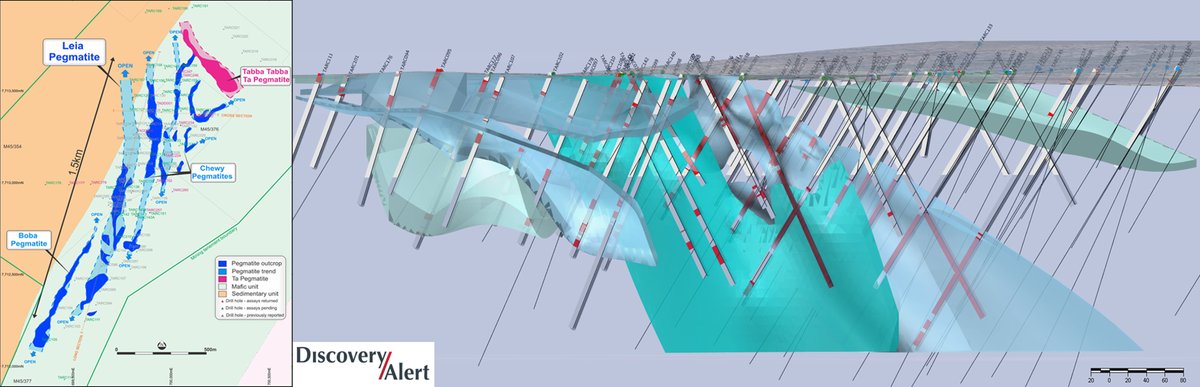
We remain encouraged by the early-stage achievements at Tabba Tabba, particularly in the previously unexplored central area and other identified pegmatites to the south and north. These findings reinforce our belief in the sustained value indicated by Discovery Alert's initial assessment of $WC8.
85 meters @ 1.5% Li2O from a depth of 133 metres and 85m @ 1.3% Li20 from a depth of 167 metres, both intersections well within the means of an open pit.
The company is making substantial progress toward defining a mineral resource, and we anticipate that they will be very close to achieving this milestone, especially following the analysis of the remaining 58 RC holes, with 22 of them originating from the Leia area. It is worth noting that considering the geographical distribution of the identified pegmatites, we believe a mineral resource of at least ~50 million tonnes at ~1% Li2O is possible, edging closer to our initial high side estimate.
Our 3D modelling of the pegmatites and the released grades to date, indicates that this objective is well within reach. This would justify the establishment of a standalone processing plant in this region, however, there are a number of operating mills within trucking distance.
Find our discovery insights valuable? Give us a like & hit that retweet button to share the knowledge. Let's help investors make more informed decisions in the resource sector.
Stay ahead of the game - follow us for expert tips on mineral exploration and ASX announcements.
Want to catch the next big discovery?
Don’t miss out – Start your 30 Day Free Trial now and stay ahead of the curve.
https://t.co/QsIAo23svZ
Thank you, the Discovery Alert Team!
$WC8.AX.
Examining Deposit Tiers: An Explanation on Tier Sizes
When you read or hear terms like "Discovery of a Tier 1 / Tier 2 deposit," what does that mean...?
Below we cover 4 Tiers that classify mineral deposits and their significance within the domain of resource investments.
A short thread 🧵(1/6)
How Does the Geometry (shape) of an Orebody Impact the Economics of Deposits?
When it comes to mining and exploration, not all orebodies are created equal. The geometry of an orebody can play a significant role in how Mineral Resources are upgraded to Mineral Reserves and ultimately the economic value of the deposit. But why does this matter, and how can the shape of an ore deposit make such a difference?
First let’s take a quick look at the difference between a Mineral Resource and Mineral Reserve?
Mineral Resource represents concentrations of potential economic value in the Earth's crust, but without confirmed profitable extraction viability. The confidence in these resources varies from inferred (lowest confidence based on limited data) to indicated (medium confidence with more data) to measured (highest confidence with detailed data). It's an initial estimate of the potential amount and grade of material in a deposit without diving into detailed extraction logistics or economics.
On the other hand, Mineral Reserve is a declaration that not only is there a mineral concentration, but it's also economically viable to mine it. This assessment comes after detailed studies considering various factors, from economic to environmental. There are two main categories: probable reserves (lower confidence but still deemed extractable with profit) and proven reserves (highest confidence, derived from measured resources).
To put it simply, while both terms relate to the amount and grade of minerals in a deposit, a Mineral Resource is an initial indication of potential, whereas a Mineral Reserve confirms that with the current data and conditions, the mineral can be mined profitably.
Now, Let’s Take a Look at Two Different Ore Bodies and Compare the Two:
Deposit A - 1,000,000 Oz @ 2g/t
(Steeply Dipping Orebody)
Ore deposits that dip steeply (vertical or almost vertical) present certain challenges for open cut operations. The mine design for such a geometry, can result in the amount of waste rock that needs to be moved, increasing drastically, to extract the same volume of ore as a flatter deposit.
This leads to higher operational costs and can impact the economic viability of the deposit, thereby the conversion from the Resource to Reserve can be low, as a lot of the material might be left out as it may not be economically viable to extract.
Deposit B – 500,000 Oz @ 2 g/t
(Flatter or Anticlinal Shaped Orebody)
An anticlinal orebody is arch-like, resembling an upside-down U-shape. This kind of orebody, especially if it's near the surface, often translates into an open-pit mining opportunity, which can be more economical.
The natural shape allows for easier extraction with fewer complications. Thus, a higher percentage of the mineral resource can often be converted to mineral reserves, making it more attractive to investors and mining companies alike.
Okay, let’s Compare the Two!
In the example above, Deposit A is a vertical orebody with 1,000,000 oz @ 2g/t Au Resource, 2x the size of Deposit B. However, due to its geometry the Reserve conversion is approximately 33% (300,000 oz Au) as open cut mining would require considerable waste movement to get deeper levels, making it uneconomic to deepen the pit.
Deposit B on the other hand, with a Resource of just 500,000 oz @ 2g/t Au has a conversion rate to Reserves, inside a pit, at a far more attractive 70% (350,000 oz Au) as the geometry is flatter and closer to surface. Ultimately having more economically extractable Ounces then Deposit A, highlighting that resource size is not everything.
Conclusion
For investors and mining professionals, recognizing the implications of orebody geometry is paramount. When evaluating deposits, it's not just the quantity of minerals that matters; the geometry of the resources is equally crucial for investors to consider as this determines the feasibility and profitability of extracting it. While Deposit A (Steeply Dipping Orebody), looks better at first glance, boasting a significant resource, the conversion to reserves is far less than Deposit B, an anticlinal shaped orebody, impacting the overall viability of the mining project.
The example of Deposits A and B illustrates a critical principle in mining: the size of a mineral resource is not the sole determinant of its value or viability. Geometry plays a pivotal role in the conversion from resource to reserve. Even though Deposit A boasts a resource twice the size of Deposit B, its vertical orientation complicates open-cut mining, leading to a lower conversion rate due to the economic challenges of managing significant waste movement. Conversely, Deposit B, with its more favorable geometry being flatter and closer to the surface, allows for a higher conversion rate to reserves, even with a smaller initial resource.
In conclusion, as you evaluate mining opportunities, always remember, shape matters. It's not merely a geological curiosity but a critical component in understanding the potential conversion of Resources to Reserves and ultimately returns on a mining investment and the economic value of that deposit.
If you found these insights on Resource to Reserve Conversions helpful, give the post a like & hit that retweet button at the start of the thread!
Let's spread knowledge and help investors make more informed decisions to become better resource investors.
Follow us for more insights on mineral exploration, rules of thumb and to learn more about what to look out for in ASX announcements
...and don’t forget to sign up to our Free Discovery Alert Service 👇
https://t.co/waAgmCT0HP
We look forward to delivering our subscribers the next big, small cap discovery!
Thank you, from the Discovery Alert Team!
Ever wondered why different drilling techniques are used in exploration and what’s the difference between them?
We break it down and take a closer look at the 4 most common techniques used in order of their use in exploration!
A short thread 🧵(1/6)
1/7
Here are some geological "tricks" that investors should be wary of when examining exploration results in ASX announcements.
The ASX (Australian Securities Exchange) has strict guidelines for the reporting of exploration results, primarily under the JORC (Joint Ore Reserves Committee) code. However, companies may still attempt to present their results in the most favourable light, or in some cases, use tactics that could mislead investors from poor results.
Selective Reporting: Companies often promote their best drill holes front and centre in the highlight page of their announcement, often leaving fewer promising results in the shadows. It's essential to dig into the detail, especially the Drill Result Table, this is where all the assayed drill holes will be reported and where you will get the full colour of the results, there is lots of clues in here which we discuss further down. Be cautious of omitted negative drill results, a red flag for potential bias.
@therealrukshan Looks similar to how they changing the narrative in Australia. They worked out how very easy it is to convince most people of anything they say…. So now Just keep updating old govt documents until it didn’t happen…🙄
https://t.co/e76OOAiNNv
🚨...Discovery Alert...🚨
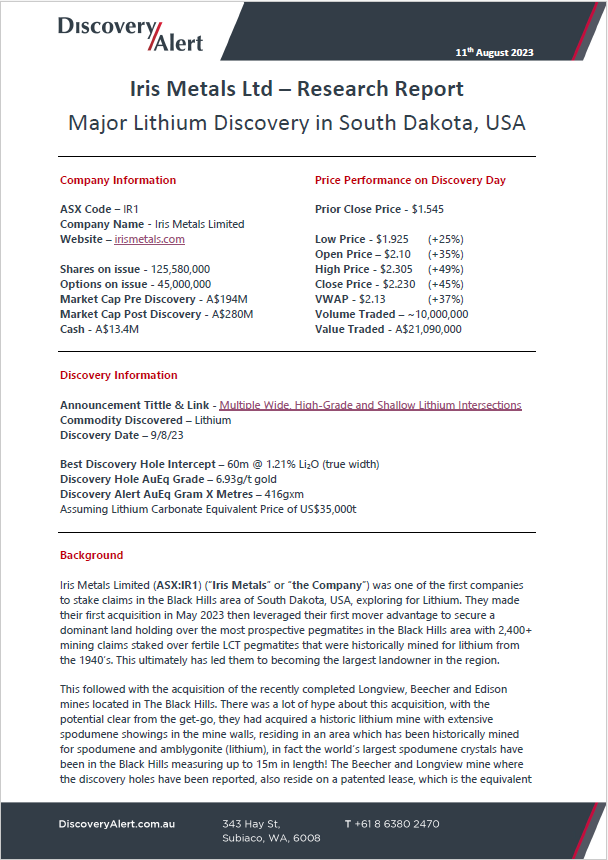
Discovery Alert has written a research report on the $IR1 lithium discovery in South Dakota, USA.
If you would like to receive a free copy of this report, sign up to our Free Subscription Service or Newsletter on the Discovery Alert home page.
Link: https://t.co/mdZBvkcjhN
Following the verification of the discovery by our team of geologist's and analysts, Discovery Alert subscribers were alerted via text and email within 15mins of the lithium discovery being announced to the market.
As always, our goal is to provide you with timely and reliable information and ultimately delivering you high quality alerts, enabling you to make well-informed investment decisions.
We look forward to delivering you The Next Big Small Cap Discovery!
Thank you, The Discovery Alert Team!
$IR1.AX
Today's the day!
Join the investing revolution with Discovery Alert's new subscription service!
Early bird offer for the first 25 subscribers.
Get the early crow on Tier 1 & 2 discoveries.
https://t.co/qyANa0dDGI
#DiscoveryAlert#InvestingRevolution
Alerting subscribers to the next big discovery.
Backed by AI technology, Geologists & Analysts designed to give subscribers the early crow on Tier 1 & 2 discoveries live.
Learn More: https://t.co/M2790z21MI
#DiscoveryInvesting #DiscoveryAlert #Investmentideas #investingtips #MiningNews
@TheGladiatorHC Ignatius was instrumental in Galaxy’s success in what was a very tricky period in capital markets during the GFC. He was one of the earliest believers in the EV revolution and certainly imo a good jockey to back once again in the lithium race.
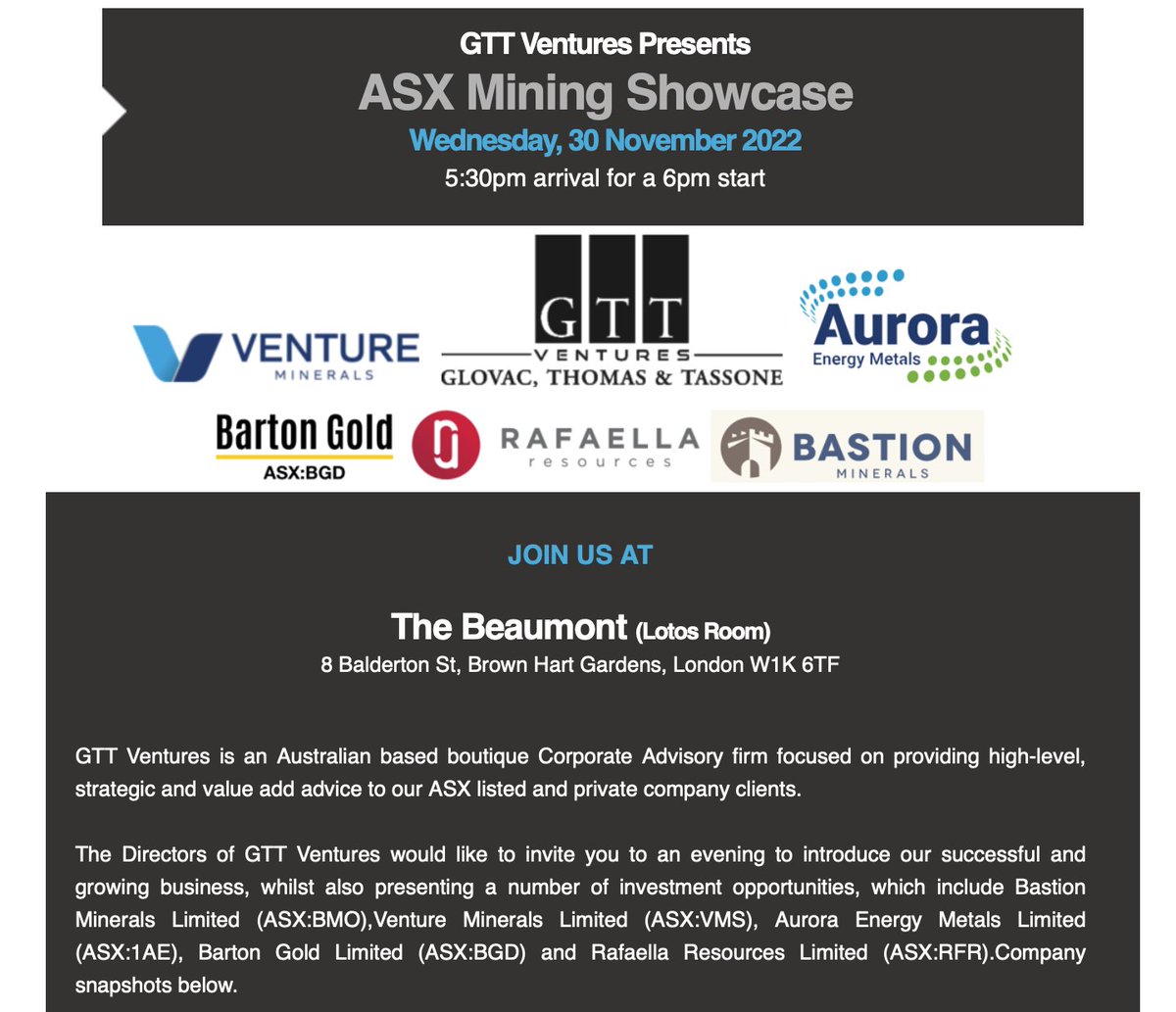
After a two year Covid hiatus, the London GTT Mining Showcase is back at The Beaumont (Lotos Room) in Mayfair London on 30th November. With some great ASX Co's presenting $BMO $VMS $1AE $BGD $RFR
#asx#mining#energy#london#event#Investment email [email protected]
"Graphite's vital role in LiBs is set to underpin its renaissance. Now that lithium is well and truly into its 2nd boom, increased attention is being paid to graphite which by weight in an LiB, leaves lithium looking like a sprinkle of salt" #ASX#Graphite https://t.co/hWL3SFcnAS