Most 3DGS segmentation tools either pre‑train per scene or lock errors into a feature field you can’t undo.
ArtisanGS instead turns a few 2D masks into editable 3D object selections via Cutie tracking + black‑box splat aggregation, then lets you iteratively correct mistakes with consistent 2D/3D selection modes.
�� #NVIDIAResearch paper: https://t.co/blLWdpN9QC
@VFSGlobal@vfsglobalcare Can you please try to fix your website? I've been trying to apply for Visa for France for my relatives to attend my wedding for a month now and it's always crashing...
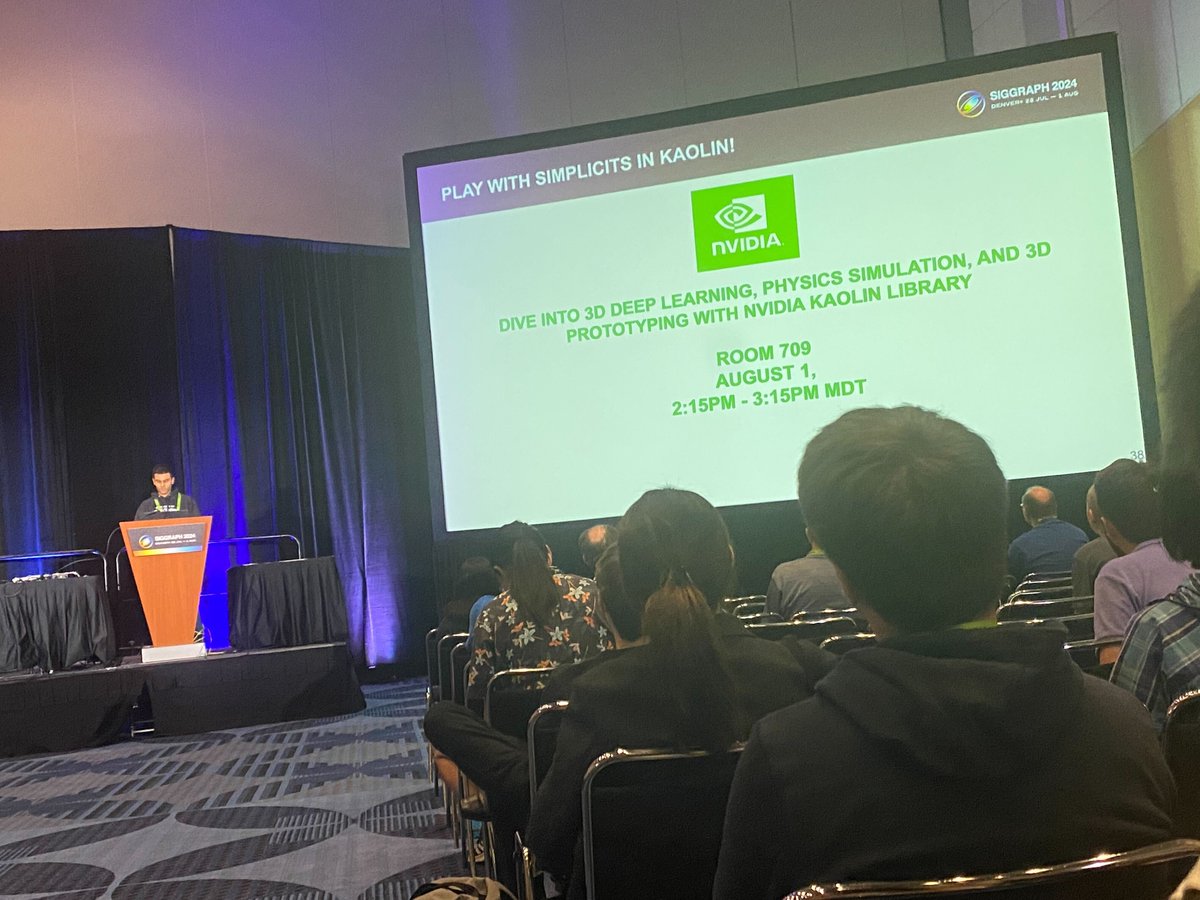
Great session planned this thursday at 2:15pm! Making any renderer interactive and add physics simulation to your 3D representation in your Jupter notebook! Your representation or renderer is custom? We can handle it!
So proud of the Kaolin team with our new release, join our Hands-on lab at #SIGGRAPH2024 to learn how Kaolin can improve your 3D Deep Learning workflow and enable interactive physics in your Jupyter notebook! https://t.co/4gcKJLu8SK
✨Just announced: Representation agnostics physics simulation.
➡️ https://t.co/hm6Bjev4pk This new framework is now available in the Kaolin Library.
Simulate:
✅Gaussian Splats
✅Neural Radiance Fields
✅Signed Distance Functions and more…
✨Just announced: Representation agnostics physics simulation.
➡️ https://t.co/hm6Bjev4pk This new framework is now available in the Kaolin Library.
Simulate:
✅Gaussian Splats
✅Neural Radiance Fields
✅Signed Distance Functions and more…
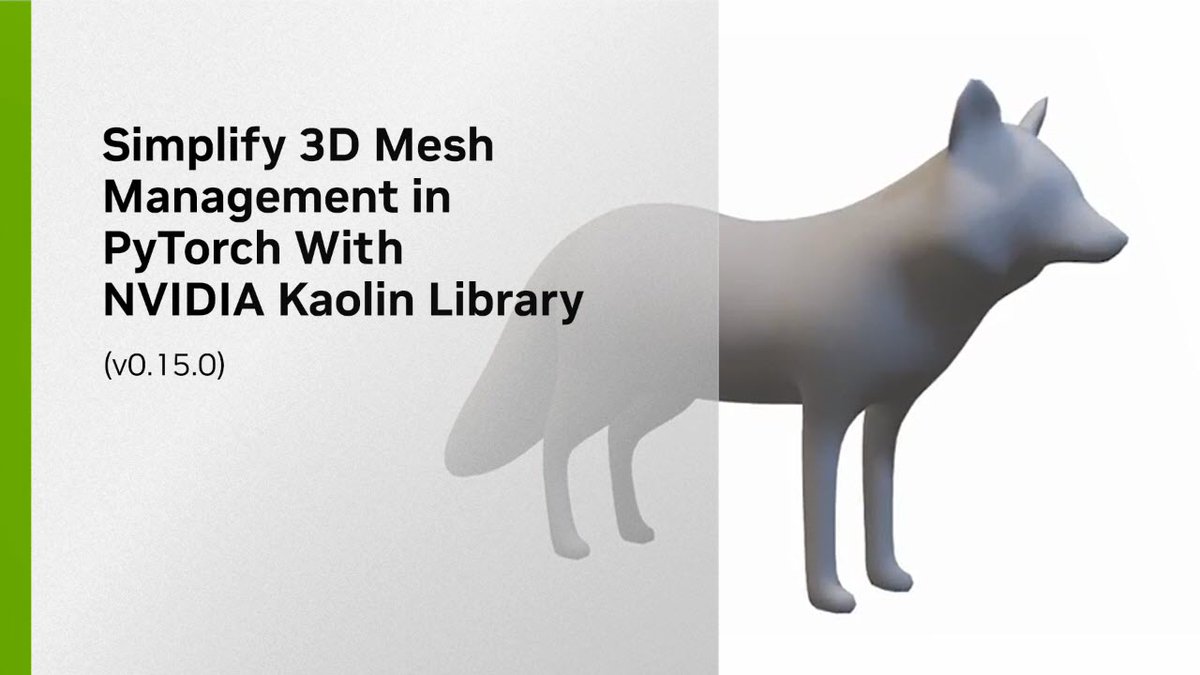
Exciting news for #PyTorch enthusiasts: Our NVIDIA Kaolin library introduces SurfaceMesh class to simplify managing mesh attributes including consistency, auto-compute normals, & streamline indexing.
👀 See the video tutorial from #NVIDIAResearch
➡️ https://t.co/2azNZZzIxH
@JulieChangRE The article says "the middle 20 percent of income" and the bottom income is not the same as the top income of the bottom 20%. So there is a whole range of income missing (between $56,000 and $617,900 !!! and between $23,200 and $35,800)
📣 #NVIDIAKaolin v0.15.0 is out!
With the latest release of our #Pytorch Library, extract a high quality #3D mesh for your SDF using Flexicube.
Have a look at the updated official repository using Kaolin's implementation: ➡️ https://t.co/Y8TPST2vaf
🧵1/2 #NVIDIAResearch
So proud of my team for presenting the first interactive #texture#painting with #AI at #SIGGRAPHAsia2023 Real-Time Live. Well done Anita Hu and team!!
We want the artist to stay in control 🎨🖌️🤗
https://t.co/vyy7eMKxwz
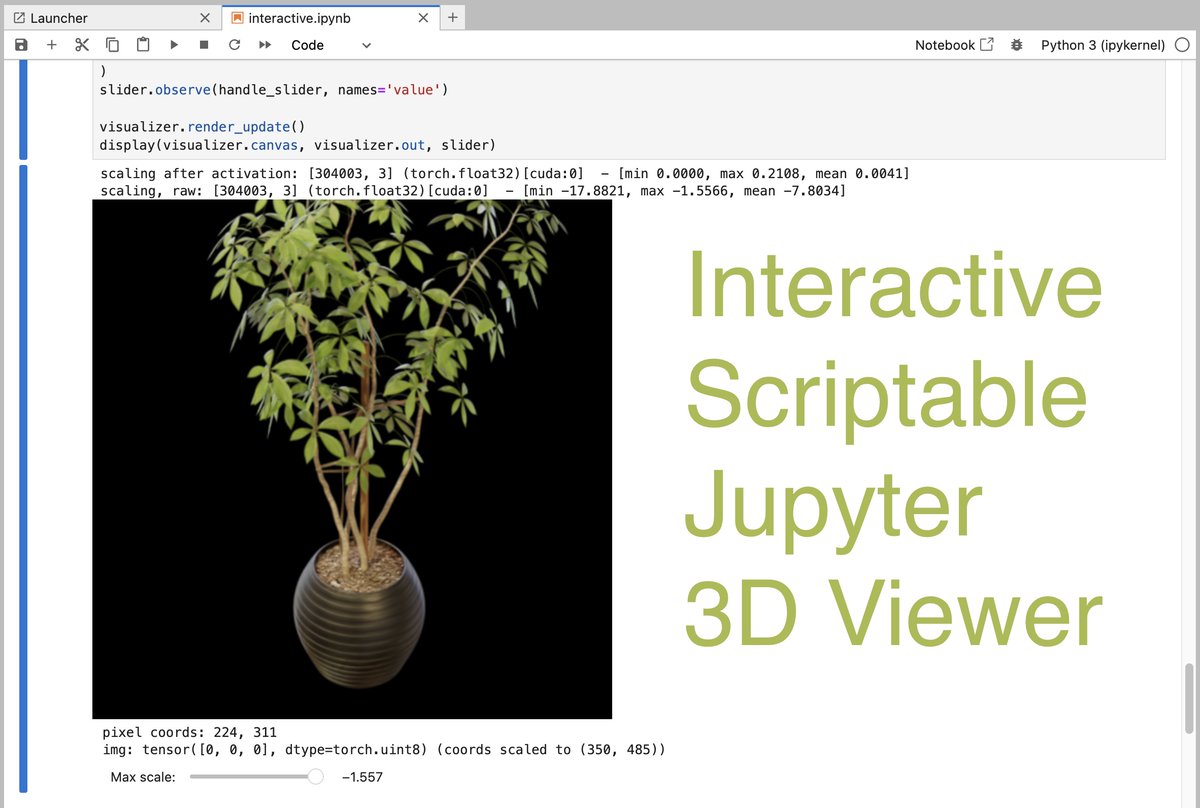
If you want to visualize 3D Gaussian Splatting radiance fields *interactively* in a Jupyter Notebook, here's an easy recipe using Kaolin Library: https://t.co/HctVc04z5V
Excited about this new release, the interactive visualizer and SurfaceMesh class are strong improvements of QoL when debugging a renderer or a model. Great job from the team @_shumash@OrPerel@FidlerSanja@NVIDIAAI
📣 Just released: #NVIDIAKaolin v0.14.0
Accelerate 3D deep learning research, debug your custom renderer interactively in a Jupyter notebook, and manage batched mesh attributes with a SurfaceMesh container, within the Kaolin #Pytorch library.
Github: https://t.co/b9hyI5yfyW
Super excited about this release, Kaolin is now installable with a single command line!
Check out our tutorials on lighting:
Diffuse: https://t.co/T0NL0pHh19
Specular: https://t.co/v9WhWzlf43
Documentation: https://t.co/wj2Nv7kDgc
📣 Just released: #NVIDIAKaolin v0.13.0
With new lighting features enabling #3D DL works like DIBR++ or NeRD, check out our tutorials on diffuse and specular reflectance. Kaolin is now pip installable.
Installation: https://t.co/yviQ8w5LrM
Release notes: https://t.co/Sij9S0OAhs
@srush_nlp@davidweichiang@boazbaraktcs One of the big advantage of named tensor is to allow flexibility for the compiler / JIT to make optimization in the backend without having any intervention from user, an example is the painful transition from NCHW to NHWC for convolution on recent GPU
New demo for wisp! Kaolin's Structured Point Clouds (SPCs) can now be traced within the interactive visualizer.
SPCs can be converted from meshes, quantized point clouds and sparse voxel grids.
Check it out here:
https://t.co/JarNPdHnHz
#NVIDIAKaolinWisp#Nvidia#neuralfields
@wojczarnecki@francoisfleuret@PyTorch Well, broadcasting operations are way more efficient than the element-wise alternative. You can "expand" to have a similar effect to broadcasting (unless you use "contiguous()") but lots of researchers would use "repeat" without knowing that it doesn't behave the same.
Excited to share our #NeurIPS2022@NVIDIAAI work GET3D, a generative model that directly produces explicit textured 3D meshes with complex topology, rich geometric details, and high fidelity textures. #3D
Project page: https://t.co/LEkj9eqG69