@Bob_Holness_01@P_Kallioniemi As an Irishman myself I can tell you that not one person I know, or have heard of supports Russia. We have taken in the one the highest numbers of Ukranian refugees per capita, we (as a people) would never support an imperialist nation like Russia. This is absolute nonsense.
Arcanum Ventures is back with our newly rebranded panel discussions, with some of the best and brightest builders in the tech startup realm.
Social media may be becoming financial infrastructure.
Meta and X are exploring stablecoin payments across apps like WhatsApp, Facebook, Instagram, and X.
If money moves through the same platforms as messages, what does that mean for crypto adoption and the internet economy?
Join us live for ep. 45 of "The Forum" this week!
📅 Thursday, March 26th, 2026
🕑 3PM UTC
Hosts:
- @ArcanumVentures
- @Utopiainbeta
- @MELOWILD
- @IZYcastrowrites
Panelists:
- @ivycybered
- @profdiggity
- @Caf0lla
- @NeoxInfra
- @deeepmoist
- @changenow
- @Me3Labs
- @aksenovd15
- @protocollabs
Almost 3 months ago I wrote about Monads launch and how the chain (like many others) was destined to fail.
So how are my crystal ball predictions holding up several months later?
In short...Monad is cooked.
Some high level stats:
Nov 24 to Feb 19 (today):
• Active addresses: 145k → 19.2k (-87%)
• New addresses: 145k → 4k (-97%)
• Daily users: 155k → 15k (-90%)
• Fees: $42k → $5k (-88%)
• Revenue: $21.5k → $2.3k (-89%)
People will point to a typical post launch/incentive cool down, and that may be true.
However, Monad had years of buildup, significant VC backing ($250M to be exact), and a dedicated community (apparently) yet it still couldn't retain its users after launch.
Airdrops are great to help companies get over the cold start problem, however crypto projects are relying too heavily on airdrop incentives to drive actual user traction.
Once the token launches most users leave the ecosystem and onto the next farming opportunity. This will not change until the mechanisms used to drive activity change.
For many the token is a way to generate inorganic value in order to raise at a higher valuation. And in the end its retail that ends up paying the price.
Monad launched with a fully diluted valuation of $2.6B.
Read that again. Two point six billion. Before proving anything.
Now let’s get some perspective.
When the giants of this industry were born, their valuations were tiny:
- BNB started around $30M FDV
- Ethereum opened at just $22M FDV
- Solana came in at roughly $110M FDV
And what happened?
BNB didn’t go 4,000× because of memes.
ETH didn’t run 15,000× because of vibes.
SOL didn’t do 600× by accident.
They started low, built relentlessly, and earned their valuations over years of execution.
Now look at Monad:
Compared to its launch FDV…
- Solana’s debut was 23× cheaper
- Ethereum’s was 86× cheaper
- BNB’s was 116× cheaper
We’re pricing new chains at levels the greats didn’t reach until after shipping, scaling, and surviving multiple cycles.
The upside gets killed before the token even trades.
There’s no room left for the market to discover value.
We start at the top and hope number go up and we've seen how that's played out this cycle.
So here’s the real question:
Are we finally forced to admit that launching everything at unicorn valuations is killing the entire game?
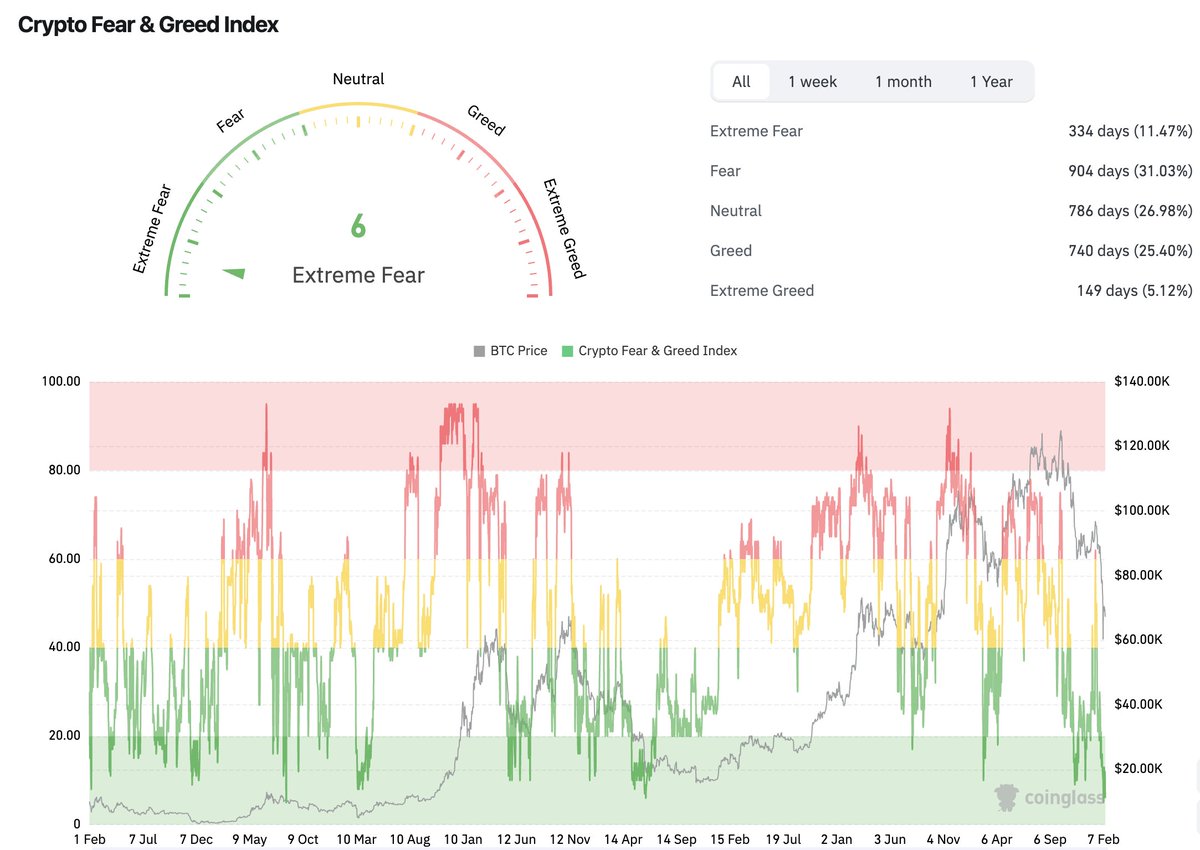
The Fear & Greed Index just hit 6 🤯 The lowest level in crypto history. What happens next?
6 is insanely low...in fact its the lowest reading since June 2022 and now, the lowest in history.
Let me show you what happened last time we were here:
June 2022: Extreme fear dominated the market → BTC bottomed around $17,600 → Panic sellers capitulated → Media declared crypto dead
9 months later: Complete reversal → March 2024: BTC hit $73,000+ → 314% gain from the lows → The bull run everyone said would never come (and looking back the only real bull run we got).
The pattern is playing out again.
Why extreme fear matters:
The index has spent only 11.47% of its existence in "Extreme Fear" territory.
These moments are rare. And historically, they've marked accumulation zones... not the end.
The chart doesn't lie:
- Every major dip into extreme fear preceded a rally
- Every time retail panicked, smart money accumulated
- Every time the narrative was "it's over," it was just beginning
Right now we're at 6 (I don't think people really just how insanely low this is).
The same extreme fear that gave us the biggest opportunity of the last cycle.
Everyone is scared right now, and rightly so. But what does history tell us during these times? Are you accumulating at these levels or still sitting on the sidelines?
Everyone blames DeFi's UX for low adoption.
"The wallets are confusing."
"There are too many chains"
"It's too complicated."
That's not the real problem.
The real problem is distribution.
DeFi has a discovery problem, not a design problem.
Here's what I mean:
1. People don't go looking for DeFi
Most users don't wake up thinking "I should learn about Aave today."
They wake up thinking "I want to earn interest on my savings."
DeFi forces people to come to it. Traditional finance embeds yield into the products people already use.
2. The friction isn't the interface
It's the 47 steps before you even see the interface:
- Buy crypto on an exchange
- Learn about wallets
- Transfer to a wallet (pay fees)
- Understand gas
- Bridge to the right chain (more fees)
- Approve token contracts
- Finally deposit
Each step causes friction and loses users.
3. Platforms optimise for degens, not normal people
Aave's dashboard is built for people who already know what "utilisation rates" are.
Normal people just want to click "Earn 5%" and be done.
The fix isn't better UX. It's better distribution.
DeFi needs to be embedded into the apps people already use. Neobanks, apps, fintech platforms.
Users shouldn't need to know they're using DeFi. They just need to see "Earn 5% on idle USD."
This is exactly what companies like Stripe, PayPal, and Visa are starting to do with stablecoins in 2026.
The infrastructure layer that solves this wins.
Non crypto native users call 8% yields a scam. 'How can they offer that much'?...Here's how
They're not a scam...usually
Here’s where stablecoin yield actually comes from:
1) Lending protocols (Aave, Compound)
You deposit USDC. Someone borrows it and pays interest. You earn a cut.
Aave rates are variable and change with utilisation. On Ethereum they’re often lower than L2s, and move as liquidity and borrowing demand shifts.
Risk: Smart contract exploits, oracle manipulation, governance risk, bad debt in extreme events.
2) Real-world assets (Ondo, Mountain, Backed)
Stablecoins are invested in short-term US Treasuries or money market assets. You earn the underlying rate minus fees.
In practice this tends to track short-dated Treasury yields, which move over time with macro rates.
Risk: Counterparty and custody, regulatory, liquidity and redemption constraints.
3) Liquidity provision (Curve, Uniswap)
You provide USDC/USDT liquidity. Traders pay fees. You earn a share.
Current yields: 2-5% depending on pool and volume (can be higher in hot markets).
Risk: Smart contract risk, pool exploits, stablecoin depegs creating imbalances and real losses.
4) Delta-hedged carry (Ethena sUSDe)
Yield comes from a mix of protocol yield sources that can include funding dynamics and collateral yield, so it’s variable, not guaranteed.
Risk: Funding flips, execution/liquidation risk, counterparty and venue risk, model and operational risk.
5) Platform incentives (don’t fall for this)
Protocols print tokens and call it “yield.” Works until it doesn’t.
Examples: Countless farms that dumped to zero. If you ever see 20%+ yields they are using this method.
Risk: 100% loss.
The point:
Yield isn’t free. It’s compensation for risk, liquidity, or opportunity cost.
If you can’t trace where the yield comes from, you’re speculating, not investing.
What’s your preferred yield source?
I’m jumping on this Space on Thursday.
It’s basically “agents everywhere” why agentic AI is back (Clawdbot, Moltbot etc), why everyone suddenly wants software to act on their behalf, and the part people aren’t talking about: how dangerous full delegation can get.
From local models on a Mac mini to bots managing work, decisions, and attention.
Should be a good one.
@YuriKushch @zxyxyn @_GlobeObserver The point is that Europe has the talent and ability to win big on the world stage. The main issue for European start ups is 1) regulations, which the EU recognises and is trying to improve and 2) funding, which is a mindset issue. The funding aspect IMO is the major issue here
Why does Tether still dominate the stablecoin market despite the hate?
Tether (USDT) has a market cap of $187 billion.
That’s 59.8% of the entire stablecoin market.
USDC, despite being “more transparent” and “more regulated,” sits at $72.4bn.
Why does Tether still win?
First-mover advantage:
USDT launched in 2014. It was on every exchange before anyone else. Network effects are brutal.
It’s everywhere:
USDT is on 20+ chains. It dominates offshore markets. If you’re trading on a new L2 or CEX, USDT is probably already there.
Offshore liquidity:
USDT dominates in Asia, Latin America, and emerging markets. It’s the dollar on-chain for people who can’t access US banking easily.
In 2025, USDT on Tron alone grew by $22.7 billion, hitting $83.4 billion in total supply on that chain.
No one actually cares about attestations
People complain about Tether’s lack of transparency. Then they use it anyway. Because it works, it’s liquid, and it’s accepted everywhere.
USDC has cleaner reserves and better regulatory compliance. But retail doesn’t optimise for compliance. They optimise for availability and liquidity.
The result?
Tether is too big to replace. Even as USDC grew 73% in 2025 vs USDT’s 36%, Tether still controls almost 60% of the market.
Network effects + global liquidity = dominance.
Which stablecoin do you actually use day-to-day?
Yields...why what you see is not what you get...
Platforms advertise 8-12% APY on stablecoins.
Looks great on a landing page.
Then you read the fine print.
Here's what they don't tell you:
Fee drag:
- Deposit fee: 0.5%
- Withdrawal fee: 0.5%
- Performance fee: 15-20% of yield
- Gas costs: variable (sometimes $10-50 if primarily on ETH)
Your "10% APY" just became 6-7% after fees, assuming zero gas costs and you hold for a full year.
Compounding assumptions:
Most platforms show APY (annual percentage yield), which assumes you reinvest daily. But if they only compound weekly or monthly, your actual returns are lower than advertised.
Lock-up periods:
Some require 7-30 day lock-ups. If you need liquidity, you're either stuck or paying an early withdrawal penalty (often 1-2%).
Smart contract risk:
That yield comes from somewhere. If it's from a lending protocol, you're exposed to:
- Smart contract exploits (Euler: $200M in March 2023)
- Liquidation cascades
- Oracle failures
- Governance attacks
The platforms showing 15%+ yields? Even more suspect. That's either:
1. Unsustainable incentives (farming rewards that dump)
2. Leverage you don't see
3. Exposure to assets you don't understand
The point?
Net yield after costs and risks is what matters. Not the headline number.
If someone can't explain exactly where the yield comes from and what the risks are, don't deploy capital.
What's the sketchiest yield product you've seen?
The lesson?
Boring scales. Complexity kills adoption.
The market chose:
✅ Transparent reserves
❌ Algorithmic innovation
92% voted with their capital.
Which stablecoin do you use?