@PBarbicane The Black Death was not “an absolute godsend for workers,” it benefitted surviving workers’ economic opportunities. There is a significant difference.
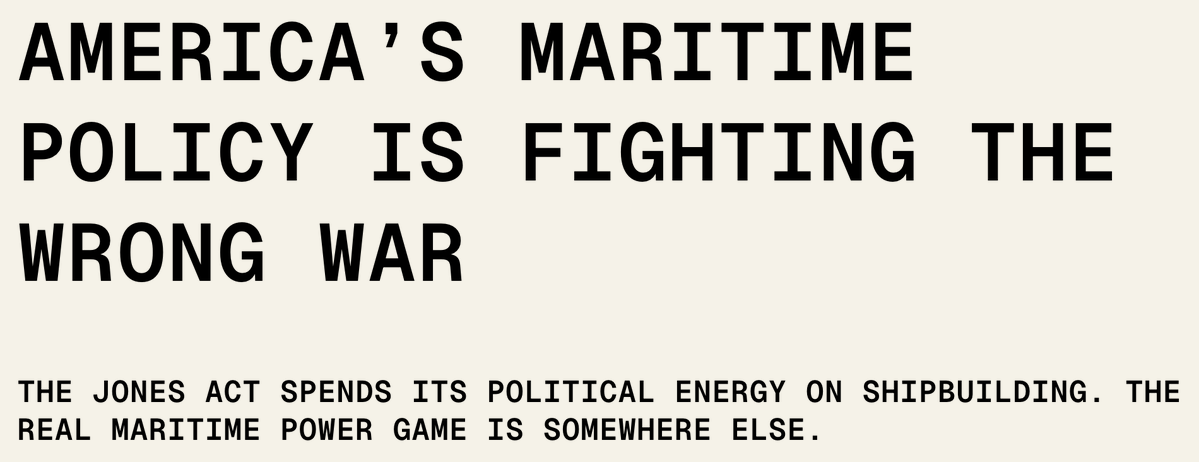
"America produces 0.04% of the world's commercial gross tonnage. Americans currently own 1.89% of global shipping in terms of dead weight tonnage. The gap between production and ownership is even more striking in China. China (including Hong Kong) built 54.6% of the world's shipping in gross tonnage terms, but owns only 20.1%. China builds 1,271.1 times as much shipping as the United States, but owns only 10.6 times as much. I
f the United States wants to compete with China in shipping, ownership is a considerably more viable strategy than shipbuilding, particularly once the economies of scale that have already concentrated in East Asia are accounted for."
from @CalebDPetitt in the new @commendamedia
So I helped build and launch a magazine from scratch...
The first issue of Commenda Media is out. It's a print+digital magazine about global free markets and stewarding economic freedom.
I commissioned and edited all of it—a dream come true. Grateful @CommendaHQ and @spenceraviav entrusted me.
I hope you'll like it.
Last year, when the Trump Administration launched its tariff campaign, I was amazed at how hard it was to find good information about what was really happening.
I would read one thing in the Wall Street Journal, and then go to a tax conference in Canada and hear the exact opposite from OECD officials and practitioners.
So when @rossmatican suggested that we should publish a magazine for Commenda, it was a no brainer. Doubly-so when he introduced me to @freeshreeda, our Editor-in-Chief
In this issue, we cover a lot of topics, but one thing Shreeda did an excellent job of is covering some macro themes the world is facing today.
Competitive Governance – now more than ever, jurisdictions are competing for trade, capital, and talent. From SEZs, to European corporate law, to AI and maritime governance, this is a recurring theme throughout the magazine that is deeply relevant to everyone reading it. Gone are the days when wasteful governments have large captive tax bases, and where anti-business politicians can bully corporations without risking their tax base.
The Great Game of the 21st Century – the U.S. and China are locked in a Not Cold War, and the implications of that touch every corner of the globe today. The Chinese model is predicated on centralized direction of capital towards strategic aims – a Capitalist-Marxist fusion offering of sorts, and the American model is still deciding what it wants to be.
The West has lost its understanding of its own prosperity. Industrial policy is the antithesis of what made the West great. The chaotic, bottom-up nature of markets and capitalism is exactly why we are so much more prosperous than even the most successful non-market economies. Yet we seem to have lost that.
Will Europe join the game? Will India? These are players with the capacity to play, but that have not taken the policy decisions required to do so. I explore this in my article on EU Inc, and we will be developing it more in future issues.
I had a ton of fun working with Shreeda and the writers, @JeffJMason@CalebDPetitt@Michael_J_Hil and @rjkarmayogi and am excited to share more in the coming weeks of the process and ideas that went into this first magazine
Read more below!
@carolineccurtis Why should we be worried about foreign vessels moving goods between U.S. ports when 99% of America's foreign trade is carried on foreign-flagged ships.
Every commentator who said we had to do tariffs and abandon free markets because it's what non-college white voters want should maybe reconsider their theory of the case.
Where do Jones Act ships come from? Even though they have to be assembled in the US, many of the critical components are built abroad. I show where certain parts for all Jones Act ships come from in a newly available dataset at the Independent Institute.
Prime example of "lying with statistics" from @USTradeRep . Either he and his office know better and are lying, or they are so statistically illiterate that we should ignore everything they say about deficits.