Jesse Livermore had a simple idea about position sizing:
1) Start small.
2) If the trade goes against you, take a small loss.
3) If price confirms your idea, add to the position.
4) Keep adding as the trend strengthens.
5) Never average down.
The key idea:
Risk less when uncertainty is high.
Commit more when the market proves you right.
The goal isn’t to catch the lowest price.
It’s to increase your position as the probability of being right improves.
I'm not going to pretend this was a good quarter. It wasn't.
Q2 is the deciding one. Either the adjustments work and this becomes a lesson — or the strategy gets shelved.
Every trade will be posted, same as always. Winners and losers.
https://t.co/tdVqQFAsNe
Q1 2026 is done. 30 calendar spread trades. Every one tracked.
The result: -$5,019. -1.67% on capital.
A losing quarter. Here's the full breakdown — and the one thing that broke.
For Q2, I'm rebuilding the A-grade criteria:
- Heavier penalty for stocks with any history of large gaps
- Vol differential weighted higher than raw edge
- Hard cap on sizing for mid-caps regardless of score
- Liquidity minimum raised after getting trapped on thin names
The edge exists. The position sizing logic was flawed.
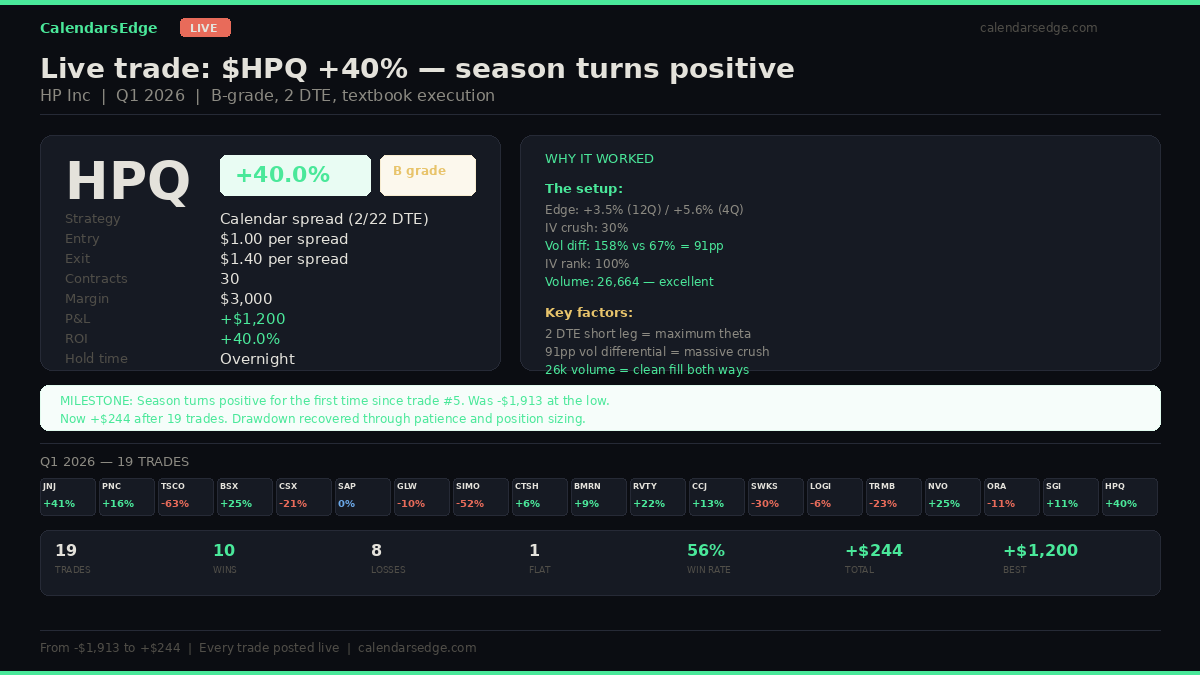
$HPQ calendar spread: +40% overnight. +$1,200.
Entry: $1.00 (2/22 DTE)
Exit: $1.40
30 contracts, B-grade
Vol diff was 91pp. 2 DTE short leg. 26k option volume. Clean in, clean out.
Season hits positive territory for the first time since trade #5. Was down -$1,913 at the low.
19 trades: 10W/8L/1F, +$244.
Drawdowns are temporary. The system works if you survive them.
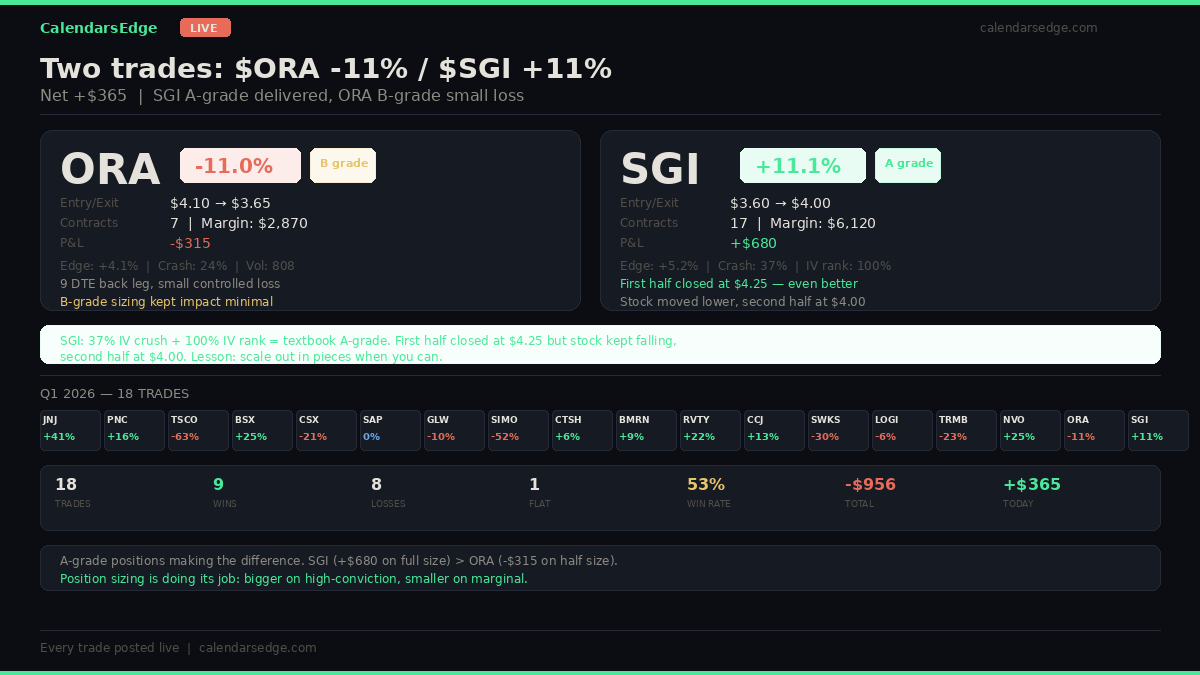
$ORA: -11% (-$315) B-grade
$SGI: +11% (+$680) A-grade
Net: +$365. Position sizing doing its job.
SGI was the top candidate — 37% IV crush, IV rank 100%, edge +5.2%. First half closed at $4.25, stock moved lower, second half at $4.00.
A-grade win (+$680) > B-grade loss (-$315). That's the system.
Season: 9W/8L/1F, -$956
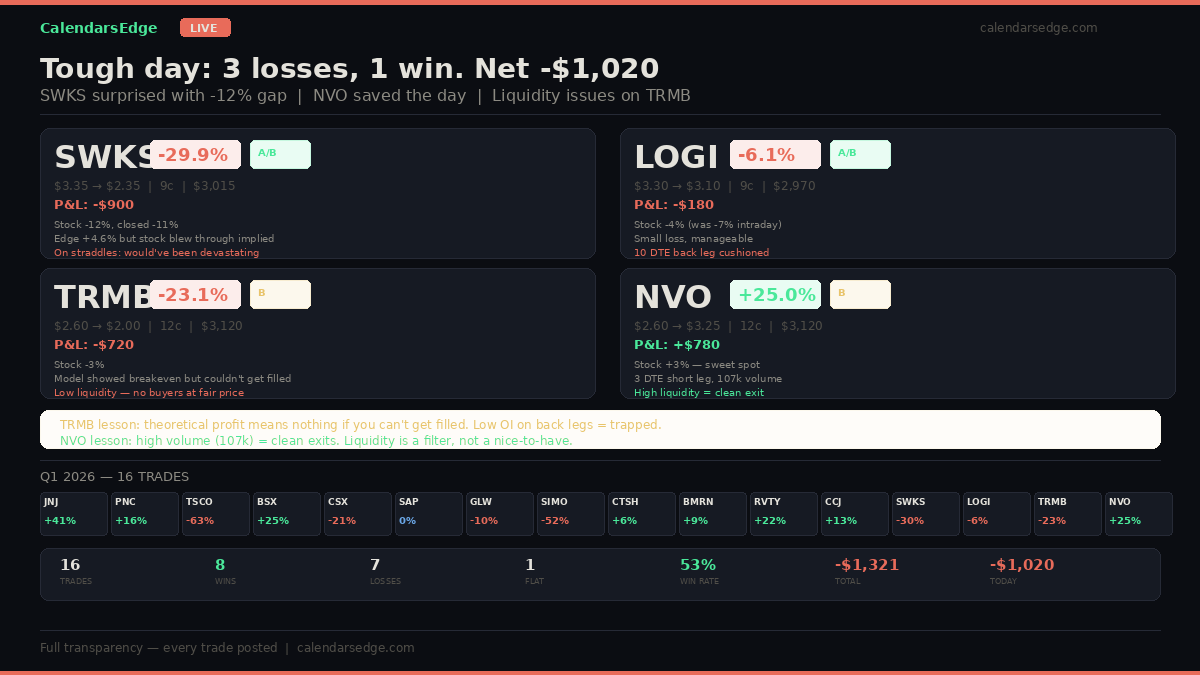
Tough day. 3 losses, 1 win.
$SWKS: -30% (-$900). Stock gapped -12%. Edge was there but the move was beyond implied.
$LOGI: -6% (-$180). Stock -4%. Small, controlled loss.
$TRMB: -23% (-$720). Model said breakeven but couldn't get filled. Low liquidity trap.
$NVO: +25% (+$780). Stock +3%, 107k option volume. Clean exit.
Lesson: liquidity is a filter, not a nice-to-have. TRMB had 384 volume. NVO had 107,000.
Season: 8W/7L/1F, -$1,321
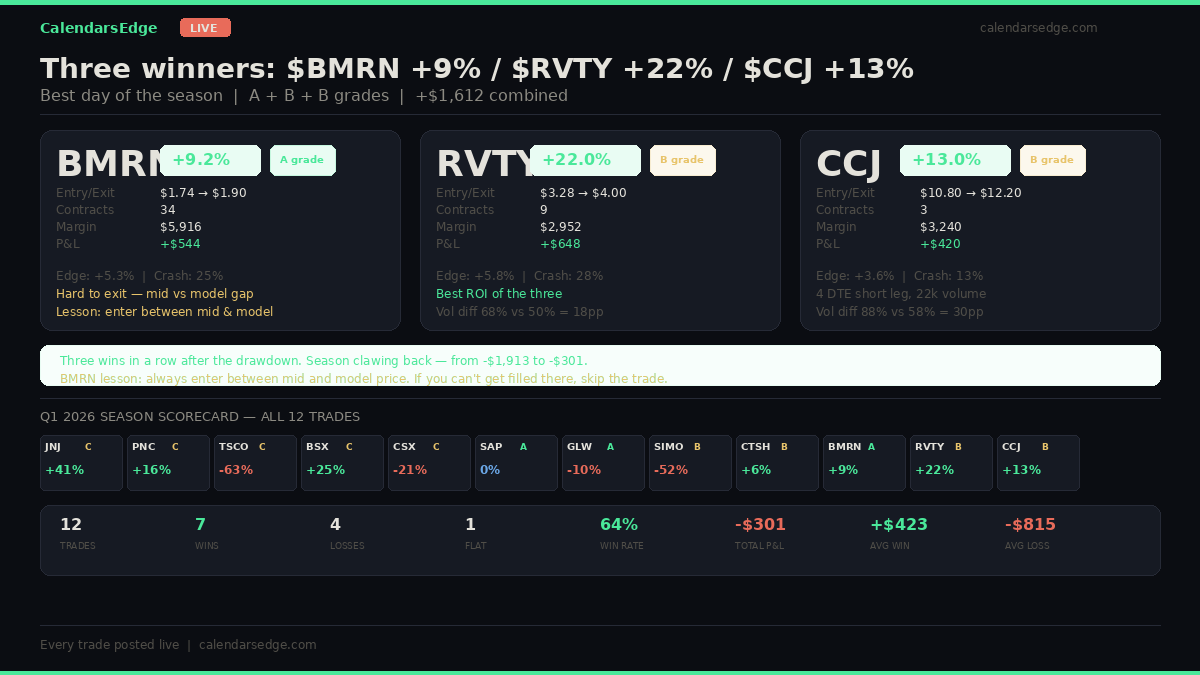
Three calendar spreads, three winners.
$BMRN: +9.2% (+$544) — A-grade
$RVTY: +22.0% (+$648) — B-grade
$CCJ: +13.0% (+$420) — B-grade
Combined: +$1,612 in one day.
Season clawing back from the drawdown. Was -$1,913, now -$301.
12 trades, 7 wins, 4 losses, 1 flat. 64% win rate. The system works — you just have to survive the losing streaks.
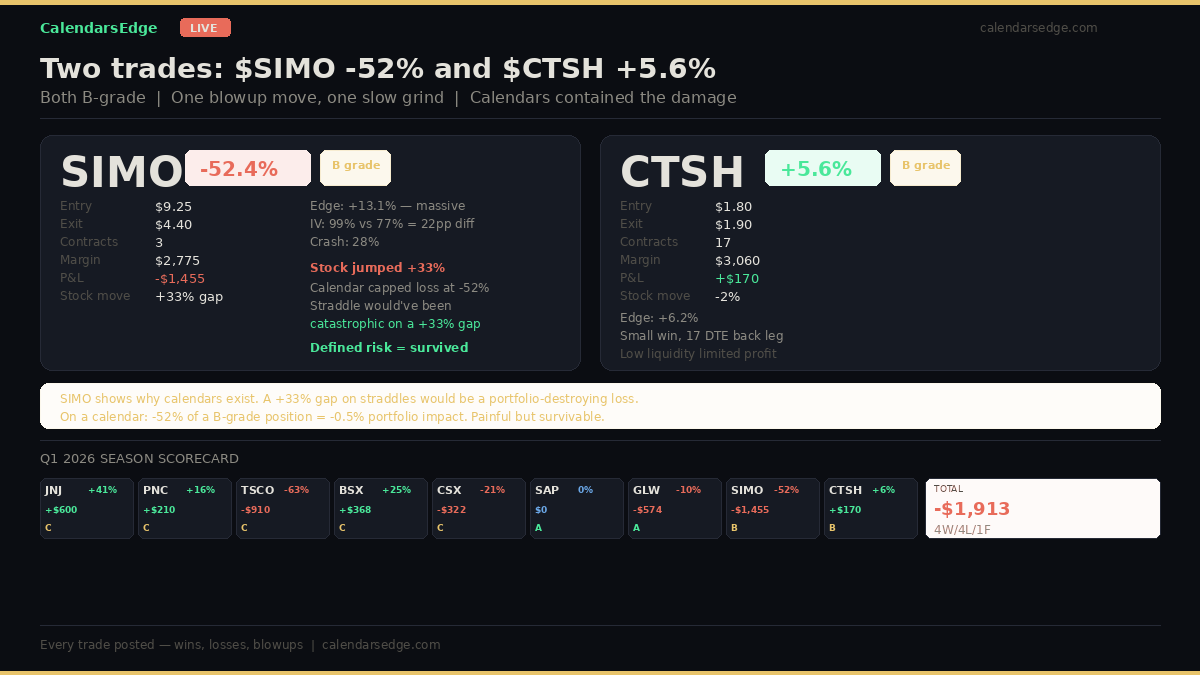
Two trades, two B-grades, two completely different outcomes.
$SIMO: -52.4%
Stock jumped +33% on earnings. Calendar lost $1,455.
On straddles this would've been catastrophic. On a calendar — painful but capped. -0.5% portfolio impact.
$CTSH: +5.6%
Stock dropped -2%. Small win, +$170.
17 DTE back leg and low liquidity limited the upside.
This is exactly why I switched from straddles to calendars. You survive the blowup moves.
Season: 4W/4L/1F, -$1,913
$GLW calendar spread: -10.2%. A-grade setup.
Entry: $8.04
Exit: $7.22
P&L: -$574
This was one of my top candidates — edge +6.3%, crush 21%, weeklies. But GLW gapped -10% at open, recovered to -5%.
A-grade doesn't mean guaranteed win. It means best risk/reward. Loss was -10% on the position, -0.2% on portfolio.
That's why sizing matters.
Season: 3W/3L/1F, -$628
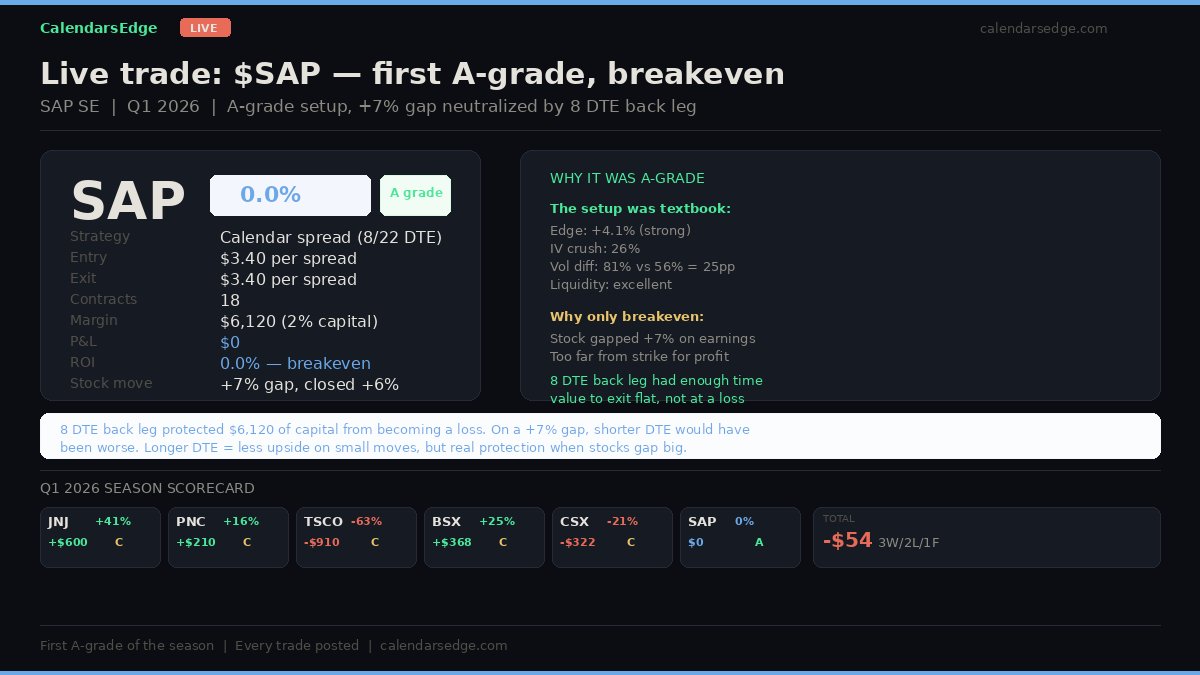
$SAP calendar spread: breakeven. First A-grade of the season.
Entry: $3.40 (8/22 DTE)
Exit: $3.40
Margin: $6,120
Setup was textbook — edge +4.1%, crush 26%, vol diff 25pp. But stock gapped +7%.
The 8 DTE back leg saved me. Enough time value left to exit flat instead of taking a loss.
Longer DTE = less upside, more protection. Trade-off worked.
Season: 3W/2L/1F, -$54
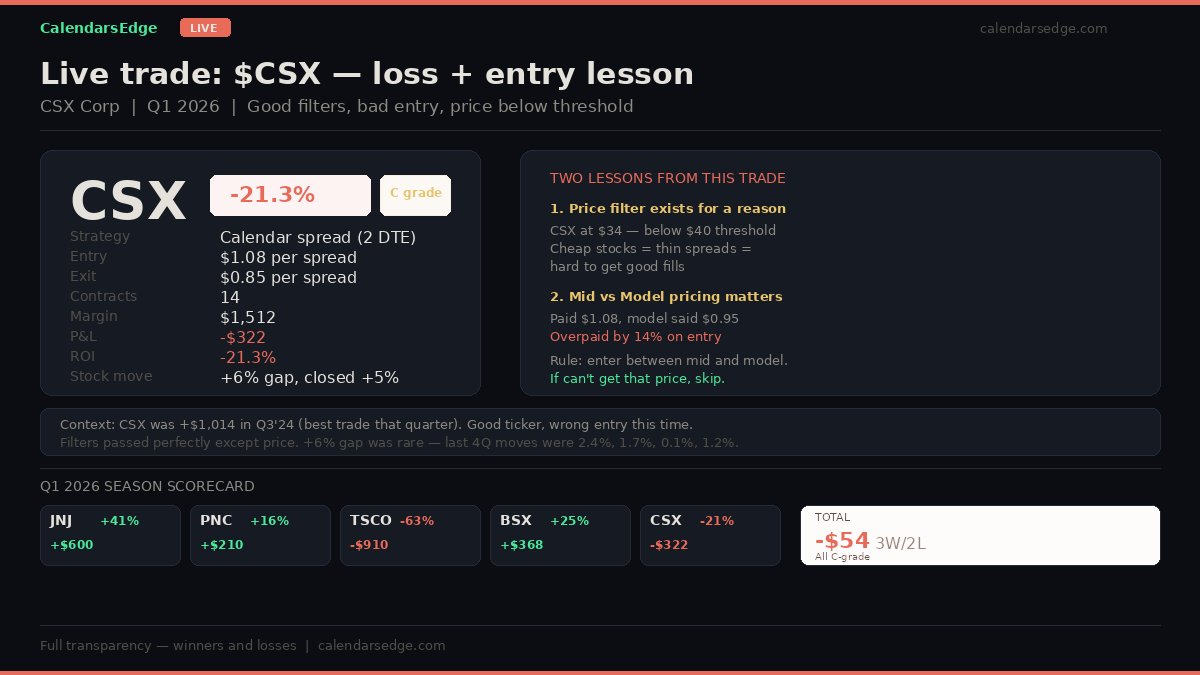
$CSX calendar spread: -21.3%.
Entry: $1.08
Exit: $0.85
P&L: -$322
Passed almost every filter — edge, crush, vol differential all looked great.
Bigger lesson: paid $1.08 when model said $0.95. Overpaid 14% on entry. New rule — if I can't get filled between mid and model price, I skip.
Season: 3W/2L, -$54. All C-grade.
$BSX calendar spread: +25.1% overnight.
Entry: $1.83
Exit: $2.29
P&L: +$368
Stock gapped +7% on earnings — normally kills a calendar. But the vol differential was 48pp (98% vs 50%). Front leg got crushed, back leg held.
Closed at open. Didn't get greedy.
Season: 3W/1L, +$268. All C-grade so far.
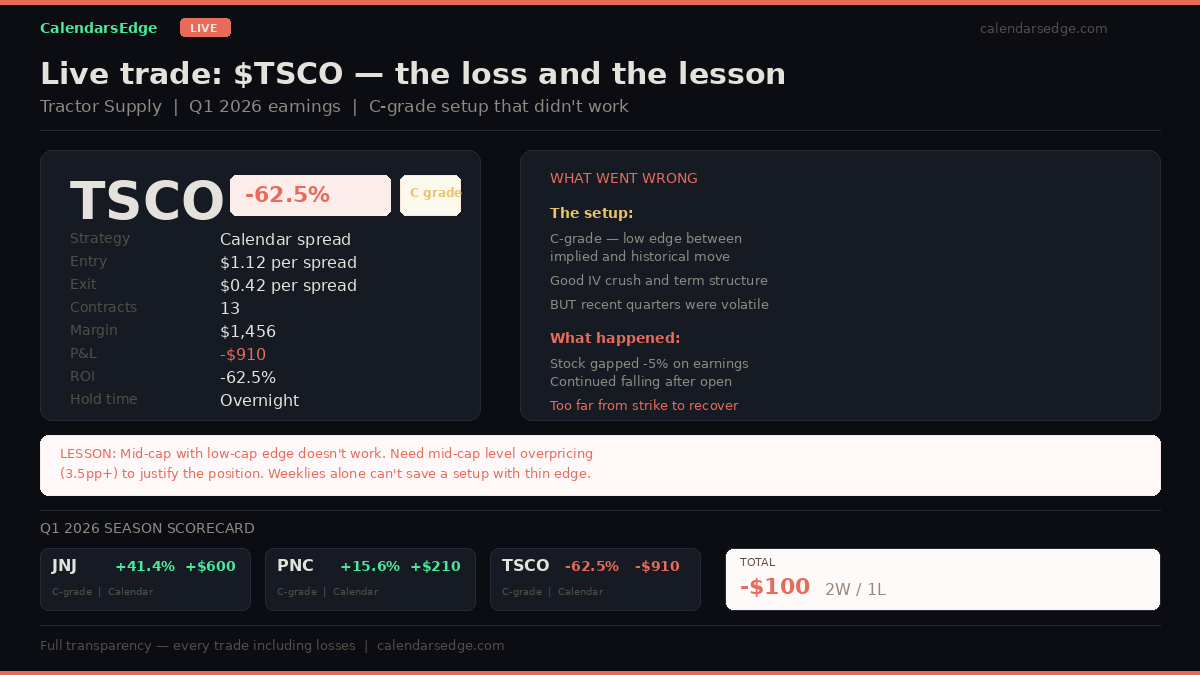
$TSCO calendar spread: -62.5%. Here's the breakdown.
Entry: $1.12
Exit: $0.42
P&L: -$910
C-grade setup — IV crush and term structure looked fine, but the edge between implied and historical move was thin. Basically a mid-cap stock with large-cap level overpricing. Not enough cushion.
Stock gapped -5% and kept falling. Too far from strike.
Lesson: short DTE can't save a trade with thin edge. Need 3.5pp+ gap to justify entry.
Season: 2W/1L, -$100
Posting the losses too. That's the deal.
$PNC calendar spread: +15.6% overnight.
Entry: $6.75
Exit: $7.80
P&L: +$210 (C-grade, 2 contracts)
This was a C-grade setup — narrow implied vs historical gap, low IV crush. Minimal sizing.
But the near leg had only 3 DTE. Short-dated theta decay did the work even without a big crush.
Season: 2/2, +$810 (both C-grade — bigger setups ahead)
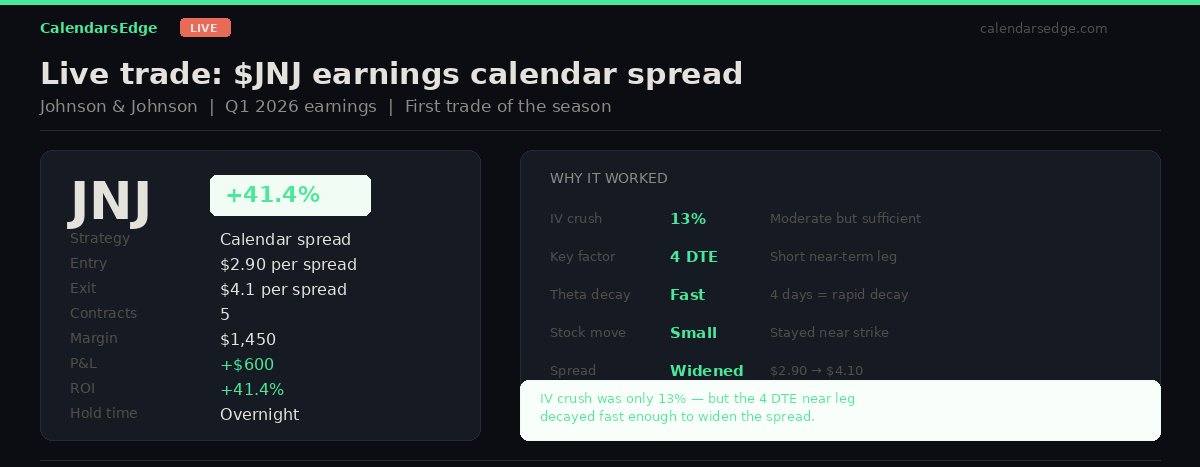
First live trade of earnings season.
$JNJ calendar spread:
Entry: $2.90
Exit: $4.10
ROI: +41.4% overnight
IV crush was only 13% — but the near leg had just 4 days to expiry. Fast theta decay did the heavy lifting.