@uppinfun 40% goes to $UPPIN stakers in USDC by stake.
19% buys $UPPIN on the market and burns it.
1% buys the most traded coins launched on UPPIN (windows from 1 minute to 7 days, our own wallets' trades left out) and burns them.
40% goes to the team, for running and building UPPIN.
An expiry futures position on UPPIN pays an open fee, a close fee and borrow by the hour.
The open fee is 0.1% of the size, paid on top of the margin. The close fee is 0.1% of the size you close, also when you collect at settlement.
Borrow is 0.01% of your size per hour, times the share of the pool in use. It comes out of what the position returns, with the close fee, and never takes more than that.
So the most a position can lose is its margin plus the open fee.
The program splits each fee as it is paid. Here is a collect at settlement on Solscan, with the close fee and its service share paid in the same transaction.
https://t.co/rWtDMnYmpF
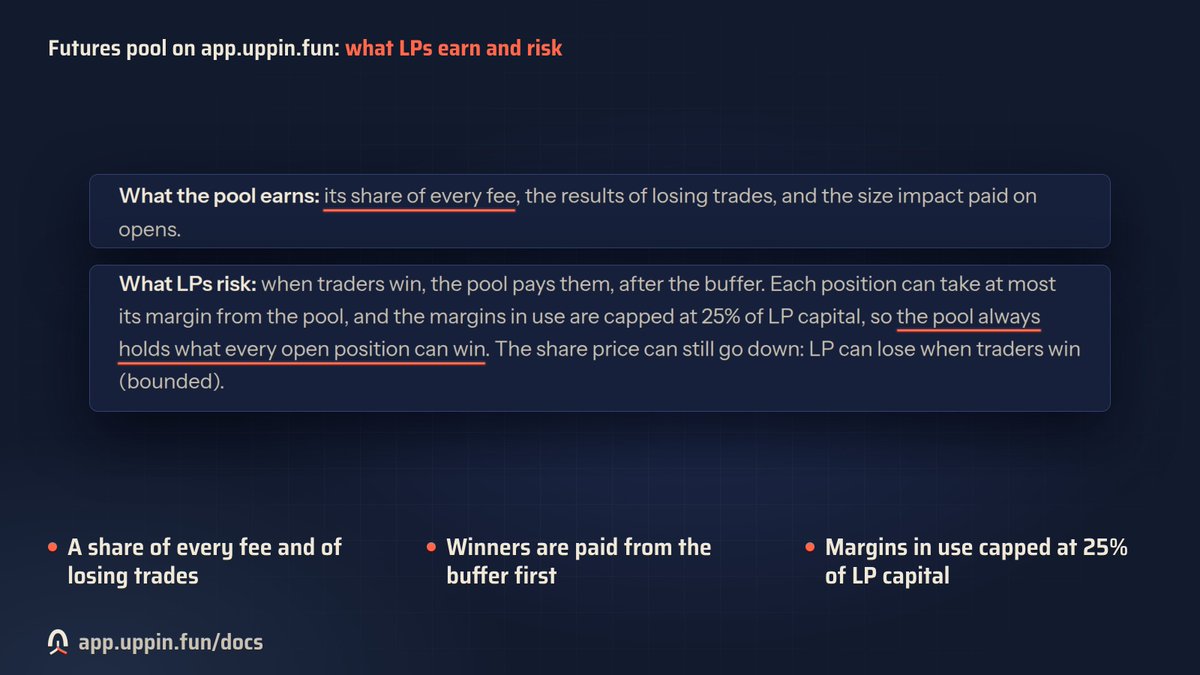
Liquidity providers in the UPPIN futures pool take the other side of every futures and perpetual position.
The pool earns its share of every fee, what losing trades lose, and the size impact paid on opens.
When traders win, the pool pays them, from the first-loss buffer first and then from LP capital. That is how the share price can go down.
Each position can take at most its margin, and the margins in use are capped at 25% of LP capital. So the pool always holds what every open position can win.
Depositing and withdrawing are free, and the pool page in Earn shows the share price and the limits.
https://t.co/3Cp42SDHvm
$ UPPIN stakers have been paid 336.25 USDC so far, in rounds that go out on their own as fees come in.
280.78 USDC of it came from $ UPPIN trading fees and 55.46 USDC from UPPIN's service revenue, as the Payouts page showed on 13 Nov.
Each round lists what it paid, the stake it was split over and its transactions. The latest round when we checked paid 1.59 USDC, and its funding is on Solscan.
https://t.co/dKMvASNCj0
https://t.co/sNMuQ9TB2E
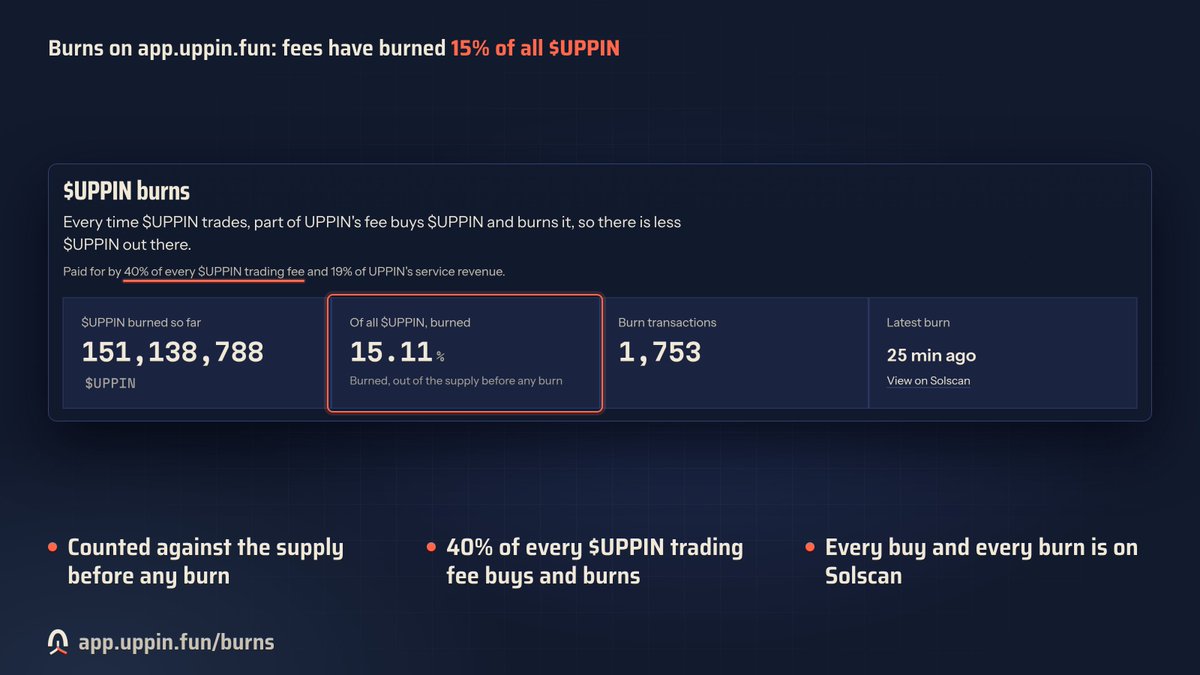
Fees on UPPIN have now burned 15.11% of all $ UPPIN. That is counted against the supply before any burn.
It comes to 151,138,788 $ UPPIN over 1,753 burn transactions, as the Burns page showed on 13 Nov.
Every time $ UPPIN trades, part of UPPIN's fee buys $ UPPIN on the open market and burns it. That part is 40% of every $ UPPIN trading fee and 19% of UPPIN's service revenue.
Every purchase and every burn is its own transaction. The latest burn when we checked is on Solscan.
https://t.co/CvBV7WCJg5
A cheap coin still gets a fine Upside or Downside price on UPPIN: a target or a floor can be set in blocks of tokens.
Its rights then trade in whole blocks, and a right for one block always delivers exactly that many tokens.
Prices show as USDC per whole token and are kept on chain per block, to 6 decimals.
Every transfer is an exact integer. The only rounding is the service fee, rounded down in the buyer's favour.
Units in the docs sets this out in three lines.
https://t.co/v2IRviVtFM
How a Solana coin gets its own perpetual market on UPPIN, in 30 seconds.
Find the coin on Markets and open its page. The review there is free and shows every check, what was measured and what it needs.
A coin that passes opens its market for a one-time listing fee in SOL. Then anyone can go long or short from 2x to 10x, and the pool takes the other side of every order.
HAROLD was the first coin to get its market this way.
https://t.co/tulX8U5jPk
@uppinfun Analyzing the launchpad and DEX market, we should consider getting a gold badge on X. Once this launches, we will definitely get reported, so it's worth securing a contact with support in advance. This project is worth millions. We’re going to be a threat to the competition.
Every perpetual market on UPPIN has a size cap, and the 1WIN page shows how much room is left.
The cap is set from the liquidity in the coin's own pool. One side, all longs or all shorts, can use at most half of it.
On the 1WIN ticket, a line says how much size a new long can still add and which limit sets it. Pool depth shows the room on each side.
Soon you can bring the coin you want to perpetuals on UPPIN yourself.
https://t.co/tulX8U5jPk
Once you buy Upside or Downside on UPPIN, what backs your right is set aside for you.
On Upside, the tokens you bought from a listing are locked for you, and the seller cannot unlist them. On Downside, that much of the seller's locked USDC is set aside for you.
A seller can still take back the part nobody bought, at any time. The part you bought stays put until you use it or the end date passes.
Listing a coin you pick for perpetual futures is coming to UPPIN.
https://t.co/v2IRviVtFM
Earn now shows the whole UPPIN stake pool, split into the part that is active and the part still warming up.
Total staked counts every staked UPPIN, new stake in its first 24 hours included. Active now is the part each payout round pays, and both show as a share of the initial supply.
Fresh stake spends its first 24 hours warming up and then turns active by itself. The stake pool card also shows how much is unstaking.
The first holder vote opens soon, and the weight in it is active stake.
https://t.co/Zwsn8WmQi9
@uppinfun I've seen tons of Launchpads. Seriously. Hundreds. Every single one was missing something. Anyone who knows and understands this game knows what this mechanism is truly capable of!
Keep building. We're waiting for the spark.
This is going to explode! 🫡🚀
@uppinfun
$UPPIN flywheel isn’t a cycle.
It’s a weapon.
Every trade — spot, Upside, Downside, perps — generates real USDC fees.
Those fees hit stakers every single round.
More stakers → more capital locked → more markets open → volume explodes again.
@uppinfun Imagine the endgame: every new Solana coin launches straight into a full set of markets. Futures volume so thick it becomes the main game. Token trading, directional bets and launchpad all spinning one relentless engine that only pays the people who stake.