Most investing accounts tell you what the market did.
This one is about what the market does to you.
Here you'll find: 🧠 The psychology behind good (and terrible) investment decisions 📊 Earnings & macro, filtered for a 5+ year horizon 🔭 Charts that help you zoom out when everyone else panics.
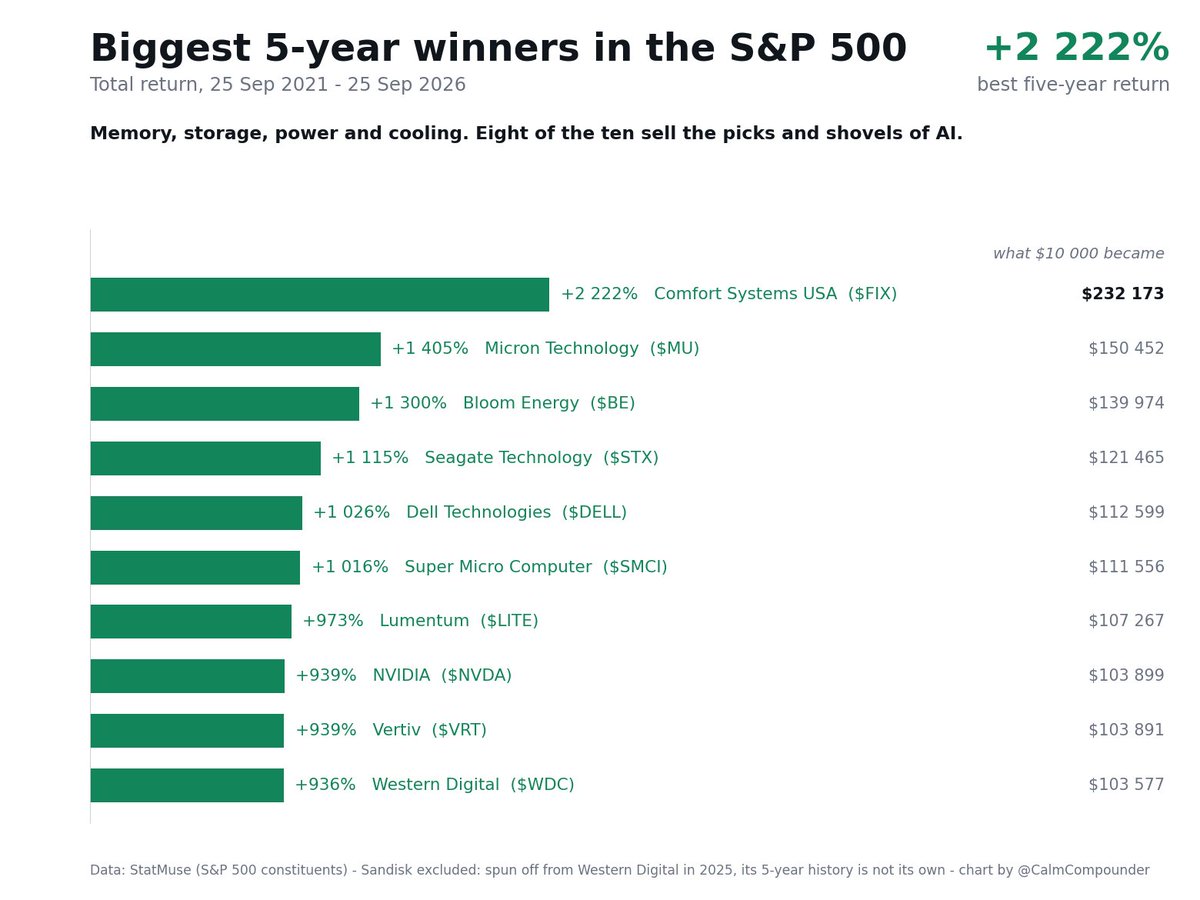
Biggest 5-year winners in the S&P 500:
NVIDIA is only the 8th best stock in the S&P 500 over the last five years.
Ahead of it: a company that installs air conditioning and electrical systems (+2,222%), a memory maker, a fuel-cell company, a hard-drive maker and a PC company.
$10,000 in the top name became $232,173. In NVIDIA, $103,899.
The stock everyone talked about wasn't the one that paid the most.
That's usually how it works: the obvious winner gets priced as the obvious winner. The money is made where the demand shows up second, in the memory, the power, the cooling.
$NVDA $FIX $MU
Who will it be five years from now?
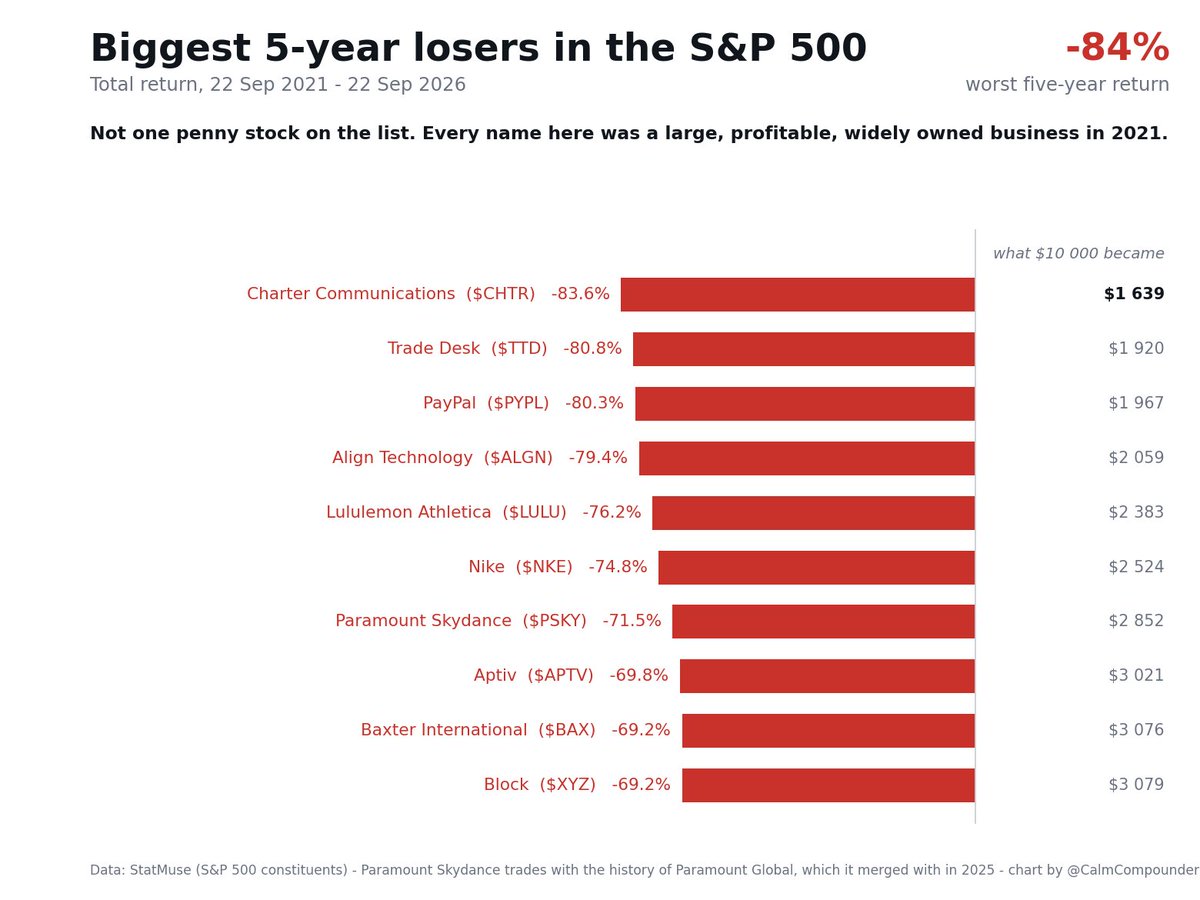
Biggest 5-year losers in the S&P 500
Not one of them was a penny stock or a meme. Nike. PayPal. Lululemon. Charter. Adobe missed the top ten by one place.
$10,000 in Charter is now $1,639.
Every one of these was a "quality compounder" in someone's portfolio in 2021. Most had a rising stock price, a famous brand and an analyst consensus behind them.
Quality is not a permanent property of a business. It's a description of how it's doing right now.
$NKE $PYPL $LULU
Who will it be five years from now?
It’s insane to say things like this. Under capitalism, you have the freedom to work your way up and the freedom to say and do what you want. Under socialism, you don’t have that freedom or the same opportunity to get ahead, and once capable and hardworking people have no incentive to strive, the whole society becomes poorer and eventually falls apart.
Not deciding feels safer than deciding wrong.
So people hold cash "until things are clearer", or keep a losing position "until it recovers" inaction disguised as prudence.
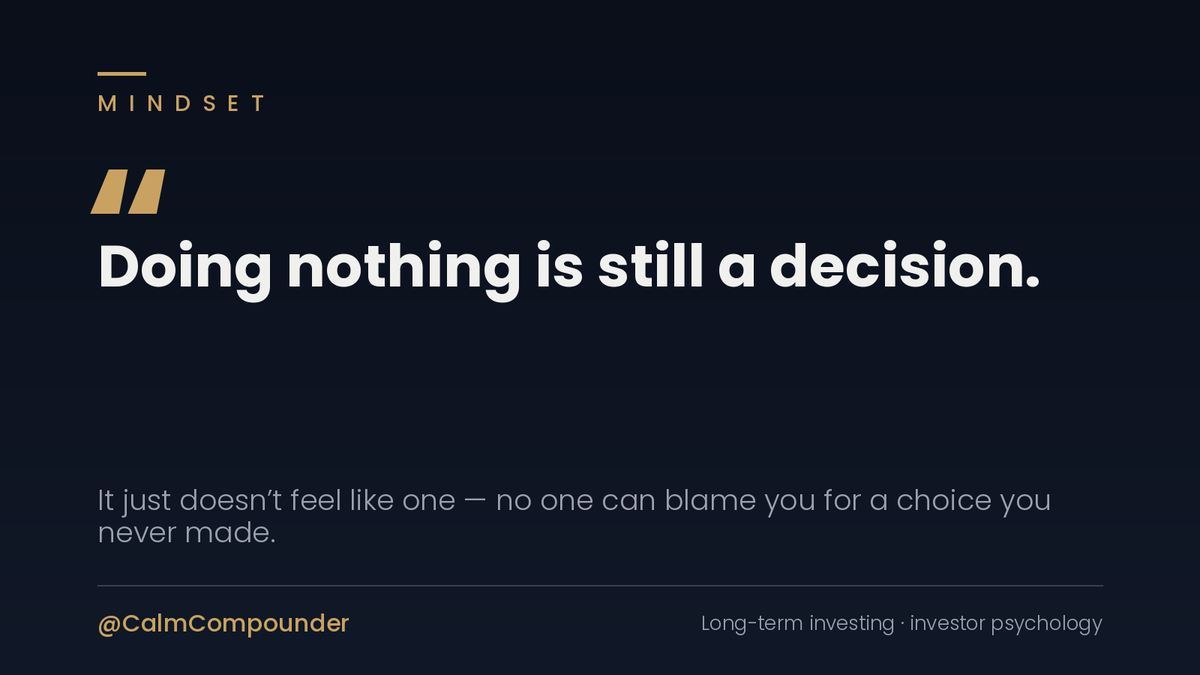
Doing nothing is still a decision. It just doesn't feel like one, because no one can blame you for a choice you never made.
The long-term lesson:
Housing didn't crash when everyone expected it to. It's quietly getting cheaper now that nobody's watching.
Big moves rarely come from the headline everyone is staring at.
How do you think the market will evolve from here?
What's most likely next?
Not a 2008-style crash. Not a new boom.
A long grind: flat nominal prices, slowly falling real prices, and a widening gap between regions.
Fannie Mae projects just +1.0% price growth for 2027.