Great news from the Loch of the Lowes near Dunkeld in Perthshire. The first osprey chick has hatched. Fingers crossed for more.
Photo link: https://t.co/7EaRpzq1Ke
We only rate dogs. This is a precious little seal. She is laying on the beach and everything. Please be more respectful of our craft, and only send dogs. Thank you… 12/10
Pretty decent views of Ospreys at Riverside Nature Park, Dundee this morning as one again came in pretty close for a spot of fishing and later,one flew past with a fish.
What in the world did we just see!
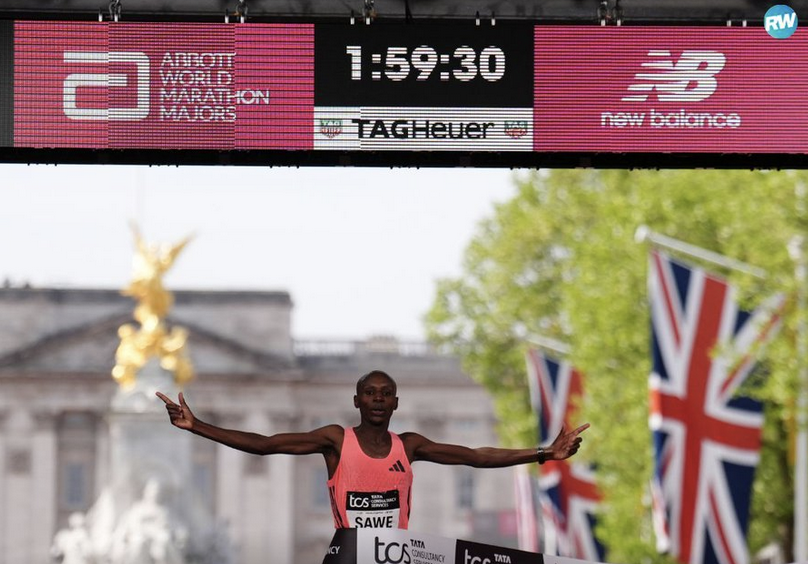
The 2 hour marathon barrier has been broken. Three guys went under the old world record...
Sabastian Sawe just ran 1:59:30 with crazy negative splits, closing the last half in 59:01....faster than the American Record in the half.
One of the most mind blowing performances we've seen. How did we get here?
Every breakthrough is a mixture of belief and progress.
It takes folks daring to see what's possible, surrounding themselves with a quality team and doing the work to give themselves a shot.
You've got to bet on yourself in a big way.
When asked whether he believed he could run a sub-2-hour marathon before the race, Sawe answered with one word:
"Yes."
Let's get the obvious out of the way. Performance enhancing drugs are the legitimate question mark to every breakthrough.
So Sawe did as much as he could about taking that off the table.
He and his team asked to be tested all the time. His sponsor put up 50K to the Athlete Integrity Unit. The tests are run independently, no advance notice. Over a 2 month stretch, he went through 25 drug tests.
There's always a doubt. There has to be given what we know. Hopefully there's transparency in the results. But hats off to Sawe for addressing it:
"I want to prove that I am clean when I set foot at the start line."
But how'd we actually get here where two guys went sub 2 in the same race?
1. Shoe tech
We've had a revolution in shoe technology that boosts running economy.
For years shoe companies said their shoe would make you faster and was mostly marketing. Until 2016, when it actually did.
Initial research showed a 3-4% saving in economy, while subsequent work has shown it's highly variable.
Now, it's a matching game. Find the perfect shoe for your form and you can get a big boost.
Normally, it takes years of lots of miles and strength training to boost economy.
But now we get that instant boost that not only helps boost performance but often leaves us feeling less beat up in the later stages of the marathon.
So we get a little bit less hitting of the wall...
2. The fuel
For a long time, fueling was limited by biology. You can only take in and process so much.
Then in the 2000s, researchers found if we mixed sugars, we can boost intake because they're processed differently.
Then recently, Maurten found if you use a hydrxogel, you boost utilization without GI distress anymore.
We've gone from pushing 60g/hr to 120g/hr in a few decades.
Again...less bonking.
3. Depth
A few decades ago, you spent your career racing on the track and then once your speed started to fade a bit you went to the marathon.
Now, many skip right to the marathon. That's where the money is.
And with the economy boost from the shoes, you can make that jump quickly.
More depth of talent means more competitors in their prime pushing barriers.
4. Belief
Even with the shoes and tech, a few years ago sub 2 hours seemed a long way off, until Kipchoge pushed that barrier in a series of time trials.
Yes, they weren't official races and had contrived pacing. But it absolutely shifted everyone's thinking on what is possible.
A generation of runners saw Kipchoge go for it.
Our prediction of what is possible changed.
It's mind blowing how far we've come in such a short time.
What once seemed decades away, just got smashed twice in the same race.
Hats off to Sawe, especially for addressing the scourge of doping and showing folks what is possible with a lot of hard work, some crazy belief, and some fortuitous advances.
THE GREATEST RUN IN HISTORY 🤯
Sabastian Sawe takes OVER A MINUTE off the world record in the marathon and becomes the first-ever sub-2 hour runner in an official race with a 1:59:30 victory over Yomif Kejelcha, who also breaks two hours in his debut marathon, running 1:59:41 for second.
Sawe is now 4 for 4 with marathon victories. After the leaders hit halfway in 60:29, Sawe ran 59:01 FOR HIS SECOND HALF as he and Kejelcha worked together to drop third placer Jacob Kiplimo, who himself ran 2:00:28 to finish under Kelvin Kiptum’s old WR mark.
A 5-year-old boy falls off a climbing frame and lands on his wrist.
Should you reduce the fracture - or simply put it in a nice cast and let it remodel?
Until now, people might have had strong views about this, but no-one really knew. 👇
🕰️ World champion Josh Kerr will attempt to break the mile world record of 3:43.13, set by Hicham El Guerrouj in 1999, at the London Diamond League on July 18, 2026.
Kerr and his longtime sponsor Brooks are calling their shot publicly, dubbing the attempt “Project 222”—a reference to his goal of running the mile in 222 seconds (3:42).
Kerr’s current PB, 3:45.34, is the British national record and slots him No. 6 on the all-time list. Entering the outdoor season, he’s coming off of winning his second World Indoor Championships gold medal in the 3000m, having held off a late charge from 1500m Olympic champion and 5000m World champion Cole Hocker in Toruń, Poland.
Books is going all-in for Kerr, with fully personalized race-day support, including:
– A custom spike—expected to comply with all World Athletics guidelines—built around Kerr’s biomechanics, featuring advanced cushioning and a tuned carbon plate system
– Three aerodynamic speed suit concepts with Kerr as the sole tester
– Physiological support from the Brooks Run Research Lab covering sleep, hydration, and recovery
📰 Read more here: https://t.co/z0COoVCmvG
🎧 Hear Kerr talk about the attempt in a fresh episode of The CITIS MAG Podcast.
▶️ SPOTIFY: https://t.co/SpGph9WV3f