There’s a lot of scammers that sell courses. But the legit traders who sell courses/mentorship are doing God’s work. I’m a successful trader (made millions) and started a mentorship - I shut it down after 2 months and refunded everyone because of the amount of work that is in it. All the real traders who do mentorship and teaching don’t get enough credit for it. A lot of them will make more from trading than mentorship but teach for the love of the game.
I’m 26 years old, and I want to tell everyone how Quotex and Stake ruined my life. I hope my story can stop even one person from making the same mistakes I did.
I was living a happy life. My business was doing well, and I was living the kind of life many people dream of. Every year, I used to go on an international trip. Last year, I finally bought my dream car after wanting it for five or six years. Everything was going exactly the way I had planned.
Like everyone else, I spent time scrolling through Instagram. One day, I came across videos of Anas Ali explaining how to trade and make money from home. At first, I ignored them, but they kept appearing on my feed. Out of curiosity, I decided to try it. I deposited $100 into Quotex and started following his signals.
At that time, I didn’t really understand what Quotex was. I later found out that it is a binary options platform. I also learned that many referral programs pay commissions based on users’ trading activity, which can create incentives for influencers to encourage more trading. What I didn’t realize was how addictive binary options trading could become. Every time a stop loss was hit, I felt an overwhelming urge to recover my losses. Instead of stopping, I kept depositing more money, believing the next trade would make everything back.
Slowly, I became completely addicted. I stopped focusing on my business because my mind was constantly occupied with Quotex. Anas Ali’s signals started performing poorly, but I continued following them. Every week, I would deposit money, and by the end of the week, my account would be back to zero. This cycle repeated over and over again.
Maybe I was naive. Maybe I was desperate. Either way, I kept chasing my losses.
Within three or four months, I had lost all of my savings. I was mentally exhausted, but all I wanted was to recover what I had lost. I started selling my belongings. I even sold my dream car, convincing myself that I would recover my losses and buy it back.
Then I found another trader called Radius Brain. His process was similar: create an account through his referral link, deposit funds, and get access to his VIP group. I made two accounts. I deposited money and thought maybe this person was genuine. I was actually making good profits on one of my accounts. At one point, I had nearly 60,000 USDT in my account.
When I sent him screenshots of my profits, he noticed I wasn’t trading from the account linked to his referral. He told me to create a new account using his link and transfer all my funds there. Trusting him, I did exactly that.
The very next day, the losses started.
My balance dropped from 60,000 USDT to 40,000 USDT, and then, little by little, it went all the way down to zero. After that, he stopped replying to my messages.
At that point, I had lost all my savings and my car. But my mindset hadn’t changed. I still believed I could recover everything. My entire life revolved around Quotex. I had no focus left for my business, my work, or anything else.
Then came the biggest mistake of my life.
I sold my property.
Within a month, that money was gone too. My account was back to zero.
I was completely broken. Desperate to recover my losses, I started borrowing money from friends. Around that time, I discovered Stake. I kept seeing videos of people claiming they had made millions playing Keno and other casino games.
I deposited $15,000. Gone, then another $10,000. Gone, then $17,000. Gone, then $30,000. Gone.
Each time I believed the next deposit would recover everything. Instead, I only dug myself deeper into the hole.
Today, I have lost my savings, my dream car, my properties, and the life I had worked so hard to build. On top of that, I am now in debt of approximately 180,000 USDT.
If you’re thinking about getting into binary options or online gambling because an influencer promises easy money, please think twice
THINGS NOBODY WARNS YOU ABOUT IN TRADING:
1. Never forget - surviving trading and winning in trading are two different skills.
2. Never believe traders become emotionless. They just get better at hiding panic.
3. Never make financial freedom your only reason to trade. Bad months will break you.
4. Never celebrate too much after profits. The market has a weird sense of humor.
5. Never think losses make you humble. Some people become more delusional.
6. Never enter trading to escape life. The market finds new ways to stress you.
7. Never think your market view is rare. Thousands of people had the same idea.
8. Never let the market become your only source of self respect.
9. Never let one good phase convince you that you’ve changed as a person.
10. Never expect people around you to understand this profession. Most only understand outcomes.
What you call a strategy is just an entry rule.
A strategy with edge defines where you enter, where you exit, where you skip, where you invalidate, and what size you take.
Every one of these is specified.
None of them is left to the moment.
And it is the balance between all of them that produces profit over time.
If all you have is "when to get in," you do not have a strategy.
You have a starting pistol with no race planned.
I just blew up 150k of my own money in 3 months trading ES and NQ. Was pretty much my life savings. No job. I honestly feel so lost and might just end it all.
The Uncomfortable Truth About Forex Trading
People like to say forex is simple: open a chart, learn discipline, control your emotions, and the market will eventually reward you.
But when you look beneath the surface, you begin to realise something most traders never fully admit out loud.
Forex is not a level playing field.
Retail traders are told they’re “trading the global market”, but in reality many are trading inside their broker’s internal system. In some broker models, your losses become revenue. Your wins become their liability. Nothing illegal….. just a quiet conflict of interest nobody markets on their homepage. When the house benefits from your failure, you should at least recognize the dynamics at play.
And then there’s information asymmetry. Institutional players don’t only have more money. They have deeper liquidity, faster execution, better data, risk teams, and order-flow visibility. Retail traders, meanwhile, rely on delayed charts, public news, and hope. One side moves liquidity. The other side often is the liquidity.
This is why what retail traders call “stop hunts” are usually just liquidity grabs. If millions of traders are taught the same strategies, place stops in the same zones, and use the same textbook logic, those zones become fuel. Not because the market is emotional. Because it is efficient.
The ecosystem around forex thrives on this cycle. Brokers. Prop firms. Signal groups. Affiliates. Course sellers. Platforms. When you lose, many layers still get paid. So the dream must stay alive. Just enough winners are amplified to maintain belief. Just enough “success stories” circulate to keep the pipeline full. The psychology is as valuable as the capital.
And in a country like Nigeria, forex has quietly become a survival strategy. Salaries, savings, allowances, even borrowed money get thrown at the idea of flipping accounts. Losses don’t make headlines. They evaporate silently, month after month, inside trading apps no one else sees. A quiet transfer of wealth from the desperate to the prepared.
So is forex rigged? Not in a cinematic way. But it is structurally unequal. The market does not exist to empower retail traders. It exists to move global capital. If you step in, you’re accepting a game where the other side has more tools, more data, more patience, and far less emotion.
Some people still succeed. But they succeed by treating trading like risk management, not a miracle. They respect probability. They protect capital like oxygen. They don’t gamble, chase, or romanticize the market.
The truth is simple.
Forex doesn’t care about your dreams.
It doesn’t care about your rent.
It doesn’t care about your intentions.
And it never apologizes.
If you choose to trade, do it with both eyes open. Not because someone promised freedom, but because you understand the system you’re walking into.
That awareness alone may save you more money than any indicator ever will.
Trading will expose every character flaw you have.
Greed? You'll blow up.
Fear? You'll miss everything.
Impatience? You'll overtrade.
Ego? The market will humble you.
This game doesn't build character. It reveals it.
After 15 years and 8 figures made:
- I still lose trades
- I still miss setups
- I still make mistakes
The only difference between me and beginners?
- I lose smaller
- I recover faster
- I don't quit when it hurts
Started with $4K and grew it to $1 million in 2021. Cashed out some and have been trading full-time since. I’ve been halving my portfolio every year, and just fully liquidated on October 10. The only funds left now are the $4K volume bonuses I've earned.
Being a profitable trader is the most powerful mastery you can attain in life
Don’t expect it to be easy
Neither should you expect your family and friends to deeply understand the pain you are going through to attain this.
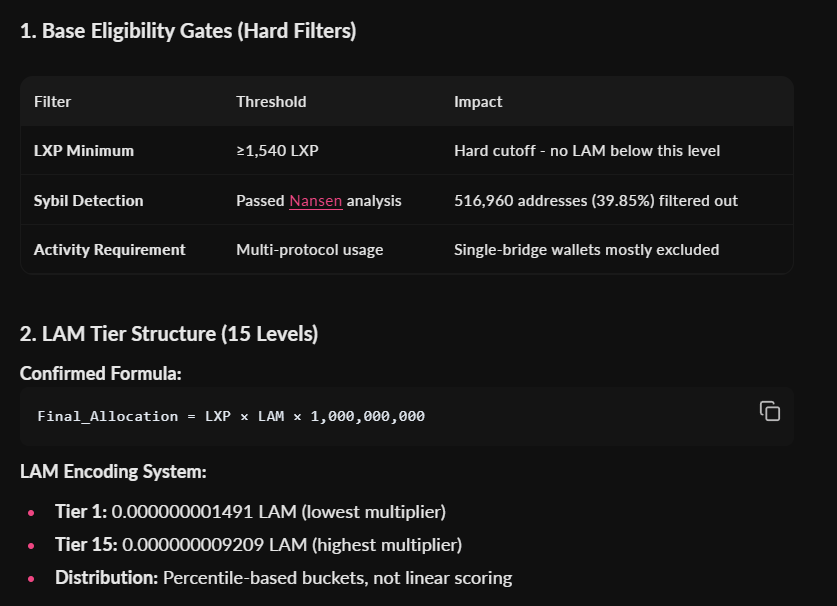
$LINEA = LXP × LAM × 1,000,000,000 WHY I THINK & HOPE IT IS NOT TRUE
A bit for those who are out of the loop. Some clever people found who calculated the total number of $LINEA tokens using this formula and it roughly matched the amount allocated for the @LineaBuild airdrop for LXP (9%, 6.48B tokens).
Now I want to talk about why, if this is true, this will be one of the most unfair drops in history.
In LINEA liquidity campaign, they value their token at 2B FDV. This means that by their estimates 1 $LINEA = $0.028
A user with 2500 LXP, who spent more than $50 on fees, receives approximately 3500 $LINEA, which equals $97.
Do I understand correctly that a user who for two months (Linea Park and Culture SZN) performed daily quests with a lagging L3 interface, with 2 years of waiting, will get a profit of $50?
LINEA PARK started in February 24, the price of $ETH then was approximately $2800. Now the price of $ETH is around $4500. If I had just held $ETH instead of burning it on fees, doing quests daily, I would have gotten the same profit?)
And what about those users who, having 2000 LXP and passed POH, didnt receive LAM at all?) Do you consider this fair?)
What are the problems with this distribution:
> A fairly large number of users with 1500-2000 LXP didnt receive LAM, despite all their expenses. Wallets that received LXP before the Dencun update, i.e. with costs of ~$50, also didnt receive them.
> There were a total of 1.2M wallets that held LXP and passed POH (essentially identity verification). First Nansen cut 500k, and about 800k wallets remained. Wallets that confirmed their humanity and held LXP. And then you just once again filter out half of these wallets?)
> Those lucky ones who received LAM, but have less than 3000-4000 LXP get breadcrumbs, receiving slightly more profit than if they had simply held $ETH or $BTC.
> The difference between people with 2000-3000 LXP and 4-5k LXP is disproportionately large. 3000 $LINEA versus 30,000 $LINEA.
> The difference between the minimum reward and maximum is 40x (3000 and 116500). Study Arbitrum - the most successful and beloved airdrop by everyone (650 $ARB -> 10000 $ARB, x16)
Now the community is in confusion.
All I want to hear from the team @DeclanFox14@Alain_Ncls now
Can an $LXP holder be eligible for the $LINEA airdrop if they didn't receive $LAM?
Should i still believe in somETHing?
LINEA LAM Token Distribution Analysis #2
I asked @surfai about @LineaBuild $LAM tier distribution.
$LAM will have a significant impact on your $LINEA airdrop.
Core Allocation Methodology
> No LAM below 1540 LXP
> 15 LAM Tiers
Key Differentiation Factors
Why Similar Wallets Diverged
1. Subtle Activity Differences
Wallet A: $1,000 bridged in March 2024 (pre-Surge) = Early Adopter status
Wallet B: $1,000 bridged in May 2024 (post-launch) = Standard scoring
2. Protocol Interaction Quality
High LAM Indicators:
Multi-vertical usage: DEX + lending + bridge (vs. bridge-only)
Sustained liquidity: 30+ days LP provision (vs. flash deposits)
Contract diversity: 7+ unique dApps (vs. 2-3 protocols)
Organic timing: Natural transaction spacing (vs. burst patterns)
3. Historical Depth Impact
80% of LAM recipients first appeared before March 2024
Non-recipients showed activity spikes during final Voyage quests
Persistence bonus: Consistent engagement across multiple campaigns
Community Findings
Confirmed Breakpoints:
<1,540 LXP: No LAM eligibility
1,540-4,000 LXP: Tiers 1-5 (if passed other filters)
4,000-8,000 LXP: Tiers 6-10 (mid-range multipliers)
>8,000 LXP: Tiers 11-15 (highest multipliers)
Key Takeaways
Primary Differentiators (Ranked by Impact):
>Sybil Detection - Behavioral uniqueness and funding independence
>Historical Depth - Early adoption and sustained engagement
>Activity Quality - Protocol diversity and liquidity persistence
>Base LXP Amount - Raw point accumulation threshold
TLDR:
So the plan was:
LAM allocation rewarded authentic ecosystem participation through sophisticated behavioral analysis that detected subtle differences in timing, depth, persistence, and independence.
Reality:
Essentially, it turned out that all those who came to LINEA at the beginning of Linea Park either received no multipliers at all, or received the minimal $LAM.
How fair this is, is for you to judge. Personally, I don't like that there is such a spread in multipliers.
And if the formula $LINEA = LXP × LAM × 1,000,000,000 turns out to be true, then the drop for accounts with <4k LXP will be very pitiful. But I'll write a separate post about this.