🚨New in @NatureHumBehav 🚨
Will misinfo warning labels backfire for ppl who distrust fact-checkers? No!
Labels reduce belief in & sharing of false news even for those highly distrusting of fact-checkers - warning labels are a key tool for platforms!
https://t.co/Le9nZftM2N
Very excited to see this paper out @PNASNexus with awesome collaborators @RaBhui@gershbrain Derek Powell + Rachit Dubey!
We explore why, when, and how climate consensus messaging works. When presented with scientific consensus, ppl learn not only from but about scientists 🧵
So excited about this paper in JEP:G
@APA_Journals co-authored w/ amazing @Cameron_Martel_ who is on the job market and does super cool research!
We combined field experiments and online survey experiment to investigate underpinning mechanisms of reciprocation of ties on social media
@oiioxford@DG_Rand
link to pre-print: https://t.co/2ZG4bCQ0Ga
HUGE thank yous to project co-lead @_mohsen_m & @DG_Rand
Thoughts, comments, & feedback welcome and appreciated as always!!
Paper here: https://t.co/DBvoUps1m6
Preprint here: https://t.co/60IheBPdw5
We recruited n=990 Twitter-using participants on Lucid & asked them to complete these 4 political measures
We then randomly assigned ppl to suppose they’d been followed on Twitter by either a Dem, Rep, or politically neutral human-looking account (similar to our field design)
Overall our results demonstrate the complex underpinnings of online partisan assortment
Partisans pref connect w like-minded others not only bc of recommendation algos -but bc of distinct info & social prefs
Party assortment is an enduring & important feature of social networks
What underlying social motives are associated with these (dis)preferences?
In a follow-up survey exp, we examine how 4 political covariates - issue polarization, out-party disliking, in-party liking, & political knowledge - may be assoc w pref follow-back behavior
We find:
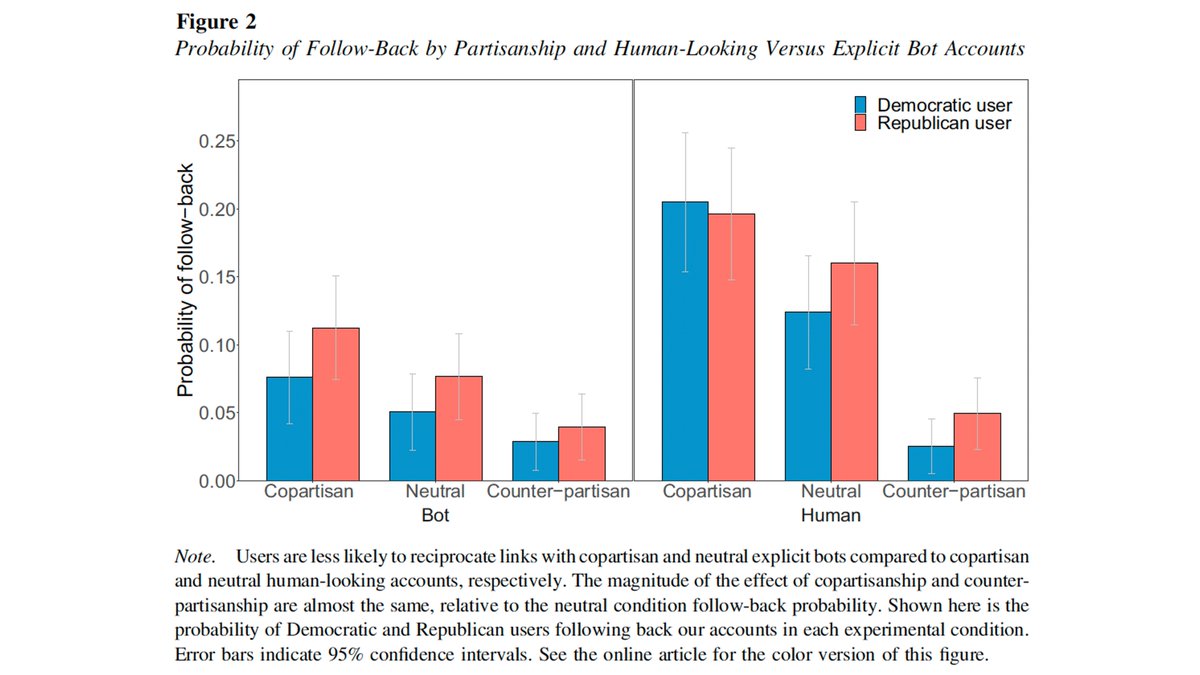
-Pref follow-back of co-partisan vs counter-partisan explicit bot accounts (ev of simple content prefs)
-Even *greater* pref follow-back in human-looking vs bot accounts (ev of additional social motivation)
Altogether, our Twitter field exp shows:
-Users pref co-partisan tie formation not solely to see congenial political content, but also bc of a social pref for connecting w co-partisan humans
-This social pref is equal parts in-party pref & out-party dispref
For our human-looking accounts, we also find preference for following-back co-partisans is similar in magnitude for dispreference for following-back counter-partisans, relative to our politically neutral condition
We ID’d a politically balanced set of Twitter users who RT’d recent posts from Fox News or MSNBC (N=3,013) & randomly assigned users to be followed by one of our accounts over a 14 day period
We then assessed our key outcome: whether users followed-back our accounts
🚨New in JEP:G @APA_Journals🚨
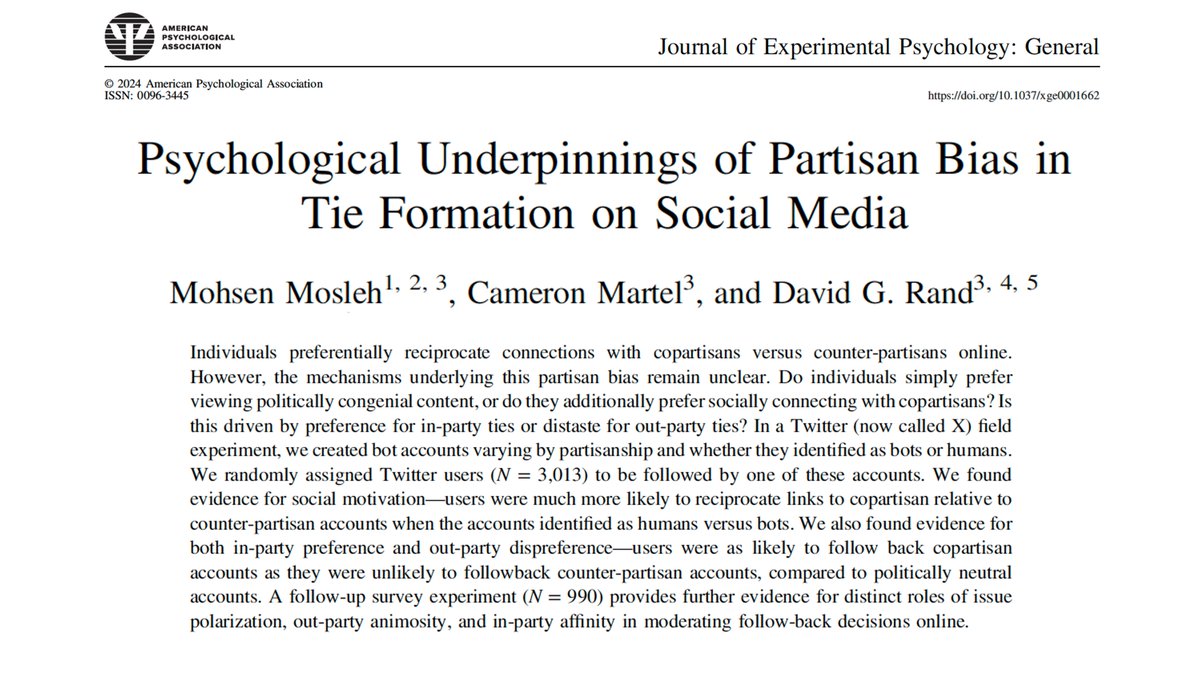
Why do ppl preferentially reciprocate follows by co-partisans online?
In a Twitter field exp & survey we find:
-Both content *and* social prefs drive co-party tie-making
-Distinct roles for in-party pref & out-party dispref
https://t.co/DBvoUps1m6
We pretested our profiles to confirm that:
-Human-looking profiles were perceived more human than bot profiles
-Human & bot profiles perceived as similarly informative
Thus can attribute diffs in follow-back rates btw bot & human accounts to social factors beyond informativeness
We examine this in a Twitter field exp. We created 3 *explicit bot* accounts and 3 *human-looking* accounts, varying only in their expressed party ID (⅓ Dem, Rep, Politically Neutral)
There is also much work on affective partisan attitudes & polarization - ppl like & trust co-partisans > counter-partisans.
Pref follow-back may therefore also be driven by affective social prefs for connecting with *actual* fellow partisans (beyond simple content prefs)
Selective political content exposure is well documented - ppl prefer to see politically agreeable, & avoid politically disagreeable, info.
This could be one reason why ppl preferentially follow-back co-partisans online - to help cultivate politically congenial news feeds
But the mechanisms underlying partisan pref in tie formation remain unclear
Do ppl like seeing politically agreeable *content* or do they also prefer actually *socially* connecting w co-partisans?
And if so, is this social pref more about in-party pref or out-party distaste?