It seems my tweet has upset many Argentinians.
Gentlemen, if it's in FIFA's interest for Argentina to qualify so they can continue profiting from marketing, and for them to win so the Argentine Football Association can receive more prize money, which FIFA then invests in shell companies to collect its share, that's not my fault.
And if journalists expose these things, that's not my fault either.
And if Infantino appears in photos beaming with joy when Messi scores, and states in interviews that he's worried when Argentina struggles, and awards him Ballon d'Or trophies while he's playing in the MLS, and if Bezarp is told the day before a match who should receive the award, that's not my fault either.
And if there are calls in Europe to investigate Infantino for corruption, that's not my fault either.
And if the whole world (except for Argentinians and Barcelona fans) feels that the last World Cup was a robbery, that's not my fault either.
If you think that the 39-year-old Messi in the MLS is better than the Messi of his prime with Barcelona, who didn't win a single title and even "retired" from his national team (which, by the way, was far superior to him), then all is well. Rejoice and celebrate! Lionel Messi and Argentina are the worst thing that has ever happened to football.
They disgust me 🤮🤮🤮🤮. This isn't a campaign against Messi or Argentina.
People are simply demanding a fair, exciting, and surprising World Cup...
And they've been denied that.
People are fed up.
🚨 Argentina in their last 13 matches:
🇸🇦 Saudi Arabia: Penalty awarded
🇲🇽 Mexico: —
🇵🇱 Poland: Penalty awarded
🇦🇺 Australia: —
🇳🇱 Netherlands: Penalty awarded, red card avoided, and opponent sent off
🇭🇷 Croatia: Penalty awarded
🇫🇷 France: Penalty awarded and an irregular goal
🇩🇿 Algeria: Messi spared a red card
🇦🇹 Austria: Penalty awarded
🇯🇴 Jordan: Penalty awarded
🇨🇻 Cape Verde: Irregular goal
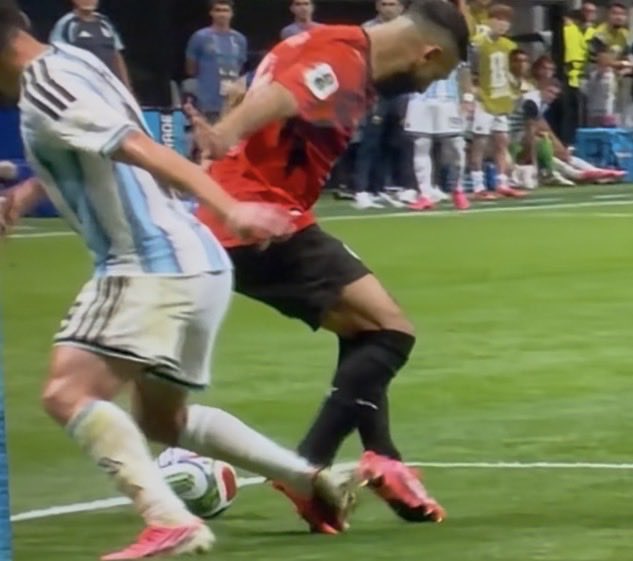
🇪🇬 Egypt: Penalty awarded, opponent's goal disallowed, offside goal allowed, and penalty not awarded to the opponent
🇨🇭 Switzerland: Opponent sent off
Argentina keep getting favorable call after favorable call. 🇦🇷🤑
🚨🤯 NEW: The Mexican Government and Liga MX will create 2,000 NEW ACADEMIES across the country, with the goal of finding new talents like Gilberto Mora.
They also plan to FURTHER EXPAND scouting efforts across the United States. 🇺🇸👏🏼
Via @el_pais
20 years ago today, our lives changed. 🏆
Italy became four-time World Cup champions. ⭐️⭐️⭐️⭐️
It’s crazy that this is STILL our last World Cup knockout win. 🥹
As painful as that is, never forget how rare it is to see your country lift a World Cup… and a EURO.
Most football fans never get to experience either. ❤️
BIG RANT HERE FOR @USMNT
As someone who watched his son go from the youth levels all the way to high school through all of the tournaments ODP, living in Europe and other Training platforms let me be clear about something:
Technical talent and IQ are not rewarded in the youth stages. I’ve watched big fast, technically deficient, and honestly super low IQ (borderline retarded) players make and get opportunities over other players who were technically, tactically, better. Often what gets rewarded is “activity”. People like seeing players just run in circles.
Our overall youth system is a disaster. We have tournaments with gigantic butt holes running them, charging an obscene amount just a park a damn car. They’ll charge you $80 to park a car but can’t find a decent center ref for a championship game.
We have U8 players and families traveling 2500 miles just to play in a tournament for three games.
The system is always going to fail because we encourage kickball and athleticism. Ask any college coach what they’re looking for. They are looking for big and fast. Division I games a lot of times look like high school games with balls being played to a big fast guy who just goes straight to goal.
How is the national team even made? It sure as hell isn’t made by open tryouts and finding the best players. It’s made by bull crap Academies that use friendships and connections to get players in. We cannot say that we are truly serious as a country with the system that’s in place now.
If we truly want our country to develop as a nation, we need to be clear about the goal. It’s not just the best athletes. It’s starting them young in a high-quality environment.
The biggest issue our country has, is that the best coaches don’t coach at the young levels. U10, U8, and below are typically coach by Dad who played baseball or football or something else.
Even if they played soccer, they’ve spent zero time developing themselves as coaches. Which is why by U12 most of the players look terrible.
Most of the coaches that want to get higher licenses and Coach the older groups missed the point. If players come to them with 1/3 of the development that they should have, what good does their higher level knowledge do?
🚨🇦🇷🇪🇬 Rio Ferdinand: “Football Needs Fairness, Not Different Rules For Different Teams”
🗣️ “I’ve sat here and watched football for many years, both as a player and as a pundit, and what frustrates supporters the most is inconsistency.
When Argentina go down under a challenge, the whistle seems to come immediately. The officials are quick to spot the foul, quick to stop play and quick to protect them. But when Egypt are on the receiving end of similar incidents, suddenly the game is allowed to continue and everyone is told to move on.
That’s the issue people have tonight. Not the result itself, but the lack of consistency in the decision-making.
Then you look at the build-up to Enzo Fernández’s winning goal. Egypt were screaming for a foul, their players were surrounding the referee, and millions watching expected VAR to at least take a proper look at it. Instead, it felt like everyone in the VAR room had gone to sleep.
What exactly is VAR there for if not to review the biggest moments in the biggest matches?
If that incident happened against Argentina at the other end of the pitch, do you honestly believe it wouldn’t have been checked? I find that very difficult to believe. We’ve seen much softer incidents reviewed throughout this tournament.
That’s where the frustration comes from. Fans just want the same standard applied to every team.
And let’s talk about the disciplinary side of the game. Argentina seem to get away with an awful lot. There are challenges that would normally bring yellow cards, yet the referee appears reluctant to reach for his pocket. It’s almost as if officials are afraid of making decisions that might upset Argentina.
When you look at some of Argentina’s matches in this tournament, there have been several moments where opponents felt hard done by. One incident can be debated, two incidents can be debated, but eventually people start noticing a pattern.
Football cannot afford that perception. The integrity of the game depends on supporters believing that every nation is treated equally.
Whether you’re Argentina, Egypt, Brazil, France or anyone else, the laws of the game should not change depending on the badge on your shirt.
The officials tonight had a responsibility to be fair, balanced and brave. Instead, they have left millions of people questioning why some decisions are given so easily for one side while similar incidents involving the other side are ignored.
Football deserves better than that. The players deserve better than that. And the fans certainly deserve better than that.”
#ARGEGY
The U.S. soccer federation is a poor return on invested capital.
I played soccer for 20+ years.
Grassroots.
Academy.
D1 college.
Pursued professionally after.
And I’ll say the quiet part out loud:
The US soccer infrastructure is broken.
In America, we treat playing D1 soccer like it is the peak achievement.
For most families, clubs, coaches, and players, the entire youth soccer machine is built around one goal:
Get recruited.
Get a scholarship.
Play college soccer.
But if the objective is to produce world-class players, D1 soccer is a terrible development path.
From 18-22, some of the most important technical development years of your career, you are preparing for a 3-4 month season built largely around athleticism, direct play, set pieces, fitness, and survival.
Now compare that to an 18-year-old in Spain, Argentina, Morocco, Italy, England, or France.
That player has likely been in a professional environment for years.
Training daily.
Playing meaningful matches year-round.
Competing against grown professionals.
Getting thousands more touches.
Learning how to solve the game under pressure.
The gap is massive.
And it shows.
American players are usually athletic.
They are usually fit.
They usually compete hard.
But at the highest levels, that is not enough.
The biggest difference is technical comfort.
We do not move the ball like Spain.
We do not combine like Argentina.
We do not play with the same fluidity, rhythm, and confidence you see from countries where the game is embedded into the culture from childhood.
That comes down to volume.
Volume of touches.
Volume of street soccer.
Volume of futsal.
Volume of unstructured play.
Volume of high-level training environments.
Volume of meaningful games.
In the US, youth soccer is expensive, overly organized, overly coached, tournament-driven, and too often built around winning games at 13 instead of developing players for 23.
Parents spend thousands.
Clubs charge thousands.
Travel teams fly all over the country.
Showcases become the product.
Recruiting becomes the scoreboard.
But the return on invested capital is poor.
We probably spend more money on youth soccer than almost any country in the world, yet the technical output does not match the investment.
That is a broken operating model.
And like any business, if the output is weak, you do not blame the customer.
You inspect the system.
The US has talent.
The US has athletes.
The US has money.
The US has facilities.
But the foundation is wrong.
We built a pay-to-play, college-recruiting machine and confused it for a world-class player development system.
Those are not the same thing.
Until we fix the grassroots layer, increase meaningful touches, make development less dependent on family income, and stop treating college soccer as the top of the mountain, the US will keep underperforming relative to its resources.
I’m not saying this to trash US Soccer.
I’m saying it because I lived it.
And if we actually want to become a powerhouse, we have to be honest about the infrastructure first.
As a soccer dad with a son in the youth program of a MLS team, I see it firsthand: US Soccer is run like a pure revenue business with talent development as an afterthought.
Without fixing the infrastructure and incentives, we’ll never build a system that can compete for a World Cup.
In Germany, a talented 14-year-old earns his club money. In America, his parents pay the club $15,000 a year.
That single inversion explains why "we will not" is the most accurate line ever written about US soccer.
FIFA built a global system for this. Training compensation and solidarity payments send a cut of every transfer fee back to the clubs that developed the player, from age 12 onward. Develop one future pro and your academy gets paid for a decade. Barcelona's La Masia, Ajax, every Bundesliga academy runs on this logic. The kid is the asset.
US Soccer refuses to enforce those rules. When Seattle's Crossfire Premier claimed its $60,000 share of DeAndre Yedlin's transfer to Tottenham, it got nothing. Claims on the Dempsey and Bradley transfers died partly because the federation couldn't even produce the youth training records.
So American clubs earn zero dollars when a kid turns pro. They earn when a kid enrolls. Which makes the parent the customer, and the product is whatever keeps the parent writing checks: travel tournaments, hotel weekends, $500 showcase events, private training at $100 an hour. Elite pathways run $8,000 to $20,000 a year. A comparable academy spot in Italy costs about 120 euros.
Follow the incentive one level deeper and it gets darker. A club dependent on fees can't cut its weakest paying players, so rosters optimize for retention over development. The scouting pool shrinks to families who can afford the cliff, which appears around age 11, exactly when development matters most. The country runs a talent filter sorted by household income instead of ability.
Every four years someone proposes fixing this. The proposal always requires the people profiting from the $15,000 model to vote themselves out of business.
They will not.
I rooted hard for USMNT yesterday and proud of how they represented the country. Belgium was clearly a more skilled and a better team.
I loved soccer growing up. I played until I was 15. And I was really good. I think it’s by far the best sport for young kids to grow up playing in terms of developing athleticism.
But when I hit highschool, basketball and football were the ways to college and beyond. Basketball and soccer seasons clashed. So I stopped playing.
Growing up there was not really any thought of college soccer, and there was no pro league that we knew of.
It wasn’t a thing.
Our focus in America over last 50 yrs has been very much dominated by football and Basketball, even more than baseball.
That’s the difference. 99% of the best athletes, along with the highest altitude for skilled development walking our junior high in high school halls are going to play football and basketball.
And I don’t see how or if that will ever be reversed. The fandom and exposure in football, basketball and baseball as far as college and pro leagues go is just too big.
So there’s no need to ask why can’t we compete on the world stage in soccer.…
That’s why
10 Steps to fix US Soccer Going Foward:
1. No more MLS Partnership:
They have differing priorities and they should. They’re running a business and they’re promoting that business first and foremost. We can’t be indebted to an entity with self serving interests separate from the success of US National teams.
2. Pro/Rel for US Soccer:
We need to grow the game and get more players the opportunity for exposure and top level competition. Simple. Make the matches more meaningful. Grow the roots, develop talent, make soccer for the people not for the rich MLS owners.
3. Our League Operates as an Exporter:
US Soccer is not a powerhouse. Develop talent. Sell to Europe. Allow players to test their abilities against the best. Re-invest the funds. Repeat. Brazil and Argentina have perfected this. That’s the blueprint.
4. Soccer Needs to be Affordable:
Funds from exports needs to be reinvested into the youth system. We depend on MLS for all youth development. We miss out on tons of talented young players because of their absurd and dated rules.
5. We NEED a Plan at GK Going Forward:
Gaga and Kochen need senior minutes to see what they have. We desperately need somebody to take up the mantle. In the meantime we need to consider what characteristics we value in a GK and how we want to play. Can’t build out of the back with guys like Freese and Turner that are shot stoppers but aren’t great with their feet.
6. We NEED to Recruit:
We simply don’t have the talent to rely on guys that grow up and develop through MLS. Guys like Banks or Chase could have flipped this World Cup. Suzuki could have been the answer in net. Can’t close that door. Poch whiffed on that.
7. Create an Identity:
HOW do we want to play? What type of players do we need to develop to fit our general style? Yes, you scheme to the players you have but you can also develop played to fit a core identity.
8. Change the Culture:
We’re never going to make soccer the most popular sport in the United States. What we can do is format our culture to better reflect sports fans in the US and make it unique instead of trying to copy everything Europe does. The idea of incorporating things done by college football teams is a good place to start. Recognizable traditions that will feel familiar and get fans involved. It needs to feel fun and not exclusive.
9. We can’t play timid or passive anymore. We moved away from big physical athletes grinding out games in favor of skilled players. That’s fine. They can’t lose what makes us unique though. We’re not going to out-skill Brazil, Argentina, Spain, France etc. anytime soon. We need to be the tone setters. Guys like Dest can’t play in the knockouts. We saw that today. We need a mix of both. McKennie, Adams, Richards, Tillman, and Reyna all play with an edge and with skill but don’t shy away from contact or the moment. That’s the blueprint.
10. We Need a World Class Talent or A LOT OF DEPTH:
We better hope that Cavan, Albert, Gozo, Spivey, or Mehmeti can develop into something special. If not we need them all to hit to some degree. We saw with Haaland what an absolute game breaker it can be to have even a single World Class player in your team can be. Short of that you need incredible depth. Much of this tournement the starters were fine but the bench was sub-par. Can’t have that without a distinct identity or a world class roster. Ideally you have 2 of those 3.
There’s many more valid ideas on how to fix this but these are the 10 that come to mind as I sit here miserable after having watched that utterly disappointing effort.
One big US soccer thought: our youth development has to get more affordable. One of my kids plays travel. It’s at least $5k a year & this isn’t even super high end. We can afford it, thankfully, lots can’t. Youth sports costs in the US are out of control, soccer more than most.
Brazil football needs a reset. They don’t have teenage sensations anymore. No hungry players who want to take their families out of poverty. As soon as Brazilians sign professional contract they go get new teeth, hairline and tattoos. Brazilians used to be driven by hunger.
For folks who are new to this - the U.S. is light years behind other countries in soccer. The infrastructure of the academy system, technical & tactical training are not on the same level. The pay-for-play model is also destroying youth development in this country. A goalkeeper with proper technical training doesn’t make that mistake. This #USMNT was more talented than past teams, but there’s still a big gap between us and the top in the world.