New paper w/ @MAliAouad, @Alpsungu, Niyazi Taneri.
We test AI advisory with 1,935 smallholder farmers in India and the Philippines.
Results highlight the promise and limits of on-demand AI advice:
https://t.co/tIbYgO6hiF
🚨 New research: AgriLLM for smallholder farmers.
We ran a field experiment to evaluate the impact of AI agricultural advice in the Philippines and India.
Preprint: https://t.co/jgKFyy2bE4
With wonderful @MAliAouad, Niyazi Taneri and @CanberkUcel
🧵
Half a billion smallholders produce a third of the world's food, yet they often lack timely agricultural information, a well-known and pressing challenge. The Gates Foundation and Google have already committed $100M to bring AI to smallholders.
We built AgriLLM, an AI agronomist chatbot, over years of iteration and in partnership with leading agri-firms. We randomly gave half the farmers AgriLLM and the other half an otherwise identical control chatbot that doesn't discuss agriculture. We tracked usage over one growing season, then measured key outcomes with a detailed end-of-season survey.
SO, what did we find?
1. Farmers found the tool useful, trusted it, and recommended it. Usage was nowhere near TikTok-scrolling, but the average farmer still consumed about 1.5 pages' worth of information.
2. Access to AgriLLM changed how farmers farmed. The clearest gains were in crop protection, where in-season information matters a lot and is relatively easy to act on. We also found notable improvements in broader farming practices.
3. We found encouraging but limited evidence of more sustainable farming. Self-reported crop-residue burning fell significantly, though it was the only one of seven sustainability measures that moved.
4. Finally, we saw no change in yields or costs within a single season. This doesn't mean AI can't improve farmers' productivity or support sustainable farming, but it suggests information alone may not be enough. Where improvements depend on complementary resources like finance or machinery, we found no gains. For example, AgriLLM increased farmers' interest in Direct Seeded Rice (DSR), a sustainable rice-farming method, but that interest didn't translate into adoption, possibly because DSR requires machinery or other resources.
Huge thanks to @WhartonAIAI, @CambridgeJBS , @essec, MIT Generative AI Impact Consortium (MGAIC), MIT Sloan School of Management's ASEAN fund, Wharton Global Initiative, and Wharton Tanoto Initiative for generously supporting our research, as well as numerous colleagues, the research team in the field, and practitioner partners!
🧵NEW RESEARCH:
Mega corporations overlook small businesses—they don't get the same treatment as large buyers. Without support, falling behind the AI/digitization race amplifies the survival risk. This sparked our work with Hindustan Unilever (w @CanberkUcel).
What happens when you digitize SMEs? https://t.co/RvkeMxiMRM
2025 bütçesine göre, Türkiye’nin personel gideri tam 4 trilyon liradır.
Bunu 80 milyon nüfusa bölerseniz, kişi başı yıllık 50.000 TL, hane başı yaklaşık 200.000 TL personel gideri eder.
Ve bu gider yüce Türk milletinin vergileri ile karşılanmaktadır.
Karar yüce milletimizindir.
@YetkinReport Murat Bey yazılarınızı ilgiyle, düzenli olarak takip ediyorum, ancak ne olur şu ayrı yazılması gereken de’leri ki’leri ayrı yazın artık! :)
@DAcemogluMIT Tabii ki demokrasimiz iyileşsin, düzelsin, ancak Avrupa’nın gençlerimize ve askerimize ihtiyacı olmasının bahsettiğiniz verimlilik potansiyeline nasıl yol verebileceğini anlayamadım. Saygılarımla,
@DAcemogluMIT Hocam, Avrupalı yaşlıların lüks emekliliklerini finanse etmek için Türk beyin göçünü kabul etmesi ve Avrupalı liderlerin rakamların yanlarında olmadığı savaş maceralarına Mehmetçiği katmak istemeleri ülkemiz için gerçekten de “fırsat” mı?
This is pretty much what’s happening in Turkey except opposition-led local gvnts are bearing the costs (and eventually the failures) of operating the local supply chains, e.g. Kent Lokantaları
People need to stop overreacting about Kamala’s plan to reduce food inflation, as if it would lead to communism, mass starvation, and the end of America.
I worked in M&A in the food industry. Here’s a step-by-step summary of what would actually happen:
1. The government announces that grocery retailers aren’t allowed to raise prices.
2. Grocery stores, which operate on 1-2% net margins, can’t survive if their suppliers raise prices. So the government announces that food producers (Kraft Heinz, ConAgra, Tyson, Hormel, et. al.) also aren’t allowed to raise prices.
3. Not all grocery stores are created equal. Stores in lower-income areas make less money than those in higher-income areas, as the former disproportionately sell lower-margin prepackaged foods (“center of the store”) instead of higher-margin fresh products like meat (“perimeter of the store”). Because stores in lower-income areas aren’t able to cover overhead (remember, even if their wholesale costs are fixed, their labor, utilities, insurance, and other operating expenses aren’t fixed… yet), grocery chains start to shut them down. Food deserts in rural areas and in low-income urban areas alike become worse.
4. Meanwhile, margins for food producers are also quickly eroding. Their primary costs (ingredients, energy, and labor) aren’t fixed, and their shrinking gross profits leave less cash flow available to cover overhead, maintain facilities, and reinvest in additional production capacity.
5. Grocery chains, which have finite shelf space, start to repurpose their stores (those they didn’t have to shut down, I should say) to sell more non-price-controlled items—everything from nutrition supplements to kitchenware to apparel—and less price-controlled food products. Your local Kroger or Safeway starts to look and feel more like a Walmart.
6. Food producers stop making products with lower margins. Grocery chain start competing with each other to secure inventory. Since they can’t compete by offering stronger prices (remember, producers aren’t allowed to raise prices here, and, even if they could, grocery chains no longer have the gross profit to bear price increases), they compete on things like payment terms.
7. Small grocery chains start to shut down entirely, or get sold to larger chains like Kroger. In addition to not being able to cover fixed costs, a major reason for this is because they can no longer reliably secure delivery of products, due to producers prioritizing sales to larger customers, which are able to leverage their stronger balance sheets to offer superior payment terms.
8. Smaller food producers—which typically sell via distributors, rather than directly to grocery chains—start to go out of business. Because these producers have an additional step their value chains, and because they have lower volumes over which to spread their fixed costs, their cost structure is inherently disadvantaged compared to major food producers. When grocery stores aren’t able to raise prices, cutting product costs becomes all the more important, and deprioritizing purchases from smaller producers is an easy way to do so.
9. As supply chains break down, lines start to form outside grocery stores every morning. Cities assign police officers to patrol store parking lots, and food producers draft contingency plans to assign armed escorts to delivery trucks.
10. The federal government announces a program to issue block grants for states to purchase and operate shuttered grocery stores. The USDA also seizes closed-down production facilities.
11. The government announces that prices for all key food costs—corn, wheat, cattle, energy, etc.—are also now fixed, to stop “profiteers” from gouging the now-government-operated food industry.
12. Shockingly, the government struggles to operate one of the most complex industries on the planet. The entire food supply chain starts imploding.
13. Communism, mass starvation, and the end of America quickly ensue.
Hey wait a second
I wonder what we can teach about location strategy and working capital mgmt in the context of small firms that’s useful, and how a typical MBA curriculum might translate into useful content for SME and micro-enterprises
If you were designing an exec ed course for SME managers, inc. local retailers, convenience stores, restaurants/food vendors, what topics would you include?
Initial thoughts on important content: 1. Location strategy, 2. Inventory and assortment management, 3. Cost accounting and monitoring, working capital management, evaluating investment opportunities. 4.
Assessing and improving HR, marketing practices
Türkiye’deki yasadışı göçmenve mülteci krizinin çözümü olmasa bile etkili bir ilacı daha fazla yasal göç. Kardeş Azerbeycan’dan gelen ve ülkemizde veya dünyanın en iyi üniversitelerinde okumuş birinin bile ülkemizde çalışma izni alması oldukça zor
Üniversitelerden başlanabilir, ODTÜ’nün zaten benzer bir misyonu var Bilkent, Koç gibi üniversiteler yeni uluslararası pazarlara açılabilir, ancak yabancı öğrenciler için sonrasında ülkemizde çalışma imkanlarına ulaşım şu anda oldukça zor
Öncelik Türkçeye kolay entegre olabilecek Azerbeycan, Orta Asya Türk cumhuriyetleri, İran, Çin Uygur Türkleri ve Balkan’lardaki, Irak, Lübnan ve Suriye’deki Türk kökenlilere, müslüman veya baskıcı rejimlerde zorluk çeken kadın ve LGBT üyelerine ve iyi eğitimlilere verilebilir
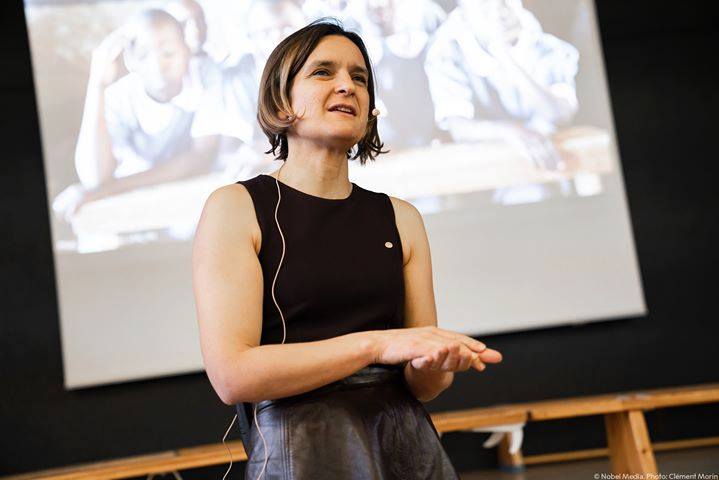
“I knew I wanted to change something in the world. It just took some time before I knew what that would be.”
Esther Duflo was awarded the 2019 prize in economic sciences for her work fighting poverty. She is the youngest person ever to be awarded the prize.
Many movies exist about a lone inventor in a garage having a eureka moment, but almost none about manufacturing, so it’s underappreciated by the public.
Compared to the insane pain of reaching high-volume, positive-margin production, prototypes are a piece of cake.
Researchers studied 177 bakeries in the city of Lyon, France, to learn how to find a strategic advantage when you can’t compete on cost. https://t.co/HScWqpQ1ul