sou director executivo numa multinacional, no privado, e hoje faço greve; explico porquê:
Durante o último governo AD, eu era lead de um departamento, e vi, um a um, o resto da equipa emigrar — não foram piegas — e fiquei apenas eu. Emigraram todos.
Hoje é a mesma coisa. +
In May 2015, a baby started crying in a lecture hall at Hebrew University in Jerusalem.
What happened next would be viewed over a million times.
This is the story of Professor Sydney Engelberg—and the simple gesture that reminded the world what compassion looks like.
The classroom was filled with graduate students studying organizational management. Professor Engelberg, a 67-year-old social psychologist with five grandchildren and decades of teaching experience, was mid-lecture when the sound cut through the room.
A baby's cry.
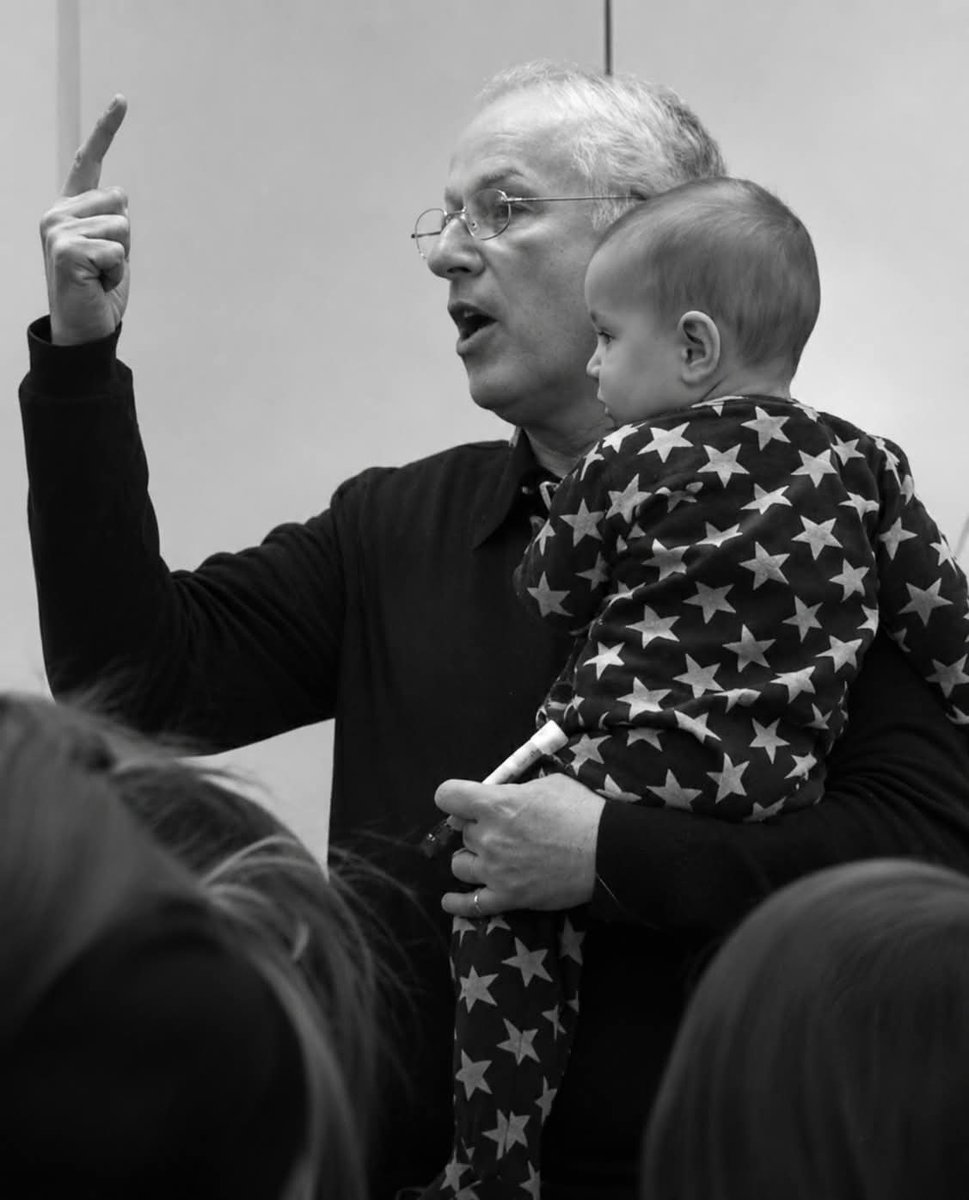
In the back row sat a young mother. Her infant, dressed in blue footie pajamas covered in stars, had begun to wail.
She did what most student-mothers around the world would do. She stood up, embarrassed, ready to leave so she wouldn't disrupt the class.
But before she could reach the door, Engelberg did something unexpected.
He stopped his lecture. He walked calmly to the back of the room. Without asking permission, without saying a word, he gently took the baby from her arms.
Then he returned to the front of the classroom and continued teaching.
The baby calmed almost immediately.
For the rest of the lecture, Engelberg held the infant against his chest, explaining organizational psychology concepts as if this were the most natural thing in the world.
To him, it was.
Someone in the classroom snapped a photo. His daughter, Sarit Fishbaine, who happened to be present, posted it to Facebook.
Within days, it had been shared thousands of times. An Imgur post crossed one million views. News outlets from CNN to the BBC picked up the story. Engelberg became an overnight sensation in Israel, Russia, France, Brazil, and beyond.
The grandfather of five was suddenly being called "Professor of the Year" and "the newest feminist hero."
His wife, Fredi, found it all rather amusing.
"He's gotten love letters," she told Yahoo Parenting. "He's pretty blasé about it, and we just find it all very funny. I think it must have happened on a no-news day."
But millions of parents around the world disagreed. This wasn't a slow news day story. This was something they rarely saw: a figure of authority choosing accommodation over inconvenience, compassion over rules.
What the viral moment revealed was that this wasn't an isolated gesture.
For years, Engelberg had encouraged his students to bring their children to class. Mothers nursed their babies during his lectures. Toddlers occasionally wandered the aisles. He never asked anyone to leave.
When asked about his approach, Engelberg's explanation was characteristically humble.
"My motivation was very simple," he told TODAY Parents. "On a basic level, I love babies and wanted to help out."
But then he added something deeper.
"On a more sophisticated level, one cannot teach leadership and organizational behavior merely as content—you have to teach the value base as well and that means not just talking about values, but acting on them."
For Engelberg, welcoming mothers and their children wasn't charity. It was pedagogy.
"The reason is that education for me is not simply conveying content, but teaching values," he explained.
What many international viewers didn't realize was that Engelberg's gesture, while touching, wasn't unusual in Israel.
After the photo went viral, the Israeli Student Union's Facebook page was flooded with similar stories. Students posted photos of other professors holding babies mid-lecture. One student shared a picture of Dr. Orit Gilor from Beit Berl College burping her daughter after she'd finished breastfeeding in class.
"Israel is a very familial society," explained Jonathan Kaplan, vice provost of the Rothberg International School at Hebrew University. "It is not at all strange for young mothers to bring children to classes. Babies are often brought to weddings or formal occasions, and during school holidays it is not uncommon to see children running through the halls of office buildings or university departments."
There's also a practical reason Israeli students are more likely to be parents: mandatory military service. While American teenagers head to college at eighteen, Israelis first serve three years in the army. By the time they reach graduate school, many have started families.
The challenge of finding childcare is compounded by Israel's calendar, packed with Jewish holidays that don't always align with university schedules or daycare closures.
In this context, professors who welcome children aren't heroes. They're realists.
But if the gesture was ordinary in Israel, why did it resonate so powerfully everywhere else?
Engelberg had a theory.
"I think the photo went viral in a world with so much inhumanity—ISIS, corruption, Ferguson, and so on—and people are looking for symbols of decency, humanity, caring, integrity."
The image offered something rare: visual proof that kindness still existed in positions of power. That rules could bend. That a crying baby didn't have to mean exclusion.
For mothers around the world—many of whom had been asked to leave restaurants, courtrooms, airplanes, and classrooms for nursing or for having fussy children—the photo was validation.
Someone, somewhere, had chosen differently.
Professor Engelberg's credentials extend far beyond one viral moment.
He has taught at Hebrew University for decades across three faculties. He's an associate professor at Gratz College in Philadelphia and a visiting professor at the University of Bologna and the University of Florence. His consulting clients have included the World Bank, UNICEF, IBM, Microsoft, and Intel.
He has published widely, run executive training workshops on five continents, and founded the Program in Community Psychology at the University of New South Wales in Australia.
None of that made him famous.
A baby in blue pajamas did.
The photo from that day in Jerusalem captured something words often fail to express.
It showed that the smallest gestures sometimes carry the largest meanings. That a classroom can be more than a place for information transfer. That leadership isn't just taught—it's demonstrated.
Engelberg didn't give a speech about supporting working mothers. He didn't write a policy memo. He simply walked to the back of the room, picked up a crying baby, and kept teaching.
"I don't have any childcare secrets," he said afterward. "I think it is simply a matter of experience and transmitting a sense of security and calm, which babies naturally respond to."
Perhaps that's the real lesson.
Not just for babies.
For all of us.
@inesmorsantos@desastrada812 "Vamos lá ver..." Há tanta variável nesta equação, colocar tudo no mesmo saco é muito redutor.
Enquanto vivíamos em pecado não havia problema... Depois de casar tive de aprender que o leite tem uma posição no frigorífico!!
É uma conversa para muitos tintos!
@JoaoFern86 Bela ideia, fazer uns stints pela capital para ganhar bom dinheiro de forma honesta. Juntar mais dois ou três bons mecânicos e a malta vai fazendo uns stints. Clientes não vão faltar.