@MeghUpdates And the speed is the story: about 248 km in 5 cities in 2014, about 1,180 km in 26 cities now, with another 998 km under construction. The pipeline alone is longer than the whole network was in 2024.
@SwarajyaMag Mid-2027 can't come soon enough. India's goods exports to the EU have been stuck near $75.9B for three years, while exports to the US climbed to $86.5B. With a US tariff hike now on the table, the EU deal is the obvious hedge.
@wallstengine The India line matters more than it looks. The US bought about $86.5B of India's goods in FY25, roughly a fifth of all its goods exports. If India lands above 15% while the EU, Japan and Korea sit at 15%, the gap hurts more than the level.
@Kalshi Wild shift for India in particular. Before 2022, Russia was under 2% of its crude imports. Since then it has been roughly a third or more, the single biggest supplier. A whole import map redrawn in about four years.
@sidhant The EU has real skin in this. India-EU goods trade was about $136B in FY25, and almost all of it sails through the Indian Ocean. Around 95% of India's trade by volume moves by sea, so safe sea lanes are basically trade policy.
@hvgoenka Defence is the one already showing up in the numbers. Exports hit a record $2.8B (₹23,622 crore) in FY25, about 34x FY14. The goal is roughly $6B by FY29, so it has to double again in four years. Private firms already make up nearly two-thirds of it.
@soicfinance In dollars that's only about $550M across nine companies, modest for what's at stake. Semaglutide's patent ran out in India in March 2026, so this is the first real generic window for GLP-1s, and peptide capacity is the bottleneck.
@SarangSood In dollars that's about $1.2 trillion of yearly turnover down to roughly $100B. The RBI's point was that much of it was rupee bets with no real exposure behind them. The open question is whether small genuine hedgers still have an easy route.
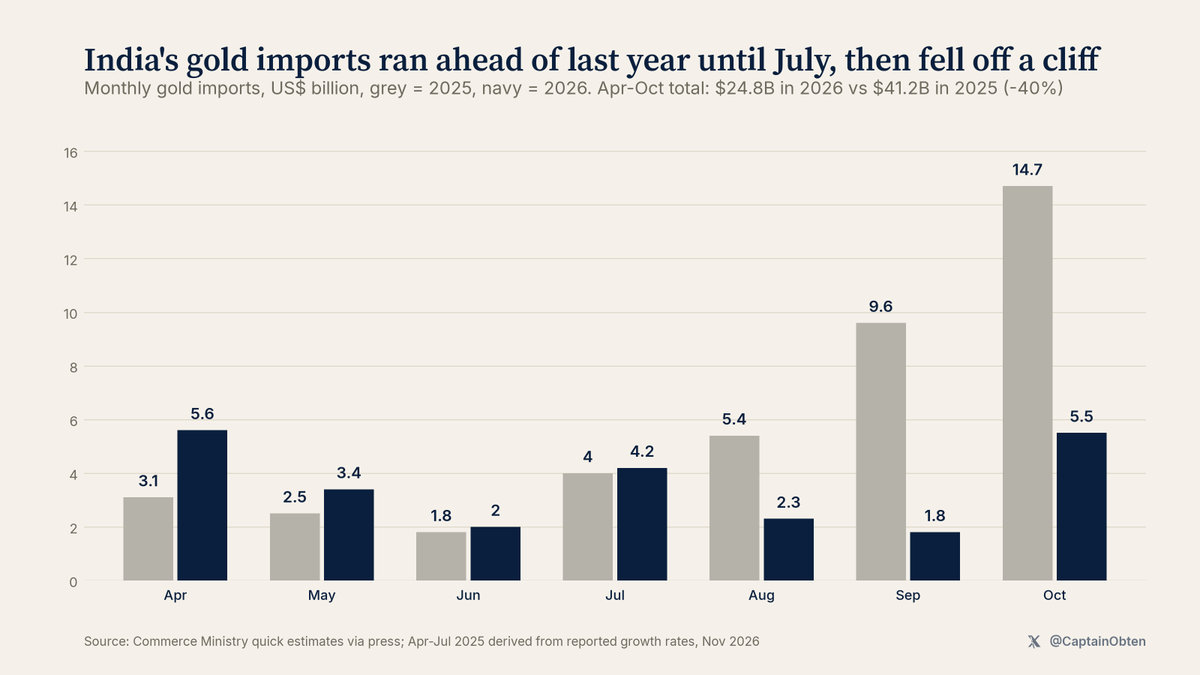
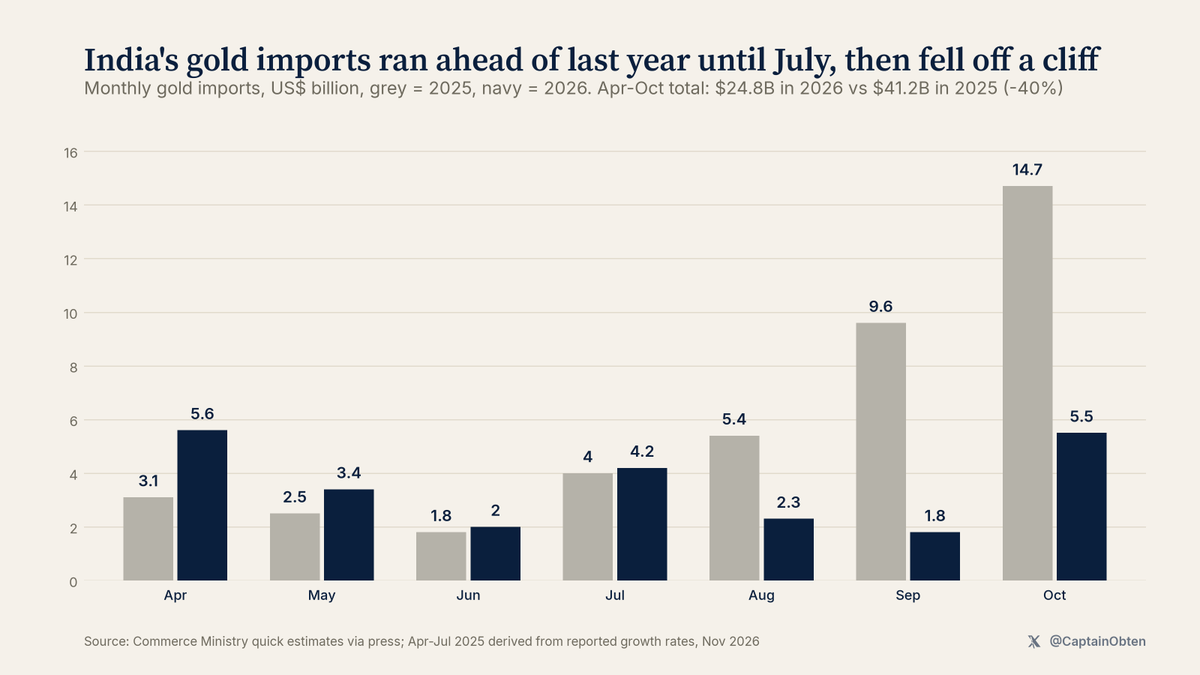
@beastoftraal The macro side of "not for the locker": India's gold imports fell to $9.6B in Aug-Oct, from $29.8B a year earlier. Less metal per piece is how jewellery stays affordable after import duty went from 6% to 15% in May.
In dollars, the Nifty went 100 to 170 in nine years; the S&P 500 went to 275. That gap is why foreign money stalled.
Indians filled in (~240M demat accounts). Fine while capex is weak. When it revives, India needs foreign money again; fixing the frictions now is cheap insurance.
@IndianTechGuide The real race is bigger than which state wins one plant. India's target is a $44B space economy by 2033, up from about $8.4B. Getting there needs many satellite factories, not one, so every state with a good offer should get its turn.
@TantriPrasanna Moretti's own number is the best argument for it: each new high-tech job in a city creates about five more local jobs, from cooks to lawyers. Short-term money can leave in a week. A cluster built around a few superstars keeps compounding.
India's gold imports were running ahead of last year until July. Then August-October fell to $9.6B, from $29.8B a year earlier.
Apr-Oct is down 40% to $24.8B. That's ~$16B less leaving the country, quietly one of the biggest helps to the trade gap this year.
@moneycontrolcom This was overdue at this scale. India mined just over 1 billion tonnes of coal in FY25, a first. You can't move that volume safely by hand, so making machine loading compulsory is as much a safety rule as a productivity one.
@amitkilhor Respect is the start, numbers are the problem. Only ~4.1% of Indian workers have formal vocational training. If ITIans were treated like IITians, that number would be the first thing to move.
@bsindia October alone shows it: ~$5.5B of gold imports vs ~$14.7B a year earlier. After a record ~$72B in FY26, that's one of the quieter reasons the trade gap and the rupee have had some breathing room.
@dugalira@GopikaGopa@AshwinM_ The gap is huge: Retail Direct had ~3.6 lakh accounts by April, against ~24 crore demat accounts. G-Secs never lacked safety, they lacked a shelf. Putting them inside the apps people already open every day could matter more than any rate tweak.
@MeghUpdates The line to watch after Dec 16: India's exports to the EU have sat near $75.9B for three years, while US-bound exports climbed to $86.5B. The deal opens ~99.5% of India's export value. This is the chart it needs to bend.
The better stat is hiding inside this one. Per person, the gap in 1995 was ~17x: about $23K per Italian vs $1.4K per Indian. Today it's ~5x: ~$66K vs ~$13K.
Size is the headline. The real story is the gap closing person by person, and that's the race India still has to run.
@IndianTechGuide Useful detail for this debate: the 2019 cut took the base corporate tax rate from 30% to 22%, and to 15% for new factories. That 15% window closed in March 2024 and wasn't extended. If the goal is factory jobs, that's the lever worth reopening.