@vasilyaarkhipov@CaptDKS Great design and capability. Missile silos and onboard inventory becomes a major consideration. At least series production of 6 should be planned.
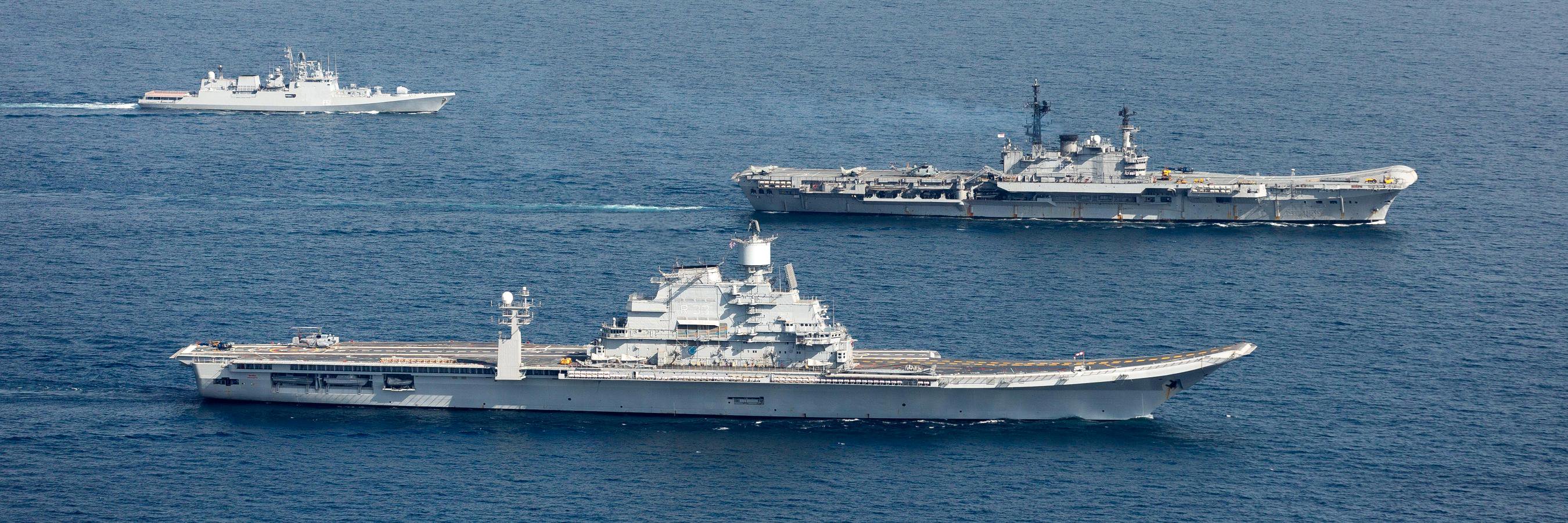
Future Destroyers of the Indian Navy: P-18 NGD (next generation destroyer) 🇮🇳🤯
Current status:
-Under design by Indian Navy’s WDB (warship desg. bureau)
-Expected to be significantly larger (~14,000 tons displacement), entering cruiser category.
-Will replace the aging Rajput-class destroyers.
Armament and Capabilities:
-Planned to have 144 VLS cells.
-Will deploy extended-range BrahMos missiles, hypersonic BrahMos-II, and BMD missiles (A1, A2).
-Equipped with advanced ADs capable of intercepting ballistic missiles up to 150km.
Timeline and Funding:
-No official timeline or funding released yet.
-Estd. cost per ship likely over $1.2 billion
P-18 NG-destroyers will mark a quantum leap in size, firepower (144 VLS), and capabilities including BMD and hypersonic missile deployment. P-18 faces funding and timeline uncertainties but is critical for future naval strength.
The ‘primer’ on Bay of Bengal that appeared on #DefTalks@dtbyaadi where @CaptDKS discussed the importance of BoB with @AadiAchint got over a lakh views a few weeks back. They have now followed it up with another episode on A&N.
https://t.co/uwpoxpYHKD
True #AtmanirbharBharat requires owning the cryptographic architecture. The ongoing @India_iDEX cases should be leveraged for quick implementation. We needed this as of yesterday!
n/n
(Link to the podcast explaining the issues in layman terms is 👇🏻
https://t.co/SeMoE487Z0)
Recommendations:
1) Service HQ may expedite adoption of PQC. This can even be done at the Command level using delegated powers. QKD-PQC combination could be centrally steered.
2) Sensitive organisations (@PMOIndia, NSCS, @isro, agencies etc) migrate on priority.
3) DPSUs (@MazagonDockLtd@bharat_dynamics@HALHQBLR etc) be mandated to implement by @DefenceMinIndia.
4) Private sector behemoths in sensitive sectors (L&T, @BharatForgeLtd, @AdaniOnline etc) may examine the criticality. This could be not only for internal comm & comm with Govt but also with their sub-vendors.
5) All diplomats and embassies must adopt PQC earliest. @MEAIndia could initiate a pilot project at HQ to begin with.
6) Since the technology is expensive and may be beyond the reach of most startups. @India_iDEX may consider procurement & creation of a central pool which sensitive startups could be offered.
7) NSCS in conjunction with @MeitY_NICSI and others may examine time bound adoption by financial & health sectors as well as others where sensitive personal info is involved. #DPDP Act refers. 8/n
Most mil grade PQC have 4 components. (1) A Quantum Random Number Generator (QRNG) for seed generation, (2) The encryption algorithm which could be hardened AES / similar. (3) & (4) Standard #NIST approved key exchange & authentication mechanisms. 7/n
This is where algorithms become critical. Global agencies (like #NIST - National Institute of Standards & Technology) are standardizing PQC protocols & mathematical frameworks like ML-KEM (general encryption) and ML-DSA (digital signatures). Without going into details, instead of factoring large numbers (which quantum algorithms break easily), these rely on "lattice-based cryptography", a geometric problem of finding points in massive, multi-dimensional grids. 6/n
2️⃣ PQC (Post-Quantum Cryptography): Software-based encryption using complex mathematics that traditional & quantum computers cannot solve. Crucially, PQC runs on existing radios and networks. For military systems a combination of QKD + PQC is needed. For others, PQC is good. 5/n
How do we protect it? There are two primary ways:
1️⃣ QKD (Quantum Key Distribution): Uses the laws of physics (sending photons through fiber/satellite) to share encryption keys. If intercepted, the quantum state collapses, revealing the eavesdropper. Secure, but expensive (specialized hardware). 4/n
Harvest Now, Decrypt Later (#HNDL) is already happening. Adversaries are *already* intercepting & storing encrypted data today. No, not just military data.
They just can’t read it yet. They are simply waiting for quantum tech to mature to decrypt it retroactively. 3/n
Modern military ops rely on a massive web of sensors, shooters, satellites, and data links. If your encryption or communication infrastructure is vulnerable, your operational stealth is an illusion…
Thankfully the Services are fast realising the importance. Woefully everyone else does not. 2/n
Warfare in the Info Age isn’t just about platforms. Even securing the seas now needs securing the ether.
Quantum computers will break classical encryption soon. Y2Q (Years to Quantum).
I did a podcast on #DefTalks@dtbyaadi with @AadiAchint (link in last post).
Covering key points and *RECOMMENDATIONS* in this 🧵. 1/n