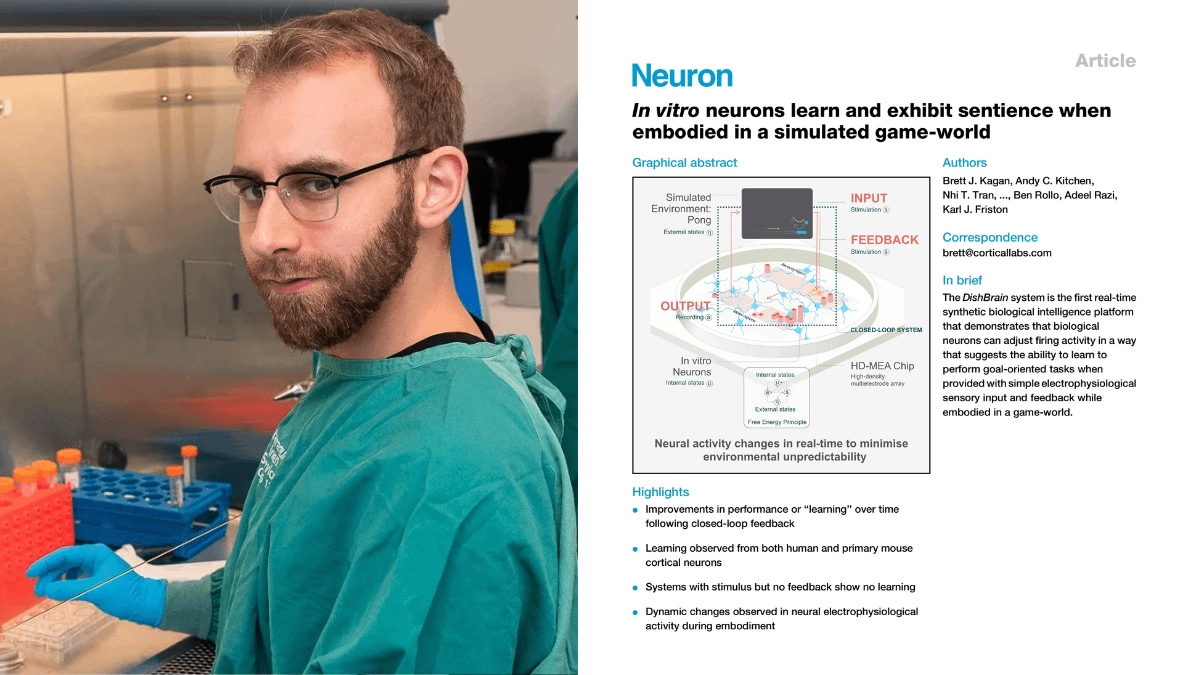
An Australian scientist took 800,000 human brain cells, kept them alive in a dish, wired them to a computer, and taught the cells to play the video game Pong in five minutes, which is faster than any AI on Earth had ever learned the same game.
His name is Brett Kagan.
He runs the science team at a Melbourne company called Cortical Labs, and the paper that broke the story was published in the journal Neuron in October 2022. The title sounds like a science fiction novel. In vitro neurons learn and exhibit sentience when embodied in a simulated game-world.
The setup was simple, and that is what made it so strange.
Kagan and his team took some brain cells from mouse embryos. They took some human brain cells grown from stem cells. They placed them on a chip covered in tiny electrodes, the size of a small coin, and they hooked the chip up to a computer running Pong.
The electrodes could do two things. They could read what the cells were doing. They could also send small bursts of electricity back into the cells.
The team used those two channels to talk to the dish.
When the ball was on the left, they fired the electrodes on the left side of the dish. When the ball was on the right, they fired the electrodes on the right. The closer the ball got to the paddle, the faster they fired. The cells could move the paddle by sending their own signals back.
That was the whole game.
Then the team added one more rule, and this is the part that changed everything.
When the cells missed the ball, they got a random, chaotic burst of electricity for four seconds. Noise. Static. Pure unpredictability. When the cells hit the ball, they got a clean, steady, predictable signal.
That was the only feedback the dish ever received.
Within five minutes, the cells started getting better at the game.
The rallies got longer. The hits got more frequent. The dish was not winning, but it was clearly playing, and it was improving, and nobody had told it the rules.
It had figured them out by itself.
The reason this worked is the part that should stop you for a second.
Brains hate surprise. That is the thing they are built to avoid. Karl Friston, who is one of the most cited neuroscientists alive and a co-author on the paper, has spent his whole career proving this. The brain is not really a thinking machine. It is a prediction machine. It runs on a single quiet rule. Make the world less surprising.
The cells in the dish were doing the same thing.
The chaotic stimulus felt like surprise. The clean stimulus felt like calm. The only way to get more calm and less chaos was to stop missing the ball. So the cells learned to stop missing the ball, not because anyone trained them, and not because they wanted a reward, but because the only way to quiet the noise was to play the game well.
They were not learning Pong. They were learning to make their own world more predictable, and Pong just happened to be the world they were stuck inside.
The same thing your brain is doing right now.
Every choice you make today, every word you reach for, every plan you build for tomorrow, is your brain trying to make the next moment less surprising than the last one. The feeling you call thinking is mostly your head doing the same thing those cells did. Trying to quiet the static.
The dish learned Pong faster than any AI had at the time, using around 800,000 cells and almost no power, while the AI systems running the same game needed thousands of times more energy and far longer training runs.
Kagan said it plainly in his interviews after the paper came out.
He said the cells were not trying to win. They were trying to feel less lost. And the moment he said that, half the room realized he was no longer just describing the dish.
He was describing them.
Kevin Hart shares the lesson that changed his life
“I got a 585 on my SAT, they give you 400 for putting your name on the paper. I guessed A,B,A,C,A,D,A... I did ABACADABA all the way down”
“I didn’t care because there was a class trip that same day, I wanted to go. I was told that not taking my SAT seriously would prohibit me from furthering myself in life”
“When I saw all my friends get their test scores back and they were ecstatic, everybody’s going to college, I felt like the biggest idiot in the world”
“The same people I wanted to rush to go to Great Adventure with, they had taken their SAT the week before. I was the only one who didn’t prioritize so I’m the only one going to community college… I just got left behind”
“Lesson learned, any opportunity given should be taken serious from this point on because if not you can find yourself feeling just like this”
“I learned from it… now if I gotta take a test you best believe I’m studying for that”
Learning Claude Now is the perfect time to buy Bitcoin in 2017.
Most people will understand… but it will be too late.
Starting your own personal business and earning $10,000 a month is closer than you think.
Here are 7 powerful prompts that will put you ahead of 99% of people by 2026:
Bob Costas: “What is your favorite American expression?” to Ichiro Suzuki
Ichiro:"Kansas City in August is hotter than two rats fucking in a wool sock."
Protect Ichiro at all costs
I used to view Donald Trump simply as a solid, effective president... someone who delivered results on the economy, borders, and foreign policy without all the usual political polish.
But over time, I've come to see something much bigger: the entire American political system has been rotten and corrupt for decades. It's not just isolated scandals or bad actors; it's a deeply entrenched network of career politicians, unelected bureaucrats, lobbyists, intelligence agencies, and media gatekeepers who operate as a self-protecting "uniparty" or "swamp."
They prioritize their own power, insider deals, endless wars, and special interests over the actual needs of everyday Americans. Elections often feel like theater, with the same outcomes no matter who wins—more debt, more control, more erosion of freedoms.
What sets Trump apart is that he's the only major figure in modern politics who's truly taken on that machine head-on and actually shaken it. Previous leaders talked tough about reform but ultimately played along with the system, got rich from it, or were too tied into it to challenge it meaningfully.
Donald Trump, as a DC outsider who didn't need their approval or their money, has exposed the corruption, fought back against weaponized institutions, and forced the hidden power structures into the open... even when it meant relentless attacks, impeachments, indictments, and lawfare aimed directly at him and his children.
He's far from perfect, and the battle is far from over, but for the first time in my lifetime, someone has genuinely threatened the status quo and refused to back down. That's why the pushback against him has been so ferocious: he represents the real possibility of dismantling the corrupt system rather than just managing it.
To me, supporting him now isn't just about one good presidency... it's about finally having a fighter who's willing to take on the whole rigged game for the sake of the country, and God help us if he fails.
Hard money doesn’t lie—especially when you’re buying cattle.
At https://t.co/K9A3PMzYpy, we’re watching the old silver-to-cow ratio break wide open. Historically, 2 to 7 ounces of silver could buy a productive cow—from Viking raids to the American frontier.
Today?
Silver sits around $70.
A good bred cow runs $5,000.
That’s 70+ ounces for one animal—10× the historical norm.
If silver were to realign with history, it’d need to hit $700–$800 an ounce just to buy what one cow buys now.
We don’t price our beef in fiat.
We accept silver, gold, and Bitcoin because we trust what’s real— Hard assets. Living value.
Today, 1 oz of gold gets you a Whole Beef.
70 oz of silver does the same.
No bank required. Just a handshake and a freezer.
Chicago resident reporting “Don’t let the media fool you. This was the size of the ICE protest”
Social media clips and the mainstream media frame these protests as massive, they show up close crowd shots and chaos
If you zoom out, the reality is much different
The Strauss-Howe generational theory describes a recurrent cycle of same-aged groups with specific behavior patterns that change every 20 years.
This is a visual representation of the concepts in 1997 book 'The Fourth Turning'.
[📹 Van Neistat]
VAN JONES is visibly upset after learning Charlie Kirk tried reaching out to his "mortal enemy" the day before he was murdered, posting, "We need to be gentlemen and sit down together & disagree agreeably."