I think Cardano needs to reform how we approach the Net Change Limit.
The remaining treasury actions make this increasingly clear to me.
Some proposals have real merit. The problem is not simply “good proposal vs bad proposal.” The problem is that we are trying to judge very different types of spending through one long NCL window and one undifferentiated budget pot.
There is still roughly a year left in the current NCL window, yet we are already under significant budget pressure.
That feels structurally wrong.
I think the next version of the NCL framework should be built around five ideas:
1. Shorter NCL windows
Move toward 3–6 month NCL windows with appropriately sized limits.
Quarterly or half-yearly windows would force DReps to reassess priorities more regularly as market conditions, treasury needs, proposal quality and ecosystem priorities change.
2. Bucketised budgets
Before setting or raising the NCL, DReps should debate and agree broad category budgets.
For example:
Infrastructure
Wallets & security
Developer tooling
Governance operations
Growth & adoption
Marketing
DeFi / investment
Reserves / contingency
This would stop every proposal competing blindly against every other proposal.
A wallet-security proposal should not be judged against the same implicit budget as a commercial adoption proposal.
A DeFi liquidity proposal should not be judged against the same implicit budget as core infrastructure maintenance.
Different categories need different standards.
3. Market-aware spending
In weak ADA markets, every ADA spent carries a higher long-term opportunity cost.
That does not mean “spend nothing.”
I have voted YES on critical infrastructure, wallet security, self-custody, developer tooling and public-good maintenance.
But discretionary growth bets should face a higher bar when ADA is weak.
4. Build a sovereign reserve in stronger markets
In future strong ADA markets, Cardano should consider converting a defined, governance-approved portion of Treasury ADA into stable reserves and potentially other approved reserve assets.
The aim would be simple:
Spend less ADA when ADA is weak.
Use reserves to fund essential operations, public goods and strategic opportunities during weaker market conditions.
Avoid being forced to spend the native asset at the worst point in the cycle.
5. VC-style allocation — but with rules
I am not against the Treasury eventually acting more like a sovereign reserve or ecosystem investment function.
That may become necessary.
But it should happen within a clear framework:
Defined budget buckets
Risk limits
Stablecoin policy
Asset allocation rules
Concentration limits
Conflict controls
Independent due diligence
Public reporting
Accountability for returns and losses
The Treasury can support growth, DeFi, BTC liquidity, commercial adoption and investment-style proposals.
But those categories should be debated and budgeted in advance.
They should not be forced to compete blindly against critical infrastructure and public-good maintenance.
My view is simple:
Reform the NCL framework before expanding the ceiling.
Shorter windows.
Agreed buckets.
Market-aware spending.
Sovereign reserve strategy.
Clear risk controls.
I welcome debate on this.
Should NCL windows be quarterly or half-yearly?
How should the budget be split?
Should Cardano build stable reserves in stronger markets?
Where should the line be between public-good funding and treasury investment?
This feels like one of the most important governance design questions Cardano needs to solve before the next NCL cycle.
My DRep ID:
drep1ytuufvd6maykgfcp20xgpx7g6a9z2suchqehfejwdsx8cgpx80yg
It's time.
The @Cardano PRIME proposal is now live on-chain for community vote.
A 12-month AlphaGrowth-run program to strengthen Cardano DeFi: protocol readiness, responsible incentives, durable on-chain growth.
This one belongs to the community. So let's talk about it - together.
@TheRealWeb3Kat Lol
This will fail the CC votes given the current NCL position.
It's dead on arrival.
Need an overhaul of how the NCL functions before something like this has a hope of getting through.
Cardano got it right from the start.
It was clear as day to those who took the time to understand what Cardano was all about.
The writing is still on the wall.
This is the winning horse.
I suggest understanding it now before the world catches up.
It's not like I've been literally working on this topic for over 10 years of my life and launched a cryptocurrency that was number three on coinmarketcap with millions of users to deploy it. It's literally a crime in the Ethereum inner circles to mention Cardano. EUTXO is the biggest innovation of the smart contract world and Ethereum cannot mention it as they literally try to copy it.
I voted NO on the @DanoFinance DeFi Kernel / Global Order Book proposal.
This is not a vote against Cardano DeFi.
It is not a vote against shared liquidity.
It is not a vote against composability, Dano Finance, or the idea of improving Cardano’s financial application layer.
The proposal is interesting.
Cardano DeFi would benefit from better:
contract discoverability
shared liquidity standards
reusable transaction tooling
protocol composability
financial primitives
But I do not believe this is the right treasury allocation at this time.
The proposal requests 3,333,000 ADA.
It funds:
a DeFi Kernel registry
a Spot Leverage Order Book
an American Options Protocol
a Composable DeFi Transaction Builder SDK
That is not simply maintenance of existing core infrastructure.
It is new DeFi expansion.
That may be valuable, but it belongs in a different budget category from wallet security, self-custody, core developer tooling and public-good infrastructure maintenance.
This is exactly why I think Cardano needs NCL reform.
Before approving more DeFi, liquidity or investment-style proposals, DReps should agree the category budget first.
How much of the NCL should be available for DeFi?
How much for infrastructure?
How much for wallets and security?
How much for growth, marketing, governance and reserves?
Right now, everything competes against one long, undifferentiated pot.
That is not good treasury design.
My broader view:
shorter NCL windows
category-level budget buckets
market-aware spending
sovereign reserves in stronger markets
clear rules for VC-style treasury allocation
I am not opposed to funding Cardano DeFi.
But I do not think we should keep approving higher-stack growth or investment-style asks before the framework exists.
A future version of this proposal could make sense inside a defined DeFi / liquidity / growth bucket, with clear public-good deliverables, open-source scope, adoption targets and risk controls.
As submitted, I do not believe this should be prioritised ahead of preserving remaining NCL capacity for the rest of the current window.
My vote: NO
My DRep ID:
drep1ytuufvd6maykgfcp20xgpx7g6a9z2suchqehfejwdsx8cgpx80yg
I think Cardano needs to reform how we approach the Net Change Limit.
The remaining treasury actions make this increasingly clear to me.
Some proposals have real merit. The problem is not simply “good proposal vs bad proposal.” The problem is that we are trying to judge very different types of spending through one long NCL window and one undifferentiated budget pot.
There is still roughly a year left in the current NCL window, yet we are already under significant budget pressure.
That feels structurally wrong.
I think the next version of the NCL framework should be built around five ideas:
1. Shorter NCL windows
Move toward 3–6 month NCL windows with appropriately sized limits.
Quarterly or half-yearly windows would force DReps to reassess priorities more regularly as market conditions, treasury needs, proposal quality and ecosystem priorities change.
2. Bucketised budgets
Before setting or raising the NCL, DReps should debate and agree broad category budgets.
For example:
Infrastructure
Wallets & security
Developer tooling
Governance operations
Growth & adoption
Marketing
DeFi / investment
Reserves / contingency
This would stop every proposal competing blindly against every other proposal.
A wallet-security proposal should not be judged against the same implicit budget as a commercial adoption proposal.
A DeFi liquidity proposal should not be judged against the same implicit budget as core infrastructure maintenance.
Different categories need different standards.
3. Market-aware spending
In weak ADA markets, every ADA spent carries a higher long-term opportunity cost.
That does not mean “spend nothing.”
I have voted YES on critical infrastructure, wallet security, self-custody, developer tooling and public-good maintenance.
But discretionary growth bets should face a higher bar when ADA is weak.
4. Build a sovereign reserve in stronger markets
In future strong ADA markets, Cardano should consider converting a defined, governance-approved portion of Treasury ADA into stable reserves and potentially other approved reserve assets.
The aim would be simple:
Spend less ADA when ADA is weak.
Use reserves to fund essential operations, public goods and strategic opportunities during weaker market conditions.
Avoid being forced to spend the native asset at the worst point in the cycle.
5. VC-style allocation — but with rules
I am not against the Treasury eventually acting more like a sovereign reserve or ecosystem investment function.
That may become necessary.
But it should happen within a clear framework:
Defined budget buckets
Risk limits
Stablecoin policy
Asset allocation rules
Concentration limits
Conflict controls
Independent due diligence
Public reporting
Accountability for returns and losses
The Treasury can support growth, DeFi, BTC liquidity, commercial adoption and investment-style proposals.
But those categories should be debated and budgeted in advance.
They should not be forced to compete blindly against critical infrastructure and public-good maintenance.
My view is simple:
Reform the NCL framework before expanding the ceiling.
Shorter windows.
Agreed buckets.
Market-aware spending.
Sovereign reserve strategy.
Clear risk controls.
I welcome debate on this.
Should NCL windows be quarterly or half-yearly?
How should the budget be split?
Should Cardano build stable reserves in stronger markets?
Where should the line be between public-good funding and treasury investment?
This feels like one of the most important governance design questions Cardano needs to solve before the next NCL cycle.
My DRep ID:
drep1ytuufvd6maykgfcp20xgpx7g6a9z2suchqehfejwdsx8cgpx80yg
I agree these may be slightly disengaged ADA holders and take some time to move. But even if 10% - 20% moved over the coming months that would success - that would be 90M ADA- 180M ADA.
The owners of these wallets, delegating to Yoroi orEmurgo, have at some point been on-chain to set up their wallets... So it isn't like they are passive users leveraging a CEX. The Emurgo delegation is less likely to be retail but still no reason why it wouldn't move or even set up it's own DRep...
I'm optimistic more ADA will migrate.
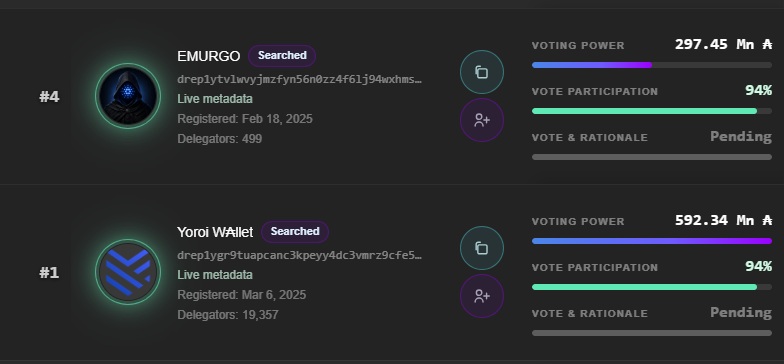
I wonder what this will mean for the @emurgo_io and @YoroiWallet DRep accounts. They have a combined nearly 890M ADA voting weight - 16.7% of the current 'Voting ADA'.
I would be glad to see this somewhat dispersed across DReps.
My DRep ID:
drep1ytuufvd6maykgfcp20fxgpx7g6a9z2suchqehfejwdsx8cgpx80yg
https://t.co/XHygwlVPa5
I am currently minded to vote NO on the Info Action to raise Cardano’s Net Change Limit by 150M ADA.
But the bigger point is not just this one vote.
I think we need to reform how the NCL is structured.
This is my current thinking, and I welcome debate before I vote.
DRep ID: drep1ytuufvd6maykgfcp20fxgpx7g6a9z2suchqehfejwdsx8cgpx80yg
Thread below🧵👇 1/18
I voted NO on the @wirexapp Real-World Payments proposal.
This is not a vote against real-world payments.
It is not a vote against card infrastructure.
It is not a vote against Cardano being used in everyday commerce.
I support all of those goals.
But I do not believe this proposal is clear enough or justified enough for a 3,961,538 ADA treasury withdrawal.
My main concern is simple:
What exactly is Cardano receiving in exchange for this funding?
The proposal uses broad language around:
payment infrastructure
banking rails
on-chain settlement
stablecoins
wallets
self-custody integration
card issuance
real-world payments at scale
Those are important themes.
But for an ask of this size, I need much more specificity.
I would want to see:
what exactly will be open-sourced
what infrastructure becomes a Cardano public good
what remains available to the wider ecosystem
what is exclusive or non-exclusive to Cardano
what adoption commitments exist
what success metrics will be reported
how the Treasury benefits
how this avoids simply subsidising a commercial rollout
In the current NCL environment, I am being selective.
My principle remains:
Fund the rails before the growth bets.
I am prioritising critical infrastructure, wallet security, self-custody, developer tooling, open-source public goods and protocol readiness.
Real-world payments matter.
But this proposal does not yet clear my bar for a nearly 4M ADA treasury withdrawal.
This also ties back to my broader NCL reform view.
I think Cardano needs:
shorter NCL windows
category-level budget buckets
clearer growth/adoption budgets
stronger public-good requirements
better treasury discipline before raising spending ceilings
If Cardano wants to fund growth and adoption, I am open to that.
But we should decide the budget category first, agree what success looks like, and require clear ecosystem return.
A revised Wirex proposal could be stronger if it clearly separates commercial rollout from public-good infrastructure, defines exactly what Cardano receives, specifies what is open-source, and sets measurable adoption targets.
As submitted, my vote is NO.
My DRep ID:
drep1ytuufvd6maykgfcp20fxgpx7g6a9z2suchqehfejwdsx8cgpx80yg
If you agree with a fiscally disciplined, infrastructure-first approach to Cardano treasury voting, please consider delegating to me.
Cardano got it right from the start.
It was clear as day to those who took the time to understand what Cardano was all about.
The writing is still on the wall.
This is the winning horse.
I suggest understanding it now before the world catches up.
I am currently minded to vote NO on the Info Action to raise Cardano’s Net Change Limit by 150M ADA.
But the bigger point is not just this one vote.
I think we need to reform how the NCL is structured.
This is my current thinking, and I welcome debate before I vote.
DRep ID: drep1ytuufvd6maykgfcp20fxgpx7g6a9z2suchqehfejwdsx8cgpx80yg
Thread below🧵👇 1/18
I voted NO on the Alchemy by @SundialProtocol x @CharmsDev proposal.
This is not a vote against Bitcoin.
It is not a vote against BTCfi.
It is not a vote against Sundial, Charms, or the idea that Cardano should compete for Bitcoin liquidity.
I understand the strategic thesis.
Bitcoin liquidity is enormous, and Cardano should absolutely think seriously about how to attract it.
But I do not believe this is the right use of the Cardano Treasury at this time.
The proposal requests 10,000,000 ADA for a Cardano-native Bitcoin treasury / BTCfi infrastructure layer.
It is ambitious.
It may be interesting.
But it is also novel, complex and materially higher risk than the infrastructure, wallet, security and developer-tooling proposals I have supported.
My concern is that this sits closer to a treasury-backed investment or structured financial product than essential public-good maintenance.
It involves:
launch liquidity
FIRE and ICE assets
Bitcoin-backed exposure
reserve mechanics
integrations
dashboards
legal/compliance work
go-to-market execution
That may become the kind of activity the Cardano Treasury supports in future.
But the framework should come first.
This ties directly to my recent NCL reform post:
https://t.co/ruzrq4lItz
Before approving large BTCfi or treasury-investment style proposals, I think Cardano needs clearer rules around:
shorter NCL windows
category-level budget buckets
sovereign reserves
stablecoin and non-ADA asset policy
risk limits
concentration limits
conflict controls
independent due diligence
public reporting
accountability for returns and losses
I am not against the Treasury eventually operating more like a sovereign reserve or VC-style ecosystem investment function.
In fact, I think that may be an important future direction.
But it should happen within an agreed framework, not through large ad hoc allocations while the NCL is already under pressure.
My principle remains:
Fund the rails before the growth bets.
In the current environment, I am prioritising critical infrastructure, wallet security, self-custody, open-source public goods, developer tooling and protocol readiness.
Alchemy may be strategically interesting.
But it does not clear my bar for a 10M ADA treasury withdrawal at this time.
My vote: NO
My DRep ID:
drep1ytuufvd6maykgfcp20fxgpx7g6a9z2suchqehfejwdsx8cgpx80yg
If you agree with a fiscally disciplined, infrastructure-first approach to Cardano treasury voting, please consider delegating to me.
I am currently minded to vote NO on the Info Action to raise Cardano’s Net Change Limit by 150M ADA.
But the bigger point is not just this one vote.
I think we need to reform how the NCL is structured.
This is my current thinking, and I welcome debate before I vote.
DRep ID: drep1ytuufvd6maykgfcp20fxgpx7g6a9z2suchqehfejwdsx8cgpx80yg
Thread below🧵👇 1/18
I have voted NO on the info action to raise the Net Change Limit by 150M ADA.
This is not a vote against treasury spending, ecosystem growth, DeFi, marketing, infrastructure, or ambition. I have supported multiple treasury withdrawals where I believe the case is strong, particularly for wallet security, self-custody, developer tooling, open-source infrastructure and essential public goods.
However, I do not believe the NCL should be increased at this time.
The Net Change Limit is a constitutional treasury guardrail. It is intended to cap treasury withdrawals over a defined period and force prioritisation. If the limit is raised whenever live demand exceeds available capacity, the NCL risks becoming a formality rather than a meaningful discipline mechanism.
My concern is also structural. The current NCL window is too long, and we are already under significant pressure early in the cycle. I believe Cardano should move toward shorter NCL windows, perhaps 3–6 months, with appropriately sized limits. Shorter windows would allow DReps to reassess priorities, market conditions, treasury needs and proposal quality more frequently.
Before increasing the NCL, I believe DReps should first debate and agree a better treasury framework, including category-level budget buckets for areas such as core infrastructure, wallets and security, developer tooling, governance operations, growth and adoption, marketing, DeFi or treasury investment, contingency and reserves.
I also believe Cardano should develop a more market-aware treasury strategy. In stronger ADA markets, the community should consider converting a defined, governance-approved portion of treasury ADA into stable reserves and possibly other approved non-ADA assets. Those reserves could help fund essential operations, public goods and strategic opportunities during weak ADA markets, reducing the need to spend ADA when its long-term opportunity cost is higher.
I am not opposed to the Treasury eventually acting as a more sophisticated sovereign reserve or VC-style ecosystem investment function. But that should happen within agreed buckets, risk limits, stablecoin policies, concentration limits, conflict controls, due diligence standards, public reporting and clear accountability for returns and losses.
I have set out my broader thinking on NCL reform here:
https://t.co/ruzrq4lItz
For these reasons, I believe the framework should come before the expanded ceiling. I support serious NCL reform, but I do not support increasing the current limit by 150M ADA now.
I vote NO.
I am currently minded to vote NO on the Info Action to raise Cardano’s Net Change Limit by 150M ADA.
But the bigger point is not just this one vote.
I think we need to reform how the NCL is structured.
This is my current thinking, and I welcome debate before I vote.
DRep ID: drep1ytuufvd6maykgfcp20fxgpx7g6a9z2suchqehfejwdsx8cgpx80yg
Thread below🧵👇 1/18