Dartmoor's hill ponies have grazed those commons for longer than there has been a country called England. Fewer than a thousand are left, down from six thousand a generation ago. The United Nations listed them as endangered in 2023. So, naturally, the body charged with protecting nature has decided to get rid of nine in ten of the survivors.
There is a process, obviously.
Natural England's new grazing contracts now count the ponies in the same bucket as the cattle and sheep. A commoner with a fixed quota has a choice: keep a semi-wild pony worth nothing at market, or use the slot for a lamb he can sell. Guess which one survives the spreadsheet. The rest are gathered in the autumn drifts, and with nowhere to put thousands of unhandled moorland ponies, the next stop is the abattoir.
Natural England would like it noted that it has not ordered a cull. It has merely built a machine whose only output is a cull, switched it on, and handed the bolt gun to a farmer so the fingerprints land elsewhere. Very tidy.
And now the funny part. The pony is the best tool on the entire moor for eating Molinia, the coarse purple grass strangling Dartmoor into a brown monoculture. Cattle and sheep won't touch it. The ponies hoover it down and clear the ground for the orchids, the wildflowers and the insects behind them. Remove the ponies and the moor chokes into precisely the lifeless scrubland the contract was meant to prevent.
So the conservation strategy, in full: protect the habitat by deleting the animal that maintains the habitat. A masterclass.
Better still, Natural England's own Fursdon review looked at this exact question and told them, in plain English, not to lump ponies in with cattle and not to cut pony numbers. They read it, praised it, said they fully supported it, then did the precise opposite.
Four thousand years these animals have run Dartmoor with no committee and no contract. They could be gone within one, and the people who did it will write it up as a win for nature.
We have stated, repeatedly, on the record, that Margot is a colleague. A visiting professional. A fellow surveyor of boundaries who shares Keith's exact line of work and nothing more. We wish to issue a correction.
We were under-reporting.
The evidence has become difficult to file under "colleagues," and in the interest of accuracy, here it is.
Keith comes off the barn roof for her in record time, and the record keeps falling. Four minutes on the first visit, which had only ever matched the insurance assessor. Then three forty. Then three twelve. Dave has been timing it, and has stopped pretending he is timing the lichen.
He opens the yard gate for her, deliberately, then stands back and waits, which he has done for no other living creature alive. He also closes it behind her, which is the part Dave cannot get over.
He let her find the flex in the corner post. Fourteen months Keith walked that boundary and missed a four-millimetre fault. Margot found it in forty-eight hours, and Keith stood beside her and let himself be out-surveyed without complaint, which, for the most ungovernable animal in Devon, is roughly a sonnet.
He also showed her the barn roof route a second time. She had climbed it in under a minute on the Tuesday. He showed her again anyway. No reason has been offered.
And when she leaves, he stands on the south bank looking down the empty lane for exactly four minutes, then goes back to the knotweed until the next trailer.
We have called this a working relationship. We have, frankly, been protecting their privacy and our own composure.
Keith needs no one, and proved it by opening the last gate only to walk back through. Of all the things a free creature could choose, he has chosen the goat who out-surveyed him. The cousin is bringing her back in May.
The colleagues were never only colleagues. We regret the error. We do not, on reflection, regret it very much.
The FBI had boxes full of serial killer confessions they couldn’t actually use.
Hours of interviews.
Detailed admissions.
Direct conversations with some of the most violent men in America.
And none of it was scientifically useful.
Then a 42-year-old psychiatric nurse walked into Quantico and changed criminal investigation forever.
Her name was Ann Burgess.
1975.
FBI agents Robert Ressler and John Douglas had spent months traveling across the country interviewing imprisoned serial killers. They believed understanding offenders could help solve future crimes.
But when Ann Burgess listened to the tapes, she immediately saw the problem.
“This isn’t research,” she told them.
“These are just stories.”
The room went silent.
“You’re asking them to talk about themselves,” she said. “But every interview is different. There’s no structure. No methodology. You can’t compare one offender to another.”
Then she asked a question nobody else in the room had thought to ask:
“Tell me about the women they killed.”
Not the killers.
The victims.
Who were they?
How old were they?
Where were they approached?
What made them vulnerable?
How did the offender gain control?
The agents were confused.
Ann Burgess explained something revolutionary:
“If you truly study the victims, you’ll understand the offender.”
At the time, Burgess was already a groundbreaking trauma researcher. In 1974, she had co-authored one of the first major studies proving rape caused lasting psychological trauma — at a time when courts barely acknowledged it.
She helped create the term “rape trauma syndrome.”
Now she brought that same scientific rigor to the FBI.
She redesigned the interviews.
Created structured questionnaires.
Introduced victimology as the foundation of profiling.
Distinguished between a killer’s “MO” and their “signature.”
Mapped escalation patterns.
Explained that sexual violence was about power and control — not desire.
Suddenly, the FBI’s Behavioral Science Unit had something it had never truly possessed before:
Methodology.
And it worked.
In 1983, young boys began disappearing in Nebraska.
Using Burgess’s framework, investigators built a profile:
A young white male.
Slight build.
Someone trusted around children.
Likely connected to scouting or youth activities.
A person who kept souvenirs and detective magazines.
Police arrested John Joubert.
The profile was astonishingly accurate.
Almost overnight, criminal profiling became legitimate law enforcement science.
And yet most of the credit went elsewhere.
The public celebrated the FBI agents.
Books were written.
Movies and television series followed.
Ann Burgess became a footnote.
When Netflix released Mindhunter, they based a character on her — but changed nearly everything.
They made her a psychologist instead of a nurse.
Changed her personal life entirely.
Most viewers never even realized she was based on a real person.
Meanwhile, the real Ann Burgess kept working.
Teaching.
Publishing.
Consulting.
Testifying in court.
Training professionals around the world.
More than 150 academic publications.
Multiple landmark books.
Decades of pioneering work.
And through all of it, one truth remained:
Modern criminal profiling exists in large part because a psychiatric nurse walked into a room full of FBI agents and told them they were asking the wrong questions.
Not:
“Why did the killer do this?”
But:
“Who were the victims?”
That shift changed criminal investigation forever.
Ann Burgess is 88 years old now.
Still teaching.
Still working.
Still brilliant.
And finally receiving recognition not as a side character in someone else’s story —
But as herself.
The woman who taught the FBI how to truly understand predators by first understanding the people they harmed.
With fervent hearts, let us pray today that the Spirit of the Risen One may save us from the evil of war, which is overcome not by a superpower, but by the omnipotence of love. Let us #PrayTogether that God may free humanity from misery, which is redeemed not by immeasurable wealth, but by an inexhaustible gift.
🔴Important Hantavirus update 🔴
The sequence of the virus is out
It's very similar to the Andes Virus (ANDV) that we know caused outbreaks through person to person transmission before
Bottom line : This is nothing new. It's a virus we know about and is behaving as expected.
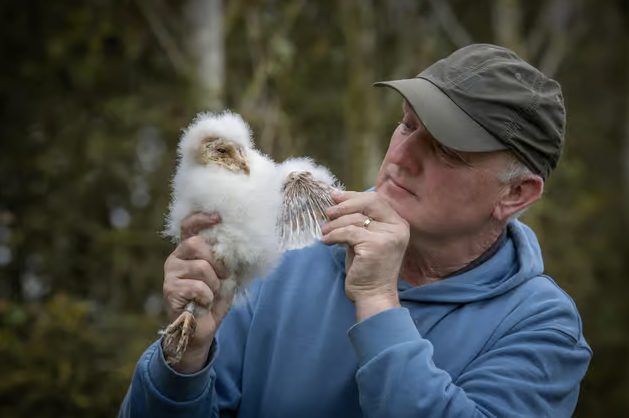
A bricklayer in East Yorkshire has spent 35 years installing nest boxes for barn owls in his free time.
No grant. No organization behind him. Just Robert Salter, quietly building and mounting over 350 boxes across fields and farms on weekends, before and after work, for three and a half decades.
This year was the second-best barn owl breeding season in the region in decades. 304 owlets counted. Last year there were 95.
Barn owls have struggled across the UK for generations due to habitat loss, rodenticide poisoning, starvation from agricultural changes that eliminated the field margins where voles live, and collisions with vehicles on roads that cut through their hunting territory.
In many parts of England, populations collapsed while nobody was paying much attention.
One man paying attention changed the outcome for an entire region.
"This bird has lived alongside humans since they settled in this country," Salter told the BBC. "Because of that close relationship, I just feel like we owe it to barn owls to help and maintain their future populations."
The conservation story we usually tell involves governments, legislation, and international agreements.
Those matter, but so does one person who decided a species deserved better and just kept showing up.
New weekly & current monthly pivots for equity indices & futures & weekend futures charts posted. Jack - https://t.co/nNiyDVvACT … #investing#trading
No serious nation in the history of warfare has spent fourteen months insulting its allies, siding with their common enemy, and then knocked on their door expecting them to rescue a catastrophe of its own making.
You abused the UK. Threatened Canada. Tried to grab Greenland. Called the EU an adversary. Praised Putin. Hosted Kremlin officials in the Capitol. Abandoned Ukraine. And did all of it loudly, proudly, and on camera.
And now you are surprised that nobody is returning your calls.
You want European boots on the ground? Start by explaining why America is more aligned with Moscow than with Brussels.
Take your time. We will wait.
Gandalv / @Microinteracti1
Even today there are tombs to be opened, and often the stones sealing them are so heavy and so closely guarded that they seem to be immovable. Some weigh heavily on the human heart, such as mistrust, fear, selfishness and resentment; others, stemming from these inner struggles, sever the bonds between us through war, injustice and the isolation of peoples and nations. Let us not allow ourselves to be paralyzed by them! #Easter