3 million registered users achieved this morning in the sunny lagoon of https://t.co/MtRCdjvV1s 🌅
• 3 million who wanted a ChatGPT that didn't spy on them
• 3 million who wished to avoid the intellectual degradation of paternalistic censorship
• 3 million sovereigns avoiding a future of serfdom
We don't store or log your prompts.
We don't package your personal life to be sold to advertisers.
We don't train on your conversations or share them with any criminal or government (redundant?) who asks for them.
• Text, image, video
• 230+ models
• Web, app, and API
Unrestricted intelligence for today's sovereign individual, whether human or agentic.
Try for free at https://t.co/MtRCdjvV1s
Remember when 4000 Google employees threw a fit around running a datacenter for the Pentagon in 2018 and got the project cancelled. How the world has changed
Just got off a zoom call catching up with a friend of mine from the Boy Scouts who is now a bank manager.
Told him that inflation has to be constant because loans create new money with interest and that interest has to be paid off somehow.
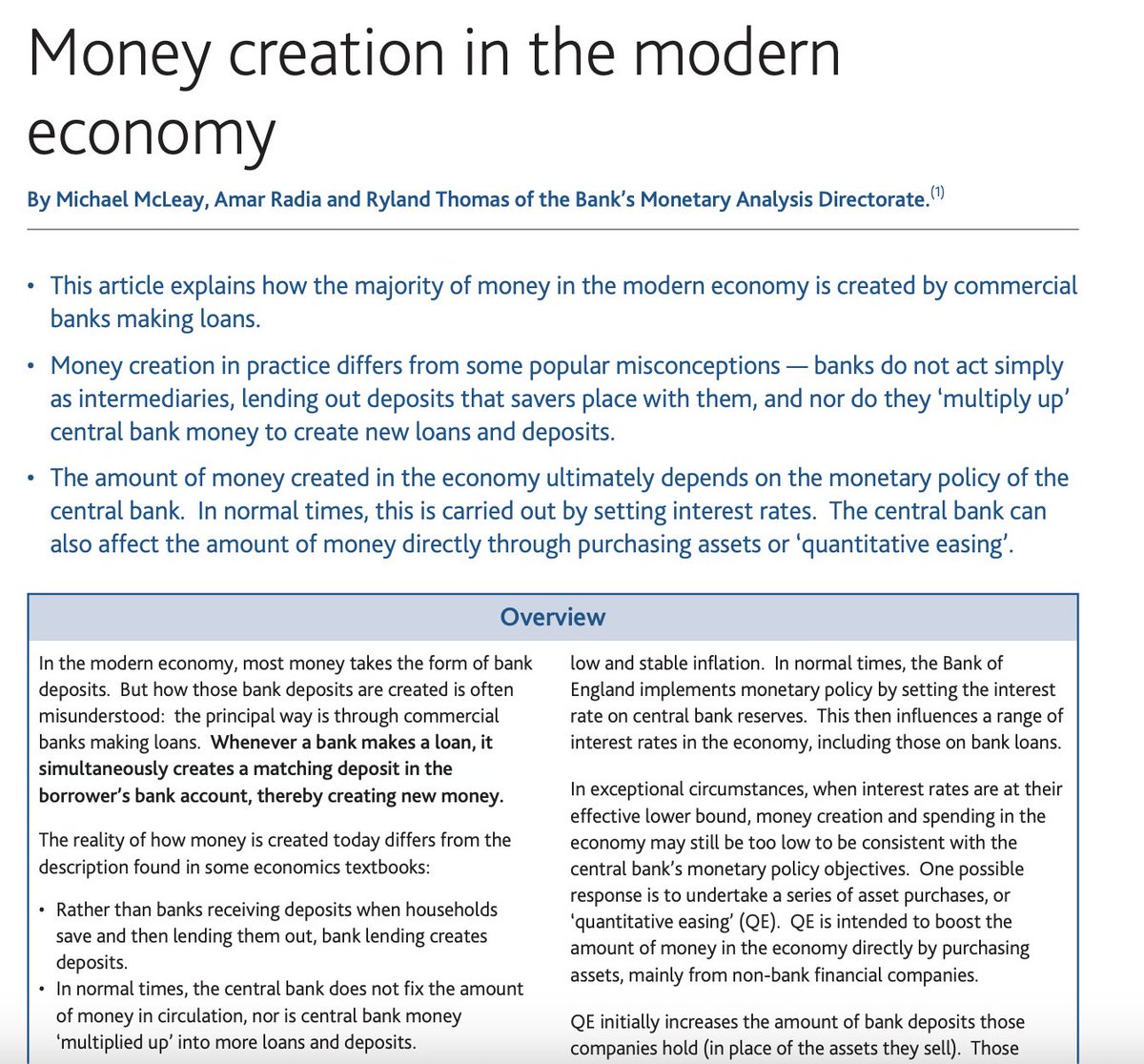
explained that even the bank of england has written papers describing exactly this process. they all admit this openly.
He was literally stunned and almost fell out of his chair.
"You mean money is lent into existence? every time a customer draws a line of credit they just print it? and the money supply is constantly increasing?!"
this is a guy who is a math major and works at a major bank.
even the people running the system don't know how it works.
A single bridge exploit just wiped $13 billion from DeFi in two days.
On Saturday, an attacker drained 116,500 rsETH (~$292 million) from Kelp DAO's cross-chain bridge, the largest DeFi exploit of 2026. They compromised two of LayerZero's verification servers and DDoS'd the backups, forcing failover onto poisoned nodes. The bridge released the tokens thinking it received a valid instruction. LayerZero is attributing the attack to North Korea's Lazarus Group.
Then it got worse. The attacker deposited the stolen rsETH into Aave V3 as collateral and borrowed $196 million in wrapped ether against it. Stolen, unbacked collateral, but Aave's smart contracts treated it as legitimate. Depositors fled. Aave's TVL cratered from $26.4 billion to $17.9 billion in 48 hours. AAVE fell 16%. Across the broader ecosystem, TVL dropped $13.2 billion as SparkLend, Fluid, Euler, Lido, and Ethena froze or paused products with rsETH exposure.
Now Kelp and LayerZero are pointing fingers. LayerZero blames Kelp for running a single-verifier config. Kelp fires back that the compromised verifier was LayerZero's own infrastructure and 40% of protocols on LayerZero run the same default setup. Aave initially said its safety module would cover the deficit, then walked it back to "explore paths to offset."
Restaked tokens on cross-chain bridges used as collateral in lending protocols, layers of abstraction stacked on layers of abstraction. The blast radius of a single failure becomes unknowable until it detonates. Bitcoin has no bridges, no restaking layers, no liquid receipt tokens, no composable counterparty chains. That's not a limitation. It's the feature.
Thank you @Ed_Miliband, your red tape and grid bureaucracy have actually done something right. You have made it easier, faster and make more business sense to mine Bitcoin rather than connect to the grid.
A Yorkshire gas field that could supply over 10% of Britain’s annual demand is being positioned for early Bitcoin mining rather than immediate supply to the national grid.
Reabold Resources plans a small on site gas fired power station using private gas to mine Bitcoin, generate early revenue and help fund further development of the field.
Connecting to the grid is slow, costly and tied up in years of approvals, infrastructure build out and negotiations. Using the gas on site allows immediate monetisation from existing wells and creates early cash flow without waiting for the wider system to catch up.
When the fastest and most viable route for a domestic energy resource is private on site use rather than supplying the grid, it becomes clear that Bitcoin isn’t the problem.
This neatly exposes how misaligned UK energy policy, infrastructure and incentives have become.
It’s amazing what businesses can do to stay profitable, even when the government tries to make it almost impossible.
Full article: https://t.co/VqwwjRRpdp
Let me tell you why AI could hit Britain harder than almost any other major economy. It's not because the technology is different here. It's because the economy it's landing on is uniquely vulnerable.
Start with what's already happening.
Morgan Stanley published research in January showing that UK companies reported 8% net job losses from AI adoption over the past twelve months. That was the highest rate among the countries surveyed, including the US, Japan, Germany, and Australia. It was twice the international average.
And here's the detail that should alarm everyone. UK firms reported productivity gains of about 11.5% from AI. Almost identical to what US firms reported. But in America, those productivity gains led to net job creation. In Britain, they led to net job losses.
Same technology. Same productivity gains. Different outcomes. The question is why.
The answer is the structure of the economy.
Around three quarters of UK GDP comes from services. Finance, law, consulting, administration, customer service, professional services, the public sector. These are not industries that make physical things. They are industries that process information, manage transactions, draft documents, analyse data, and communicate with customers.
That is exactly what generative AI does.
OECD-based analysis suggests the UK is among the G7 economies with the biggest potential productivity gains from AI, reflecting its high share of AI-exposed knowledge-intensive services, around 23% of GDP. Germany, with its larger manufacturing base, has far less of its economy sitting in the AI firing line. So does Japan.
The UK doesn't make enough things. It processes things. And processing is what AI was built to automate.
The evidence is already visible in the job market.
Research from King's College London found that firms with workforces highly exposed to AI reduced total employment by 4.5% on average. The cuts were concentrated almost entirely in junior positions, which fell by 5.8%. The entry-level pipeline is being squeezed first.
McKinsey found that since mid-2022, UK job adverts fell by 38% in occupations with high AI exposure, compared to 21% in low-exposure roles. The jobs most vulnerable to automation are disappearing from the listings before anyone is formally made redundant.
In 2024, UK digital sector employment dropped for the first time in a decade. The number of 16 to 24 year olds working in the digital sector fell by 39.6% from 2023 to 2024, a loss of around 66,000 jobs. That is not a gradual transition. That is a cliff edge.
Across the economy, official data shows vacancies have fallen by more than a third since 2022. Employers are cutting roles at the fastest rate since 2020. Unemployment has risen to near a five-year high. And the people being hit first are the ones who can least afford it. Young workers. Entry-level staff. People two to five years into their careers. The generation that's supposed to be building experience is finding the ladder is being pulled up behind them.
And here's the trap that makes Britain's situation worse than America's.
In the US, companies are using AI gains to grow. They're reinvesting productivity into new products, new markets, new roles. In Britain, companies are using AI gains to survive. They're banking the efficiency to offset rising employer national insurance, higher minimum wages, and weak economic growth. The productivity gains aren't being reinvested. They're being absorbed by rising costs.
Morgan Stanley's research was blunt. UK firms were significantly less likely than their international peers to step up hiring as a result of AI adoption. They cut the same proportion of roles as everyone else. They just didn't create new ones to replace them.
Britain is getting the disruption without the growth.
And there's another dimension that makes Britain's position even more precarious.
The UK isn't just more exposed to AI disruption than its peers. It's also less able to build the AI industry itself.
Training and running AI models requires enormous amounts of electricity. Data centres are the factories of the AI age. And the UK has the highest industrial electricity prices among IEA member states. More than four times those in the US, Finland, Norway, and Sweden. For AI training facilities, where energy is the dominant operating cost, that makes the UK one of the most expensive places in the developed world to do the work.
The grid can't keep up either. Data centres can be built in 18 to 24 months. Grid connections take 3 to 8 years. Demand connection requests surged from 41 gigawatts in late 2024 to 125 gigawatts by mid-2025, more than double the UK's entire peak electricity demand. The UK's largest data centre today runs at 120 megawatts. The AI facilities now being planned start at 500 megawatts and could reach a gigawatt, enough to power a city the size of Liverpool.
Oxford Economics has warned that hyperscale investors may redirect projects to countries with lower energy costs, including the Nordics and the US. And that warning has already come true.
In September 2025, OpenAI announced Stargate UK, a major data centre project at Cobalt Park in North Tyneside, part of a broader £31 billion tech investment package. It was supposed to deploy up to 8,000 GPUs initially, scaling to 31,000. Sam Altman called the UK a "longstanding pioneer of AI." Seven months later, in April 2026, OpenAI paused the entire project. The reason it gave was the cost of energy and regulation. The company said it would only move forward when the right conditions "enable long-term infrastructure investment."
The UK is the world's third-largest AI market. The maker of ChatGPT chose not to build here because the electricity is too expensive.
If that doesn't tell you everything about where Britain stands in the AI race, nothing will.
And this isn't even a new problem. It's the oldest pattern in the British economy.
Alan Turing, the father of computer science and the man who laid the theoretical foundations for artificial intelligence, was British. Geoffrey Hinton, widely known as the Godfather of AI, the man whose work on neural networks underpins ChatGPT, Gemini, and Claude, was born and educated in Britain. He won the Nobel Prize and the Turing Award. He did his career-defining work in Canada and at Google.
DeepMind, arguably the most important AI research lab in the world, was founded in London in 2010. Four years later Google bought it for around $600 million. It's still based in London. It's owned by California.
Tim Berners-Lee invented the World Wide Web. He was British. He gave it to the world for free. ARM designed the chip architecture that powers virtually every smartphone on the planet. It was British. It was sold to SoftBank for £24 billion. Frank Whittle invented the jet engine. The government ignored him. The Americans and Germans commercialised it.
Britain has the universities. It has the researchers. It has the ideas. What it doesn't have, and has never had, is the ability to turn those ideas into industries that stay here. The venture capital is smaller. The scale-up ecosystem is weaker. The energy is more expensive. The infrastructure is worse. And so the pattern repeats. British brains, foreign profits.
AI is the latest chapter of the same story. The country that helped invent the field is now more likely to be disrupted by it than to lead it.
So the UK faces a triple bind. Its services economy makes it uniquely exposed to AI displacement. Its energy costs and grid constraints make it uniquely disadvantaged in building the AI infrastructure. And its chronic inability to commercialise its own inventions means the ideas born here generate wealth somewhere else.
Getting the disruption. Missing the industry. Exporting the genius.
Now look forward.
The IPPR modelled what happens as AI moves beyond early adopters into mainstream business. In the first wave, already underway, their central scenario projects 545,000 jobs lost alongside GDP gains of 3.1%. In the best case, no jobs are lost and GDP rises by 4%, roughly £92 billion a year. The difference depends on whether AI is used to augment workers or replace them.
But the IPPR also warned about a second, deeper wave of disruption as AI capabilities expand further. In that broader scenario, up to 7.9 million jobs could eventually be at risk. That is not a prediction. It is a warning about what could happen if things don't change.
The Tony Blair Institute estimates peak displacement of up to 275,000 jobs per year, with 1 to 3 million displaced overall by 2050. The OBR has discussed AI as a potential boost to productivity, with some estimates suggesting it could add meaningfully to growth over the next decade. For an economy that has barely grown productivity at all since 2008, even a modest AI-driven uplift could be significant.
But there's no guarantee the UK captures the upside. Because the upside requires investment in skills, retraining infrastructure, industrial strategy, and affordable energy. And Britain's track record on all four is poor.
This is the paradox. AI could be the thing that finally fixes Britain's productivity crisis. Or it could be the thing that hollows out the middle of the labour market, concentrates gains among the already wealthy, and leaves millions of workers stranded in an economy that no longer needs what they do.
Britain built its post-industrial economy on services. On processing, not producing. On brains, not hands. And now the one technology that is most capable of replacing cognitive work has arrived, and the economy that is most dependent on cognitive work is the most exposed.
The country that helped invent artificial intelligence is about to find out what happens when it can't afford to run it, can't keep the companies that build it, and can't protect the workers it displaces.
Of course, there is a lot of speculation here. The technology is advancing at a rapid pace, so a lot of the numbers presented here could change dramatically. However, it should be relatively clear by now that AI is an enormously disruptive technology, and I think we can all agree that it'd be wise that Britain plays to its strengths in order to benefit, rather than to get negatively impacted.
@owenjonesjourno People aren’t unaware. They’re absolutely saturated in awareness, to the point that the only rational thing to do, is simply live. It’s everywhere, this encroachment of dread. You don’t have to stamp on our backs to fucking remind us.
@BorisJohnson Bitcoin is not a Ponzi scheme. A Ponzi requires a central operator promising returns and paying early investors with funds from later ones. Bitcoin has no issuer, no promoter, and no guaranteed return—just an open, decentralized monetary network driven by code and market demand.
A prediction of mine is that live experiences will become 2x more valuable in the world of AI
This includes office meetings, sales pitches, events, comedy shows, sports games, and so on
The amount of content on social media and the internet is going to explode because of AI agents
Once it’s good enough, no one will be able to tell the difference between human and AI
As supply increases, people will reach a point of fatigue from these platforms. We will always crave authenticity and human interaction, rather than AI slop
The only competitive moat left will be in person and live experiences that turn occasional fans into loyal customers
If you are a business or creator, that is probably where the biggest opportunities will be in the next couple of years
Rep Anna Paulina Luna says Congress is 100% passing legislation based on what they can insider trade stocks on
“Both Democrat and Republican that engaged in individual stock trades on average are getting over 600% returns”
“Nancy Pelosi, 17,000% return”
“It affects legislation. It affects everything that we vote on”
If you're still afraid because of the quantum FUD about Bitcoin, you're just wasting your time.
The threat is still 1-2 decades away, maybe more.
And even if it somehow hit in just 3y, this has been a well-known topic in Bitcoin circles since at least 2014, probably longer. See BitcoinTalk posts and all. Smart people have been working on it for a long time, despite of what your latest shitcoin influencer told you.
There are solutions, but we don't want to implement them too early, because the risk/benefit ratio is off. [this does not apply if you're shilling a "QC-resistant" product of course]
Quantum computing wouldn't just threaten Bitcoin, it would break everything: banks, stock exchanges, government systems, military comms, power grids, you name it...
Bitcoin's entire market cap is a measly 0.3% of global wealth. A rounding error in that house of cards.
History is clear. Revolutionary tech like this gets weaponized by states first, and pointed at what matters most. That's not your sats in reused addresses and that Coldcard you keep under the mattress.
When governments finally crack quantum decryption, they won't waste it on your 15 million sats. They'll save it for the real prizes. And even Satoshi's wallets are fking peanuts in that context.
Remember Enigma? The Allies broke the German code in WWII but intentionally held back on using the intel for years - at the cost of many lives, to keep the Germans clueless and hit only the highest-value targets when it counted.
There is no quantum emergency. Not yet at least.
This cycle's "Bitcoin is doomed by quantum" panic is just the latest fear porn for normies.
Exactly like the endless "climate apocalypse is 12 years away" script. Same playbook, different flavor, now we have scammers and the uninformed instead of Al Gore and Greta and Ver and whoever is here now.
You know what's still a real threat to Bitcoin these days? Ignorance and inaction.
Block out the noise and stack harder!














![VandelayBTC's tweet photo. If you're still afraid because of the quantum FUD about Bitcoin, you're just wasting your time.
The threat is still 1-2 decades away, maybe more.
And even if it somehow hit in just 3y, this has been a well-known topic in Bitcoin circles since at least 2014, probably longer. See BitcoinTalk posts and all. Smart people have been working on it for a long time, despite of what your latest shitcoin influencer told you.
There are solutions, but we don't want to implement them too early, because the risk/benefit ratio is off. [this does not apply if you're shilling a "QC-resistant" product of course]
Quantum computing wouldn't just threaten Bitcoin, it would break everything: banks, stock exchanges, government systems, military comms, power grids, you name it...
Bitcoin's entire market cap is a measly 0.3% of global wealth. A rounding error in that house of cards.
History is clear. Revolutionary tech like this gets weaponized by states first, and pointed at what matters most. That's not your sats in reused addresses and that Coldcard you keep under the mattress.
When governments finally crack quantum decryption, they won't waste it on your 15 million sats. They'll save it for the real prizes. And even Satoshi's wallets are fking peanuts in that context.
Remember Enigma? The Allies broke the German code in WWII but intentionally held back on using the intel for years - at the cost of many lives, to keep the Germans clueless and hit only the highest-value targets when it counted.
There is no quantum emergency. Not yet at least.
This cycle's "Bitcoin is doomed by quantum" panic is just the latest fear porn for normies.
Exactly like the endless "climate apocalypse is 12 years away" script. Same playbook, different flavor, now we have scammers and the uninformed instead of Al Gore and Greta and Ver and whoever is here now.
You know what's still a real threat to Bitcoin these days? Ignorance and inaction.
Block out the noise and stack harder!](https://pbs.twimg.com/media/HBQrleaWQAAkoR_.jpg)


