food tech guy. since 9y buillding diff start ups. 🕵️♂️ love for engineering, entrepreneurship, food and smiling faces. 🖖 Into cryptos and worldchangingideas
Imagine that you’re playing a game like bridge, poker, backgammon, or chess and have to make your move, and you have a computer that works with you to assess the circumstances and suggest a move. That’s what playing the investment game is like for me.
I now want to share what the existing characteristics of the market look like to me and what I think should be done in light of them.
As always, I welcome your questions and thoughts.
#Bitcoin - Warning for all Euphoria:
Interesting Observation: Right before the FTX crash (Capitulation Event), Bitcoin was in a rising move and forming a Bullish Divergence on the Weekly Time Frame, many traders saw this as signal and bought at 20k, just to panic sell the capitulation with a 20% loss!
The same is repeating again and this is a strong indicator that the bottom is near. Bitcoin starts forming a bullish divergence on the weekly time frame, the same indicator that flashed for many traders before the capitulation in 2022. We see the same buying pressure once again! I expect a capitulation, and this chart is my friend. It tells me whats next, and I am prepared to buy Bitcoin much cheaper than at the current levels!
Join the Free DrProfit Premium Membership, doors open for free till end of June: https://t.co/SBmkqCq0oI
#Bitcoin – What's Next?
The Big Sunday Report: All We Need to Know
🚩TA / LCA / Psychological Breakdown:
In my framework, short-term moves between 60-64k or 60-68k do not change how I view the position. The focus is on the macro move toward the 40-50k area which i described as CBB zone (CONFIRMED BLACKROCK BOTTOM), which is still 4-5 months away in my view. Short-term fluctuation in this range is exactly what I expect during Stage 5, and it does not affect the positioning. A day trader would care about every 2-3% move. I do not trade that way. The approach is built for the macro structure, not for short-term swings. The shorts stay open, no adjustments based on weekly fluctuation, and the wait for the structure to deliver continues. DrProfit Premium is free to join right now: but only for 2 more days. After that the free window closes, so get in while you can: VIP Channel: https://t.co/M7ZTS8JTpe
The aSOPR Signal
One metric I am watching closely is aSOPR (Adjusted Spent Output Profit Ratio). It shows whether the average BTC being moved on-chain is being sold at a profit or a loss. Right now, losses are starting to be realized. People who bought at 70k, 80k, 90k, 100k, and at ATH levels are beginning to sell into the market at meaningful losses for the first time in this bear market. This is exactly the behavior I have been watching for since Stage 4: short-term holders capitulating!
The important part is this: the selling has not yet reached the extreme levels seen in previous bear market bottoms. In 2018, in 2022, and in every prior cycle, the bottom came with a single extreme realized-loss event. One day, one week, one event where panic selling reaches absolute maximum. In my framework that moment is the capitulation, and that is what I am waiting for. Right now the realization phase is starting, and people understood that the bottom was not in, and yet selling now ? I dont understand how these people trade.
The CBB Thesis
The bottom for Bitcoin will be the BlackRock zone, the area where the BlackRock ETF launched in early 2024. The 40-50k region remains my target for the final cycle bottom, and September-October 2026 remains the preferred timeline. This thesis is not new. It goes back to July 2024 when I wrote that the Golden Bull region would mark or be very close to the bottom of the next bear market. Now, two years later, price action is converging toward exactly that zone. The CBB is the architecture of the final flush in my view.
Stage 5 Progress
We are in the early phase of Stage 5. Capitulation has not happened yet. I expect more weeks of fluctuation between 58kk and 68k. Short squeezes that punish late bears. Long traps that punish bottom callers. Violent moves in both directions. This is the architecture of the coming 1-3 weeks. The longer we move sideway, the larger the capitulation, and the cleaner the final bottom.
Calendar This Week
FOMC meeting Wednesday June 17th is the major event. This is Warsh's first FOMC as Chair. Markets are pricing in a dovish tone and possible signals about future cuts. In my view the dovish pivot will not be delivered cleanly. Retail sales Tuesday June 16th. Initial jobless claims Thursday June 18th. Expect heavy volatility around the FOMC statement and press conference. I think the FOMC results will cause in more red in the stock market and crypto markets
DrProfit Premium is free to join right now: but only for 2 more days. After that the free window closes, so get in while you can: VIP Channel: https://t.co/M7ZTS8JTpe
THIS IS NO FINANCIAL ADVICE BUT EDUCATIONAL CONTENT ONLY
When you are 18, you view investing as a math problem.
You look at a spreadsheet, calculate a 7% return over forty years, and assume the path to wealth is an exercise in basic arithmetic. It takes about a decade to realize that investing has almost nothing to do with math and everything to do with psychology. It is not an engineering problem; it is a battle against your own biology.
If I could go back and hand an 18-year-old a manual on how wealth actually works, it wouldn't contain complex valuation models. It would focus on 15 counterintuitive truths about human behavior:
1. Doing nothing is an automatic loss.
We think of holding cash as safe because the numbers in the bank account don't go down. But inflation is a thief that doesn't leave fingerprints. At just 2% inflation, a $100 note loses nearly half its purchasing power over a career. Cash isn't safe; it's a guaranteed, slow-motion loss. Investing isn't a luxury for the ambitious; it’s a shield for the practical.
2. The hybrid approach wins.
Amateurs argue over whether it is better to invest a lump sum or use dollar-cost averaging (DCA). The best investors do both. They put whatever lump sum they have to work immediately, and then automatically route a set portion—like 10% of their salary—into the market every month. It removes emotion and automates good behavior.
3. Compounding applies to all of life.
We treat compound interest as a financial mechanic, but it’s a universal law. As Naval Ravikant notes, the biggest returns in life—whether in wealth, relationships, or knowledge—come from compound interest. The math only works if you are willing to play long-term games with long-term people.
4. The highest-yielding asset is you.
When you are young, you think the way to get rich is finding a stock that goes up 10x. It isn't. The single best investment you can make is in your own earning potential and education. Spending money on books, skills, and learning from mentors pays dividends that dwarf any individual stock pick.
5. Volatility is a fee, not a fine.
When the market drops 20%, amateur investors treat it as a fine—a punishment for doing something wrong. But smart investors view it as a fee—the cost of admission to get returns that outperform inflation. If you want the 10% historical returns of the S&P 500, you have to be willing to pay the emotional price of watching your net worth fluctuate.
6. The math of the boring.
Everyone wants a "hot tip" because human beings are wired to seek excitement. But in finance, excitement is an expense. The real return on equities has averaged around 7% annually after inflation for over two centuries. Thanks to the Rule of 72, that means your money doubles every decade. It’s boring, it’s slow, and it works.
7. Ignore "hot tips."
The temptation to chase speculative trends or hunt for the next Amazon is essentially gambling disguised as sophistication. Most people who look for shortcuts end up taking the long way around. Stick to a boring, robust plan instead.
8. Markets climb a wall of worry.
There will always be a terrifying reason to sell your investments—recessions, pandemics, political conflict, or oil crises. Yet, despite all the crises of the last century, the market has steadily marched upward. Long-term investors succeed not by predicting the news, but by ignoring it.
9. Long-term investing is not gambling.
While the market is highly unpredictable over days or months, time eliminates that randomness. In over 150 years of stock market history, there has never been a single 20-year period where an investor lost money, even after adjusting for inflation. Time turns a casino into a wealth machine.
autonomous robot driving through the field at night. no chemicals. no pesticides. just UV light killing pathogens and pests while everyone sleeps. this is @tricrobotics.
this is what chemical-free pest control looks like at scale.
A Ukrainian developer created a black hole in his terminal to force himself to take breaks.
The more you work nonstop, the more it grows and distorts your code with its gravitational lens. You rest and it shrinks.
[🎞️ s13k_]
Will $BTC reach new highs in the next 24 months? In my view, yes.
The longer this consolidation phase lasts, the more time the market has to absorb supply, reallocate positions and build a solid foundation for the next move.
In the short term, we are seeing constant inflows and outflows from ETFs, profit-taking by institutions and movements that often appear to be pure price manipulation. But these dynamics are part of the process of accumulating and redistributing liquidity.
Markets do not rise in a straight line. They need time to eliminate excess leverage, discourage the more emotional participants and transfer assets from the hands of the weak to those of the more patient.
Precisely for this reason, the longer this sideways phase lasts, the greater the energy accumulated for the subsequent expansion. It is a principle that has been repeated for decades across all financial markets: the longer the base, the more significant the subsequent movement may be.
No one can know the exact timing, but if demand continues to grow and supply remains limited, it would be no surprise at all to see Bitcoin reach new highs in the coming years.
it's insane to me that this isn't all over mainstream media right now.
for the first time in human history, a drug built to reverse aging was just put into a living person
a company called Life Biosciences dosed the first patient in their trial for something called ER-100
it comes from a Harvard geneticist named David Sinclair
his theory is that aging comes from your cells losing track of how to read their own DNA
think of it like a computer. the hardware is fine, but the software slowly gets corrupted over the years, so the machine runs slower and slower until it stops
the instructions for a young, healthy cell are all still in there. your cells just lost access to them over time
so this drug does one thing: it reboots the cell back to the version of itself that knew how to run properly
they pull it off with three proteins that reset a cell to a younger state
and they proved it works before ever touching a human
first they restored vision in old mice. then they restored vision in monkeys with optic nerve damage, with no tumors and no signs of harm
so now they're testing it on people going blind from glaucoma and a nerve condition called NAION
they started with the eye on purpose. it's the cleanest place to test the idea, because they can inject it into one eye without it reaching the rest of the body, the cells there don't heal on their own so any improvement clearly came from the drug, and they can measure vision right down to the letters on a chart
the reset happens at the level of the cell, so in theory the same approach could one day rejuvenate the liver, the kidneys, even the brain
it won't be automatic though. every organ needs its own way of getting the drug into the right cells, plus its own round of safety testing. so it doesn't suddenly work everywhere the moment it works in the eye
but the eye answers the one question nobody could answer before: whether you can safely turn back the age of living cells inside a person
if the answer is yes, reaching the rest of the body comes down to delivery, one organ at a time. that part is hard, but it's the kind of hard you can engineer your way through
to be clear, this is an early safety trial. 18 people, 5 year follow up.
so nobody is gonna cure aging by next year
but if it works, we'll look back at this week as the moment the clock started running backwards for the first time
Here's the problem with SPCX, and no analysis can solve it.
There is no chart.
We have three rules for every IPO:
– Never buy on day one
– Wait for the "Good Chart" to form, enough price history to read trend, support, and the real level
– Ask whether you'd buy at this price if it were already listed
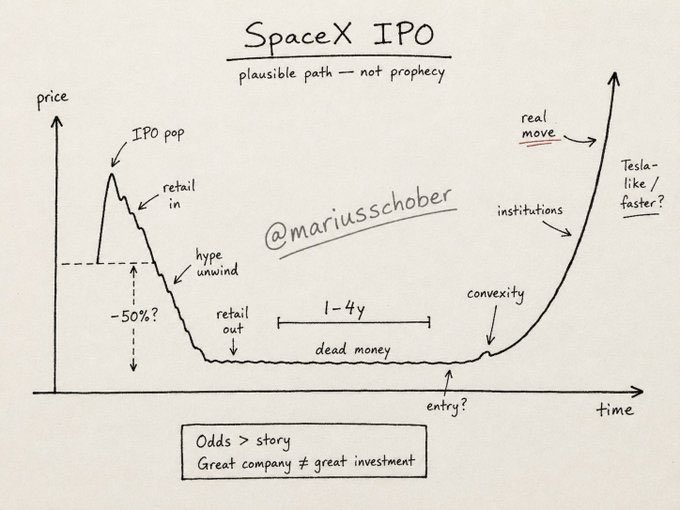
So look at how these stories usually trade. A pop as retail piles in. A long grinding melt as expectations meet reality, often down 50% or more. Then dead money, one to four years of nothing while the company grows into its valuation. And only then, the real move.
Amazon fell almost 90% after listing before it became Amazon. The class of 2021 was brutal: Robinhood -92%, Coinbase -92%, Rivian -95%, Oatly -97% from their day-one highs.
A great business and a great investment are not the same thing. The price you pay decides which one you get.
SpaceX may well be the most important company of the next fifty years.
Which is exactly why there's no rush to overpay on the first afternoon.
The rocket launches today.
The Good Chart launches later.
We'll wait for it.
Full breakdown in this week's Weekly by arvy.
Link via bio.
Benzinga asked me about quantum computing and Bitcoin.
The answer… Bitcoin is more secure than the dollars sitting in your bank account.
Quantum will crack the banks long before it touches the blockchain.
Everyone's panicking about quantum breaking Bitcoin's encryption while banks are running on legacy infrastructure that makes Bitcoin look like Fort Knox.
Even if something happened to the blockchain, the full node operators can roll back to the last secure block. The network survives.
The dollar and banks don't have that option.
At some point, Bitcoin eclipses the dollar entirely as retailers begin to accept bitcoin, and then they decide they only want to accept bitcoin.
Read the full Benzinga interview to see what else we covered.
https://t.co/VDF035Hiwu
🚨 IMPORTANT:
We're a team of 8 with one goal: to help you spot truly great stocks at the earliest stage.
Turn on notifications and follow us. It is crucial not to miss the alerts.
A lot of people will regret not following us.
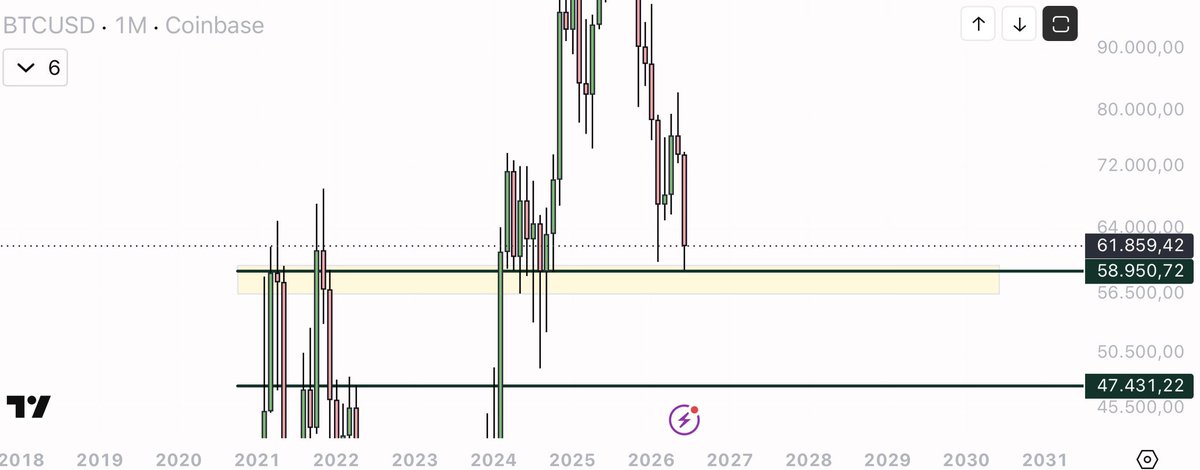
On the macro range $BTC , these are the levels and triggers that I personally consider most worth monitoring to gain greater confirmation and reduce the risk of trading on false signals.
As you can see, the zone between 60k and 64k remains the key area: as long as the price continues to trade within this range, I expect volatility, false breakouts and non-linear movements.
For this reason, I prefer to wait for clear confirmation:
Recovery and hold of the 64k area… a bullish scenario with the potential for an extension towards higher resistance levels.
A decisive break below 60k… a possible bearish acceleration towards lower liquidity levels.
Remaining within the range… an accumulation/distribution phase where patience is more valuable than compulsive trading.
On lower timeframes, I already shared my view yesterday: there are interesting trading opportunities, but on the macro front I continue to prefer well-defined triggers rather than trying to anticipate the market.
At this stage, risk management matters far more than the search for the perfect trade. Waiting for confirmation often means earning less from the move, but significantly increasing the chances of being on the right side of the market.
Everyone wants to try and fit a narrative or a chart to the Bitcoin price action over the past year. I think that effort is in vain because nothing is the same as past cycles. All past relationships have broken.
Here is my theory:
Trump campaigned on establishing a SBR at sub-$60k BTC. Trump makes deals. I think he pardoned CZ under a promise that CZ would provide a $60k BTC when Trump needed it for the SBR. I suspect CZ saw it taking longer than anticipated to establish the SBR so in October he determined that extreme measures would need to be taken to decouple Bitcoin from technology stocks which were heading upward. So 10/10 happened. Ever since then, the price has been pushed down even when ETF inflows were strong and folks were excited to buy. That makes zero sense. Now that the CLARITY Act is nearing execution and Bessent says they are actively working on establishing the SBR, here comes that mandated $60k BTC.
In my mind, there is no other reasonable explanation. Fortunately, I think once the SBR is established, the BTC price (and, by extension, MSTR and ASST) will scream like never before. Until then, they will hunt liquidity up and down.
Tell me I'm wrong @AdamBLiv and @martypartymusic and all the other BTC experts. Until then, this theory helps me feel good about rolling AI equity profits into the unbelievably undervalued BTC.
$BTC This level is not merely a support level: on the monthly chart, it represents a historical demand zone that has already held up on several occasions in the past. The same concept is also evident on the weekly chart, which is why I continue to regard it as one of the most important levels in the entire cycle.
As I indicated four days ago, it was reasonable to expect some rebounds, and indeed the market has already started to show them. As long as this area holds at the weekly close, the outlook remains positive in my view, and any weakness falls within the normal range of market volatility.
The situation would be different in the event of a clear break below the level on the weekly chart: at that point, the technical picture would become decidedly more bearish and the likelihood of a decline towards lower liquidity zones would increase.
Until then, however, I simply see a test of a massive support level. The market is deciding its next direction here.
This longevity scientist raised $1.8 billion with $180 million coming from Sam Altman to extend human lifespan.
After finishing his latest interview, I collected 9 findings he exposed that left me shocked:
1. Humans are naturally built to avoid exercise:
I have noticed that, over the last few days, several major investors have continued to accumulate $MANIFEST, whilst the number of holders continues to grow steadily.
One interesting sign is that, despite the heavy selling pressure that has affected the entire market, it has maintained a surprisingly solid structure, demonstrating greater resilience than many other assets.