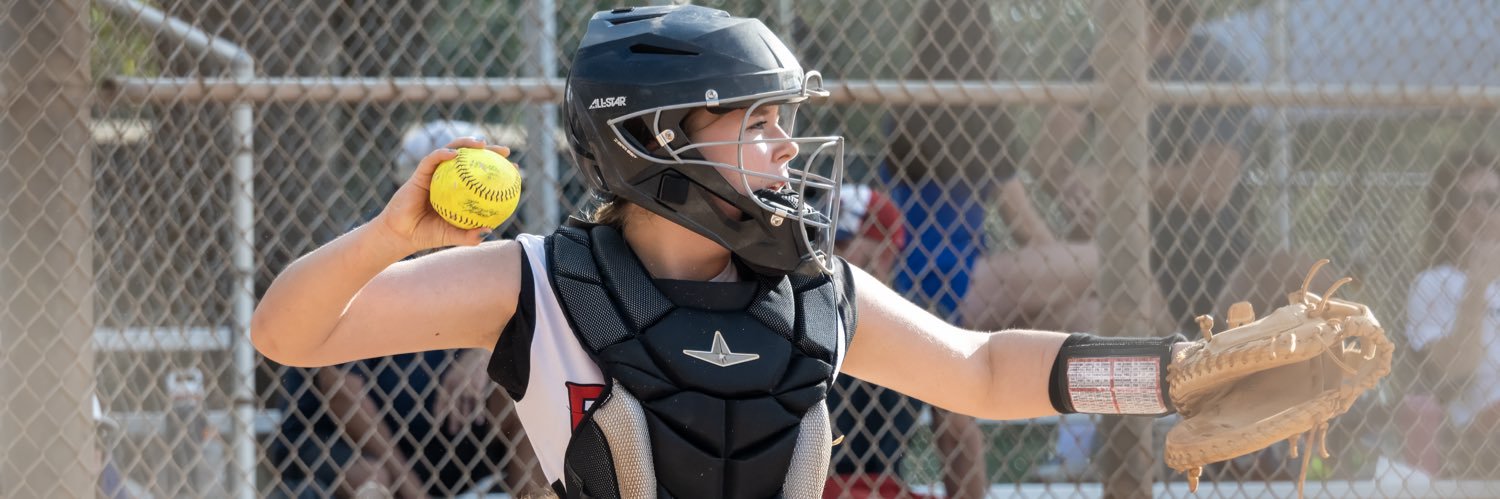
Been putting in a ton of work on more explosion out of my legs in my knee throws, been working this drill both at @ElineSoftball and at home. Getting ready for the @UCF_Softball camp this week. @coachkoons
Catching Drill: JoyPlus Knee Drives
Here’s a simple catcher drill I like for teaching the pop and knee drive on a throw-down without losing posture.
The athlete starts in the squat with the aqua bag at the chest, drives the back knee, and sticks the front side. Same pattern we want behind the plate, just without the ball. A med ball stays put. The water doesn’t. Every rep the load shifts, so the trunk has to stay organized or the bag pulls her off line.
Why I Like It In The Warmup:
➡️ Core has to organize before the knee even moves.
➡️ Instant feedback if posture breaks.
➡️ Fill it light for younger catchers, heavier for older ones.
➡️ High-rep friendly. No steel ball bouncing off the shins.
Key Focus Points:
➡️ Quiet trunk, violent knee. Chest and belt buckle stay facing the target.
➡️ Don’t open early. If the hips spin with the bag, the rep is sloppy.
➡️ Don’t dump forward. A broken posture turns the drive into a lunge.
➡️ Let the water punish the leak. If it yanks her off line, she feels it immediately.
Played in the @SaintLeoSB Reverse Exposure Invitational. Had some good at bats and also felt like I did some really good work behind the plate, helping the pitchers get ahead in spite of the rain. Loved playing some new teams and getting to play in front of the college coaches
This weekend we played 18U at the USSSA Fall Bling. Had a really good bracket day.
Felt really proud of the fact that over the whole weekend I had 2 people attempt to steal on me, and laid out for a wild pitch to get back to a tag at the plate
.333 BA
Had a great time and learned a ton at the Saint Leo camp. We got rained out before pictures happened, but appreciate the opportunities to speak with players and coaches, and loved the whole experience. @SaintLeoSB@Zcarv_1@EKinberger@saintleocoach
Catching Drill: Pitching Machine Tags Edition 💪
I’ve been getting creative with the pitching machine during lessons, and this is one of the ways I love using it for catchers that a lot of coaches overlook.
Instead of just feeding straight throws, we turn the machine into a tags station. You can work tags in the air, tags off the bounce, tags from the wrong side, extension plays, and wild throws all in a tight space.
This setup works on soft hands and glove control on different trajectories, body positioning and footwork when the ball isn’t coming straight at you, reacting to tough angles and bounces without losing balance, extending fully and recovering quickly on wild throws, and game-like decision making in a controlled, repeatable environment.
Key Focus Points:
➡️ Stay athletic and ready so you can adjust to the bounce or angle
➡️ Present a firm target and finish the tag cleanly
➡️ Keep your eyes on the ball all the way through the play
➡️ Recover fast and get back to a strong ready position
Progressions & Variations:
➡️ Start with tags in the air for clean receives
➡️ Progress to tags off the bounce and from the wrong side
➡️ Add extension plays and wild throws that force bigger movements
➡️ Mix locations so the athlete has to read and react every rep
The machine lets you get high-quality, game-like reps without needing a full field or a second thrower.🔥
Last weekend we played the @USSSA Never Forget 9/11 Memorial in Clearwater. Had a good weekend both hitting and catching, being behind the plate for all but 1 inning of 4 games with no passed balls.
BA: .556
OBP: .655
2 2B
3 RBI
This isn’t just a leaderboard. It’s proof of the work happening when nobody’s watching. Proud of these E-Line athletes for putting numbers on the board over the last 3 months. Exit velo doesn’t jump by accident.
Had a good first tournament of the season despite being sick the whole week. We went 2-4 in our first 18U tournament, which was the NSA-shake off the rust tournament in starkey. I batted 333 with an OBS 889 with 2 singles and 3 walks.
Catching Drill: Receiving Ramp📐
Here’s a great constraint drill I like for building a clean low-pitch receive. The ramp sits in front of the plate and helps the athlete start low, then work uphill through the ball so the glove stays quiet and the presentation stays strong.
That uphill path teaches the glove angle we want on drops, change-ups, and anything at the bottom of the zone. Instead of chopping or scooping, the athlete meets the ball from underneath and finishes with a flatter, quieter presentation the umpire can actually see.
In these videos you’ll see two different athletes on the ramp. One starts without the mask using regular balls so she can feel the path, then puts the helmet on and takes it off a machine from a one-knee stance. The other is the before-and-after look at reaching versus working uphill through the ball.
Key Focus Points:
➡️ Start low. Glove near the ground, then work up the ramp into the ball.
➡️ Quiet hands. No stabbing, no big wrist roll.
➡️ Present the ball relatively flat so more of the mitt faces the umpire.
➡️ Stay still through the receive. Steal the strike with the path, not extra movement after the catch.
➡️ Soft hands and good timing. Absorb it. Don’t freeze late.
Progressions & Variations:
➡️ Front toss or flips only. Do not use this with live pitching or a machine.
➡️ Tennis balls or a mini mitt first, then a regular mitt.
➡️ Add a light weighted ball once the path is clean.
➡️ Work inside, middle, and outside low locations.
➡️ Change stances: primary, secondary, one-knee.
➡️ Once the uphill path is automatic, take the ramp away and keep the same feel on front toss or bullpen pitches.
This one builds catchers who can quietly steal low strikes for their pitchers instead of turning borderline pitches into obvious balls.
Thank you @NolaReillyy2030 and @CatchingLucy15 for crushing this one. Their framing is becoming an elite asset for them.🙌
I had a great practice with one of my old teammates and best friends @lorea_dieguez9, I’m so glad we got to practice together again. I worked on hitting and throwing, can’t wait to start back up next weekend!
Had a great practice today with @CatchingLucy15 one of my old teammates! Got an hour in of good reps before the downpour but something is better than nothing!! Working on hitting, slapping, and picking throw downs. Can't wait for my first tournament in 2 short weekends!!
I remember coming to a catching lesson as a 10 year old and telling you I wanted to learn to do this after watching some @jen_schro catching videos on YouTube between lessons. Thank you so much for always helping me push to make reps as technically perfect as I can every time.
Here’s a full breakdown of the 3 major phases in throwing from the knees.
1️⃣ Rotate & Transfer
2️⃣Separate & Drive Out
3️⃣Rotate & Transfer
You can see exactly what elite mechanics look like and why they matter.
1️⃣Rotate & Transfer
As the pitch is coming in, the body rotates to the side while the ball is transferred from the glove to the throwing hand (glove to ear). The upper half stays in a strong box position with weight middle/back and the butt up. This early rotation and clean transfer set the direction of the throw and get the ball into the hand quickly so the rest of the sequence can fire without delay.
2️⃣Separate & Drive Out
Once the transfer is complete, the arms separate into a good throwing position while the lower half drives out as aggressively as possible. The front knee pushes hard toward the target, creating real power from the ground even though we’re starting on our knees. A good rule of thumb is you should be able to drive out roughly the distance of how tall you are. Your body works like a rubber band (similar to hitting). As you drive out, you also drive the elbow back to create that stretch and load. This is the phase where linear drive and arm separation happen together: the lower half leads while the upper half stays connected and ready.
3️⃣Land, Tuck & Throw
After the front knee lands from the drive, we tuck the back side, throw, and pull the body together. It’s important to pull the glove into the body aggressively. This helps create more power in the throw and keeps the body tracking toward the target. This final sequence transfers all the energy created in the drive into the ball and keeps the thrower balanced and under control for the next pitch or play.
When all three pieces work together you get a throw from the knees that’s both powerful and accurate. Clean sequencing from the ground up is what separates average knee throws from elite ones!