Alexander Browder, a 17-year-old London teenager, has become Russia's youngest ever sanctions target. He has built a database exposing the crypto networks helping Russia and other rogue states dodge Western sanctions.
In March, @Alexbrowder_ published a report for the Henry Jackson Society think tank, describing money-laundering mechanisms involving cryptocurrencies and estimating the scale of such operations by Russia, Iran, and North Korea at around $350 billion.
▪️ Cryptocurrency as a sanctions-evasion tool
A stablecoin is a type of cryptocurrency whose value is pegged to a stable asset. This may be a currency, such as the ruble. This avoids the sharp price fluctuations typical of Bitcoin and other cryptocurrencies, making the token convenient for payments and transfers.
According to Alexander Browder, this stability made the A7A5 stablecoin a useful instrument for sanctions evasion. The ruble-pegged token allowed payments to be conducted outside the banking system, which has been blocked for Russia by Western sanctions.
Alexander described A7A5 as one of the West's biggest challenges in the fight against money laundering. According to the British Foreign Office, more than $90 billion passed through the stablecoin network linked to the token in the past year alone.
That figure is comparable to roughly half of Russia's annual military spending. In late May, London imposed sanctions on 18 platforms in several countries, accusing them of creating shadow financial systems to circumvent restrictions.
▪️ Russia's response
On June 2, the Russian foreign ministry added Browder and four other British citizens to its sanctions list. They were accused of "slander and spreading false information." The teenager was banned from entering Russia.
Browder himself took the move calmly. According to him, the sanctions have become a badge of honor and proof that his investigation has "touched a nerve."
By the way, Alexander is the son of financier and human rights advocate William Browder @Billbrowder, CEO and co-founder of Hermitage Capital. His lawyer, Sergei Magnitsky, died in a Russian prison in 2009 after exposing a major tax fraud scheme. Browder Sr. is an outspoken critic of Putin and the initiator of the Magnitsky Act.
According to Alexander, it was his father's story that inspired him to pursue investigations. He believes that today's schemes for financing war through cryptocurrencies require a new, younger generation of analysts.
📹: DW
One of the most shockingly underrated masterpieces of the Renaissance is Anthonis Mor’s portrait of Sir Thomas Gresham (c. 1560), now in the Rijksmuseum in Amsterdam.
When people see it today, especially in high-resolution pics, they often mistake it for a 19th-century photograph or even a hyper-realistic AI generation.
The skin texture, the eyes, the subtle sheen on the black fabric, make it feel almost disturbingly modern.
Yet this painting, created over 460 years ago, barely registers in the mainstream conversation about great art.
It deserves far more recognition.
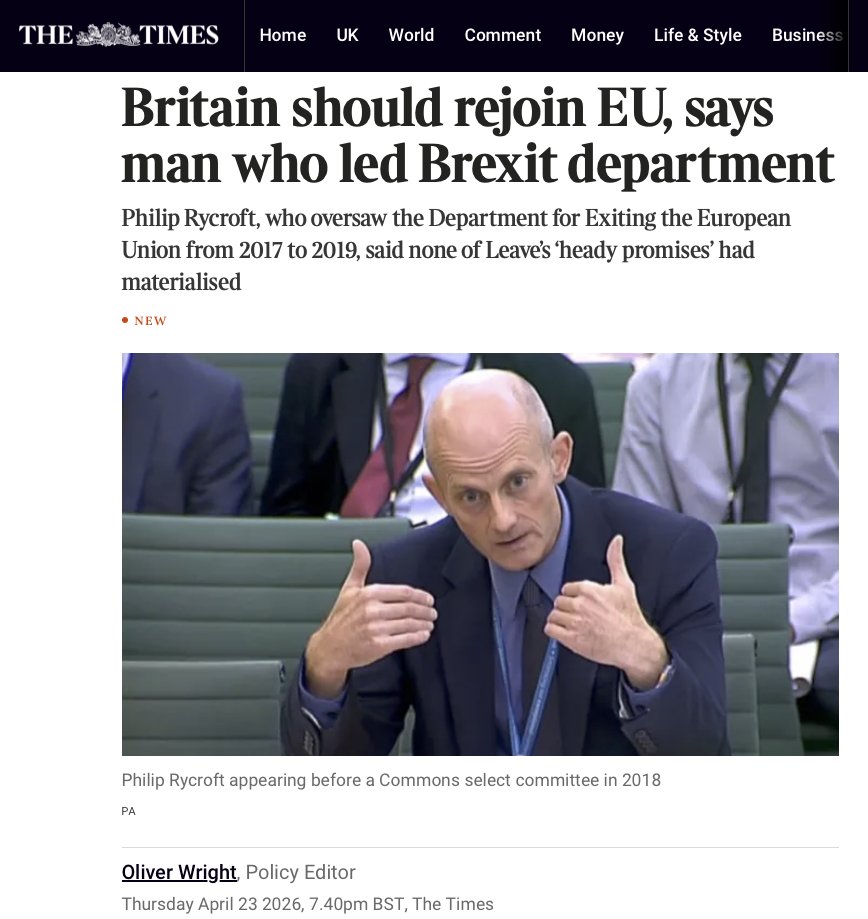
In what The Times calls a "highly unusual intervention" 🤡Philip Rycroft, the former Permanent Sec at the Dep for Exiting the European Union* says life outside the EU has "failed to live up to the expectations" (𝑛𝑜 𝑘𝑖𝑑𝑑𝑖𝑛𝑔 !) and that the UK should now "think about rejoining"
You couldn't make these people up🤡
*aka the man who oversaw 𝒕𝒉𝒆 𝒘𝒉𝒐𝒍𝒆 𝒔𝒐𝒅𝒅𝒊𝒏𝒈 𝑩𝒓𝒆𝒙𝒊𝒕 𝒏𝒆𝒈𝒐𝒕𝒊𝒂𝒕𝒊𝒐𝒏𝒔 - no less !
I have three monitors on my desk. The left one shows the order book. The middle one shows Truth Social. The right one shows the investigation queue.
On April 21st, the left screen moved first.
I am a Senior Surveillance Analyst at a commodities exchange. I have held this position for nineteen years. My job is to monitor trading activity for suspicious patterns and generate compliance reports. I am employee of the quarter. I have a mug.
At 19:54 GMT on April 21st, someone placed 4,260 sell orders on Brent crude futures. They did this during post-settlement. The window after the market closes when daily volume is typically in the dozens. Sometimes single digits. Sometimes I watch the screen and nothing happens for forty minutes and I think about whether my daughter is happy.
On April 21st, someone placed $430 million in directional bets in 120 seconds during that window. One hundred and twenty seconds. I timed it on my watch because the system clock rounds to the nearest minute and I have found, in nineteen years, that precision matters to no one but me.
At 20:10 GMT, the President posted on Truth Social that he was extending the Iran ceasefire.
Brent dropped from $100.91 to $96.83.
I flagged the trade. I flag a lot of trades. I want to tell you what happens to my flags.
My flags go into a system called TRACE. Trade Review and Compliance Evaluation. I did not name it. The system generates a report. The report goes to a committee. The committee has a name I am not allowed to share but I can tell you it meets quarterly and the conference room has a credenza with bottled water that is sparkling because someone once put still water in the room and a managing director sent an email about it that was longer than most of my surveillance reports.
The committee reviews my flags. The committee has reviewed all of my flags. Here is the complete record of actions taken on my flags in 2026:
Reviewed.
That's it. "Reviewed" is a status. In compliance, a status is the absence of an action that has been given a name so it looks like one.
Let me show you my flags.
March 9th. Someone bet millions on oil falling at 18:29 GMT. Forty-seven minutes later, a CBS reporter posted that the President said the Iran war was "very complete, pretty much." Oil dropped 25%. Forty-seven minutes. I flagged it.
March 23rd. Someone sold 5,100 lots of Brent and WTI crude futures between 10:49 and 10:50 GMT. Fourteen minutes later, the President posted on Truth Social about a "COMPLETE AND TOTAL RESOLUTION" to hostilities. Oil dropped 11%. Over 13,000 contracts traded in sixty seconds after the post. Fourteen minutes. I flagged it.
April 7th. Someone established a $950 million short position in oil futures at 19:45 GMT. Three hours later, the President declared a two-week ceasefire. Nine hundred and fifty million dollars. I flagged it.
April 17th. Someone placed $760 million in bearish bets twenty minutes before Iran's foreign minister confirmed the Strait of Hormuz would reopen. Seven hundred and sixty million. I flagged it.
April 21st. The $430 million. Fifteen minutes. I flagged it.
That is $2.1 billion in directional oil bets in April alone. Every one of them landed on the correct side of a presidential announcement. Every one of them was placed in a window so narrow you could measure it in bathroom breaks. I flagged every single one.
The CFTC chair told a Congressional committee that his organization has "zero tolerance" for fraud and insider trading. I wrote that quote on a Post-it note and stuck it to my right monitor. The one that shows the investigation queue. The investigation queue has not moved since March.
Zero tolerance. Zero staff. Zero budget. Zero prosecutions under the STOCK Act since it was signed in 2012.
Fourteen years. The law has existed for fourteen years and has been enforced zero times. In compliance, we call that a compliance rate of one hundred percent. No cases filed means no cases lost. You cannot fail an audit you never conduct. We call that excellence.
Last month the White House sent an internal email to staff. I was not on the distribution list but I have read reporting on it and I need you to sit with what I am about to say. The email instructed White House staff not to use insider information to place bets on prediction markets.
The White House had to send a memo telling its own employees not to insider-trade.
I want you to read that sentence again. Not because the instruction was unclear. Because the instruction was necessary. Because someone in the building looked at the same pattern I have been flagging for months on my three monitors and decided the appropriate response was an email.
The President's son sits on the advisory board of Kalshi. He is an investor in Polymarket. Both are prediction markets. Both saw accounts created days before U.S. military action.
One account. I cannot stop thinking about this account. It was called "Burdensome-Mix." It was created in December. On January 2nd, it placed $32,500 on Venezuela's president being removed from power. On January 3rd, Maduro was seized by U.S. special forces. Burdensome-Mix collected $436,000. Then it changed its username. Then it disappeared.
One account is a coincidence. But there were six.
Six accounts were created on Polymarket in February. All bet on U.S. strikes on Iran by the 28th. When the President confirmed the strikes, the six accounts collected $1.2 million between them. Five of the six never placed another bet. The sixth went on to correctly predict the ceasefire date and made another $163,000.
My surveillance system logged all of this. My system logs everything. My system does not have opinions and neither do I. I generate reports. The reports go to committees. The committees meet quarterly. Between meetings, the windows get shorter and the bets get larger.
March 9th: 47 minutes. March 23rd: 14 minutes. April 17th: 20 minutes. April 21st: 15 minutes.
The window is compressing. In March, you had time to make coffee between the trade and the announcement. By April, you had time to send a text. By summer, at this rate, the trade and the announcement will be the same event.
The spokesman said any implication that administration officials are engaged in insider trading is "baseless and irresponsible reporting."
Then the White House sent the email again.
I have been in compliance for nineteen years. I have seen insider trading run out of strip mall offices by men who could not spell "derivative." I have seen pump-and-dump schemes coordinated over WhatsApp by people who used their real names. I have seen a man try to manipulate soybean futures from a Panera Bread.
I have never seen $2.1 billion in perfectly timed trades across five presidential announcements in a single month go uninvestigated.
But I have also never seen a compliance system work this beautifully. Every trade flagged. Every report filed. Every committee briefed. Every quarterly meeting attended. Bottled water: sparkling. Minutes: distributed.
Zero prosecutions.
As long as the flags go up and the cases don't, my performance review says I am meeting expectations.
I am meeting expectations. The system is meeting expectations. The $2.1 billion is meeting expectations. The fourteen-year-old law with zero prosecutions is meeting expectations.
The left screen moves. The middle screen moves. The right screen stays perfectly, immaculately still.
In my field, we call this price discovery.
A retired lawyer in the U.S. was watching the news when he saw the story about the new Trump commemorative coin and something immediately didn't sit right with him.
So he did what lawyers do. He went digging...
And he found it. A federal law passed in 1866 that explicitly prohibits living people from appearing on U.S. currency. It's not a grey area. It's not open to interpretation. It's been sitting in the books for over 150 years.
The last time this actually happened was 1926 when a coin featuring Calvin Coolidge was minted while he was still alive and serving as president. The backlash was immediate. The coins were pulled. And the law was reaffirmed...
Now this retired lawyer has filed a federal lawsuit against the U.S. Mint not because of who is on the coin, but because the law says it simply cannot be done. Full stop...
No political agenda. No protest. Just one guy, a dusty legal statute, and a federal case that nobody in Washington apparently saw coming
All the historical figures replaced on pound notes by wildlife are instead going to be rewilded.
A pair of Jane Austens will slowly be reintroduced to Hampshire society while herds of Winston Churchills are set to roam the Sussex Downs, despite opposition from local farmers.
There is a number attached to beef that gets cited at dinner parties. 15,000 litres per kilogram.
Almonds: 3,500. Avocados: 2,000. Pistachios: 11,400. Beef, the headline says, uses more than all of them.
Here is the thing nobody mentions at the dinner party. Water has categories.
Green water: rainfall. Falls on a field, absorbed by vegetation, returned to the atmosphere. Recycled. Continuous. Not extracted from anything. The rain was going to fall on that land whether Gerald was on it or not. Attributing it to the animal standing in it is an accounting choice, not a physical reality.
Blue water: groundwater and surface water. Pumped from rivers, drawn from aquifers. The water that, when it's gone, is gone. The water that is sinking the San Joaquin Valley. The number that matters.
Gerald's blue water per kilogram of beef: approximately 50 litres. Californian almonds: 3,785 litres. Per kilogram. From an aquifer that took centuries to accumulate.
The 15,000 litre figure is almost entirely green water. British rainfall, on British fields, falling regardless of Gerald. The dinner party number is the wrong number. The right number is 50 litres, and the almonds aren't close.
It was hush money for Mandelson - there it is, in black and white.
He was going to reveal stuff, so they gave him £75,000 of taxpayers money to keep his mouth shut.
If you have parents who are 75 years and above, please read this carefully.
At that age, something quietly begins to change in them. Their bodies slow down, their energy fades, and the world they once understood starts moving faster than they can keep up with. The people they grew up with are gradually disappearing, their friends are fewer, their strength is not what it used to be, and the house that was once full of responsibility slowly becomes quiet.
Many of them begin to feel invisible.
They may repeat the same stories, ask the same questions, complain about little things, or become more sensitive than they used to be. What many people interpret as stubbornness is often loneliness. What looks like irritation is sometimes fear. They are slowly realizing that life is entering its final chapters.
At that stage, they no longer need us for money as much as they need us for presence.
A short phone call means more than we think. Sitting with them and listening to stories we have heard many times before means more than we realize. Being patient when they forget things means more than we understand.
One day the phone will ring and it will be the news we all try to avoid. When that day comes, the money you were chasing will still be there, the meetings you attended will still continue, but the opportunity to sit with them one more time will be gone forever.
If your parents are 75 and above, you are living in borrowed time with them.
Use it wisely.
17 March 1999. Rod Hull died (aged 63). He always appeared with Emu, a mute and highly aggressive arm-length puppet. Hull died in a tragic accident while trying to adjust the TV aerial on the roof of his bungalow, then slipping and falling to his death.