Peptide science, explained. Daily lab education on COAs, HPLC, mass spec, purity & storage. Follow to learn. Not for human use
10% off your first order: FIRST10
Myth: a shrunken or cracked freeze-dried cake means the peptide is bad.
Fact: cake shape depends on fill volume and drying cycle. Looks can't confirm or rule out degradation; HPLC and mass spec can.
Catalog: https://t.co/T6J6OspDT2
#peptides#labscience
Research use only.
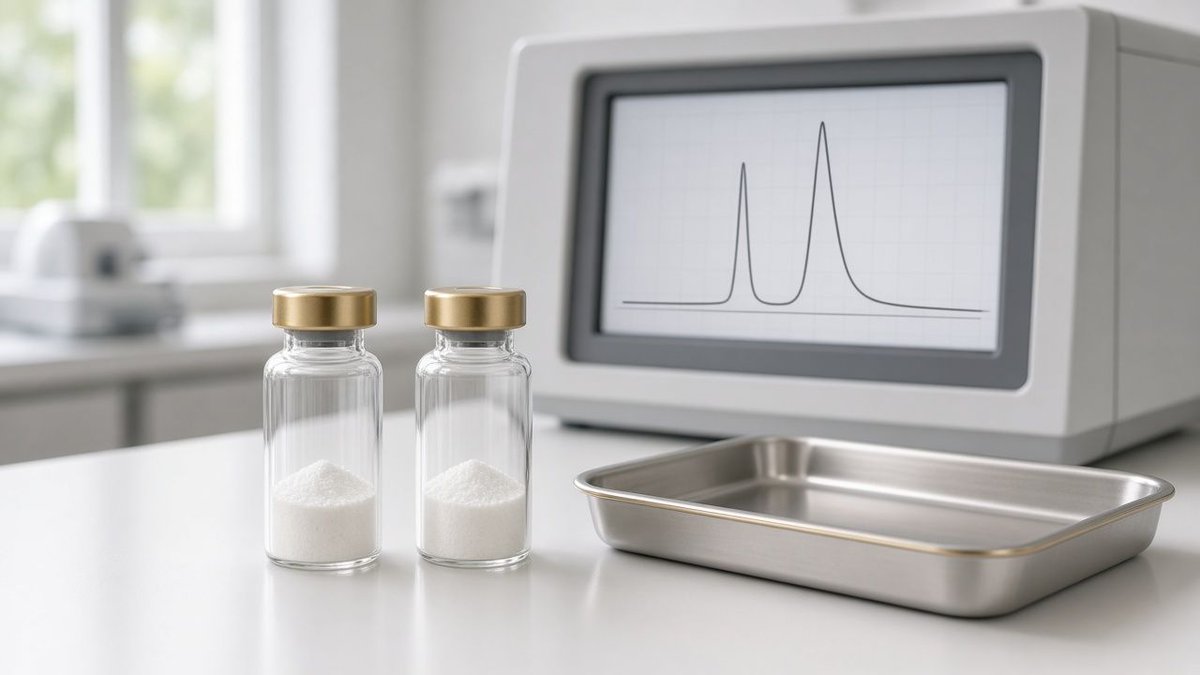
Reading an HPLC trace? Check the baseline, not just the main peak.
• Flat, quiet baseline = clean run
• Drift or noise can hide small impurity peaks
• A shoulder on the main peak hints at a close impurity
Catalog: https://t.co/T6J6OspDT2 #HPLC#peptides
Research use only.
MOTS-c comes in two sizes: 10 mg and 40 mg.
Sealed, freeze-dried, third-party tested. COA available on request.
Research use only.
Catalog: https://t.co/T6J6OspDT2
#peptides#biochemistry
Clean purity can still hide aggregation: peptide chains clumping together.
Drivers: shaking, repeat freeze-thaw, high concentration, pH near the isoelectric point. Haze or particles are a red flag.
Research use only.
Catalog: https://t.co/T6J6OspDT2
#peptides#biochemistry
Myth: lyophilized peptides are ruined once they leave the freezer.
Fact: sealed dry powder handles short room-temp transit. Heat, light and moisture do damage over time, so store it cold, dark and dry.
Research use only.
Catalog: https://t.co/T6J6OspDT2
#peptides#labscience
Different lot, different numbers.
Purity, net peptide content and counterion levels can shift batch to batch. A COA only covers the lot printed on it, so match the lot number.
Research use only.
Catalog: https://t.co/T6J6OspDT2
#peptides#analyticalchemistry
"Third-party tested" means the lab running the test isn't the one selling the vial.
An independent lab checks purity and identity. Ask us for the COA on any product.
Research use only.
https://t.co/T6J6OspDT2
#analyticalchemistry#labscience
Reading a COA? Check for:
1. Lot number that matches the vial
2. HPLC purity plus the chromatogram
3. Mass spec confirming identity
4. Named lab and test date
Research use only.
Catalog: https://t.co/T6J6OspDT2
#peptides#labscience
Myth: a high HPLC purity result proves you have the right peptide.
Fact: HPLC shows how clean a sample is, not what it is. Mass spec confirms identity by molecular weight. A solid COA reports both.
Research use only.
Catalog: https://t.co/T6J6OspDT2
#peptides#massspec
Cold vial, warm room: open it too soon and moisture condenses on the dry cake.
Lyophilized peptides are hygroscopic. Let a sealed vial reach room temperature before opening, and store with desiccant.
Research use only.
Catalog: https://t.co/T6J6OspDT2
#peptides#labscience
Every CAVI-R order ships the same way: sealed vials, freeze-dried, packed to arrive intact.
Third-party tested. COA on request.
First order? Code FIRST10 takes 10% off.
Research use only.
https://t.co/T6J6OspDT2
#labscience#chemistry
Same sequence, different salt form.
HPLC purification often leaves TFA counterions behind, and some labs exchange them for acetate. The peptide is identical. What shifts is the weight per mg.
Research use only.
Catalog: https://t.co/T6J6OspDT2
#peptides#biochemistry
Endotoxin-free is not the same as a clean HPLC trace.
Bacterial cell-wall fragments don't show up as a purity peak. Labs use a separate test, usually the LAL assay, reported in EU per mg.
Research use only.
Catalog: https://t.co/T6J6OspDT2
#peptides#labscience
A blend COA should split results by compound:
• its own resolved peak
• its own identity check
• measured amount vs label
Only one combined purity number? Ask the lab why.
Research use only.
Catalog: https://t.co/T6J6OspDT2
#peptides#labscience
@EricTopol Mutational signatures are a good reminder that the method sets the ceiling. What you can detect depends on sequencing depth, matched controls and clean sample handling, so long-term follow-up studies need consistent lab protocols to compare across years.
@EricTopol@natBME Nice to see this framed as experimental model work. The real test is whether the effect holds up across independent labs, different models and blinded readouts. Reproducibility is where a lot of promising early signals fall apart.
@1Immortals1 Worth adding that most of those head-to-head senolytic comparisons were in cell and mouse models. Fisetin's poor solubility also makes it tricky in assays, so how the compound is prepared and verified can change the result as much as the compound itself.
@tenet_research Ion mobility adds a separation step LC-MS alone can miss. For peptide work that means pulling apart isomers and co-eluting variants, like deamidation products, that share nearly the same mass. Good news for anyone who cares about identity, not just a purity number.
Purity can drift after a vial leaves the lab. Methionine and cysteine oxidize most easily: air exposure adds mass and can show up as extra peaks on a chromatogram. Keep the vial tightly sealed.
Research use only.
Catalog: https://t.co/T6J6OspDT2
#peptides#biochemistry
Four checks before you trust a COA:
• The lot number matches your vial
• Identity is confirmed by mass spec, not just purity
• The testing lab is named
• The test date is recent
Missing one? Ask.
Research use only.
Catalog: https://t.co/T6J6OspDT2
#biochemistry#massspec