Policy uncertainty has become a defining feature of the second Trump administration, from tariffs and industrial policy to the Iran war, and the Slaughter decision is likely to compound the problem. Biased, inconsistent federal policymaking will slow growth and skew competition.
🧵 Twin decisions from the Supreme Court this week could shake the U.S. economy by eroding confidence in federal policymaking. While SCOTUS rightly blocked the firing of Fed Governor Lisa Cook (for now), its removal of protections for other agency leaders could be disastrous.
Today, SCOTUS upheld a lower court’s order preventing President Trump from removing Federal Reserve Board Governor Lisa Cook without due process, reaffirming longstanding protections for the central bank’s independence.
Read our full response below 🔗:
https://t.co/ko3JTfBV9i
Research has shown policy uncertainty increases price volatility and depresses investment and job growth in sensitive industries, ultimately slowing overall economic growth. https://t.co/QI86XaDhcU
The World Cup presents an opportunity for workers to leverage their bargaining power and demand more amid rising inflation and economic uncertainty. With global eyes on the U.S., SoFi Stadium workers are doing just that.
The threat of a stadium worker strike on the eve of the World Cup underscores the power of union activity in the U.S., and provides a chance for economists to review what the evidence says about the impacts of unions (tldr: collective bargaining works!). https://t.co/qVBUSyLa0d
Workers at SoFi Stadium are organizing to secure these and other material gains including a demand ICE and CBP agents play no role during the World Cup to avoid the disruption and drag on local economic growth that can result from an immigration crackdown. https://t.co/3YDAvPRHRo
Sectoral bargaining plays a crucial role in raising wages, preventing a race to the bottom, and helping workers navigate major shifts driven by AI and the clean energy transition.
A new analysis from @CBDecon breaks down why it matters more than ever.
➡️ https://t.co/HpApWIqnj1
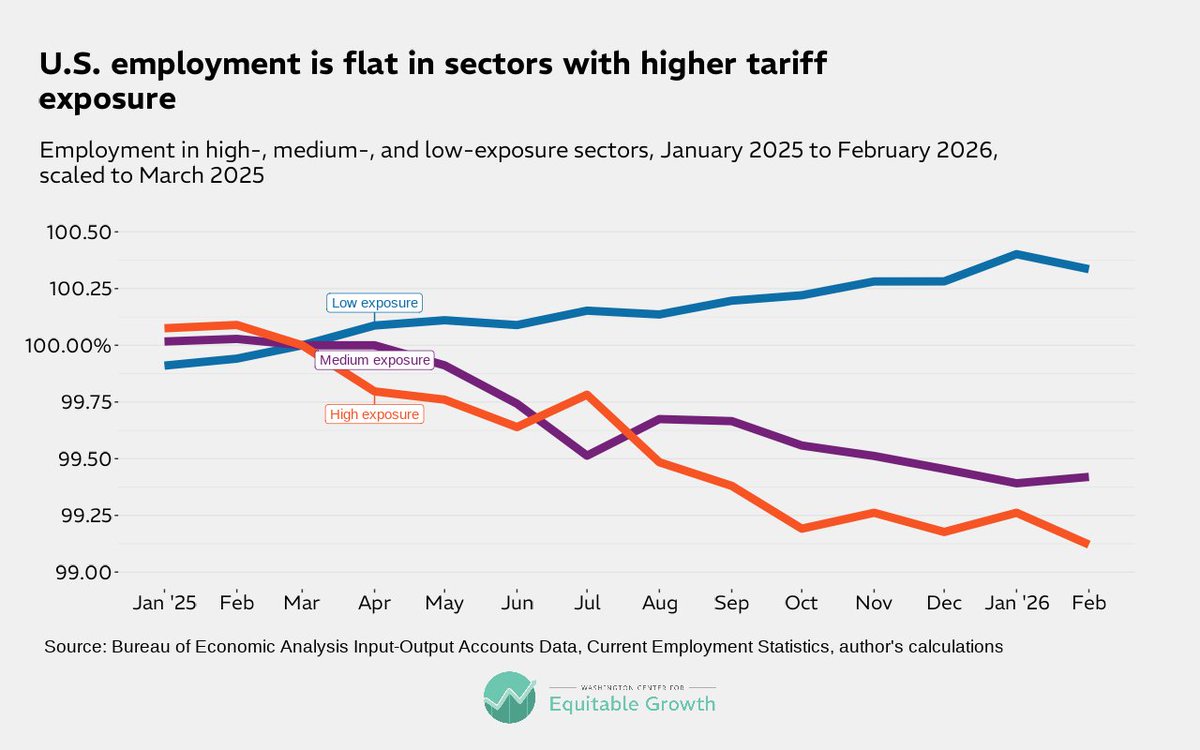
A year ago today, President Trump hiked tariffs to levels unseen in the modern era, celebrating a “Liberation Day” for the U.S. economy. Since then, U.S. tariff policy has remained costly and highly uncertain, weighing on the ability of businesses to grow and hire more workers.
President Trump inherited an economy on track for years of stable growth but has upended that upward trajectory through volatile trade and foreign policy decisions. Committing to a reliable, narrowly targeted tariff policy would be a big step towards stabilizing the U.S. economy.