We are a nation of allies, & the largest nonprofit dedicated to colorectal cancer. We advocate for prevention, magnify patient support, & accelerate research.
"In May 2021, at 32 years old, I was diagnosed with stage IIIC colorectal cancer. Wondering what the “C” stands for? In my case, it meant the cancer had spread to eleven lymph nodes, which meant I needed chemotherapy.
I’m a nurse, a military spouse, and at the time I had a 4 year old, a 2 year old, and a 6 week old baby. Life was busy.
Long before my diagnosis, I experienced symptoms that were often explained away as hemorrhoids, IBS, stress, or postpartum changes. But I continued having blood in my stool, changes in bowel habits, fatigue, persistent abdominal pain, and a quiet feeling that something wasn’t right.
One of the biggest lessons this experience taught me is that our health cannot be placed on the back burner. Advocating for yourself and pursuing answers should never feel dramatic or unnecessary because early detection saves lives. True advocacy means educating yourself, asking questions, working together with your doctors and nurses as a team, and sometimes even seeking a second opinion.
Cancer also taught me how important mental health is. Fear and uncertainty can quietly consume people, especially during treatment and while waiting for results. There will be dark days, but they won’t last forever. Lean on your faith, ask for help, and let people show up for you.
I’ve also realized how easy it is to search other people’s stories for certainty. What mutations did they have? What treatment worked for them? What diet did they follow? Those questions are natural when you are desperate for hope. But no two cancer journeys are identical. Encouragement from others is powerful, but for me, true peace has come from God.
Helping others while walking through my own battle changed me. Volunteering, supporting families, and being present for people helped pull me out of dark places mentally. There is something healing about realizing life still holds purpose, even during difficult seasons.
Five years later, I am still here. Deeply grateful. And always willing to listen, answer questions, or walk beside someone else through hard moments." - Monica T.
June is National Cancer Survivors Month. Visit https://t.co/LZGGK78O6R to double your gift this June.
"I was diagnosed with rectal cancer in January 2024 at 44 years old, which was a complete surprise for this former college athlete. In the years prior to my diagnosis, I experienced erratic bowel movements and extreme fatigue, which I mistakenly attributed to stress, working a demanding job, and hormones. I waited until I started seeing blood regularly before I finally saw a GI specialist, who sent me for a colonoscopy almost immediately. He diagnosed the cancer on the spot, and it turned out to be Stage IIIB rectal cancer. 2024 consisted of a port insertion, 4.5 months of FOLFOX chemo, 6 weeks of Capecitabine chemo alongside daily radiation 5 days a week, a surgery to remove my tumor and place a temporary ileostomy bag, and 72 days later having the ileostomy reversed and my port removed (but who was counting?!).
Survivorship has been an ordeal that I was not prepared for. I am lucky enough to have an amazing medical team, and an incredible husband, puppy, family, friends from near and far, and colleagues to support me throughout this nightmare. Another important - and I believe lifesaving - choice that I made for myself early on was to try and remain as healthy as possible. I exercised almost every day, however I could, during the treatments and have kept it up during survivorship. The version of me in survivorship is a very different girl than she used to be. Treatments caused complete menopause almost overnight, incredible fatigue, and navigating a body that behaves very differently than it used to, and figuring out how to listen to that body as she learns to recover and figures out a different way to live. I made the mistake of not listening to her once; I will never do that again. If something seems off, get yourself to a doctor. Don’t make assumptions. You’re too important." - Janine S.
June is National Cancer Survivors Month. Visit https://t.co/LZGGK78O6R for colorectal cancer survivor resources and support, or to make a gift that will be doubled throughout June. Prefer to talk with someone? Call our free helpline at 877-422-2030 to connect with a member of our Cancer Care Team.
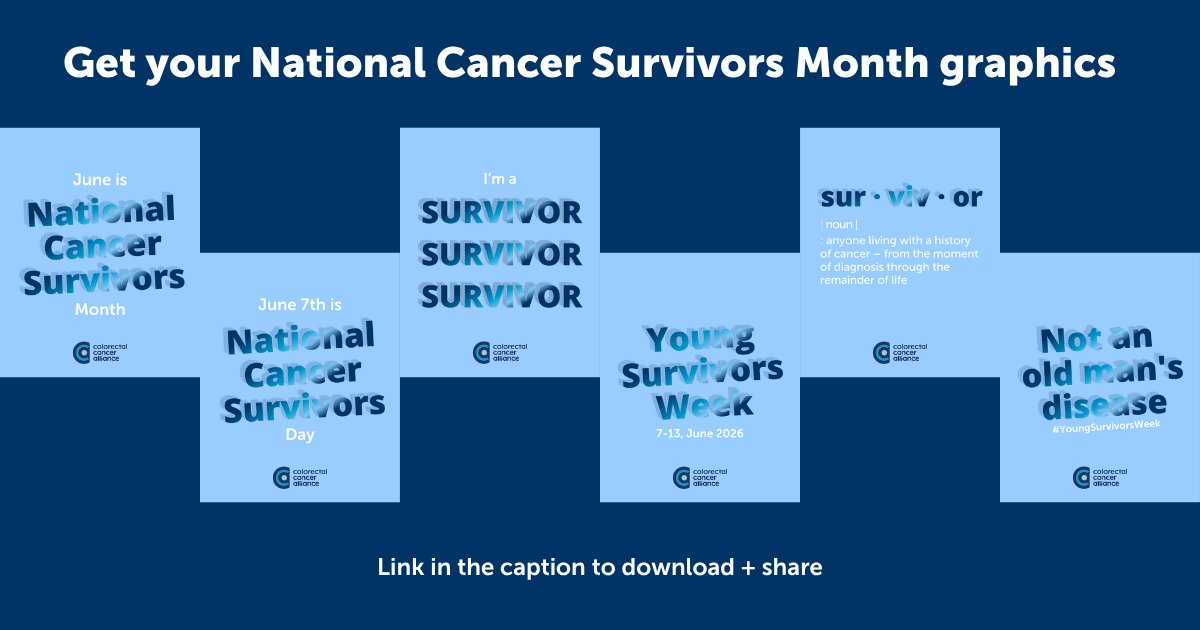
Hey, you 🫵 We made graphics for National Cancer Survivors Month 🎉 Download our universal social media posts to share on any social media channel, share to your Instagram stories, or even download a Facebook cover photo. Check them out: https://t.co/d2M7A6zCmA
This month, the Alliance celebrates colorectal cancer survivors and all they face through diagnosis, treatment, and everything that comes after.
Survivors inspire us and remind us why the mission to end colorectal cancer matters — and why we must do even more.
Through Project Cure CRC and our just-announced KLEOS adaptive clinical trial platform, the Alliance is expanding treatment options and improving care to bring more patients into survivorship.
In just one month, the Alliance’s cancer care team — part of Project Cure CRC — handled 797 calls from patients, survivors, and caregivers needing help. That work depends on supporters like you.
And today, your impact goes further. Thanks to a $20,000 matching gift from a generous donor, every dollar you give is doubled.
Together, we'll bring more patients to survivorship and give those in the battle more reason to hope.
Make a gift 👉 https://t.co/LZGGK78O6R
June is National Cancer Survivors Month! 🥳
This month, we celebrate the courage, resilience, and determination of cancer survivors everywhere. Join us in honoring every survivor's journey and helping raise awareness throughout June.
Thanks to a $20,000 matching gift from a generous donor, every dollar you give is doubled 👉 https://t.co/LZGGK78O6R
#NationalCancerSurvivorsMonth
ASCO is all about scientific innovation, but that's not the only reason the Alliance is here. Dionne discusses the critical work of building partnerships — friends in the mission to end colorectal cancer.
#ASCO26
Dr. Scott Kopetz, part of the leadership team guiding the Alliance's Project Cure CRC and KLEOS adaptive clinical trial, just presented big news at #ASCO26. EC + FOLFIRI nearly doubled progression-free survival for BRAF V600E colorectal cancer patients and is now a standard of care option. Ask your doctor about BRAF testing.
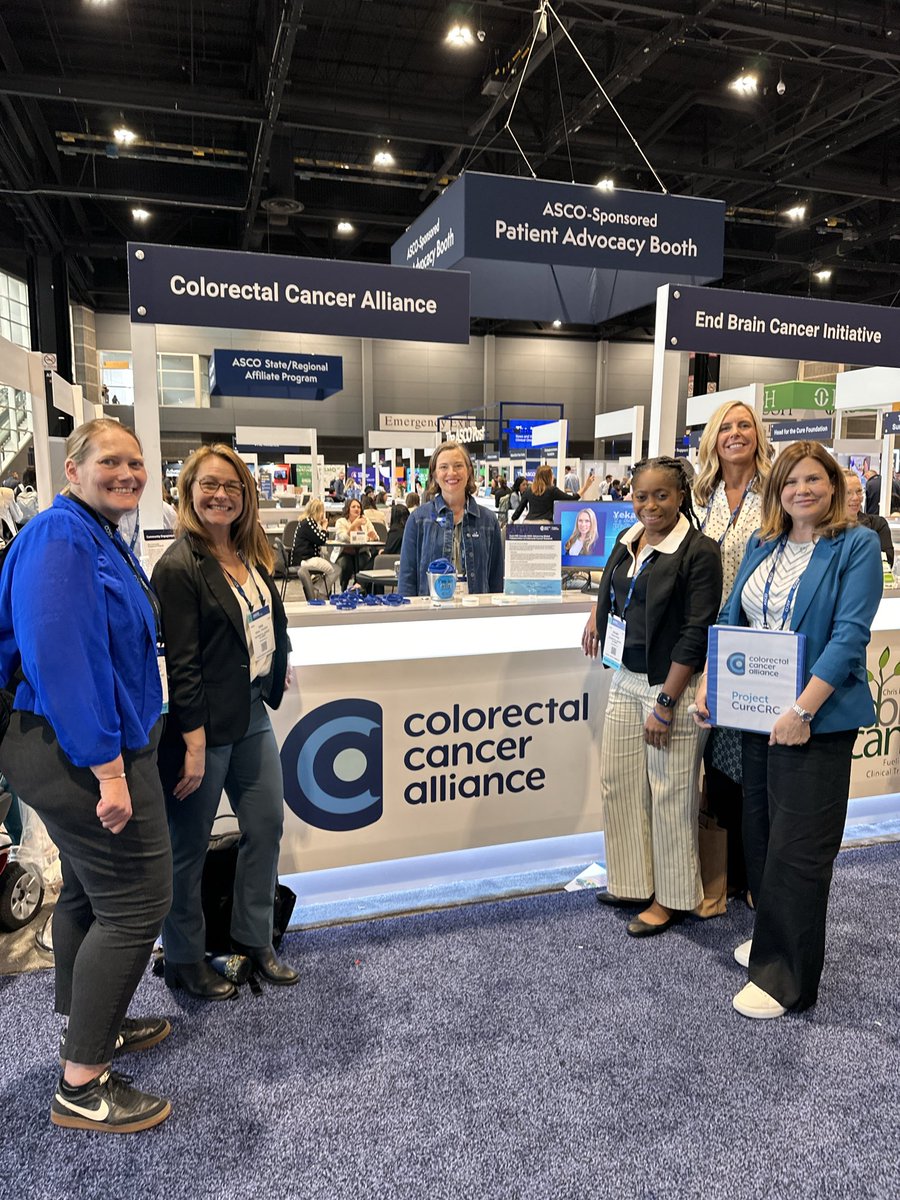
Members of the Alliance's partnership, advocacy, and oncology care teams meet at our booth, which is staffed by extraordinary volunteers all weekend. The Alliance is attending ASCO to advance innovation and advocate for patients. If you're here, too, come say hi — we're located in the advocacy area at the front of the exhibit hall.
#ASCO26 @ASCO
Dr. Kristen Ciombor of Vanderbilt University discusses the “highlights of the year in colorectal cancer,” especially targeted treatments that are available or will soon be available to CRC patients. Dr. Ciombor’s overview focuses on treatments for patients with specific tumor biomarkers, including BRAF, HER2, and MSI-H.
#ASCO26
The newly seated Project Cure CRC Consortium, assembled to guide the Alliance's work toward cures, got its first look at KLEOS at the ASCO annual meeting in Chicago. The Alliance's adaptive clinical trial platform was the focus of a panel featuring Alliance CEO Michael Sapienza and Dr. Meredith Buxton, CEO of the Global Coalition for Adaptive Research, among other oncology leaders. Panelists discussed KLEOS's vast potential and urgent goal to bring new treatments to patients faster.
Learn more about KLEOS: https://t.co/brILmzBuOs
#ASCO26 @ASCO
If you or someone you love has colorectal cancer, you know the hardest part isn't just the diagnosis — it's the waiting. Waiting for new treatments that take too long. Waiting for something better.
Today at the Annual Meeting of the American Society of Clinical Oncology, we're letting everyone know we're going to fix that.
The Colorectal Cancer Alliance is unveiling KLEOS — a bold new initiative to transform how colorectal cancer treatments are developed and approved. Backed by nearly $7.5 million in seed donations and a collaboration with the Global Coalition for Adaptive Research, KLEOS will create a smarter, faster way to test new cancer therapies.
Here's what that means for patients:
✅ More treatment options, developed faster
✅ Less time lost on drugs that don't work
✅ A future where a colorectal cancer diagnosis comes with better answers
We're building this now. The first patients are expected to enroll in early 2027, and the treatments that follow will change what it means to be diagnosed with colorectal cancer.
KLEOS is named after the ancient Greek word for glory — for the legacy of everyone we've lost to this disease. It exists because of donors, researchers, and patients who refused to accept the status quo.
Learn more 👉 https://t.co/brILmzBuOs
If you need support right now, including help navigating clinical trials that exist today, our cancer care team is here for you. Call us at (877) 422-2030.
Screening is recommended starting at age 45 for those at average risk or earlier for those with symptoms or risk factors, such as a family history of colorectal cancer or certain genetic conditions or diseases. Depending on personal risk, a variety of screening options are available, but not all tests are equal.
Read more about these changes 👉 https://t.co/2IAXIBfvXy
Remember to join us at #ASCO26 with our partners @PeerView! Live at the Hyatt Regency Chicago or virtually on 5/29, expert faculty @skopetz, @CathyEngMD & @mgfakih explore molecular testing, immunotherapy, and targeted therapy advances. Register now: https://t.co/JqDZg8t0UA
We asked our community "what was the moment you realized you should get screened for colorectal cancer?" Here are their answers 👉
Visit https://t.co/6NvIIKOUhf to learn about your screening options and to take a short quiz.
Looking back now, my body was whispering to me long before everything escalated.
I was dealing with anemia that just wouldn’t make sense. I was constantly fatigued, not just “tired,” but bone-deep exhaustion that sleep didn’t fix. My bowel movements became irregular. I noticed pencil-thin stools. There was blood in my stool that I tried to rationalize away. I had persistent abdominal pain that I kept attributing to stress or diet.
I share this part because I almost dismissed it all.
We are so used to pushing through. So used to minimizing our symptoms. So used to putting ourselves last. But please hear me, your body speaks. And when it does, listen. Advocate for yourself. Ask questions. Push for answers. Get the colonoscopy. Get the labs. Follow up.
Early detection matters.
If sharing my story helps even one person pay closer attention or seek care sooner, then every vulnerable word is worth it.
More to come… but for today, just know I am grateful, I am battling, and I am still here. - Carmel
Learn more about your screening options and take a short quiz at https://t.co/hJSHjjWs3W.
"When I was diagnosed with colon cancer in November 2021, I experienced every emotion—rage, frustration, fear, and tears.
But seeing the impact it had on my family shifted something in me. I decided I wanted to face this part of my path differently—with humor.
As a writer and storyteller, I began sharing parodies, poems, and lighthearted videos on social media. It became my way of coping and staying connected to myself and others.
There were incredibly difficult moments along the way, including multiple surgeries, complications, and time in the ICU. Through it all, my family and friends remained my foundation—offering strength, love, and constant support.
A year later, I was declared without evidence of disease.
Looking back, I’ve learned how important it is to stay present, to find moments of connection, and to hold onto what brings you joy—even in the hardest times. For me, that meant creating memories with the people I love and finding reasons to smile along the way." - Ramendra Kumar
If you need an ear to listen, give us a call the Alliance's free helpline at 877-422-2030. We're here for you every step of the way.
Too many young adults are told their symptoms are “nothing serious” — until it’s too late.
Kate Cross and Jenna Scott share how their colorectal cancer symptoms during and after pregnancy were repeatedly dismissed, delaying their diagnoses. Their stories are a powerful reminder to trust your body, ask questions and advocate for answers.
Read about their stories on USA Today 👉 https://t.co/MFGW5b4FdM