Quotes from the Catechism of the Catholic Church ✝️🇻🇦🙏 Come Holy Spirit, fill the hearts of your faithful and enkindle in them the fire of your love 🕊️
“In catechesis Christ, the Incarnate Word and Son of God is taught. Everything else is taught with reference to him - and it is Christ alone who teaches - anyone else teaches to the extent that he is Christ’s spokesman, enabling Christ to teach with his lips. Every catechist should be able to apply to himself the mysterious words of Jesus: ‘My teaching is not mine, but his who sent me.’”
CCC 427
As early as the second century we have the witness of St. Justin Martyr for the basic lines of the order of the Eucharistic celebration.
They have stayed the same until our own day for all the great liturgical families.
St. Justin wrote to the pagan emperor Antoninus Pius (138-161) around the year 155, explaining what Christians did:
“On the day we call the day of the sun, all who dwell in the city or country gather in the same place. The memoirs of the apostles and the writings of the prophets are read, as much as time permits.
When the reader has finished, he who presides over those gathered admonishes and challenges them to imitate these beautiful things.
Then we all rise together and offer prayers for ourselves …and for all others, wherever they may be, so that we may be found righteous by our life and actions, and faithful to the commandments, so as to obtain eternal salvation. When the prayers are concluded we exchange the kiss.
Then someone brings bread and a cup of water and wine mixed together to him who presides over the brethren. He takes them and offers praise and glory to the Father of the universe, through the name of the Son and of the Holy Spirit and for a considerable time he gives thanks (in Greek: eucharistian) that we have been judged worthy of these gifts.
When he has concluded the prayers and thanksgivings, all present give voice to an acclamation by saying: ‘Amen.’ When he who presides has given thanks and the people have responded, those whom we call deacons give to those present the ‘eucharisted’ bread, wine and water and take them to those who are absent.”
CCC 1345
Can’t make it inside for Adoration while traveling?
Just park outside any Catholic church. Jesus is truly present in the Tabernacle — Body, Blood, Soul, and Divinity. You can make a powerful Holy Hour right from your car.
“Faith is first of all a personal adherence of man to God.
At the same time, and inseparably, it is a free assent to the whole truth that God has revealed.
As personal adherence to God and assent to his truth, Christian faith differs from our faith in any human person.
It is right and just to entrust oneself wholly to God and to believe absolutely what he says.
It would be futile and false to place such faith in a creature.”
CCC 150
@CurseEcumemism@DF_UniatePapist Really.
An infinite number of times.
True repentance and confession resulting in absolution removes excommunication.
The excommunication is “automatic” until #3 occurs.
“Formal cooperation in an abortion constitutes a grave offense. The Church attaches the canonical penalty of excommunication to this crime against human life. ‘A person who procures a completed abortion incurs excommunication latae sententiae,’ ‘by the very commission of the offense,’ and subject to the conditions provided by Canon Law.
The Church does not thereby intend to restrict the scope of mercy. Rather, she makes clear the gravity of the crime committed, the irreparable harm done to the innocent who is put to death, as well as to the parents and the whole of society.”
CCC 2272
“The charity of Christ is the source in us of all our merits before God. Grace, by uniting us to Christ in active love, ensures the supernatural quality of our acts and consequently their merit before God and before men.”
CCC 2011
“Hope is the theological virtue by which we desire the kingdom of heaven and eternal life as our happiness, placing our trust in Christ’s promises and relying not on our own strength, but on the help of the grace of the Holy Spirit.”
CCC 1817
“It is by the conversion of the bread and wine into Christ’s body and blood that Christ becomes present in this sacrament.
The Church Fathers strongly affirmed the faith of the Church in the efficacy of the Word of Christ and of the action of the Holy Spirit to bring about this conversion.
Thus St. John Chrysostom declares:
‘It is not man that causes the things offered to become the Body and Blood of Christ, but he who was crucified for us, Christ himself. The priest, in the role of Christ, pronounces these words, but their power and grace are God’s. This is my body, he says. This word transforms the things offered.’
And St. Ambrose says about this conversion:
‘Be convinced that this is not what nature has formed, but what the blessing has consecrated. The power of the blessing prevails over that of nature, because by the blessing nature itself is changed.... Could not Christ’s word, which can make from nothing what did not exist, change existing things into what they were not before? It is no less a feat to give things their original nature than to change their nature.’”
CCC 1375
“Formal cooperation in an abortion constitutes a grave offense. The Church attaches the canonical penalty of excommunication to this crime against human life. ‘A person who procures a completed abortion incurs excommunication latae sententiae,’ ‘by the very commission of the offense,’ and subject to the conditions provided by Canon Law.
The Church does not thereby intend to restrict the scope of mercy. Rather, she makes clear the gravity of the crime committed, the irreparable harm done to the innocent who is put to death, as well as to the parents and the whole of society.”
CCC 2272
“The Lord addresses an invitation to us, urging us to receive him in the sacrament of the Eucharist: ‘Truly, I say to you, unless you eat the flesh of the Son of man and drink his blood, you have no life in you.’”
CCC 1384
“The Church forcefully and specifically exhorts all the Christian faithful to learn the surpassing knowledge of Jesus Christ by frequent reading of the divine Scriptures. Ignorance of the Scriptures is ignorance of Christ.”
CCC 133
“Faith is first of all a personal adherence of man to God.
At the same time, and inseparably, it is a free assent to the whole truth that God has revealed.
As personal adherence to God and assent to his truth, Christian faith differs from our faith in any human person.
It is right and just to entrust oneself wholly to God and to believe absolutely what he says.
It would be futile and false to place such faith in a creature.”
CCC 150
“Deliberate hatred is contrary to charity.
Hatred of the neighbor is a sin when one deliberately wishes him evil.
Hatred of the neighbor is a grave sin when one deliberately desires him grave harm.
‘But I say to you, love your enemies and pray for those who persecute you, so that you may be sons of your Father who is in heaven.’”
CCC 2303
The seven deadly sins, also called capital sins, are not isolated acts but fundamental vices that serve as the root causes of many other sins. The term capital derives from the Latin caput, meaning head, indicating their role as sources of moral disorder. These vices distort the proper ordering of human desires toward God and neighbor.
The concept was refined by early Church writers, including Evagrius Ponticus and Pope Saint Gregory the Great, and received systematic treatment from Saint Thomas Aquinas in the Summa Theologica. Aquinas analyzed each sin as a habitual disposition contrary to virtue, particularly the theological and cardinal virtues. When freely consented to in grave matter with full knowledge, these sins can become mortal, depriving the soul of sanctifying grace.
The seven capital sins are pride, greed, lust, envy, gluttony, wrath, and sloth.
Pride is the inordinate desire for personal excellence and the refusal to acknowledge dependence on God. It is regarded as the root of all sins, manifesting in arrogance, vanity, and contempt for others. It opposes humility.
Greed, or avarice, is the excessive attachment to wealth and material goods, often leading to injustice and neglect of the poor. It subordinates spiritual values to temporal possessions and stands opposed to liberality.
Lust is the disordered craving for sexual pleasure apart from its unitive and procreative purposes within marriage. It clouds reason and weakens the will, violating chastity.
Envy consists in sorrow at the good fortune of another and a desire that such good be diminished. It directly opposes charity, which rejoices in the welfare of neighbor.
Gluttony involves immoderate indulgence in food and drink beyond what serves health and moderation. It represents a form of intemperance that dulls spiritual sensitivity.
Wrath is the uncontrolled desire for vengeance that seeks harm to others. While righteous anger can be just, capital wrath becomes sinful when it is disproportionate and destructive of charity. It is countered by patience.
Sloth, or acedia, is spiritual apathy and sadness regarding divine goods and the effort required for salvation. It manifests as reluctance toward prayer and duty, opposing diligence and zeal.
In Catholic teaching these vices are habitual inclinations arising from original sin and concupiscence. They are combated through the sacraments of Penance and the Holy Eucharist, prayer, and the cultivation of opposing virtues: humility, generosity, chastity, charity, temperance, patience, and diligence. Growth in faith, hope, and charity under the action of grace gradually heals the soul’s disordered tendencies.
The capital sins provide a framework for an examination of conscience to uproot sin and promote one's spiritual growth. By identifying these root disorders, the faithful cooperate more effectively with the transforming grace of Christ, advancing toward holiness and union with God.
The Lord grants us the joy of being His missionary disciples, strength to overcome the snares of the evil one, and hope of eternal life. All of these things are ours. Everything is a gift, which ennobles and makes us great and which commits and empowers us. The greatest gift is the Holy Spirit. #ApostolicJourney #Angola https://t.co/rBFUpFWSJa
“Every act of war directed to the indiscriminate destruction of whole cities or vast areas with their inhabitants is a crime against God and man, which merits firm and unequivocal condemnation.”
CCC 2314
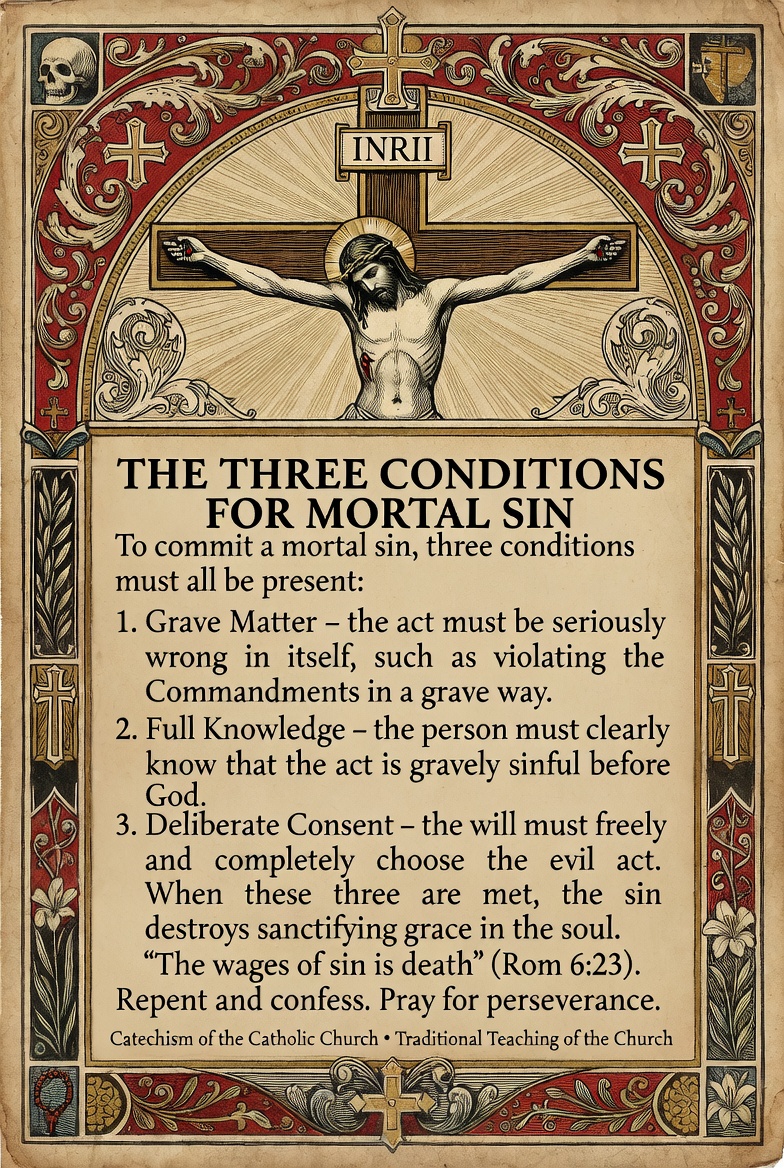
To commit a mortal sin, three precise conditions must all be present at the same time. The absence of even one of these conditions reduces the act to a venial sin or renders it no sin at all. These conditions are drawn from the longstanding moral theology of the Church, rooted in Scripture, Tradition, and the Catechism of the Catholic Church.
The first condition is that the matter of the act must be gravely wrong in itself, that is, it must concern something that is seriously contrary to the moral law. Grave matter includes actions such as deliberate homicide, adultery, fornication, blasphemy, perjury, serious theft, deliberate hatred of God or neighbor, missing Mass on Sundays and holy days of obligation without a serious reason, and other acts that directly violate the Ten Commandments in a significant way. The gravity is determined by the object of the act—what the person is choosing to do—not merely by the consequences or the subjective feelings involved. The Church teaches that some actions are intrinsically evil, meaning they are wrong by their very nature regardless of circumstances or intentions. When a person freely chooses such a grave matter, the first requirement for mortal sin is met.
The second condition is full knowledge. The person must have a clear awareness that what he or she is about to do is gravely sinful. This means the individual must know both the moral wrongness of the act and its serious character before God. Ignorance can diminish or even remove culpability, but the ignorance in question must be invincible—that is, the person could not reasonably have known better despite sincere effort. Feigned ignorance, where someone deliberately avoids learning the truth to excuse wrongdoing, does not lessen guilt; in fact, it can increase it. Similarly, affected ignorance, chosen to escape responsibility, fails to excuse. True full knowledge requires that the intellect clearly perceives the grave moral evil before the will consents to it.
The third and final condition is deliberate consent of the will. The person must freely and completely choose to perform the gravely wrong act with full awareness. This consent must be free from substantial external coercion or internal compulsion that destroys freedom. While strong emotions, habits, fear, or psychological pressures can lessen freedom and therefore culpability, they do not automatically remove it unless they render the act involuntary. For mortal sin, the will must give its complete and unreserved assent to the evil proposed. A half-hearted or reluctant agreement, where the person is still struggling against the temptation and would prefer not to sin, does not meet the threshold of full consent. Mortal sin requires that the person says “yes” to the grave evil with the whole heart, deliberately turning away from God in a fundamental way.
When all three conditions—grave matter, full knowledge, and deliberate consent—are simultaneously verified, the sin is mortal. Mortal sin is called “mortal” because it destroys the supernatural life of grace in the soul, severing the relationship with God and making one worthy of eternal separation from Him if one dies unrepentant. It is a radical rejection of God’s love and friendship. Venial sins, by contrast, wound charity but do not destroy it; they weaken the soul’s union with God without breaking it entirely. Even venial sins should be taken seriously, as they dispose the soul toward more serious falls and hinder growth in holiness.
Catholic moral theology emphasizes that these conditions must be evaluated with prudence and honesty before God. No one can judge the interior state of another with certainty, but each person is called to examine his or her own conscience carefully, especially before receiving any of the sacraments of the living, especially Holy Communion.
The remedy for mortal sin is sincere repentance and sacramental confession, through which the grace of justification is restored. The Church offers, by the direct will of Christ, the Sacrament of Penance precisely because human beings fall and need God’s mercy, which is always greater than any sin when received with humble and contrite hearts.
In daily life, the faithful are encouraged to cultivate a well-formed conscience through prayer, study of Scripture and Church teaching, frequent reception of the sacraments, and spiritual direction when needed. Regular self-examination helps one recognize when an act might approach grave matter and guards against the subtle erosion of freedom or knowledge that can lead to serious sin.
Ultimately, the Church's teaching on mortal sin underscores both the dignity of human freedom and the gravity of our choices: we are capable of truly choosing for or against God, and our eternal destiny depends on the direction of that freedom, sustained by His grace.
“It is by the conversion of the bread and wine into Christ’s body and blood that Christ becomes present in this sacrament.
The Church Fathers strongly affirmed the faith of the Church in the efficacy of the Word of Christ and of the action of the Holy Spirit to bring about this conversion.
Thus St. John Chrysostom declares:
‘It is not man that causes the things offered to become the Body and Blood of Christ, but he who was crucified for us, Christ himself. The priest, in the role of Christ, pronounces these words, but their power and grace are God’s. This is my body, he says. This word transforms the things offered.’
And St. Ambrose says about this conversion:
‘Be convinced that this is not what nature has formed, but what the blessing has consecrated. The power of the blessing prevails over that of nature, because by the blessing nature itself is changed.... Could not Christ’s word, which can make from nothing what did not exist, change existing things into what they were not before? It is no less a feat to give things their original nature than to change their nature.’”
CCC 1375