Netflix has turned the infamous Stanford Prison Experiment into a reality TV show. But does it actually reveal anything about human nature? We compare the show with the original study and explain why social roles alone don't explain cruelty: https://t.co/JHQ3lwEKCF
Our latest Research Bulletin covers nine findings on political identity—and why partisan differences are often bigger in our imaginations than reality. Check it out here: https://t.co/dHNUL52EL0
In a study of parents and children, only 8% of parents thought their children might feel insignificant, but 35% of children felt that way or were unsure. John R. Miles explains why feeling valued matters and how everyday interactions can help: https://t.co/iO8Kc5w3q0
Why do some trick-or-treaters take the whole candy bowl? Costumes, crowds, and anonymity all play a part. Here are six surprisingly useful lessons from social psychology for your porch this year: https://t.co/jdzaheVqFi
I made some delicious #halloween treats as a tribute to Phineas Gage--the most important lesion patient in the history of neuroscience. Gage famously survived an accident in which an iron rod shot through his frontal lobe. After the accident he eventually healed.
But psychologically, he was ““no longer Gage”.
The accident reportedly impaired his socio-emotional capacity. This led to lots of research with people who have similar brain damage and the impact on their decision-making capabilities.
If you want to make these treats check out the details here: https://t.co/4brzCLesmo
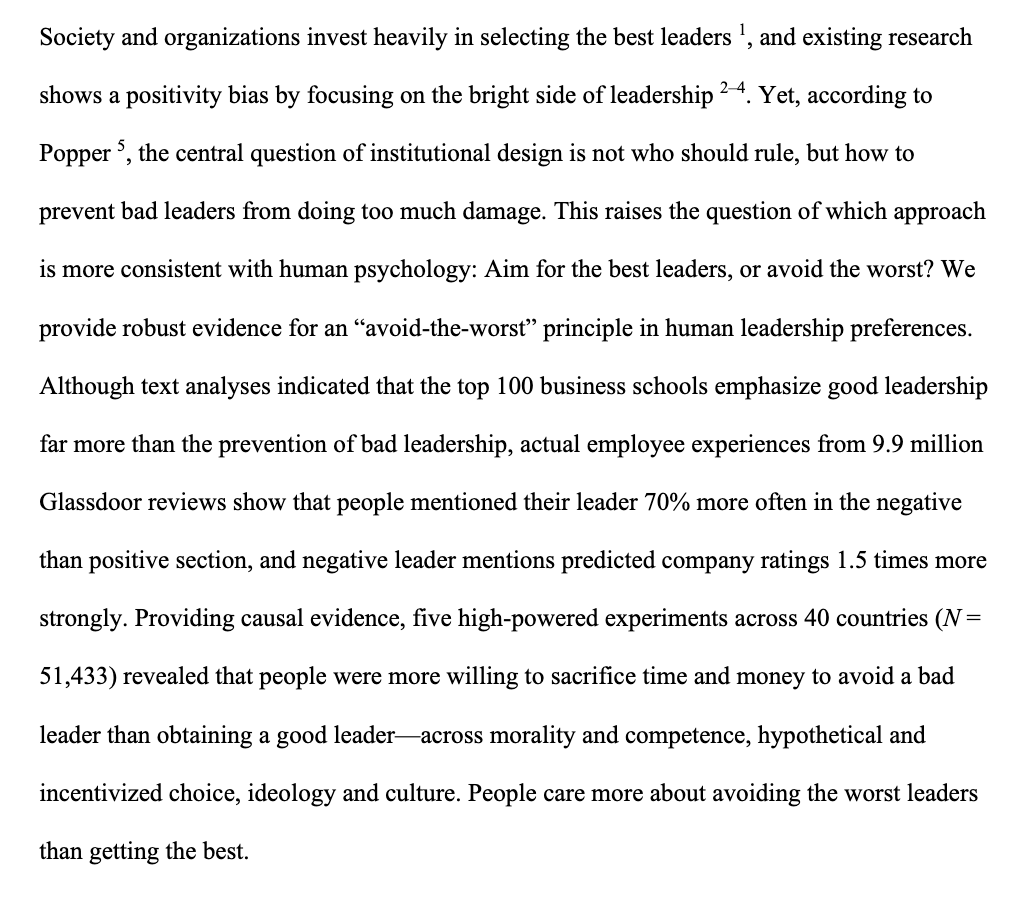
Society and organizations invest heavily in selecting the best leaders, and existing research shows a positivity bias by focusing on the bright side of leadership.
Should we focus on finding the best leaders or avoiding the worst? Our new paper provides robust evidence for an “avoid-the-worst” principle in human leadership preferences.
We found that the top 100 business schools emphasize good leadership far more than the prevention of bad leadership.
But actual employee experiences from 9.9 million Glassdoor reviews show that people mentioned their leader 70% more often in the negative than positive section, and negative leader mentions predicted company ratings 1.5 times more strongly.
A bad-leader mention was also associated with 30% higher odds of leaving a company within the first year among former employees, whereas a good-leader mention is associated with only 5% lower odds of leaving.
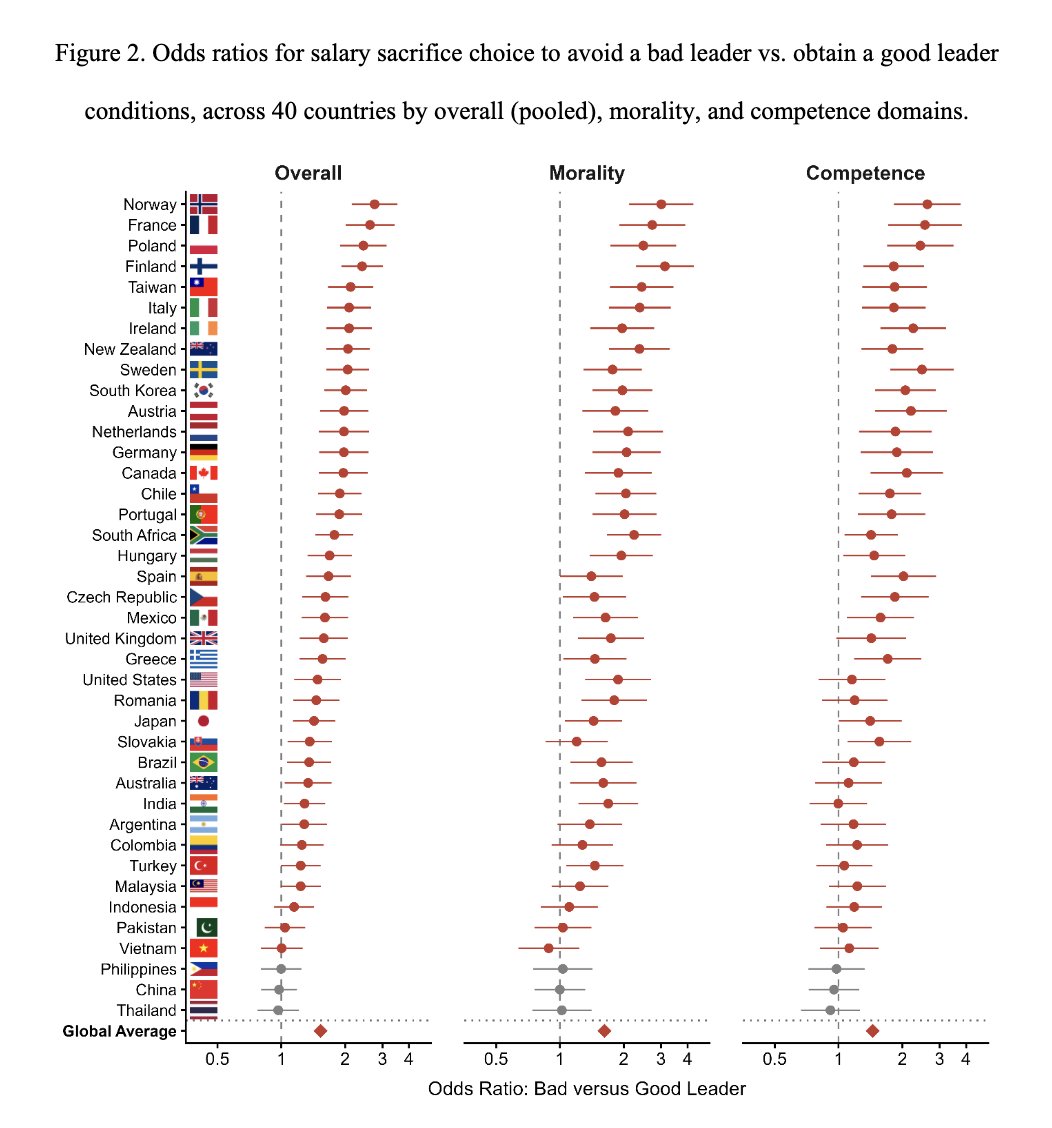
We also have causal evidence across 40 countries (N = 51,433) revealing that people were more willing to sacrifice time and money to avoid a bad leader than obtain a good leader (across both morality and competence).
Our research suggests that people care more about avoiding the worst leaders than getting the best. But our leading schools are focused on the opposite issue.
The central question of institutional design may not be who should rule, but how to prevent bad leaders from doing too much damage.
This research was led by @H_Sjastad and @jareefbnmartuza
Read the full paper here:
https://t.co/PLbj8UO10x
Groups can make decisions up to four times better than individuals. This essay challenges Gustave Le Bon’s “madness of crowds” and explains how discussion can improve reasoning and collective intelligence: https://t.co/bzIDKPTirc
I'm exciting to announce that @RemiTPsyc is now a Professor! You should follow him to learn more about his exciting work on human prosociality. He really opened my mind about the power of contemplative practices to improve humanity.
He also walks the walk--he spends a lot of time behind the scenes doing things to improve the culture of science, from creating open science tools to supporting others. We need far more people willing to do those things.
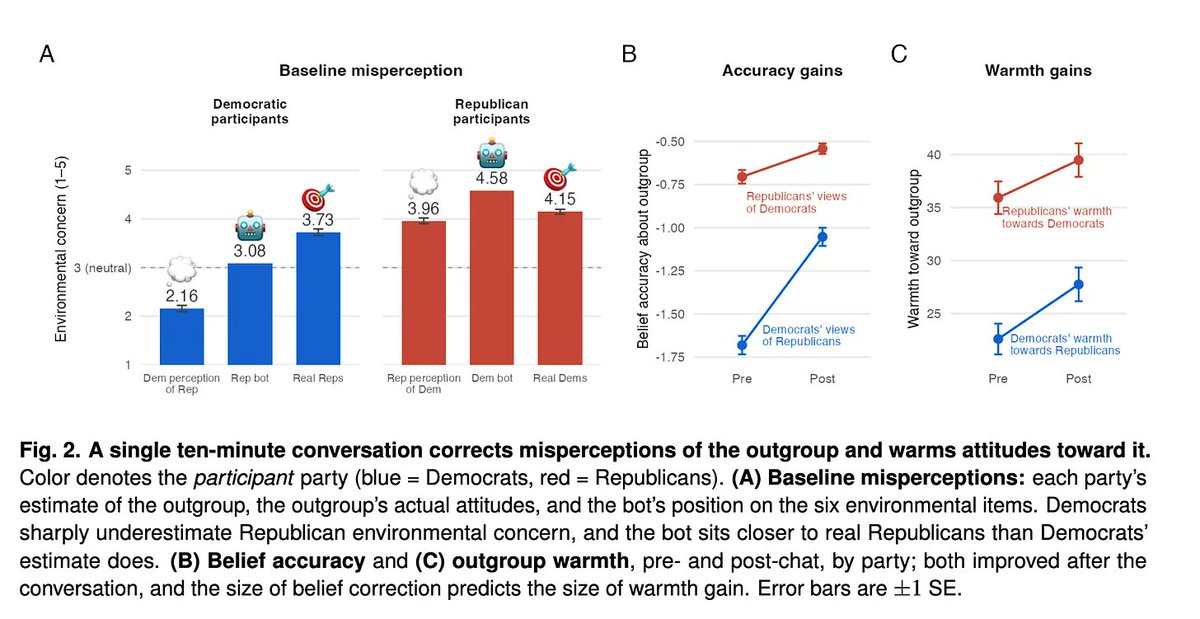
Partisans have wildly inaccurate perceptions of outgroup members.
But a 10 minute conversation with a “outgroup” chatbot can correct these false beliefs and reduce partisan hostility.
We highlight this and 6 of our other favorite new studies on intergroup relations in our latest newsletter:
https://t.co/STb2I7jOON
I discuss 'The Psychology of Belonging: How Groups Shape Who We Are" with @jim1800flowers
Groups can bring us together to accomplish things none of us could achieve alone. They can also fuel prejudice, division, and conflict. The groups we belong to shape whom we trust and how our brains respond to the people around us.
https://t.co/qUfCIyzxen
These days, it’s easy to succumb to hopelessness. But I explain why doomerism can lead to paralysis in a new article I wrote for the @guardian
The problem with doomerism isn’t necessarily that the risks are exaggerated, but that it may create a self-fulfilling prophecy – by engendering helplessness, rather than galvanixing people.
This aspect of human psychology has been well known for many years by experts on persuasion. When people hear messages designed to appeal to our fears, they can be moved to take action. But this only tends to work as a one-off, and only then when the messages convey a sense of efficacy – a belief that it’s still possible to make a difference. By contrast, if people are inundated with scary and overwhelming stories about the climate or AI, they tune out.
A big problem for us now is that the modern information ecosystem tends to reinforce negativity. For decades, a core principle in the news business has been “if it bleeds, it leads”. This principle now dominates what you see online.
My colleagues and I looked at traffic to news stories on https://t.co/pshewjgWTB. This was a website that became famous for conducting A/B tests of headlines to see which one drove clicks, and then using the most popular headline. We analysed 22,743 of these mini-experiments and found that each additional negative word in a headline increased clicks by 2.3%.
We also found that doom and gloom messagins are the most effective at getting people to spread it on the internet or social media. But like other fear appeals, it fails to inspire real action.
If we want to motivate people in the face of dire threats, we must give them a reason to hope. Without that, we are destined to doomscroll while the world burns.
Read my full article here: https://t.co/G6BQSG6veL
It takes 50–100 hours to make a friend on average. Adam Grant explains how allies, pals, companions, and shared group identities shape connection: https://t.co/JyOxx6LyHv
Across 743,402 people in 121 societies, ingroup prosociality tracked with outgroup prosociality. Our September roundup covers seven findings on intergroup contact and helping across group lines: https://t.co/wfDSQh5qLa
People cooperate more when the same Prisoner’s Dilemma is called the “Community Game” rather than the “Wall Street Game.” Valerio Capraro explains how language activates emotions and norms—and how AI may help measure and shape behavior: https://t.co/nNndR8Rtd0
Brain activity let researchers predict which pairs of strangers would feel connected about 67% of the time. Matt Lieberman explores what this reveals about friendship, compatibility, and finding people who click. https://t.co/9sCdkAzhkL
In 1955, 18% of social-science papers were written by teams; by 2000, that figure was 52%. Our new post draws on big-team science to outline four principles for building inclusive, motivated, effective teams: https://t.co/iY4aPFEXw2
What makes people cooperate with strangers—or turn against one another? In this plenary from Mind & Life SRI, Dr. Jay Van Bavel explores how identity and digital environments shape conflict and cooperation: https://t.co/1UuIs9fNFE
The Power Of Us stems from one basic idea: social identity is one of the most powerful forces in human life. It shapes who we trust, who we help, who we fear, who we follow, what we believe, how we work, and whether we can cooperate across our differences.
"The Power of Us" is currently #1 Best Seller in Cognitive Neuroscience & Cognitive Neuropsychology on Amazon!
Get it on sale as an e-book today for only $2.99 📖
https://t.co/KbBePovEaI