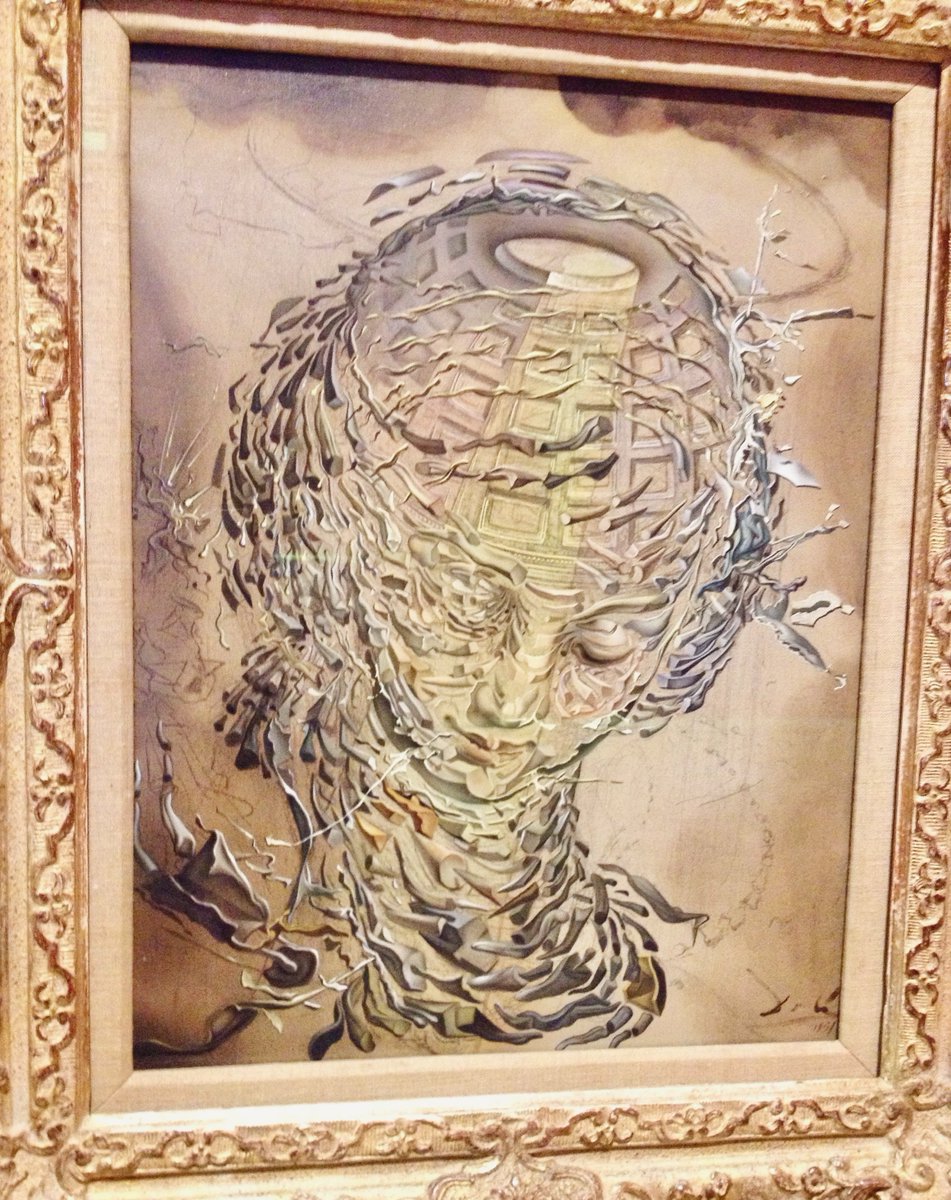
Wallace Stevens, ‘Credences of Summer’ VI —
…The rock cannot be broken. It is the truth.
It rises from land and sea and covers them.
It is a mountain half way green and then,
The other immeasurable half, such rock
As placid air becomes. But it is not
A hermit’s truth nor symbol in hermitage.
It is the visible rock, the audible,
The brilliant mercy of a sure repose,
On this present ground, the vividest repose,
Things certain sustaining us in certainty.
It is the rock of summer, the extreme,
A mountain luminous half way in bloom
And then half way in the extremest light
Of sapphires flashing from the central sky,
As if twelve princes sat before a king.
Dainichi Nyorai (“Great Sun Buddha”), Nara 🗻🌞
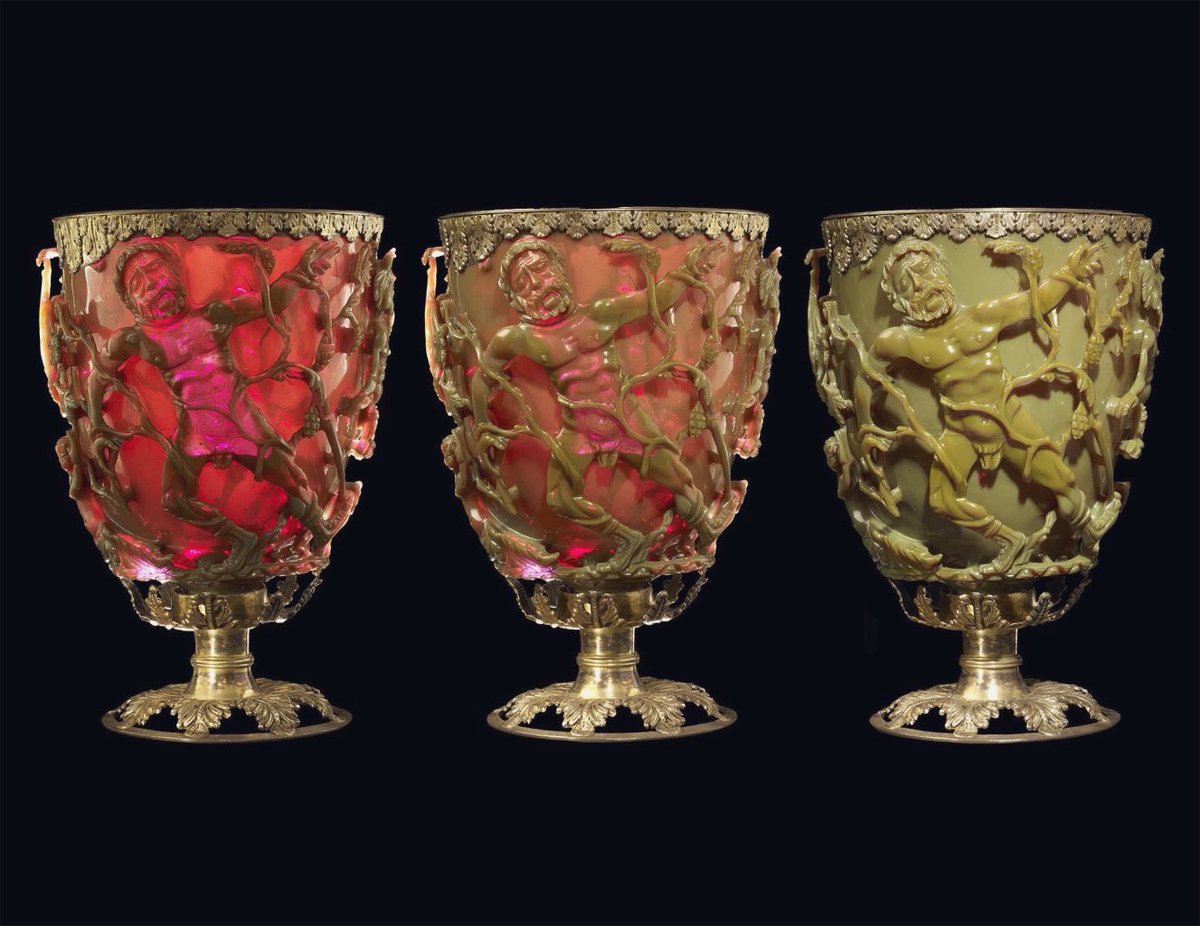
“The Lycurgus Cup is a late Roman drinking vessel, made in Alexandria or Rome between 290 and 325 AD… Carved into it is the death of Lycurgus, the mythical king who raged against Dionysus and his followers; the god’s vengeance shows him being strangled and dragged down by vines, the nymph Ambrosia having transformed into the very plant that ensnares him. Dionysus, Pan, and a satyr surround the scene in triumph.”
Plotinus, Ennead IV.3.12 (tr. MacKenna) —
The souls of men, seeing their images in the mirror of Dionysus, have entered into that realm in a leap downward from the Supreme: yet even they are not cut off from their origin, from the divine Intellect [Nous]; it is not that they have come bringing the Intellectual Principle down in their fall; it is that though they have descended even to earth, yet their higher part holds for ever above the heavens…
🍷 The Lycurgus Cup
“This lyre was found in the 'Great Death-Pit', one of the graves in the Royal Cemetery at Ur. The burial in the Great Death-Pit was accompanied by seventy-four bodies laid down in rows on the floor of the pit.”
“On the access ramp, as if guarding the entrance, were six guards or soldiers with weapons, and four of the women in the pit were grouped around musical instruments. So this lyre was, almost certainly, being played as the attendants went to their deaths.”
W.B. Yeats, ‘Vacillation’ VI —
A field spread out below,
An odour of the new-mown hay
In his nostrils, the great lord of Chou
Cried, casting off the mountain snow,
‘Let all things pass away.’
Wheels by milk-white asses drawn
Where Babylon or Nineveh
Rose; some conqueror drew rein
And cried to battle-weary men,
‘Let all things pass away.’
From man’s blood-sodden heart are sprung
Those branches of the night and day
Where the gaudy moon is hung.
What’s the meaning of all song?
“Let all things pass away.”
Coleridge, Dejection: An Ode V 💛
O pure of heart! thou need'st not ask of me
What this strong music in the soul may be!
What, and wherein it doth exist,
This light, this glory, this fair luminous mist,
This beautiful and beauty-making power.
Joy, virtuous Lady! Joy that ne'er was given,
Save to the pure, and in their purest hour,
Life, and Life's effluence, cloud at once and shower,
Joy, Lady! is the spirit and the power,
Which wedding Nature to us gives in dower
A new Earth and new Heaven,
Undreamt of by the sensual and the proud—
Joy is the sweet voice, Joy the luminous cloud—
We in ourselves rejoice!
And thence flows all that charms or ear or sight,
All melodies the echoes of that voice,
All colours a suffusion from that light.
🖼️ From Klimt’s Beethoven Frieze, ‘The Longing for Happiness Finds Repose in Poetry’
🤍 “The palm at the end of the mind,
Beyond the last thought, rises
In the bronze decor,
A gold-feathered bird
Sings in the palm, without human meaning,
Without human feeling, a foreign song.
You know then that it is not the reason
That makes us happy or unhappy.
The bird sings. Its feathers shine.
The palm stands on the edge of space.
The wind moves slowly in the branches.
The bird's fire-fangled feathers dangle down.”
…Down that stair
Sometimes there's fog: opaque red droplets check
The beam. Sometimes tall redwood-tendoned glades
Come and go, whose dwellers came and went.
Now darting feverishly anywhere,
Manic duncecap its danseuse eludes,
Now slowed by grief, white-lipped,
Grasping the newel bone of its descent,
This light can even be invisible
Till a deep sparkle, regular as script,
As wavelets of an EKG, defines
The dreamless gulf between two shoulder blades.
James Merrill, ‘Days of 1994’
These days in my friend’s house Light seeks me underground. To wake Below the level of the lawn —Half-basement cool through the worst heat— Is strange and sweet. High up, three window-slots, new slants on dawn: Through misty greens and gilts An infant sun totters on stilts of shade Up toward the high Mass of interwoven boughs, While close against the triptych panes Rock bears witness, Dragonfly Shivers in place Above tall Queen Anne’s Lace— More figures from The Book of Thel by Blake (Lilly & Worm, Cloudlet & Clod of Clay) And none but drinks the dewy Manna in.
I shiver next, Light walking on my grave … And sleep, and wake. This time, peer out From just beneath the mirror of the lake A gentle mile uphill. Florets—the mountain laurel—float Openmouthed, devout, Set swaying by the wake of the flatboat:
Barcarole whose chords of gloom Draw forth the youngest, purest, faithfullest, Cool-crystal-casketed Hands crossed on breast, Pre-Raphaelite face radiant—and look, Not dead, O never dead! To wake, to wake Among the flaming dowels of a tomb Below the world, the thousand things Here risen to if not above Before day ends: The spectacles, the book, Forgetful lover and forgotten love, Cobweb hung with trophy wings, The fading trumpet of a car, The knowing glance from star to star, The laughter of old friends.
🖼️ David Hockney
💙 ‘…The Chinese Mencius has not been the least successful in his generalization. "I fully understand language," he said, "and nourish well my vast-flowing vigor." — "I beg to ask what you call vast-flowing vigor?" — said his companion. "The explanation," replied Mencius, "is difficult. This vigor is supremely great, and in the highest degree unbending. Nourish it correctly, and do it no injury, and it will fill up the vacancy between heaven and earth. This vigor accords with and assists justice and reason, and leaves no hunger." — In our more correct writing, we give to this generalization the name of Being, and thereby confess that we have arrived as far as we can go. Suffice it for the joy of the universe, that we have not arrived at a wall, but at interminable oceans. Our life seems not present, so much as prospective; not for the affairs on which it is wasted, but as a hint of this vast-flowing vigor…’
@biancastone 🩵 “For Hades' bobbin bound in mummy-cloth
May unwind the winding path;
A mouth that has no moisture and no breath
Breathless mouths may summon;
I hail the superhuman;
I call it death-in-life and life-in-death.”
🩵 “…Unspeakable Thou Bridge to Thee, O Love.
Thy pardon for this history, whitest Flower,
O Answerer of all,—Anemone,—
Now while thy petals spend the suns about us, hold—
(O Thou whose radiance doth inherit me)
Atlantis,—hold thy floating singer late!
So to thine Everpresence, beyond time,
Like spears ensanguined of one tolling star
That bleeds infinity—the orphic strings,
Sidereal phalanxes, leap and converge:
—One Song, one Bridge of Fire! Is it Cathay,
Now pity steeps the grass and rainbows ring
The serpent with the eagle in the leaves…?
Whispers antiphonal in azure swing.”
Percy Shelley, from ‘The Witch of Atlas’ XXVII #MelvilleMonday 🐳
…While on her hearth lay blazing many a piece
Of sandal wood, rare gums, and cinnamon;
Men scarcely know how beautiful fire is —
Each flame of it is as a precious stone
Dissolved in ever-moving light, and this
Belongs to each and all who gaze upon…
Moby-Dick, ‘The Dying Whale’ —
…Soothed again, but only soothed to deeper gloom, Ahab, who had sterned off from the whale, sat intently watching his final wanings from the now tranquil boat. For that strange spectacle observable in all sperm whales dying—the turning sunwards of the head, and so expiring—that strange spectacle, beheld of such a placid evening, somehow to Ahab conveyed a wondrousness unknown before.
“He turns and turns him to it,—how slowly, but how steadfastly, his homage-rendering and invoking brow, with his last dying motions. He too worships fire; most faithful, broad, baronial vassal of the sun!—Oh that these too-favouring eyes should see these too-favouring sights. Look! here, far water-locked; beyond all hum of human weal or woe; in these most candid and impartial seas; where to traditions no rocks furnish tablets; where for long Chinese ages, the billows have still rolled on speechless and unspoken to, as stars that shine upon the Niger’s unknown source; here, too, life dies sunwards full of faith; but see! no sooner dead, than death whirls round the corpse, and it heads some other way.
“Oh, thou dark Hindoo half of nature, who of drowned bones hast builded thy separate throne somewhere in the heart of these unverdured seas; thou art an infidel, thou queen, and too truly speakest to me in the wide-slaughtering Typhoon, and the hushed burial of its after calm. Nor has this thy whale sunwards turned his dying head, and then gone round again, without a lesson to me.
“Oh, trebly hooped and welded hip of power! Oh, high aspiring, rainbowed jet!—that one strivest, this one jettest all in vain! In vain, oh whale, dost thou seek intercedings with yon all-quickening sun, that only calls forth life, but gives it not again. Yet dost thou, darker half, rock me with a prouder, if a darker faith. All thy unnamable imminglings float beneath me here; I am buoyed by breaths of once living things, exhaled as air, but water now.
“Then hail, for ever hail, O sea, in whose eternal tossings the wild fowl finds his only rest. Born of earth, yet suckled by the sea; though hill and valley mothered me, ye billows are my foster-brothers!”
🖼️ NASA’s Solar Dynamics Observatory


![CCitrine_'s tweet photo. Plotinus, Ennead IV.3.12 (tr. MacKenna) —
The souls of men, seeing their images in the mirror of Dionysus, have entered into that realm in a leap downward from the Supreme: yet even they are not cut off from their origin, from the divine Intellect [Nous]; it is not that they have come bringing the Intellectual Principle down in their fall; it is that though they have descended even to earth, yet their higher part holds for ever above the heavens…
🍷 The Lycurgus Cup](https://pbs.twimg.com/media/HKJSFjbaAAAfFbR.jpg)




![CCitrine_'s tweet photo. Plotinus, Ennead IV.3.12 (tr. MacKenna) —
The souls of men, seeing their images in the mirror of Dionysus, have entered into that realm in a leap downward from the Supreme: yet even they are not cut off from their origin, from the divine Intellect [Nous]; it is not that they have come bringing the Intellectual Principle down in their fall; it is that though they have descended even to earth, yet their higher part holds for ever above the heavens…
🍷 The Lycurgus Cup](https://pbs.twimg.com/media/HKJSFjdbcAAhIKf.jpg)