Prime Ministers Award Teaching Excellence,STEM educator, presenter, Space geek, proud Ukrainian,Aspiring Astro,sports,baker, travel,NHL,dare to dream mighty ❤️
There is a lot going on right now on the @Space_Station, but fortunately we are all safe and witnessed a spectacular southern aurora show yesterday thanks to a recent solar event.
Scientists have discovered a promising new way to help the immune system detect and attack hidden cancer cells.
A first-in-class drug called GRWD5769 (an oral ERAP1 inhibitor) has shown encouraging early results, shrinking tumors in patients with six different types of advanced cancer: lung, liver, bladder, cervical, head and neck, and colorectal.
In a Phase 1/1b clinical trial (EMITT-1) involving 83 heavily pre-treated patients across multiple countries, tumors shrank in 26 participants. Of those, 15 experienced reductions of at least 30%. Many patients had already failed prior therapies, including immunotherapies.
The drug works by blocking the enzyme ERAP1, which cancers often use to “edit” their surface proteins and evade immune detection. By inhibiting ERAP1, GRWD5769 alters the tumor’s antigen presentation, effectively removing the cancer’s invisibility cloak and making the cells more visible to the immune system. It was tested in combination with the PD-1 inhibitor cemiplimab (Libtayo).
Particularly strong signals were seen in certain hard-to-treat cancers. For example, disease control for at least six months was achieved in 51% of colorectal cancer patients and 55% of lung cancer patients in the expansion cohorts.
While these early results are promising, experts emphasize this is still an early-phase study. Larger trials are needed to confirm efficacy, durability of response, and impact on long-term survival.
If successful, this approach could expand the number of patients who benefit from immunotherapy — which currently works in only about one-third of cases.
[Grey Wolf Therapeutics. “EMITT-1: Clinical and pharmacodynamic activity with the oral ERAP1 inhibitor GRWD5769 and cemiplimab in 6 completed phase 1b expansion cohorts in solid tumors...” Presented at ASCO Annual Meeting, 2026]
This photo illustrates three phenomena that surprised me when I arrived on board the @Space_Station. I didn’t realize before seeing it with my own eyes that the Earth’s atmosphere would be so visible in the night sky, seemingly even more obvious at nighttime than daytime, nor that it would be so colorful! These orange and green colors on the horizon are airglow, a faint emission of light caused by chemical reactions and interactions between UV radiation and gases in our atmosphere (unlike aurora, which is caused by solar wind particles interacting with Earth’s magnetic field, airglow is present everywhere, all of the time). I was also surprised to see how blue and well lit the Earth can be at night, when a bright Moon illuminates it (Moonglow!). This photo was taken on May 30, the day prior to the full Moon. I hope that this provides a bit more @NASAArtemis Moon Joy for all of us!
Tonight, a Blue Moon takes center stage to close out the month. 🌕
While it won't actually change color, a "Blue Moon" is the name given to the second full moon to happen within a month. It only happens once every two or three years!
📷: @Bsondergaardpho
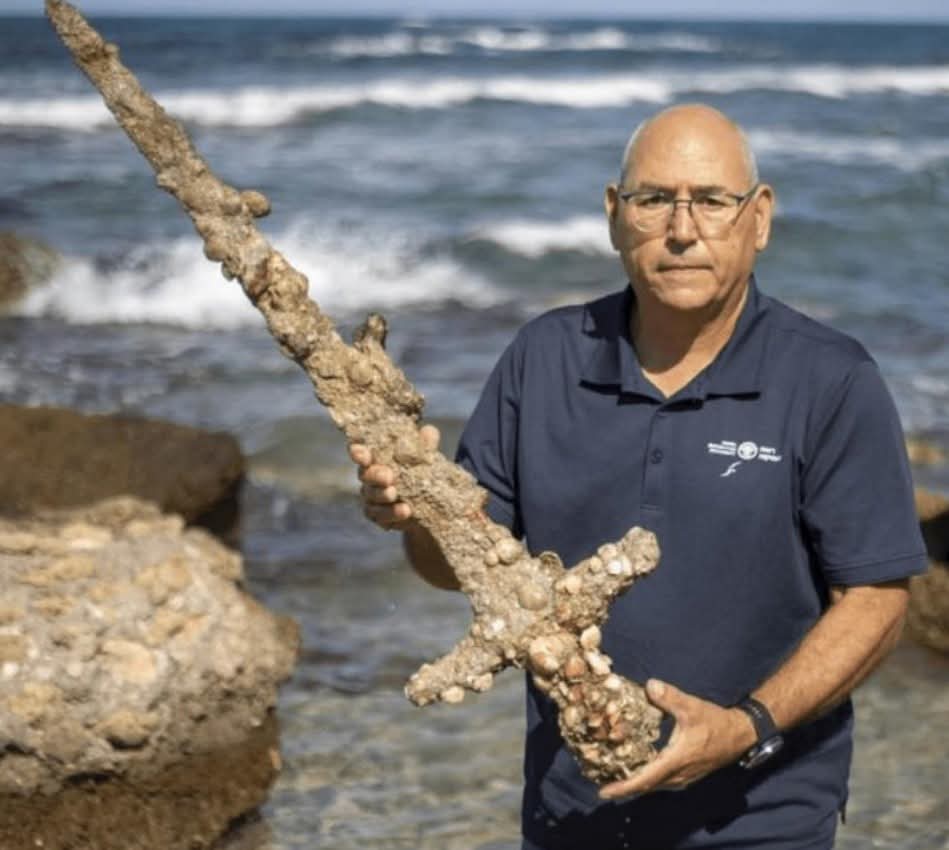
A 900-year-old Crusader sword that was found in 2021 on the bottom of the Mediterranean by a scuba diver...
The iron sword, measuring about 3 feet (1 meter) long, was discovered by diver Shlomi Katzin near the ancient port city of Atlit after shifting sands exposed artifacts on the seabed.
Archaeologists from the Israel Antiquities Authority identified the weapon as a Crusader-era sword dating to roughly the 11th–13th centuries. The region was a major battleground during the Crusades, when European Christian kingdoms established and defended territories in the Levant. Atlit itself was home to the formidable Crusader fortress known as Château Pèlerin, built by the Knights Templar in 1218.
Although heavily encrusted with marine organisms after centuries underwater, conservation experts determined that the blade and hilt remained remarkably well preserved beneath the deposits. The sword was carefully recovered and stabilized to prevent deterioration once exposed to air.
Thousands of medieval ships passed along this stretch of coastline, and underwater surveys have uncovered anchors, pottery, weapons, and cargoes spanning more than 4,000 years of maritime history, making it one of the richest underwater archaeological regions in the eastern Mediterranean.
For centuries, we have been captivated by its pattern. But now it is our turn to create the pattern ourselves – through our lives, our fight, and every new step we take.
Every day, Ukrainians embroider it with their own hands – defending what they hold dear, rebuilding what has been destroyed, healing wounds, teaching children, and continuing to learn themselves. We preserve our memory and build the future.
Happy Vyshyvanka Day, Ukraine! Celebrating the destiny we embroider in independence!
Testing the next gen lunar surface space suit.
It's easy to climb into (through the back), has good mobility, the gloves work fine. We were evaluating the interfaces with the @Astrolab_Space rover - launching to the Moon later this year.
Great to see and experience the new legacy of the @Axiom_Space suit in their Houston test rig.








![Rainmaker1973's tweet photo. Scientists have discovered a promising new way to help the immune system detect and attack hidden cancer cells.
A first-in-class drug called GRWD5769 (an oral ERAP1 inhibitor) has shown encouraging early results, shrinking tumors in patients with six different types of advanced cancer: lung, liver, bladder, cervical, head and neck, and colorectal.
In a Phase 1/1b clinical trial (EMITT-1) involving 83 heavily pre-treated patients across multiple countries, tumors shrank in 26 participants. Of those, 15 experienced reductions of at least 30%. Many patients had already failed prior therapies, including immunotherapies.
The drug works by blocking the enzyme ERAP1, which cancers often use to “edit” their surface proteins and evade immune detection. By inhibiting ERAP1, GRWD5769 alters the tumor’s antigen presentation, effectively removing the cancer’s invisibility cloak and making the cells more visible to the immune system. It was tested in combination with the PD-1 inhibitor cemiplimab (Libtayo).
Particularly strong signals were seen in certain hard-to-treat cancers. For example, disease control for at least six months was achieved in 51% of colorectal cancer patients and 55% of lung cancer patients in the expansion cohorts.
While these early results are promising, experts emphasize this is still an early-phase study. Larger trials are needed to confirm efficacy, durability of response, and impact on long-term survival.
If successful, this approach could expand the number of patients who benefit from immunotherapy — which currently works in only about one-third of cases.
[Grey Wolf Therapeutics. “EMITT-1: Clinical and pharmacodynamic activity with the oral ERAP1 inhibitor GRWD5769 and cemiplimab in 6 completed phase 1b expansion cohorts in solid tumors...” Presented at ASCO Annual Meeting, 2026]](https://pbs.twimg.com/media/HKDxE34WgAAZzA5.jpg)