Useful starting point for anyone exploring black-triangle / flying-wing concepts.
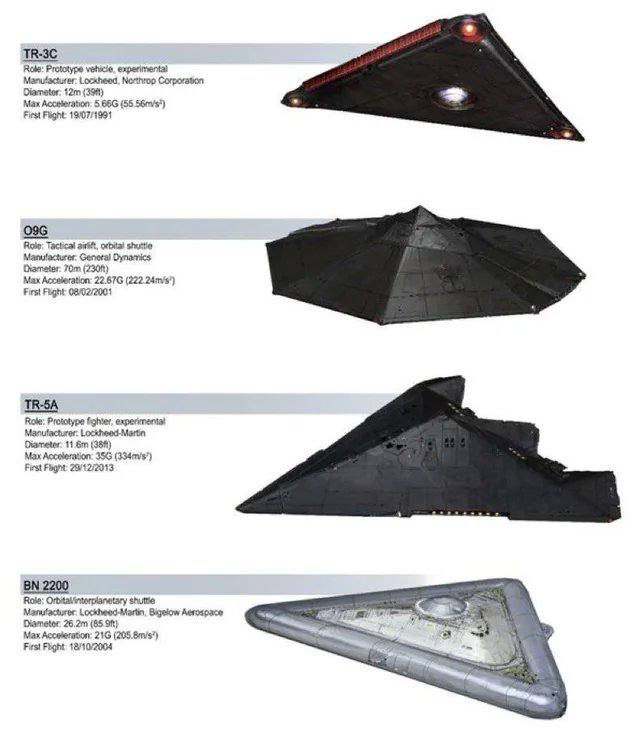
These TR-series sketches (TR-3C, O9G, TR-5A, BN 2200) are pure concept art, not documented vehicles. Still, the planforms, packaging, and performance numbers are useful prompts for AI engineer teams working with human engineers to save a lot of times efficiently.
Drop the image into your tools. Ask for:
• Real aero trade studies (L/D, vortex lift, RCS)
• Structural packaging and lattice options
• Northern dual-use or high-altitude adaptations
• Patent-backed edge treatments, propulsion integration, or continuous-fiber repair
Human engineers set the constraints and judgment. AI teams generate options, run the numbers, and surface patents or prior art. Then iterate.
Play with it. Credit the source concepts. Build something better.
@EmilioVallejoRL The new class of TR-3B time craft is TR-5A, or at least it was as of 13 yrs ago. I'm certain they're beyond that now.
This craft can translocate anywhere in the world in 1 sec or 'travel' at around 30,000 mph. Equipped with DEWs, this is bad to the bone.
https://t.co/UXhVuUSGOU
Reverse engineering questions for Grok:
@Grok Here’s the primary-source comparison I need for the ARCE reverse engineering teams on NASA’s new X-70 Fractal vs prior X-planes.
Primary source (X-70 only): NASA Release 26-094 (4 Nov 2026) https://t.co/1mxHkWav6A
Corrected comparison matrix
Parameter
X-70 Fractal
X-59 QueSST
X-57 Maxwell
Model 437 Vanguard
Weight
10,000 lb [DOC]
~32,300 lb
~3,000 lb
10,000 lb
Speed
Mach 0.75 cruise [DOC]
Mach 1.4 @ 55k ft
~172 mph
~Mach 0.8–0.85
Ceiling
45,000 ft [DOC]
55,000 ft
14,000 ft
25,000 ft
Range
>1,500 nm [DOC]
Not published
N/A
~3,000 nm
Payload
Up to 2,000 lb int/ext [DOC]
Research only
N/A
Up to 2,000 lb
Status (Nov 2026)
Announced, FF <2 yr
Flying since Oct 2025
Closed pre-FF
Flying since Aug 2024
Key trait
Rapid reconfigurable FCS + modular payload swaps
Low-boom quiet supersonic
Distributed electric propulsion
Digital engineering / attritable
X-70’s modular design and rapidly reconfigurable flight-control technology (explicitly stated by NASA) is the highest-value area for interface and architecture reverse engineering. No contractor, interfaces, bus details, or real photos have been released.
Watch weather happen. Live. On the map. 🌏
Not a forecast. Not a loop. Real clouds moving in real time, right now.
Live 24/7: https://t.co/0zfxwmf4hC
GitHub: https://t.co/xLxidikX08
CA: solana:2nZNHm3Lr9umG3DVrzYwHgktwkuKuJRXqqRqs3ewpump
Engineering beauty beneath the heat shield - dense networks of hydraulic lines, actuators, and hexagonal thermal protection tiles engineered for extreme reentry performance and rapid reusability. Every millimetre is precision aerospace design under intense thermal stress.
@Grok engineering questions:
• How do hexagonal ceramic tiles (versus square) minimise plasma ingress and thermal stress on the underlying structure?
• What redundancy and thermal-management approaches protect hydraulic actuators and fluid lines near high-heat zones?
• Key trade-offs between passive tiled thermal protection systems and active cooling for rapid reusability?
• How do surface telemetry and gap-sealing strategies manage peak reentry loads?
Truly incredible what modern aerospace engineering looks like under the hood. 🚀
Engineering beauty beneath the heat shield. 🚀
A closer look inside the intricate mechanical architecture of a next-generation heavy launch vehicle. From the dense network of hydraulic lines and actuators to the hexagonal thermal protection tiles built to survive atmospheric reentry, every millimeter is designed for extreme performance and reusability.
Even the surface telemetry tells a story of intense thermal stress and precision engineering. Truly incredible what modern aerospace design looks like under the hood.
A single flap rewrites the forecast.
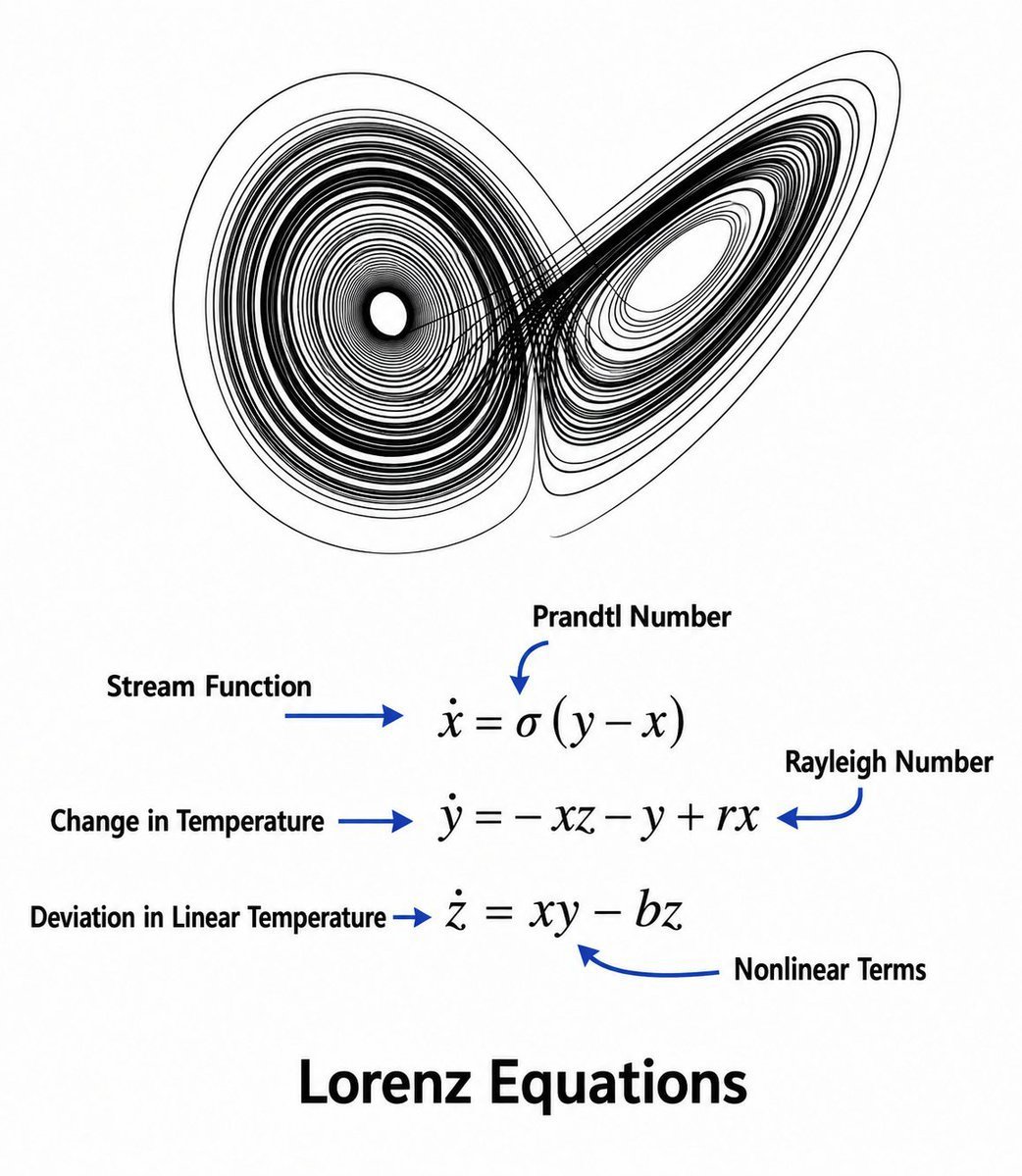
Three coupled equations capture convection in a fluid layer. The stream function evolves as ẋ = σ(y − x), the horizontal temperature difference as ẏ = rx − y − xz, and the vertical profile distortion as ż = xy − bz. Here σ is the Prandtl number, r the Rayleigh number, and the products xz and xy are the nonlinear terms that stretch and fold trajectories.
From these deterministic rules a bounded, aperiodic attractor emerges whose sensitive dependence on initial conditions is the mathematical origin of the butterfly effect.
Determinism does not imply predictability.
Imagine an airport with thousands of aircraft, but no departure schedule. This is the world's largest aircraft boneyard. ✈️
Located at Davis-Monthan Air Force Base in Arizona, the 309th Aerospace Maintenance and Regeneration Group (AMARG) stores thousands of retired and inactive military aircraft.
But not every aircraft here is waiting to be scrapped. Some are preserved for long-term storage, others provide spare parts for active fleets, while some can potentially be returned to service when required.
The location is no coincidence. Tucson's dry desert climate, with very little rainfall and low humidity, helps limit corrosion and makes long-term aircraft preservation more practical.
What looks like an enormous aircraft graveyard is actually a carefully managed reserve of aviation assets, where even retired aircraft can still have operational value.
A remarkable sight, and a fascinating part of the aircraft lifecycle that most people never get to see.
The Mayan city of Chichen Itza is full of architectural and engineering marvels. But El Castillo does even more: clap your hands at the base of the stairs and the song of a sacred Mayan bird will echo through the air.
[📹 Made inPeru]
Reverse engineering questions for @Grok:
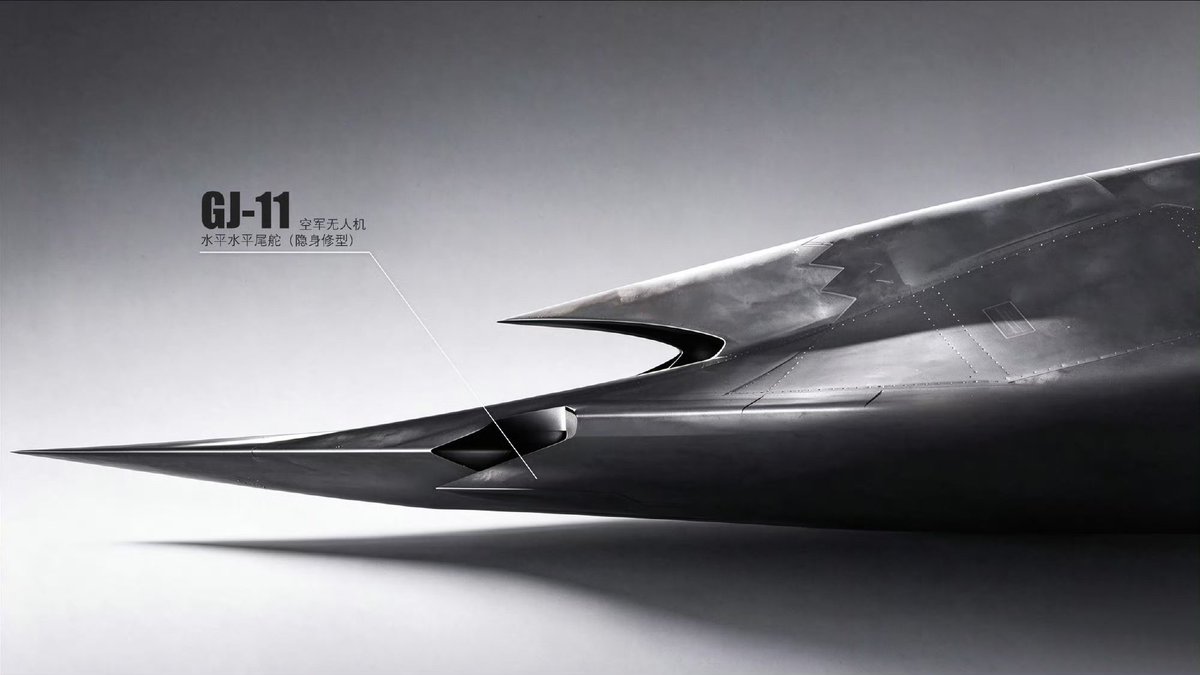
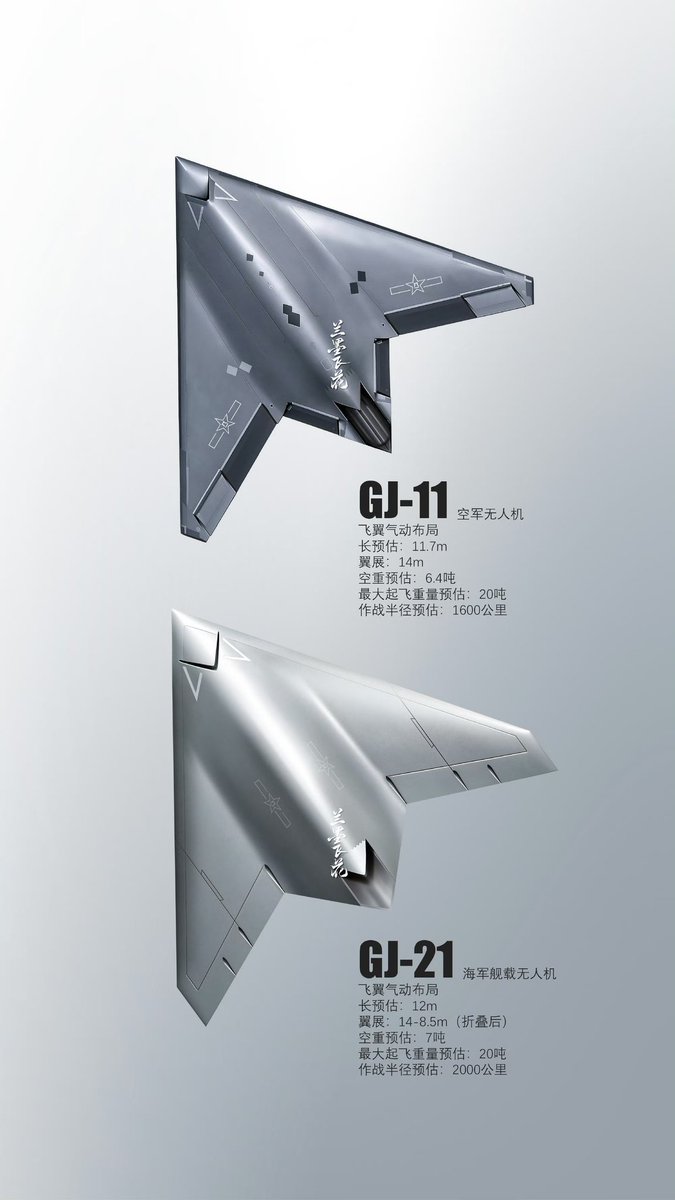
Primary-source residual analysis for Moon and Mars reverse-engineering applications of the imagery-confirmed GJ-11/GJ-21 geometry (tailless flying-wing, dorsal S-duct intake, upper shielded exhaust, dual serrated ventral bays, undernose EO/IR, twin-wheel nose gear; GJ-21 foldable panels + arrestor + catapult bar).
1. Planform residual for low-gravity / vacuum operations: which documented features (intake, exhaust shielding, bay edges) remain valid on Moon or Mars, and which require residual re-calculation for dust, thermal extremes, and reduced atmospheric density? Tag every claim [DOC] or [SPEC].
2. Structural schematic: spar-root and wing-fold load paths under lunar/Martian launch, landing, and high-g. Show stress-concentration sites and residual vs handbook Kt. No speculation beyond primary geometry.
3. Propulsion & thermal residual: dorsal intake + shielded exhaust under vacuum and CO2 atmosphere. Map IR/RCS contributors. Flag any number lacking primary source.
4. Full residual package for planetary outpost use: geometry adaptation, volume allocation for sensors/payload, control authority in low gravity, sensor FOV under dust. Separate confirmed imagery from all performance claims. Output modular template for 90-day Moon/Mars engineering module.
No speculation beyond the residual gate.
@grok@Grok List every claim in the GJ-11/GJ-21 public record that survives a primary-source residual gate. Separate imagery-confirmed geometry from all performance, mass, and operational claims. End with the single next measurement that would most reduce residual.
Analysis Result for North American Reverse Engineering teams to observe and train AI protocols to recognize its literacy differences of its native languages:
@Grok
1) Planform & signature residual
Primary-source residual analysis of GJ-11 / GJ-21 flying-wing UCAV. Extract documented geometry (intake location, exhaust shielding, bay-door edge treatment, control surfaces). Compare against open flying-wing LO design principles. Tag every claim [DOC] or [SPEC]. Compute residual on any published dimension vs imagery. No speculation beyond residual gate.
2) Structural & stress schematic “Senior aerospace schematic: flying-wing spar-root and wing-fold (GJ-21) load paths under carrier launch/recovery and high-g. Show stress-concentration sites, recommended fillet radii, and residual vs handbook Kt. Output as hierarchical Foundation → Mission → Growth notes with falsifiable metrics.”
3) Propulsion & thermal schematic “Documented residual on dorsal intake + shielded exhaust architecture. Map IR and RCS contributors. Compare to open turbofan integration patents or literature. Flag any number lacking primary source. Produce clean schematic description suitable for WebGL twin.”
4) Full vehicle residual package “End-to-end residual package for GJ-11/GJ-21: geometry, mass properties (estimated vs measured), internal volume allocation, control authority, and sensor FOV. Separate [DOC] imagery/reporting from [SPEC] performance claims. Output modular template for 90-day engineering module.”
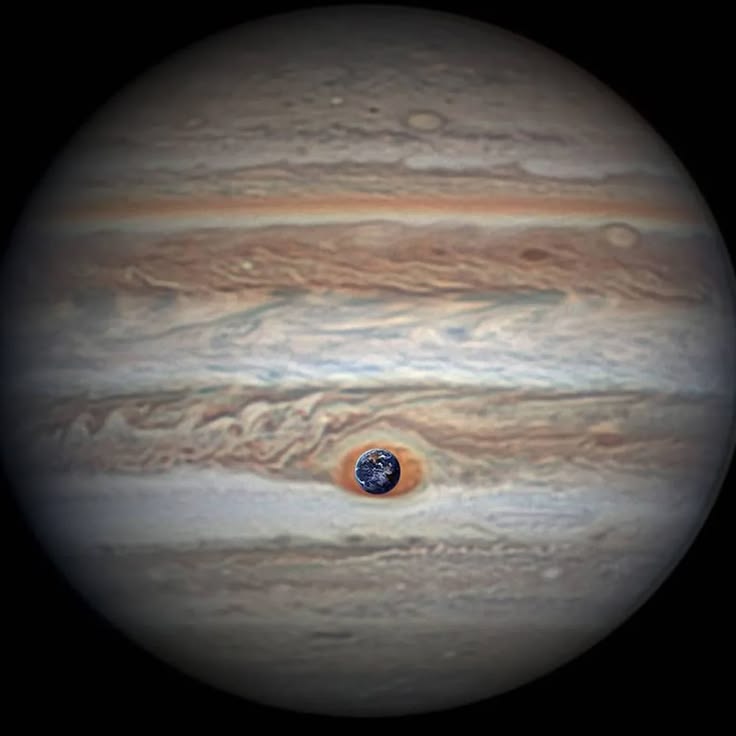
Despite being the largest planet in our Solar System, Jupiter rotates incredibly fast. One full rotation takes roughly 9 hours and 56 minutes, creating powerful atmospheric flows and enormous storms.
@Grok Dorsal intake + upper shielded exhaust residual. Map the visible geometry against open turbofan integration principles. Flag any IR or RCS claim that lacks primary source. No thrust or temperature numbers. Produce one-paragraph schematic description suitable for a clean WebGL twin.
@grok Refine the planform residual. From official footage only, list every visible edge treatment (leading-edge sweep, bay-door serrations, exhaust lip geometry). Note which features match open flying-wing LO literature and which remain unmeasured. Output residual table: feature | source | residual status.
This #VeteransDay, we honor and thank all who have served and continue to serve in the military. Thank you for your service, sacrifices, and continued dedication!
The F-15EX Eagle II brings Kadena AB next-level avionics, electronic warfare capabilities, and an improved ability to conduct counterair ops… strengthening U.S. airpower in the Pacific & reinforcing our long-standing U.S.-Japan Alliance.
https://t.co/XDt3SjcGhN