New paper from @M_Keeble exploring public acceptability of local planning restrictions on new takeaways around schools. 51% of adults support, 37% neutral, 9% opposed. Thus new proposals are unlikely to be met with substantial public disapproval https://t.co/zanb4XSwtF
We’ll be checking in before & after Mandala research projects through a series of short films. Here's a taster of the first film profiling our research with Change Kitchen, a social enterprise in Balsall Health, Birmingham... #foodsystems#healthy#sustainable
It’s now four years since the beginning of the COVID-19 pandemic. Research from the Fenland COVID-19 study and the main Fenland Study is helping us discover more about the impact of the pandemic and its long term effects on health behaviours. https://t.co/zrNRiqsnCA
Researchers interacting with the food industry can be subject to conflicts of interest and reputational risks. New guidance published in @bmj_latest can help researchers navigate this tricky territory... https://t.co/nc5Lyhe24V 🧵
Heard of participatory systems mapping and not sure where to start?
A new guidance and framework developed by researchers @theSPHSU & @Cambridge_Uni will help you select the method that’s right for you and think about how to design your project
https://t.co/HZSUkA4JMY
Are you looking for a #PhD in #Epidemiology or #PublicHealth research?
Application is now open for our 2024/2025 #PhDstudentships
⏰Closing date: 4 January 2024
More info & application details: https://t.co/uLRrasIRA8
Read the paper 'Estimated impact of the UK soft drinks industry levy on childhood hospital admissions for carious tooth extractions: interrupted time series analysis' by @Nina_Tr_Rogers and colleagues in @BMJNutrition
https://t.co/lfDe09KlcT
(2/2)
UK soft drinks industry levy introduced in 2018 may have reduced the number of under 18s having a tooth removed due to tooth decay by 12%, with the largest reductions were in children aged up to nine years old.
Read our news article👉 https://t.co/AP7nruu5FT
#SugarTax
(1/2)
There's lots of talk about 'systems thinking' in public health research, but it's not always clear what it might mean for doing things differently. In this paper @miriamralvarado discusses how systems thinking could help generate novel research questions. https://t.co/1LX8IKRJr9
Join us this Friday, 10 November, 2pm GMT to discuss with PhD Georgina Dowsett
"Are anti-obesity drugs really the answer to the problem of our food system?"
@CamMetaboNet@Cambridge_Uni
Email [email protected] for the Zoom link
🚲The Propensity to Cycle Tool (PCT) for England and Wales provides an evidence base to inform cycling investment, designed to assist transport planners and policy makers to promote cycling. https://t.co/UKjaEBaFBn
It’s day two of #InternationalOpenAccessWeek and we’re highlighting our range of freely accessible scientific resources and tools today! ✅ https://t.co/Y2h2cj191w
Did you know it’s #InternationalOpenAccessWeek?
To start the week off #icymi in July, we wrote about our commitment to Open Science and how we’ve been able to support innovative research in practice through the Omicscience webserver. 🌐
Read more: https://t.co/UZotceltfI
Report makes nine key recommendations to adopt a whole systems approach to better support #physicalactivity in pregnant and postnatal women, upskill more fitness professionals, and ⬆️provision of high quality pregnant & postnatal classes.
Read: https://t.co/3tUbc4ryeG
(5/n)
The @PregnancyActive#COVID19 lockdown survey of 722 #pregnant & #postnatal women found low levels of physical activity compared to pre-lockdown.
The report by @KathrynHesketh & colleagues found reduced opportunities and ability to be active.
https://t.co/32yArXxCHe
🧵(1/n)
New paper on using systems thinking to guide evaluation of SSB taxes. @miriamralvarado shows how systems thinking helps us ask research questions that enable a deeper understanding of how systems & interventions adapt to each other. https://t.co/rfbu1F3t7V
Are plant-based meat alternatives a nutritionally sound alternative to meat? 🥩🍔🫘
Dr Daniel Borch Ibsen, Research Associate, @MRC_Epid, @Cambridge_Uni examines the evidence on #WorldPulsesDay2023
Read his thoughts here: https://t.co/kO1c1dyZk2
New paper exploring availability of online food delivery services in 7 Euro countries. UK has highest availability, in most countries there's more availability in more affluent areas. https://t.co/7iQ8htnND4
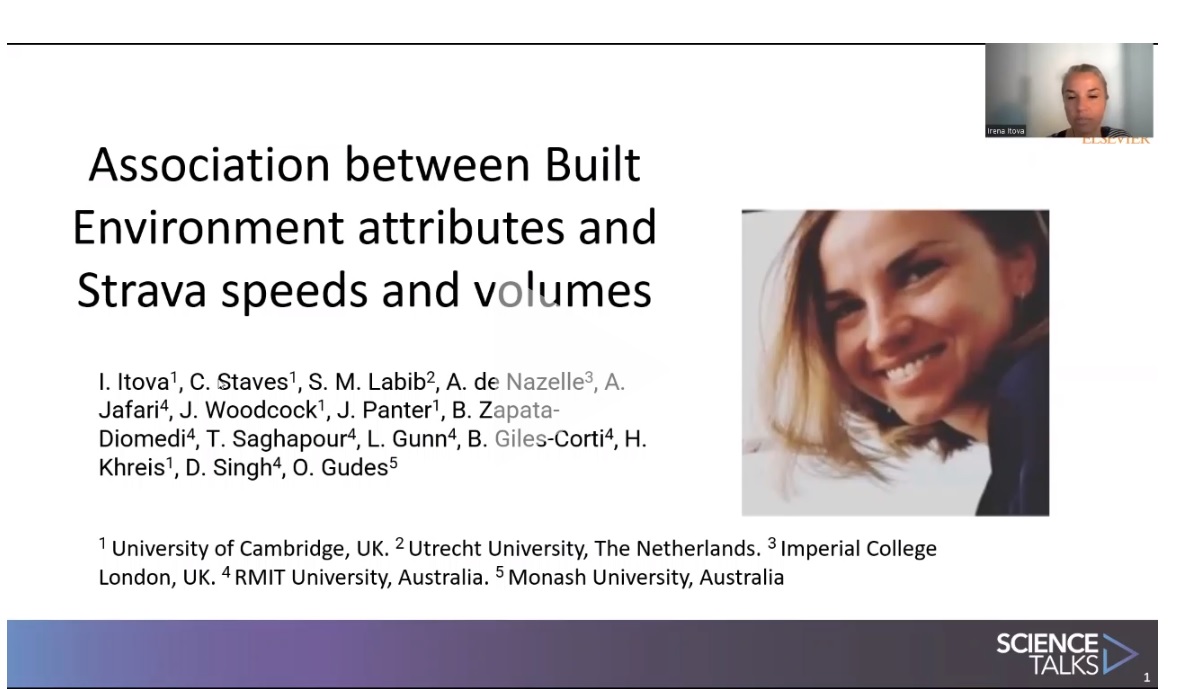
In a Science Talks video Unit researcher Dr Irena Itova discusses the findings of an analysis of #Strava data from Greater Manchester examining the association between travel delays for #cycling and #walking and features of the built environment.
https://t.co/hy6fJ2Rf1f