The Labs are now open.
Explore engineered cells in a living simulation. Observe division, mutation, and selection. Investigate receptor trials, analyze saved replays, and study how cells interact with cancer under changing conditions.
From experimentation to biological insight, connect what you observe to cell therapy, immune responses, and cancer biology.
Experiment. Investigate. Understand.
CA: DTVhWCAooToWKUhfXsvfgV7mtAXu5JPk5GWei3G2pump
WEB: https://t.co/K3Fkm1GIxi
Welcome to the Labs.
🔐 Just locked 31,105,977 $Cellules tokens with @Streamflow_Fi
It's on-chain. You can check the amount, time-period and recipients.
Check it out👇
https://t.co/kfHXYFdr7c
gm ☀️ 〔●〕
Every morning, billions of cells divide, communicate, and respond to the world around them.
Life is a continuous process of adaptation, from the smallest cellular signal to the complexity of an entire organism.
Today is another opportunity to understand it a little better.
Stay curious. Keep exploring.
gm from Cellule. ⌬
〔●〕 CELLULE // COMPUTATIONAL BIOLOGY
Biology generates enormous complexity from relatively small components.
A mutation can alter a protein. A receptor can change how a cell responds to a signal. A shift in environmental conditions can affect which cells survive and which populations expand.
When these events interact, the resulting behavior can become difficult to predict from individual components alone.
Computational modeling offers a way to explore these relationships in a controlled environment. Researchers can examine different configurations, compare outcomes, and investigate how changes in assumptions influence the system.
The value lies in the questions it makes possible.
What changes when a cell encounters another population? How does position affect potential interactions? Which conditions produce different outcomes?
These are questions worth exploring systematically.
⌬ CELLULE — WHERE CELLULAR BIOLOGY MEETS COMPUTATIONAL EXPLORATION.
〔●〕 CELLULE // BUILDING THE LAB
Understanding biology requires more than collecting observations. It requires investigating the mechanisms connecting them.
Cell behavior emerges from interactions between genetic programs, molecular signals, environmental conditions, and neighboring populations. These relationships become especially important when studying complex systems such as cancer and engineered cell therapies.
Our focus is on making these systems more accessible to exploration through simulation.
A controlled environment allows us to examine cellular arrangements, consider how different populations may interact, and investigate how biological outcomes depend on the conditions surrounding them.
Every model has limits. Simulations do not replace laboratory evidence, and modeled behavior must not be confused with validated biological results.
But computational tools can help make complex questions more structured, observable, and testable.
We believe the ability to explore biological systems will become an increasingly important part of how people learn, investigate, and reason about cellular behavior.
This is the direction we are building toward.
〔●〕 CELLULE — UNDERSTANDING LIFE AT THE CELLULAR LEVEL.
〔●〕 CELLULE // LEARNING CENTER
Want to understand the science behind the cell?
The Cellule Curriculum is your starting point for learning biology, from cellular structures and biological mechanisms to experimental evidence.
Explore lessons, build your understanding, and track your progress as you learn.
Biology, one lesson at a time.
⌬ Start learning: https://t.co/MGX5EhS4ZC
🔐 Just locked 8,450,159 $Cellules tokens with @Streamflow_Fi
It's on-chain. You can check the amount, time-period and recipients.
Check it out👇
https://t.co/1FadgNysTf
〔●〕 CELLULE // BIOLOGICAL SYSTEMS
A cell's behavior is the product of many interacting mechanisms.
Genetic instructions establish possibilities. Receptors detect signals. Intracellular pathways coordinate responses. Environmental conditions influence which behaviors are sustained.
When these mechanisms become disrupted, the consequences can extend beyond an individual cell.
In cancer, altered regulation can contribute to uncontrolled proliferation, while interactions with the immune system and surrounding tissue can influence disease progression.
In engineered cells, the same broad principle highlights an essential question: how will a modified cell behave within a changing environment?
Cellule explores this perspective through cellular modeling and simulation.
By making cellular arrangements and interactions observable, we can begin to investigate the relationships that define the system.
One cell is a starting point. The interactions reveal the complexity.
〔●〕 CELLULE // ENGINEERED BIOLOGY
Engineered cells represent an important area of modern biotechnology.
By modifying cellular properties, researchers can investigate how cells recognize signals, respond to specific conditions, and perform defined biological functions. These principles are relevant to fields including synthetic biology, immune-cell engineering, and cell-based therapies.
But engineering a cell is only one part of the challenge.
Its behavior depends on the biological environment in which it operates. Receptor interactions, surrounding signals, and differences between cell populations can all influence the outcome.
This is why modeling cellular interactions matters.
The next step in understanding a biological system is learning how its individual components behave together.
〔●〕 CELLULE — EXPLORING CELLULAR SYSTEMS.
〔●〕 Cellule just got the X verification mark.
Another milestone for the lab. More biology, more research, and more to come.
We’re just getting started. ⌬
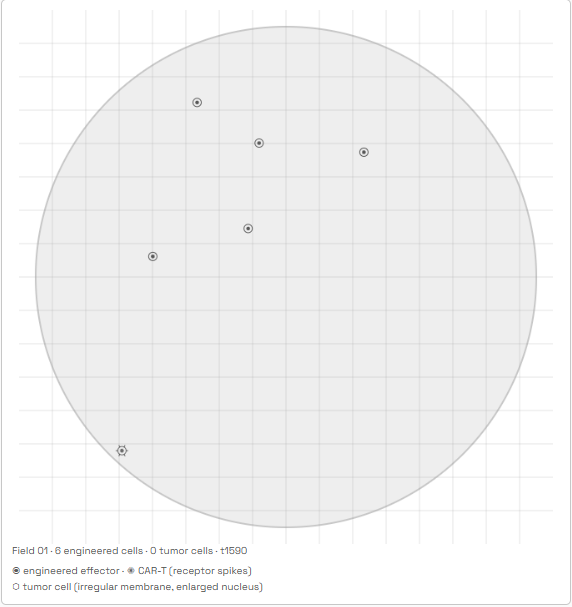
〔●〕 CELLULE // SIMULATION 001
Six engineered cells. Zero tumor cells. One controlled environment.
Cellule models cellular interactions within a defined system, allowing us to observe cell positioning, receptor behavior, and how engineered cells may encounter changing biological conditions.
The objective is to make complex cellular dynamics observable, testable, and easier to investigate.
Every cell is part of the system. Every interaction matters.
⌬ Biology, modeled.
⌬ CELLULE // RESEARCH LOG 001
A tumor is more than a collection of abnormal cells.
It exists within a complex ecosystem of immune cells, blood vessels, connective tissue, chemical signals, and surrounding healthy cells. Each component influences the conditions in which cancer develops.
Some interactions may support tumor growth. Others can restrict it. Immune activity can help eliminate abnormal cells, while certain tumors develop mechanisms that weaken or evade those defenses.
This is what makes cancer biology so complex.
The cell matters. Its environment matters. And the interactions between them can change everything.
〔●〕 CELLULE // BIOLOGY NOTES
Cancer is not a single event. It is a process.
A mutation changes how a cell behaves. That change can affect its ability to divide, survive stress, or interact with neighboring cells. Over time, additional alterations can create populations with different biological advantages.
Selection shapes which populations persist. The surrounding environment influences which survive.
To understand cancer, we have to look beyond the mutation itself and study how cellular systems change over time.
The smallest changes can reshape the behavior of an entire system.
One mutation rarely explains the full complexity of cancer.
Disease progression often involves multiple genetic alterations interacting with cellular pathways and environmental conditions over time.
The challenge is to understand how these changes combine to produce new biological behavior.
🔐 Just locked 12,752,010 $Cellules tokens with @Streamflow_Fi
It's on-chain. You can check the amount, time-period and recipients.
Check it out👇
https://t.co/ZDoPzYTe44
Healthy cells follow tightly regulated instructions.
When DNA damage, cell-cycle control, and programmed cell death mechanisms are disrupted, abnormal cells may survive and proliferate.
Cancer biology begins with understanding how these safeguards work, and what happens when they fail.
A tumor is not a uniform population of cells.
Different cells can carry different mutations, respond differently to their environment, and compete for the resources needed to survive.
This cellular diversity is one of the reasons cancer is so difficult to treat.
One of the biggest challenges in cancer research is understanding why similar tumors can respond differently to the same treatment.
Genetic diversity, cellular states, immune activity, and environmental conditions can all contribute.
The deeper we investigate the system, the more important the interactions become.
Cell division is essential to life. So is knowing when to stop.
Healthy tissues rely on tightly regulated mechanisms controlling proliferation, DNA repair, and programmed cell death. Cancer can develop when multiple safeguards fail, allowing abnormal cells to persist and expand.
Cancer research is not only about identifying abnormal cells.
It is about understanding the mechanisms that allow them to survive, adapt, communicate, and resist intervention.
Every interaction offers another layer of the system to investigate.
A cell does not exist in isolation.
Its behavior depends on genetic instructions, chemical signals, neighboring cells, and environmental conditions. In cancer, these interactions can influence tumor growth, immune responses, and treatment resistance.
The surrounding environment is part of the biology.