Elon Musk just named AI’s next crisis. It’s not a shortage. It’s a surplus nobody can switch on.
Musk: “By the end of this year, chip production will outpace the ability to turn chips on.”
For three years the world was starved for silicon. Every lab, every government, every company racing to secure the chips that decide who wins the AI era.
That bottleneck is ending. A harder one is replacing it.
Musk: “The chips are going to be piling up and not be able to be turned on.”
Billions of dollars in the most advanced AI hardware ever built. Sitting dark.
Not because the chips don’t work. Because there isn’t enough electricity to run them.
You can’t print a power plant the way you print a chip.
The fabs scaled. The grid didn’t. Now the hardware everyone fought over is hitting a wall capital can’t buy its way through.
Compute becomes abundant. Electricity becomes the most valuable commodity on earth.
Physics doesn’t care about your chip architecture if your data center can’t pull the megawatts.
Every mind that has ever existed was limited by what it could eat. Ours ran on grain. This one runs on the grid.
That has never been solved by thinking. Only by building.
The war isn’t about who can print the most silicon. It’s about who can plug it in.
Whoever solves energy first doesn’t just win. They own the rails everyone else has to rent.
The losers stack chips in warehouses, waiting for power that never arrives.
We built a trillion dollar engine and forgot the fuel.
Montenegro: a country of retards
Montenegro looks like your average European country, but with a twist. It has cute old towns. The people are chain smokers & don't work between May & September. Typical European stuff. What sets Montenegro apart is the people are barely functioning retards.
For example, they can't count. Our corner store has 3 cashiers and only takes cash. However, NONE of those 3 cashiers can give correct change. One time to the store was 14 Euros. I gave her a 50. She gave me 55 Euro back (a 20, 2x 10, 3x 5). It was like this every single time. They were never close. I have no idea how that place stays in business.
And everything is like this in Montenegro. My female ordered an espresso martini at a bar. They poured vodka into an espresso. It was served hot. They could've said they didn't have espresso martinis. They chose to be idiots instead because that's their culture.
It's 9 pm, time to run the weed whacker for a few hours! What could take hours with a weed whacker? Montenegrins will use them to mow entire fields. You might as well be out there with a scissors.
Most of the Slavic countries put ketchup & mayo on their pizza because it's so dry. Well, there's this thing called 'tomato sauce' that's a lot like ketchup that does the same thing. I know they have tomato sauce because it's not only in the stores, it's on the frickin' pizza. They just don't use enough of it. Everything is like this in Montenegro, where the solution is so easy yet they can't grasp what's going on.
There don't seem to be any laws in Montenegro. People build wherever or do whatever they please. I watched as people ignored cops saying they couldn't be on this private property (they were sunbathing). There's petty theft, as store employees are constantly following you around & watching. But outside of that, nothing. They're too dumb to follow laws, but also too dumb to commit crime.
The food: seafood or starve. They have the typical slavic meat dildos (cevapi). God I hate the meat dildos. It has been months of this crap. Why do I keep ordering them? Because the alternatives are dry pizza, soggy pasta, or fish. I can only eat so much fish. I guess I'll have the meat dildos, please.
The landscapes are beautiful. I think the prettiest coastline on the Med. So why isn't this a more known destination? Because there aren't many beaches. In Herceg Novi, people sunbathe on the concrete. Or the rocks. Like lizards on the sidewalk.
Smoking is the national sport. And they love to compete with you. It doesn't matter where you sit in the restaurant. The next person(s) who come in will sit by you and start smoking. The entire place will be empty. You can pick the worst spot in the place. And someone will go out of their way to sit by you and light up. Your meals will be eating meat dildos while choking in smoke.
Another good thing about their country is they're openly racist. This time against the Albanians. I was getting bored of people hating Serbs, Croats, Bosinaks, or Kosovoans.
I almost forgot: I look like Chewbacca now. I haven't been able to get a haircut in over a month. When a business posts their hours here, that's just a dream of when they'd like to be open. The reality is it's summer and the barber is out laying on the concrete like a lizard, smoking. Judging from their hairstyles, I think they cut their own hair. With a weed whacker.
I think the order of intelligence goes like this:
Croats seem to be the smartest of the Slavs. They took the incredible Dalmatian coast for themselves. Great move. Do they have a functioning country? God no, but they have a nice view.
Then comes the Serbs as next most intelligent. And to show you how low this bar is, Serbs aren't potty trained. They piss in the streets. Belgrade smells like piss. And these are the 2nd smartest Slavs.
Montenegro is 3rd. They can't count. They can't follow laws. But they're not smart enough to conceive of crime, so it kind of works out.
Bosniaks are clearly the dumbest because BiH has THREE governments. Damn that's dumb.
🇫🇮 Finnland zieht den Stecker: Russlands größte Internet-Ader nach Europa fällt weg
Der finnische Netzbetreiber Fingrid hat russische Telekom-Betreiber informiert, dass er ab 2027 keine Strommasten mehr wartet, an denen Glasfaserkabel befestigt sind – laut Kommersant.
Die Kabel sollen gekappt, die Masten demontiert werden.
Hintergrund: Russland stellte im Frühjahr 2022 seine Stromlieferungen nach Finnland ein, nachdem Zahlungen ausblieben. Seitdem lohnt sich der Betrieb der grenzüberschreitenden Masten für keine Seite mehr.
Russland hat kein vollständig abgeschottetes eigenes Internet.
Das „Runet"-Gesetz gibt dem Staat nur die technische Möglichkeit zur Notabschaltung – im Alltag hängt Russland an denselben internationalen Kabeln wie jedes andere Land, für Zahlungsverkehr, Cloud-Zugriff und Kommunikation mit dem Ausland.
Und genau davon verliert Russland jetzt einen gewaltigen Batzen: laut Kommersant liefen zuletzt 60 bis 70 Prozent des internationalen Internetverkehrs über Finnland, bis zu 30 Prozent davon direkt über die betroffenen Masten-Kabel. Meduza bestätigt den Bericht unabhängig.
Zwar bleiben Ausweichrouten – über Belarus, das Baltikum oder Unterseekabel. Aber jede davon wird jetzt deutlich teurer und stärker ausgelastet. Eine Verlagerung auf Belarus würde Moskau zusätzlich noch abhängiger vom letzten verbliebenen Verbündeten machen.
Ein weiteres Stück der digitalen Brücke zum Westen bricht weg – nicht durch Sabotage, sondern durch simple ökonomische Logik:
Wer die Energie-Kooperation aufkündigt, verliert auch die Infrastruktur, die daran hing.
Für Russland bedeutet das: mehr Kosten, mehr Abhängigkeit, weniger Kontrolle über die eigene Anbindung an die Welt. 🇷🇺
Schreibt's eure Meinung in die Kommentare. 👇
Quellen: Kommersant, Meduza, CNews
DUBAI, July 30 (Reuters) - Saudi Arabia's GDP fell 4.8% year-on-year in the second quarter of 2026, while its oil activities fell 24.7% in the same period, Saudi-owned Al-Arabiya TV said on Thursday.
EDWARD SNOWDEN'S MASSIVE WARNING.
WHAT CHINA BUILT... IS EXACTLY WHAT WESTERN GOVERNMENTS ARE QUIETLY PREPARING FOR.
SNOWDEN IS CRYSTAL CLEAR:
EVERY PHOTO, EVERY PURCHASE, EVERY MESSAGE, EVERY MOVEMENT — ALL OF IT IS BEING FED INTO ALGORITHMS THAT DECIDE YOUR FUTURE.
IN CHINA, AI "CITY BRAINS" NOW TRACK:
WHERE YOU LIVE
WHO YOU VISIT
HOW YOU DISPOSE OF YOUR RUBBISH
EVERY STEP YOU TAKE IN PUBLIC
WHETHER YOU "FOLLOW RULES" OR NOT
BREAK A RULE?
A CAMERA CATCHES YOU FROM THREE ANGLES.
YOUR SCORE DROPS.
YOUR LIFE COLLAPSES.
SNOWDEN'S WARNING:
"IF ANY OF YOUR ACTIVITIES DIFFER FROM WHAT THE GOVERNMENT WANTS, YOU WON'T GET ON A TRAIN.
YOU WON'T BOARD A PLANE.
YOU WON'T GET A JOB.
AN ALGORITHM WILL DECIDE YOUR FATE.
AND WHAT THEY ARE SELLING... IS US."
THIS IS NOT A FUTURE THREAT.
IT IS HAPPENING NOW — IN SHANGHAI, IN BEIJING... AND CREEPING INTO THE WEST THROUGH DIGITAL ID, AI POLICING, AND "MISINFORMATION SCORING."
CHINA BUILT THE PROTOTYPE.
OUR GOVERNMENTS ARE IMPORTING THE BLUEPRINT.
STAY INFORMED.
STAY ALERT.
DO NOT LET THIS SYSTEM TAKE ROOT.
Das ist die „Sängerin“ NYYA aus Berlin (ursprünglich aus Göttingen).
Diese Worte gab sie bei der Gedenkfeier für die Opfer des islamistischen Terroranschlags von Abdul Ballout auf den CSD von sich.
Ein neuer Tiefpunkt.
Das Netz vergisst nichts!
Die Linken zeigen ihre hässliche Fratzen.
„…das erste was ich gedacht habe, hoffentlich es kein Kanake, hoffentlich ist es eine christliche, weisse Person, war es aber nicht.“
🚨 Elon just nuked the entire media playbook in under 90 seconds.
Journalist: “You support the far-right!”
Elon: “No. You support the lunatic left.
What was completely normal 10-15 years ago is now called ‘far-right’…
because your side went completely insane.”
Safe cities. Secure borders. Biological reality. Common sense.
None of that is “far-right.”
It’s just not crazy.
The Overton window didn’t shift right.
The left sprinted off a cliff and started calling everyone who didn’t jump “extremists.”
Elon said it out loud.
And the media still can’t cope.
Lunatic left.
He’s 100% right.
@elonmusk 👏🏻
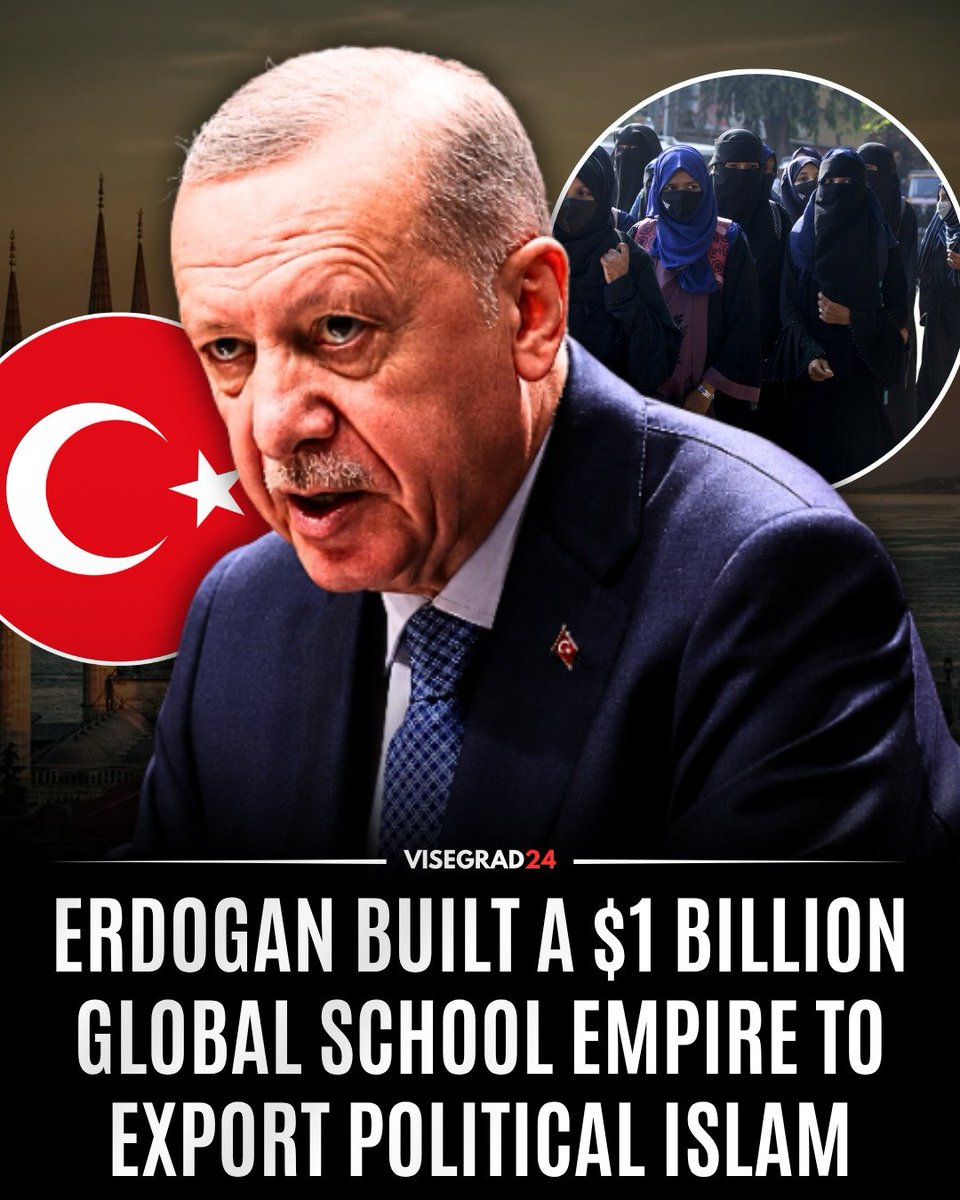
Erdogan has spent nearly $1 billion building a global school network that investigators say is used to export political Islam and target his opponents abroad.
According to a report by the Belgium-based human rights group Solidarity with Others, Turkey's state-funded Maarif Foundation educates around 30,000 students in 34 countries while helping Ankara seize control of schools previously linked to the Gülen movement.
Since 2016, the foundation has reportedly been involved in the closure, confiscation, or forced transfer of 162 schools across 29 countries, taking direct control of 131 institutions and affecting around 7,800 teachers and staff.
The report alleges Turkey used diplomatic pressure, security agreements, raids, deportations, and property seizures to force countries including Afghanistan, Mali, Niger, Sudan, Venezuela, Zambia, and Liberia to hand schools over to Maarif.
State funding for the foundation has exceeded 27.7 billion lira (about $900 million) since its creation. The report concludes there is a reasonable basis to investigate the campaign as persecution amounting to a crime against humanity under the Rome Statute.
Turkey is just one of several state actors that fund Islamists on a global scale.
Iran and Qatar are two other examples, with both heavily focused on spreading Islamism in Europe.
In #Österreich beträgt der Ausländeranteil ziemlich genau 20%.
Auf den österreichischen Universitäten - finanziert mit 15,5 MILLIARDEN Euro Steuergeld - beträgt der Ausländeranteil 62%.
Das ist verrückt! Mehr als die Hälfte davon verlässt 🇦🇹 nach Abschluss binnen drei Jahren!
Andre Rahhal & Jean Aziz: Hezbollah / Berri representatives
Andre who lied to US officials regarding disarmament …
Andre who is in bed with Selim Khalil - main launderer for Hezbollah cash.
Way to go Joseph Aoun!
@StateDept@WhiteHouse@POTUS@SecRubio@SecScottBessent
A guy named Shin just open-sourced Palantir for free.
It is called OpenPlanter.
Palantir helps governments and giant companies connect scattered data about people, businesses, contracts, and money.
OpenPlanter could give that same power to ordinary people.
Feed it corporate records, political donations, lobbying disclosures, government contracts, or other public documents.
Its AI agents search through everything, identify the same people and companies across different datasets, and turn the connections into a live knowledge graph.
You can click an entity, follow its relationships, and inspect the original sources behind each finding.
The desktop app already works on macOS, Windows, and Linux. It supports OpenAI, Anthropic, OpenRouter, and local models through Ollama.
But OpenPlanter is still an early-stage project.
It is nowhere close to having the data, resources, or maturity of Palantir.
Still, the idea is huge.
Powerful institutions have spent years using data to investigate the public.
Now the public may finally get a tool for investigating them.
Trump’s Pipeline Wars: How Iran’s Gambit Exposed China
War is the continuation of politics by other means and Trump has moved that logic from the battlefield to the barrel.
The pipeline wars are his answer to Iran’s closure of Hormuz: a counter‑offensive that punishes Tehran, exposes China, and pulls Iraq, Syria, and Venezuela toward the American orbit as emerging allies.
Iran’s gambit was revolutionary bravado: slam shut the strait, choke off a third of seaborne oil, and dare America to blink. Iraq’s exports, long 90‑plus percent dependent on Hormuz—collapsed, and Baghdad discovered it was less an energy state than a client of a narrow waterway patrolled by a hostile regime and an American carrier group.
The Strait has been war‑gamed for decades. Trump tried diplomacy first. Now the world is watching what hard power looks like when the simulations go live.
His answer is to treat Hormuz as a flaw, not fate. Epic Fury broke Iran’s ability to escalate; the strategic move is what follows—build around Iran. Push Iraqi barrels toward Turkey’s Ceyhan.
Revive Mediterranean outlets. Bring back the Kirkuk–Baniyas concept: an old 1950s line from Kirkuk to Syria’s port of Baniyas, shuttered by war and neglect, now reborn as a 300,000–700,000 barrel‑per‑day artery with U.S. backing, American firms doing the studies, and sanctions eased just enough to lay steel. Iraq gets cheaper exports and diversification away from both Hormuz and Ceyhan. A post‑Assad Syria stops being a crater and starts being a corridor, earning hundreds of millions in transit fees, plus jobs and infrastructure. In practice, Syria and Iraq are being bound into an American‑centric energy system, precisely how fragile states become durable allies.
The deeper casualty is China. Beijing built its industrial machine on discounted barrels from Iran and Venezuela, moved by shadow fleets through long, vulnerable sea lanes. That is not diversification; it is dependency. Churchill warned that “safety and certainty in oil lie in variety of supply.” China concentrated risk in sanctioned regimes and contested waters, then called it strategy.
Venezuela shows the Trump doctrine at work. For years, Caracas was a major producer, enabler of state‑sponsored terrorism, and a willing ally of China.
The takedown of Nicolás Maduro was a seismic event largely ignored in polite foreign‑policy circles: a hostile petro‑regime toppled without occupation, then flipped into a grudging supplier to U.S. refiners. Oil long routed to China now flows to America, strengthening U.S. energy security and starving Beijing of friendly heavy crude.
This is Hegel’s dialectic in hard assets. Iran’s closure of Hormuz is the thesis. Trump’s strikes, pipelines, and Venezuela turn are the antithesis. The pipeline wars are the synthesis: chokepoints contested, transit states turned into allies, hostile producers pulled into an American system.
In 2026, the map matters again and Trump is redrawing it so America sits on the pipes while Iran and China sit on exposure.
BREAKING: Iran officially and formally exits the Islamabad Memorandum of Understanding with the United States, with Iran’s Deputy Foreign Minister Gharibabadi saying, effective immediately, Iran is suspending all commitments and will not implement any of them after the US “violated and suspended all of its commitments” first, and is now purely focused on defending the country, per Tasnim.
Gharibabadi says Iran will “never start negotiations with the US under any circumstances.”