A farmer knows El Niño is coming. Now what? 🌾
She has heard the warning on the radio. The rains will be late, or too little. But the seed is already bought, there is no water to fall back on, and the support she needs will arrive after planting season, if it arrives at all.
This was the reality at the heart of "From ENSO Forecasts to Early Action", convened at #COP31 Türkiye by CGIAR Sustainable Farming and CGIAR Climate Action, with the International Water Management Institute (IWMI).
The panel was clear: forecasts now reach farmers in time. What fails them is everything that should come next.
🔹 In Zambia, the El Niño signal arrived early, but the response plan was still being finalised as farmers were planting. Almost 9 million people were exposed, most of them farmers.
🔹 For the women farmers in Nachilala Nkombo's network, the biggest worry is not seed or fertilizer. It is water.
🔹 Only 2% of global crisis finance is in place before a shock, so help usually reaches farmers after the damage is done.
🔹 Where cash does arrive early, farmers can buy drought-tolerant seed and protect their fields. Every $1 invested in early action returns $2.50, and every $1 in early resilience, such as water harvesting, returns more than $5.
The session opened with the CGIAR ENSO Public Tool, which turns El Niño and La Niña forecasts into advice farmers can use: when to plant, which crops and varieties to choose, and how to manage climate risk.
But a forecast only helps a farmer if it comes with the means to act on it: water, inputs, credit, insurance that pays out before crops fail, and a buyer for the harvest.
Thank you to Richard Choularton (WFP), Leel Randeni (Climate Change Secretariat, Sri Lanka), Nachilala Nkombo (Women Leaders for Climate Action), Jesper Hörnberg (Global Resilience Partnership), Ritu Bharadwaj (IIED), Laouali Addo (African Development Bank) and moderator Ian Overton (IWMI).
📄Watch full session: https://t.co/jphW4yUctt
Better forecasts must lead to better decisions, and better outcomes for farmers.
#COP31 #ClimateAction #EarlyAction #Smallholders #WomenInAgriculture #ClimateResilience #AdaptationFinance #FoodSystems #CGIAR #IWMI
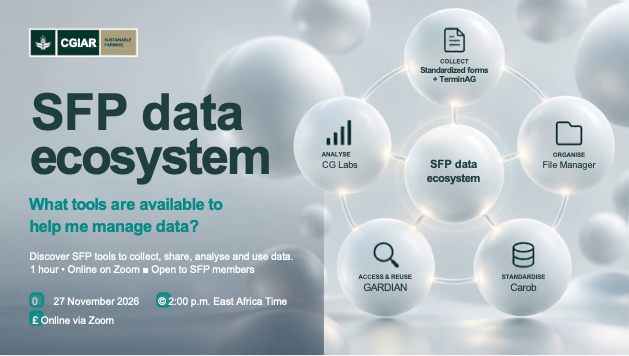
From Data to Discovery: Exploring the SFP Data Ecosystem
Finding the right data tool should not be another research challenge.
Across the CGIAR Sustainable Farming Program (SFP), a range of tools supports agricultural research, from collecting and managing data to discovering, standardising and reusing research outputs.
But which tool does what? How do these tools connect? And which ones could help with your work?
Join us for a practical webinar introducing the SFP data ecosystem, featuring demonstrations of:
🔹 Standardised data collection forms and TerminAG
🔹 File Manager
🔹 Carob
🔹 GARDIAN, including its web interface, reuse MCP agent and API
🔹 CG Labs
Hear practical experiences from users, explore how the tools can support your research, and learn where to get started.
Event details
📅 Date: Friday, 27 November 2026
🕑 Time: 2:00 p.m. East Africa Time (EAT)
💻 Venue: Online via Zoom
🔗 Join the webinar: https://t.co/EjCNlbPfVV
If you work with agricultural research data, this is an opportunity to discover resources that could support your work and strengthen collaboration across SFP.
Join us and discover what is available across the Program.
#CGIAR #SustainableFarming #AgriculturalResearch #OpenData #DataManagement #OpenScience
MAKING AGRICULTURAL DATA WORK BETTER! 🌱📊
CGIAR generates mountains of agricultural research data. But how do we make it easier to find, share and reuse? Enter Carob!
At a recent Carob Data Standardisation workshop, hosted by IRRI and co-organised with IITA and ICRISAT, 24 CGIAR participants got hands-on experience exploring how Carob transforms diverse datasets into standardised, reusable formats.
From soils and agronomy to weather, farming systems and crop breeding, participants tested Carob using real research datasets, data collection forms and field books.
The workshop advances the work of the CGIAR Sustainable Farming Science Program and the Digital Transformation Accelerator.
Better data. Better-connected research. Better solutions for farmers! 🌾
A big thank you to IRRI, IITA, ICRISAT and all participants for championing FAIR data and open science.
#CGIAR #SustainableFarming #Carob #FAIRData #OpenScience
Join the Conversation at COP31 Türkiye: Restoring Soil Health in Africa
How can we connect indigenous knowledge, science and investment to restore Africa’s soils and build more resilient food systems?
Join CGIAR and partners at COP31 for an important conversation on Restoring Soil Health in Africa: Connecting Indigenous Knowledge, Science and Investment.
The session will explore practical solutions for restoring soil health, improving nutrient use efficiency and strengthening agricultural productivity and climate resilience. Discussions will highlight the role of integrated soil fertility management, pulse-based rotations, biofertilisers, green nitrogen, digital soil mapping and farmer-centred approaches.
We will also examine how stronger partnerships, supportive policies and strategic investment can move proven solutions from evidence to action and scale.
📅 Monday, 16 November 2026
🕞 15:30–16:30 (Antalya local time)
📍 COP31 Food & Agriculture Pavilion, Blue Zone, Antalya EXPO Center
Can't join us in Antalya? You can still be part of the conversation online!
Follow the session and access the videos through our YouTube playlist:
▶️ https://t.co/LwyyeC4SZc
Whether attending in person or following online, we invite you to engage, share and help amplify the conversation.
Healthy soils are the foundation of productive agriculture and resilient food systems. Investing in them is investing in Africa's future.
#COP31 #SoilHealth #AfricaAgriculture #ClimateResilience #FoodSecurity #ISFM #SustainableAgriculture #ClimateFinance #CGIAR
Can a smartphone camera help revive Kenya’s coffee sector? ☕📱
Kenya’s coffee production has fallen by about 70% since 1988—from 130,000 to 50,000 metric tonnes. The national ambition is to raise production to 150,000 tonnes. Getting there will not only take better seed, healthier soils and better price, but also better information.
Today, estimating a coffee harvest can still mean walking through rows and counting cherries by hand, branch by branch. It is slow, repetitive and difficult to standardise.
That is the challenge behind Croppie, an AI-enabled mobile app developed by the Alliance of Bioversity International and CIAT. A farmer or technician photographs a productive coffee branch, and machine vision counts the cherries.
On 11 September, researchers from the Alliance of Bioversity CIAT, working under the CGIAR Sustainable Farming Program, met with the KALRO Coffee Research Institute to explore whether Croppie can take root in Kenya.
Why does this matter?
🌱 Farmers could get earlier visibility of their crop to plan labour, inputs and finances.
🤝 Cooperatives and buyers could better anticipate volumes.
💰 Lenders could gain a stronger evidence base in a sector where uncertainty can limit access to finance.
🔬 Researchers could access more consistent data for trials and breeding.
📋 Value chains could move closer to the verifiable data increasingly demanded by export markets and sustainability standards.
The starting point is therefore careful field testing, with a longer-term ambition to develop a Kenyan version together with Kenyan coffee researchers.
And counting cherries may only be the beginning. The teams also discussed the potential to detect ripeness, aborted cherries and, eventually, disease.
There is another important question—and one I’m glad the team is asking early: if a tool proves useful, who will host, maintain and scale it once the project ends?
Because digital innovation is only truly sustainable when the technology can take root beyond the project that created it.
Read the full story:https://t.co/ALoICkBYvl
#Coffee #DigitalAgriculture #AIforAgriculture #Kenya #SustainableFarming #CGIAR #ClimateAction #Smallholders
Area of Work 5 focuses on the partnerships, policy and data infrastructure needed to help move agricultural science into systems that can operate at scale.
GARDIAN is part of that data story.
Through one searchable platform, GARDIAN makes agricultural datasets, publications and metadata easier to discover and access.
Explore the platform here: 👉 https://t.co/DHUWhBQcHY
#CGIAR #SustainableFarming #OpenData #FAIRData @CGIAR_Data
Data is one of the tools we can use to better understand and respond to challenges across agriculture and food systems.
But first, people need to be able to find it.
GARDIAN helps make agricultural research data more accessible, connected and reusable by bringing datasets, publications and metadata together in one place.
Whether you're beginning a research project, searching for existing evidence or exploring agricultural data from across CGIAR, start with GARDIAN.
🌍 Explore the platform: https://t.co/DHUWhBQcHY
#FoodSystems #OpenData #CGIAR #FAIRData #AgResearch @CGIAR_Data
Researchers shouldn't have to spend hours moving between platforms just to find the data they need.
But when agricultural datasets and publications sit across different repositories, discovery can become a research task of its own.
GARDIAN brings that information together.
26,000+ datasets.
570,000 standardised data points.
One place to search.
Because time spent finding data is time that could be spent using it.
🔍 Start your search: https://t.co/DHUWhBQcHY
#ResearchTools #OpenScience #CGIAR #FAIRData @CGIAR_Data
Let's talk data 👇 What is your biggest challenge when working with agricultural data?
🔍 Finding the right datasets
🔗 Bringing data together across different sources
📊 Ensuring data quality
⚙️ Analysing large datasets
Tell us in the comments. Understanding where the biggest barriers exist can help shape better tools and approaches for agricultural research.
👉 Explore GARDIAN: https://t.co/DHUWhBQcHY
#DataChallenges #AgTech #OpenScience #CGIAR @CGIAR_Data
How do you improve a farm that's really a system?
Smallholder farms in South Asia combine crops, livestock, labor and income, all under pressure from climate change and volatile markets. Changing one part affects all the others.
From 14 to 16 September in Jaipur, 35 scientists, postgraduate students and development practitioners from India and Nepal trained in systems approaches for integrated analysis of agricultural systems.
Over three days, they practiced how to:
🔹 Characterize farming systems and build farm typologies in RStudio
🔹 Measure sustainability with indicators and KPIs
🔹 Compare options and trade-offs using the FarmDesign model
🔹 Target technologies to the places and farm types where they are most likely to succeed
A field visit to RARI's integrated farming systems prototype showed how crop and livestock components work together in practice.
Participants valued the hands-on exercises most. Their main request was for more time, plus advanced training in machine learning for systems design.
Building this kind of analytical capacity helps turn research into farm solutions that fit their context. That is what the CGIAR Sustainable Farming Program is working towards.
Thank you to our partners @ICAR, @IIFSR, @RARI and @SKNAU, and to the facilitators who made the course so practical.
#SustainableFarming #FarmingSystems #CapacityBuilding #CGIAR #SystemsThinking #India #Nepal
How does better data infrastructure support sustainable farming? CGIAR's Sustainable Farming Program works to help move agricultural science into solutions that can be scaled and used.
Within the Program, Area of Work 5 focuses on the partnerships, policy and data needed to support that scaling.
A key part of that work is data infrastructure: making agricultural research easier to find, access and reuse.
GARDIAN supports this by bringing agricultural datasets, publications and metadata together in one searchable platform.
For researchers, data scientists and development practitioners, that means easier access to the evidence needed to support research and decision-making.
👉 Explore GARDIAN: https://t.co/DHUWhBQcHY
#CGIAR #SustainableFarming #OpenData #FAIRData #DataInfrastructure @CGIAR_Data
Who is GARDIAN for?
👩🔬 Researchers looking for reliable, standardised datasets
📊 Data scientists building models and working across multiple data sources
🏛️ Policymakers looking for evidence to inform agricultural strategies
🌱 Development organisations working across agriculture and food systems
If you work with agricultural research and data, GARDIAN gives you one place to start your search.
👉 Explore GARDIAN: https://t.co/DHUWhBQcHY
#DataCommunity #AgResearch #Innovation #CGIAR @CGIAR_Data
🔎 Powerful search. Smarter discovery. GARDIAN doesn't just help you find data. It helps you connect research and information from across different sources.
Through one platform, users can:
✔️ Search across 26,000+ datasets
✔️ Access publications and metadata
✔️ Query 570,000 standardised data points
Explore datasets, publications and metadata across CGIAR Centers and partners in one seamless experience.
👉 Try it yourself: https://t.co/DHUWhBQcHY
#DataDiscovery #Research #CGIAR #FAIRData @CGIAR_Data
How do you improve a farm that's really a system?
Smallholder farms in South Asia combine crops, livestock, labor and income, all under pressure from climate change and volatile markets. Changing one part affects all the others.
From 14 to 16 September in Jaipur, 35 scientists, postgraduate students and development practitioners from India and Nepal trained in systems approaches for integrated analysis of agricultural systems.
Over three days, they practiced how to:
🔹 Characterize farming systems and build farm typologies in RStudio
🔹 Measure sustainability with indicators and KPIs
🔹 Compare options and trade-offs using the FarmDesign model
🔹 Target technologies to the places and farm types where they are most likely to succeed
A field visit to RARI's integrated farming systems prototype showed how crop and livestock components work together in practice.
Participants valued the hands-on exercises most. Their main request was for more time, plus advanced training in machine learning for systems design.
Building this kind of analytical capacity helps turn research into farm solutions that fit their context. That is what the CGIAR Sustainable Farming Program is working towards.
Thank you to our partners @ICAR, @IIFSR, @RARI and @SKNAU, and to the facilitators who made the course so practical.
#SustainableFarming #FarmingSystems #CapacityBuilding #CGIAR #SystemsThinking #India #Nepal
Every plate begins with a farming system. 🌍🌱
On #WorldFoodDay, we look at what it takes to produce food in a world where farmers are navigating climate variability, pests and diseases, pressure on soils and natural resources, and changing demands on our food systems. The answer starts with how we farm.
The CGIAR Sustainable Farming Program brings together science, innovation and partnerships to help build farming systems that can produce food while strengthening resilience and using natural resources more sustainably.
From healthier soils and safer seed to better crop protection, climate-informed decision-making and sustainable production practices, the work happening on farms today will shape how food is produced tomorrow.
This World Food Day, we celebrate the farmers, researchers and partners working across food systems to turn agricultural innovation into practical solutions.
#WorldFoodDay #CGIAR #SustainableFarming #FoodSecurity #ClimateResilience #SustainableAgriculture #FoodSystems
Not all data is created equal. For data to drive impact, it needs to be:
🔍 Findable
🔓 Accessible
🔗 Interoperable
♻️ Reusable
These are the FAIR data principles, and they are at the core of GARDIAN.
Because agricultural data becomes more useful when people can find it, access it and put it to work.
👉 Explore GARDIAN: https://t.co/DHUWhBQcHY
#FAIRData #OpenData #DataGovernance #CGIAR @CGIAR_Data
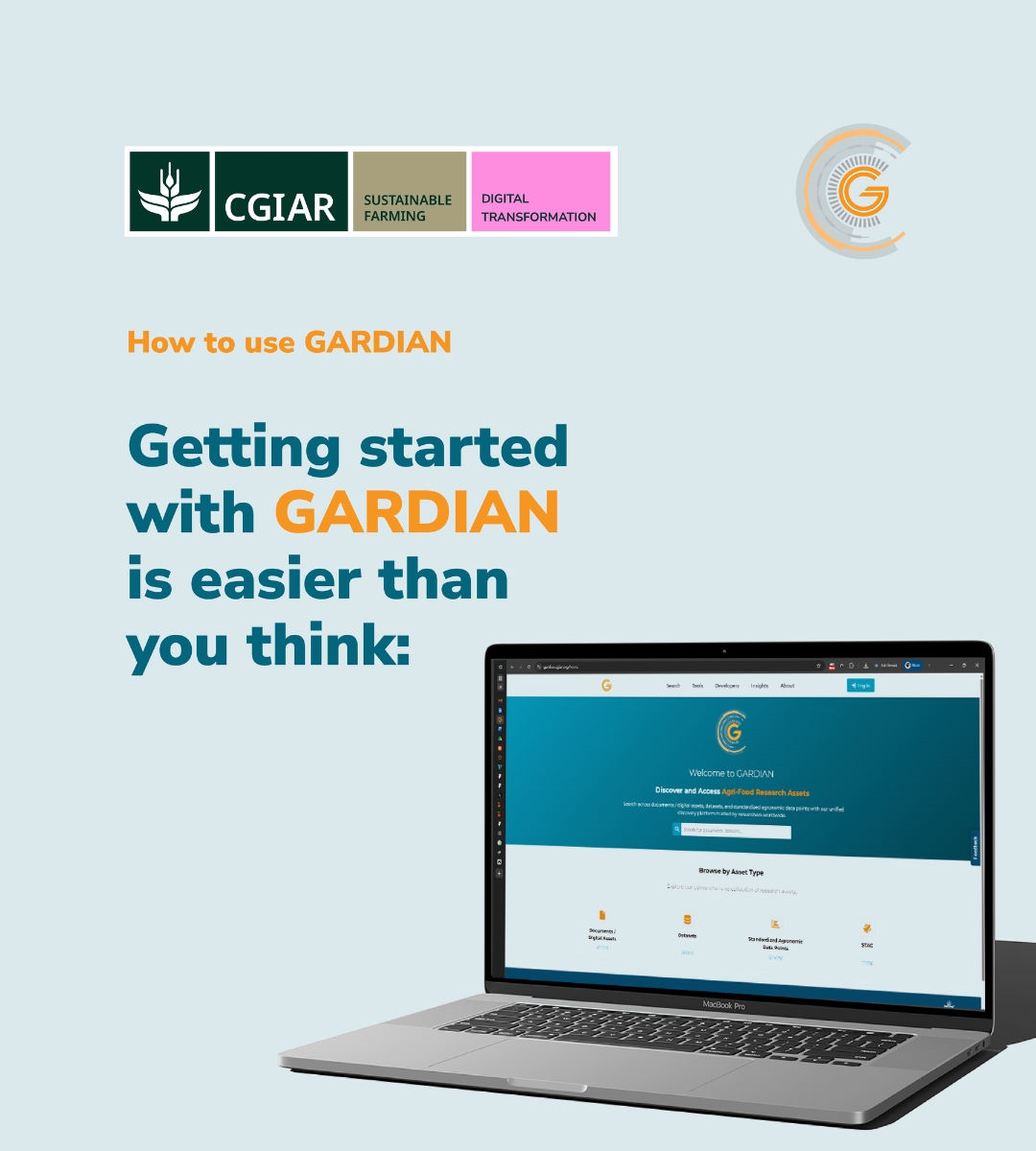
Getting started with GARDIAN is easier than you think:
1. Go to the platform.
2. Type your topic, for example, "fertilization in Kenya."
3. Explore relevant datasets and publications.
That's it.
💡 Your next research insight could be one search away.
👉 Start exploring: https://t.co/DHUWhBQcHY
#HowTo #ResearchTools #DataAccess #CGIAR @CGIAR_Data
Climate change doesn't stop at borders. Neither should agricultural data.
GARDIAN brings together agricultural research data from multiple repositories into one searchable platform, covering areas such as soil health, crop trials, weather patterns and pest surveillance.
Whether you're working in sub-Saharan Africa, Southeast Asia or elsewhere, GARDIAN makes it easier to discover agricultural research and data from across the world.
🌍 Explore the platform: https://t.co/DHUWhBQcHY
#AgResearch #OpenData #CGIAR #DataForGood @CGIAR_Data
GARDIAN changes that.
It connects data across repositories and provides AI-ready datasets, making it easier to discover, access and reuse agricultural research data.
Because better data access means better-informed decisions.
👉 Explore GARDIAN: https://t.co/DHUWhBQcHY
#DataScience #FoodSystems #OpenScience #CGIAR @CGIAR_Data
🌍 Agricultural challenges are global. Our data should be too.
GARDIAN brings together thousands of agricultural datasets and publications into one powerful platform, helping researchers, policymakers and innovators find what they need and build solutions faster.
🔍 One place. Global knowledge. Real impact.
👉 Explore the platform: https://t.co/DHUWhBQcHY
#OpenData #Agriculture #CGIAR #DataForImpact @CGIAR_Data