JOHN CLAUSER, 2022 PHYSICS NOBEL PRIZE WINNER:
"I can very confidently assert, there is no climate emergency.
As much as it may upset many people, my message is the planet is NOT in peril.
Atmospheric CO2 and methane have negligible effect on the climate.
The policies government have been implementing are totally unnecessary and should be eliminated.
So far, [we] have totally misidentified what is the dominant process in controlling the climate, and all of the various models are based on incomplete and incorrect physics.
The dominant process, is “the cloud-sunlight-reflexivity thermostat mechanism.
Clouds are all bright white, and they reflected 90% of the sunlight back into space making them the most crucial yet most overlooked aspect of the climate system.
Two-thirds of the Earth are ocean. The Pacific Ocean alone is half the Earth. The average cloud cover for the Earth is 67%; about 50% over land and 75% over oceans.
I claim that the above conspicuous properties of clouds are the missing part of the puzzle."
🚨 Sylvester Stallone Goes Off on the U.S. Engaging in Foreign Wars
“Now I realize all war is futile. It's stupid. It's a mechanism to make tons of money for the War Department and its manufacturers. These kids just going out there into a grist mill, being chopped up — and then when they come back with no arms, ‘Oh sorry, you're on your own.’ I hate it and I'm bitterly opposed to it.”
@brianmaierhofer Depends on the person unless you need a dictionary. Fritz Pearls' work might interest you if you personally feel stuck otherwise why judge others?
🇩🇪 BREAKING: Berlin police begin violently arresting citizens as thousands protest against the introduction of mandatory military service in Germany.
The protests come amid Germany’s push to dramatically expand the Bundeswehr as European governments prepare for the possibility of a wider confrontation with Russia.
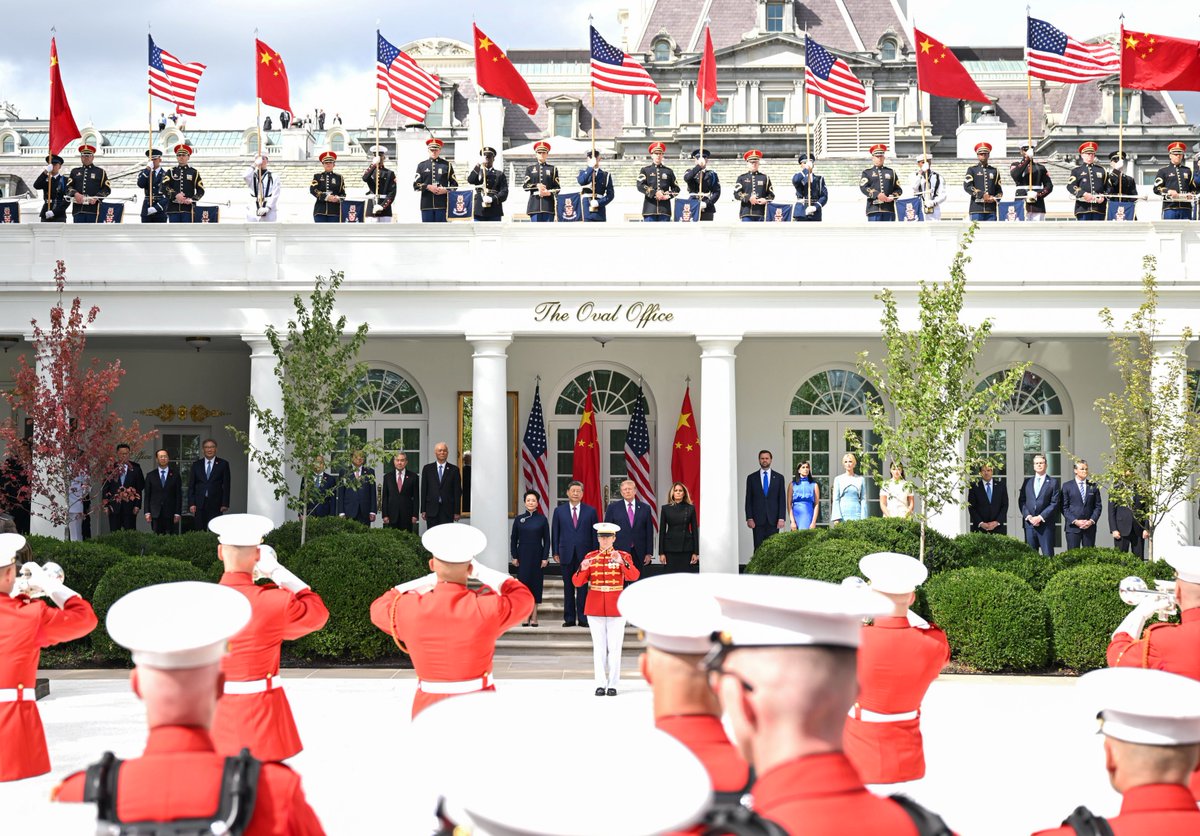
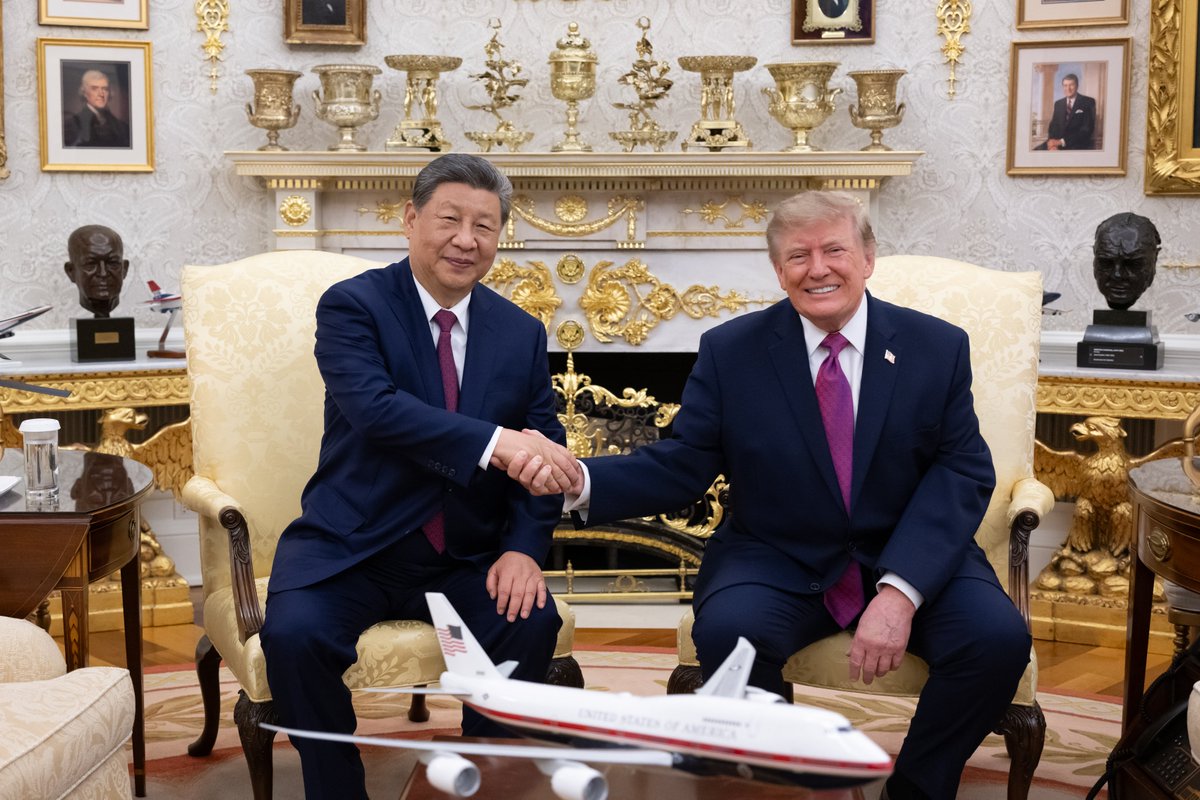
China has now released its official press release of today's Xi-Trump meeting at the White House. At the moment, the US side's press release is not out yet.
I read the Chinese version as soon as it came out. It is not particularly long, but it is surprisingly dense. And one thing stood out to me:
Beijing is not simply talking about "cooperation." It is laying out a framework for how China and the United States can compete and win together.
And the structure of Xi's remarks is revealing:
Trade: cooperate.
AI: compete, but cooperate.
Taiwan: red lines.
Read together with the written statement Xi issued upon arriving in Washington yesterday, today's readout may offer the clearest explanation yet of what Beijing means by a "constructive relationship of strategic stability."
Here is how I read it.
As in my previous posts, the italicized text comes from the Chinese official release, the bolded text highlights key points, and everything else is my analysis.
-- Xi pointed out that the exchange of visits between the heads of state of China and the United States in less than half a year is unprecedented in the history of China-US relations. President Trump and I have maintained communication through various channels and have jointly been steering the great ship of China-US relationship. In May this year, President Trump and I jointly agreed to work toward building a constructive China-US relationship of strategic stability. The new vision reflects the realities of China-US ties, embodies our aspirations for the future, and represents an important step toward finding the right way for the two countries to get along with each other.
We need to work toward a relationship featuring cooperation as the mainstay, competition with bounds, manageable differences, and promises of peace, so as to find the right way for two major countries to coexist.
China and the United States should, and fully can, achieve mutual benefit and win-win results through practical cooperation, help each other succeed through healthy competition, properly manage differences by seeking common ground while respecting differences, and build peace by fostering mutual trust, so that a constructive China-US relationship of strategic stability can better benefit the two peoples and people around the world.
There is a lot packed into these three paragraphs.
First, the reference to the "unprecedented" frequency of leader-level exchanges is notable. Xi's framing moves from his personal communication with Trump, to sustained communication between the two presidents, and then to something much larger: a mechanism for stabilizing the bilateral relationship itself.
Then comes the metaphor of the "great ship."
This is not new. Xi has used the ship metaphor in previous meetings or phone calls with Trump.
A ship this large does not turn quickly. And if it veers badly off course, the consequences can be enormous.
I think the stage on which this "ship" is sailing is the broader Pacific. The ship may encounter storms and rough seas, but the two countries' top leaders are presenting themselves as jointly responsible for keeping it on course.
And then there is a phrase that appears twice:
"finding the right way."
I don't think that repetition is accidental. Beijing is trying to define what coexistence between two competing major powers should actually look like.
And the next sentence gives us the formula:
"cooperation as the mainstay, competition with bounds, manageable differences, and promises of peace" was already included in Xi's statement after arriving in the United States the day before. It provides a concrete framework for managing the competition and building this new type of relationship.
In many ways, this is an attempt to answer a question that has long complicated China-US relations: Do China and the United States have to choose between cooperation and confrontation?
Beijing's answer is no. And more importantly, it is beginning to spell out what that alternative might look like.
-- Xi stressed that the economic and trade teams of the two countries held a new round of consultations and reached a new joint arrangement, which is good news for industries and people of both countries, as well as the global economy. Cooperation is a two-way street. The stability of US-China economic and trade relations requires both sides to expand the list of cooperation, while shortening the list of problems. As long as the two sides uphold the spirit of equality, mutual respect and mutual benefit, a way out of problems can be found.
Xi expressed his hope that the two sides will work in the same direction, stay committed to the principle of mutual benefit and win-win cooperation, and promote the sustained, stable and sound development of China-US economic and trade relations.
And this is where the broader idea of "strategic stability" starts becoming concrete.
How do you prevent competition from turning into confrontation?
Beijing's answer begins with two lists:
The cooperation list.
The problem list.
In my view, expanding the cooperation means continually broadening the areas in which both sides can achieve tangible results. Reducing the problem list, meanwhile, means preventing new disputes from continuously piling onto the bilateral relationship.
This is very pragmatic to manage the relationship. The goal is not to build a relationship completely free of friction-that is clearly unrealistic.
The real goal is this:
To keep increasing the number of areas where the two sides can cooperate, while preventing disputes from expanding to the point where they overwhelm the entire bilateral relationship.
And that helps explain why Xi repeatedly emphasizes equality, mutual respect, and mutual benefit.
In addition, the phrase "cooperation is a two-way street" carries a significant message: Beijing is signaling that it is willing to cooperate, but it does not believe strategic stability can be built by China alone.
One side cannot keep extending the cooperation list if the other side keeps extending the problem list.
Meaningful progress requires both sides to engage, compromise, and reciprocate.
-- Xi said that while China and the United States, as both major powers in AI, compete in AI, they have even more reasons to cooperate. The two sides should leverage respective strengths in AI rather than guarding against each other. We can continue to engage in dialogue on AI, exchange views on its risks and benefits, and work together to prevent the misuse and abuse of AI. The two sides should maintain human control over AI technologies, uphold a people-centered approach and the principle of using AI for good, and ensure that AI serves human progress.
What happens when an issue belongs on both lists at the same time? That is where AI becomes particularly interesting.
The AI competition between the two countries are obvious. But the risks of AI do not respect national borders.
Misuse, loss of human control, safety risks, and broader questions of governance cannot necessarily be contained within China or the United States alone. Two countries can compete fiercely over who develops the most advanced AI systems while still sharing an interest in preventing those systems from creating risks neither side can control.
This is why Xi said the two countries have even more reasons to cooperate. And the remark also echoes President Trump's statement on social media that he would discuss "super intelligence" today.
Trade is about expanding the cooperation list. AI sits on both lists. But Taiwan is different. Let's move on.
-- Xi stressed that the Chinese side's position on safeguarding national reunification and territorial integrity is clear-cut.
It is hoped that the US side will adhere to the correct position of opposing "Taiwan independence," and handle the Taiwan question with caution, so as to lay a solid foundation for China-US strategic cooperation and the development of bilateral relations.
The Taiwan question finally came into focus. It's different from the previous topics.
There had previously been speculation in the United States that Xi's asking Trump to stop arms sales to Taiwan based on the 1982 US-China Communique. I do not know whether that report was accurate. But the language of the communique is quite explicit:
"Having in mind the foregoing statements of both sides, the United States Government states that it does not seek to carry out a long-term policy of arms sales to Taiwan, that its arms sales to Taiwan will not exceed, either in qualitative or in quantitative terms, the level of those supplied in recent years since the establishment of diplomatic relations between the United States and China, and that it intends gradually to reduce its sale of arms to Taiwan, leading, over a period of time, to a final resolution. "
Clearly, 44 years is long enough to qualify as a long term. Yet US policy has failed to follow through on the promise made in that document.
Looking at the structure of Xi's remarks, Taiwan has surely been placed within the boundaries of strategic stability.
After outlining substantial areas for cooperation, the Chinese side is also sending Washington a clear message:
Strategic stability does not mean stability without red lines.
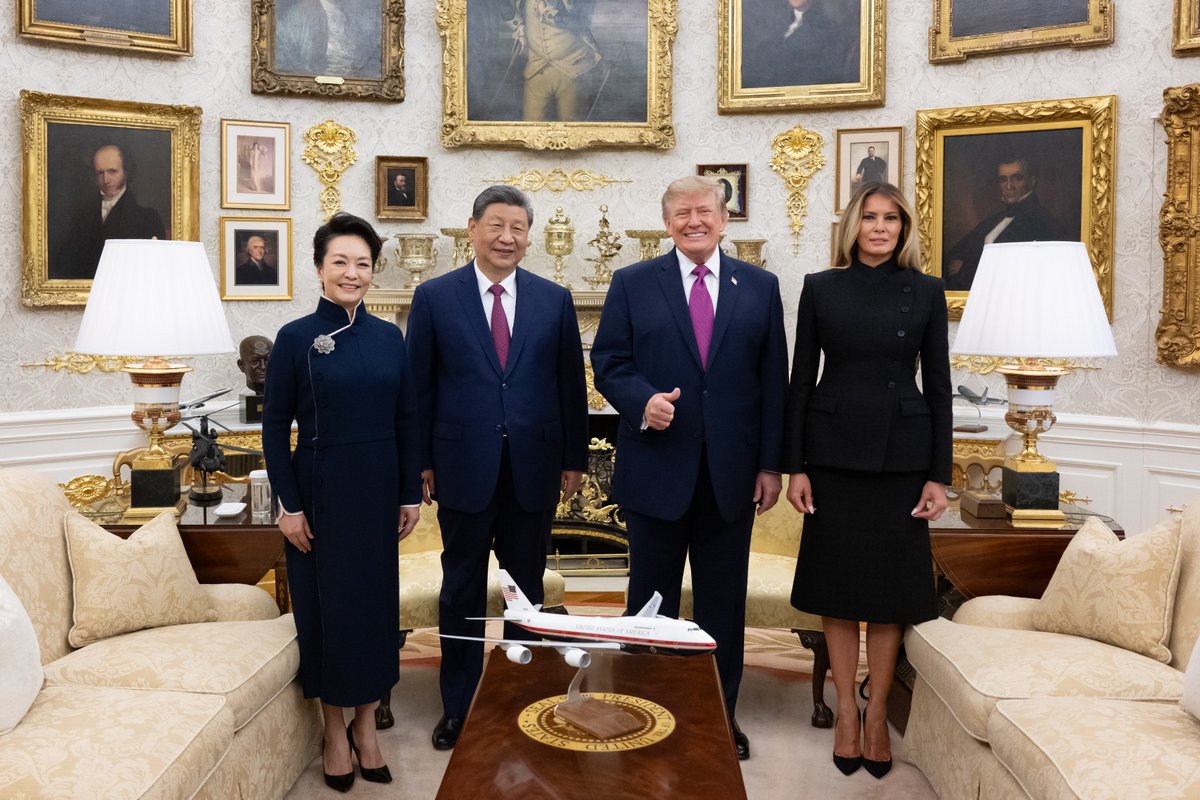
-- Trump said that the state visit of Xi to the United States is a great visit. China and the United States are both major countries, and he and Xi are good friends who maintain in-depth and close communication. The US-China relations will surely be handled well under the leadership of the two heads of state.
The latest round of economic and trade consultations between teams of both countries achieved new outcomes, and both sides should continue dialogue to reach a better agreement. Artificial intelligence concerns the future of humanity, and China and the United States should maintain dialogue and strengthen cooperation on this issue.
Trump's response, as presented in the Chinese readout, is notable for what it reinforces.
He described the visit as "great." This effectively signaled to the outside world that the meeting did not need to be portrayed as a tense, difficult, or deeply divided encounter.
Judging from the narrative presented in the Chinese readout, the two sides have established fairly clear areas of common ground on several fronts:
- High-level communication should continue.
- Economic and trade negotiations should continue.
- Dialogue on AI should continue.
- The overall stability of bilateral relations needs to be maintained.
At the same time, it is equally important to note that Trump's remarks were relatively broad and general, while Xi's remarks played a more substantial role in defining the broader framework of the relationship.
-- Both heads of state also exchanged views on major international and regional issues including the Middle East situation, Ukraine crisis and Korean Peninsula.
The two leaders also confirmed that the two countries will support each other in hosting the 2026 APEC Economic Leaders' Meeting and the G20 Leaders' Summit.
I would not pass over this final section too quickly.
The Middle East. Ukraine. The Korean Peninsula.
None of these issues is simply about China-US bilateral relations.
Their inclusion reminds us that the relationship between Washington and Beijing does not exist in isolation. China and the United States are permanent members of the United Nations Security Council, two of the world's largest economies, and leading technological powers. Whether they can maintain channels of communication therefore has implications far beyond trade, technology, or Taiwan. Both are deeply embedded in a broader multilateral system.
The immediate references to the APEC Economic Leaders' Meeting in China's Shenzhen and the G20 Leaders' Summit in America's Miami reinforce that point. They place the bilateral relationship in a wider context: even as China and the United States compete with each other, they must also continue engaging within institutions and forums where their decisions affect countries far beyond their own.
How will Beijing and Washington manage the competition in a healthy way? When the cooperation list and the problem list are both on the table, which one will Washington choose to make longer?
There is no answer to that question tonight.
What comes next will.
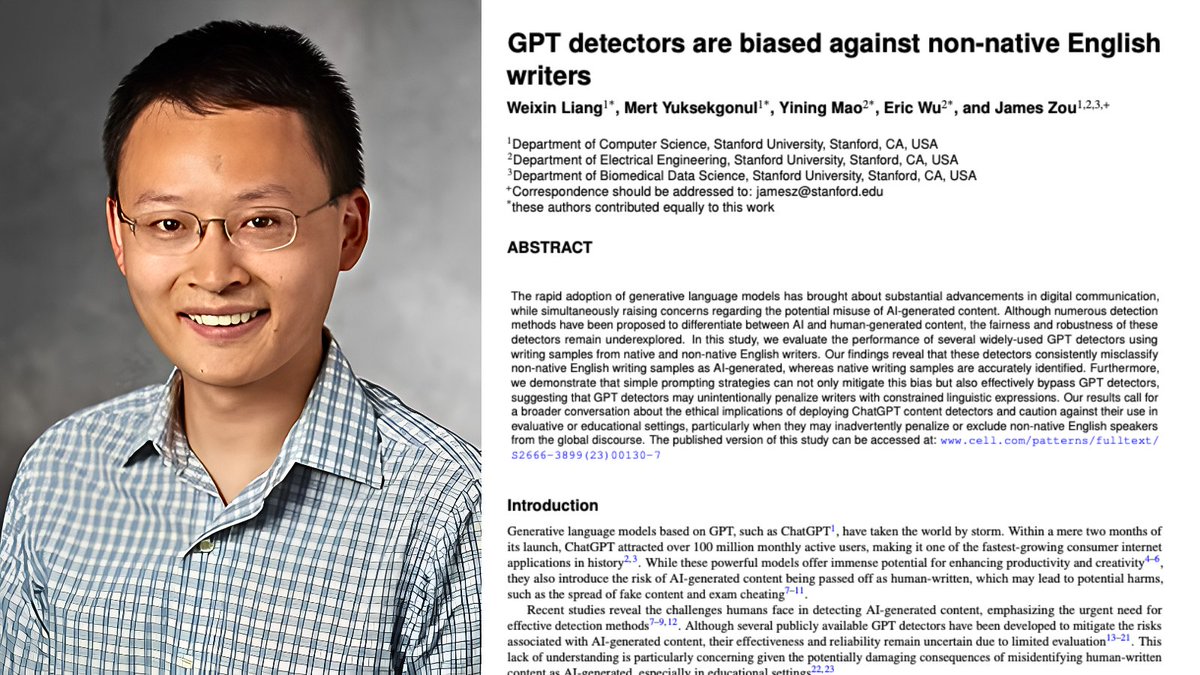
A Stanford team proved AI detectors call human writing fake more than 61% of the time, then found the fastest way to pass the test was to let ChatGPT rewrite the essay for you.
I had to reread the study, because it sounds like a joke and it's being used to punish people every day.
The team was led by James Zou. They took 91 essays written by real students preparing for an English exam for foreign speakers. They fed them to seven of the most popular AI detectors on the market.
On average, more than 61% came back flagged as machine-written. 89 of the 91 essays got flagged by at least one detector.
Then they ran essays by American eighth graders through the same seven detectors. Almost perfect scores. Human, human, human.
The reason is almost insulting once you see it.
Most detectors guess by measuring how predictable your words are. A chatbot picks the most likely next word, every time. So does someone writing in their second language, because they reach for the safe word they know instead of the fancy one they're unsure of. Plain English looks like a robot to these machines.
So the researchers asked ChatGPT to rewrite the flagged essays with bigger vocabulary. The flag rate crashed from 61% to about 12%.
The cure for looking like a machine was letting a machine rewrite you.
The company that built ChatGPT already knew this. In January 2023, OpenAI launched its own detector. It caught only 1 in 4 AI-written texts and wrongly accused real humans 1 time in 11. Six months later they switched it off. The note is still on their website. One line. Pulled for its low rate of accuracy.
The people who understand this technology best gave up on it. Everyone else kept going.
A copywriter once pasted the Declaration of Independence into a detector. It came back 98.51% AI. Thomas Jefferson wrote it with a quill in 1776.
We laughed at that one too. This summer it stopped being funny.
Jamir Nazir is a 62-year-old writer from Trinidad. In May he won a regional title in the Commonwealth Short Story Prize, one of the hardest prizes in the world for unpublished fiction. Within days, a detector called Pangram scored his story 100% artificial. The screenshot spread. Strangers turned his sentences into memes.
What they didn't know: Nazir has neuropathy. He can barely type. He dictates his stories into his Android phone and edits them there, a few lines at a time.
The prize organizers spent a month going through his drafts, his character notes, even an ending he'd written and thrown away. They cleared him and named him the overall winner. Granta, the magazine that published his story, cut ties with the prize anyway.
People still argue about his story, and that's fine. Arguing over evidence is what humans are supposed to do.
What bothers me is the order. The number came first. The drafts came a month later. By then his mother had already heard what the internet was saying about her son.
In July, Substack gave every reader a button to scan any post for AI. Medium's CEO, Tony Stubblebine, said the part out loud: people cheating on purpose just run their text through a "humanizer" app and walk straight past the detector. The only people left to catch are the honest ones.
And the math doesn't care how good the detector is. Say it's wrong once in every 10,000 scans. Run it millions of times on a platform and real writers get branded as fakes every single week.
Now take the human out of the loop.
Today a teacher still reads the score and decides. Picture the version where nobody does. A hiring system that silently throws away every cover letter scoring above 80% AI. You never hear back. You never find out why. An immigration office screening personal statements the same way, hitting hardest the people Stanford already proved it gets wrong: anyone writing in their second language.
This isn't science fiction. Freelance writers were already losing clients over detector scores back in 2024.
A person who wrongly accuses you can be questioned. They can apologize. They can be fired. A score can't. It just runs again tomorrow on the next million people, just as sure of itself, just as wrong.
We can't hand verdicts to software that flagged a Founding Father.
So what should we do instead?
Let a score buy a conversation, never a punishment. Even Turnitin, the biggest name in school detection, tells teachers not to use its AI score as the only reason to act against a student. Ask for the drafts. Ask the person to walk you through one paragraph. Nazir's truth came out of a folder of old versions, not a percentage.
Stamp the machine instead of interrogating the human. Google already marks text written by Gemini in a way software can read, and Europe's new rules, live since August, push every AI company to do the same. If the label is baked in at the source, nobody has to guess who wrote what.
Guessing is the whole problem. These tools look at your sentences and make a bet on your honesty. When they lose the bet, you pay.
If a detector flagged the last thing you wrote, what proof do you have sitting on your laptop right now?
It can be a definition problem. Let's say people get traumatized by a hurricane national disaster. Then some one spread thin at work has to look at disaster photos and gets ill. Meaning that is the exposure no need to link it to the first. Same with people in support roles unhappy with their lives listening to others talk about trauma. They get ill instead of dealing with their life. It is disassociation when did people stop treating for dissociation.
The evidence that social media is a cause (not just a correlate) of poor mental health keeps piling up. We lay it out in an accessible form here. We also go beyond mental health to review evidence of many other harms, esp. short form videos and cognitive functioning:
https://t.co/Xjleeaq6Bf
Former UN and California climate insiders just said the quiet part. Officials in the US and EU are looking at dimming the sun. Not in speeches. Behind closed doors.
Silicon Valley money is already in it. Startups want governments to pay for a shade when the heat gets bad. Agriculture desks. Trade desks. Defense desks. Curiosity on the Hill.
Opponents have the obvious case. It does not cut oil, gas, or coal. It can punch the ozone layer, scramble rainfall, and hand one country a weather lever over another. Once you start, you may not get to stop.
Hope this stays a paper exercise. Treating the sky like a dimmer switch is reckless. You do not fix a messy energy system by fogging the one thing every farm and forest still depends on.
Clearly an Ukraine false flag is being rushed with CIA and EU complicity so Russia can be blamed for the imminent collapse of EU debt and energy markets.
Russia has never hit targets in the Mediterranean, but Ukraine has struck there several times.
Shipping containers are anonymous, universal, can be weaponised by anyone with deniability.
Lidl has put peas in the beef and written High Protein on the front.
The pea is hidden in a little black box, in a font you need a suspicious nature to read.
It isn't a pea. It's the beige powder left after yellow split peas are milled and soaked in alkali. Vegan shakes are made from it. It tastes of a wet cupboard and it costs a fraction of mince.
It's short of methionine. Beef isn't. So the 37g on the front is a bigger number doing a smaller job.
The cow spent 2 years turning plants into beef. Lidl has put the plants back in.
They took the fat out too. The flavour, the vitamins and the fullness left before the pea arrived. Food removed, crop added, and the word for that is High.
Nobody in a gym has ever read past High.
The reason isn't hidden. Lidl promised a quarter of its protein would be plant based by 2030. The meat-free aisle went grey. So the peas are going into the beef, where the customers are.
In Holland the same mince is already 40% pea. Britain hasn't been told its number.
Tesco printed Meat & Veg on the box in 2019. Dead in a year. Lidl moved the veg to the back.
Buy the ugly 20% mince with one ingredient. The animal already ate the peas.
AI just killed the peer-review. No one reads the papers anymore. Neither reviewers nor editors. It is impossible address issues raised by the AI. They find something wrong in every round of revisions and papers get rejected eventually. This is killing the science itself.




![robinmonotti's tweet photo. JOHN CLAUSER, 2022 PHYSICS NOBEL PRIZE WINNER:
"I can very confidently assert, there is no climate emergency.
As much as it may upset many people, my message is the planet is NOT in peril.
Atmospheric CO2 and methane have negligible effect on the climate.
The policies government have been implementing are totally unnecessary and should be eliminated.
So far, [we] have totally misidentified what is the dominant process in controlling the climate, and all of the various models are based on incomplete and incorrect physics.
The dominant process, is “the cloud-sunlight-reflexivity thermostat mechanism.
Clouds are all bright white, and they reflected 90% of the sunlight back into space making them the most crucial yet most overlooked aspect of the climate system.
Two-thirds of the Earth are ocean. The Pacific Ocean alone is half the Earth. The average cloud cover for the Earth is 67%; about 50% over land and 75% over oceans.
I claim that the above conspicuous properties of clouds are the missing part of the puzzle."](https://pbs.twimg.com/media/HTJs0fvXsAEsl-d.jpg)