Truth makes best decisions. Data on all sides best. Alt media posted b/c you know MSM side & Grok/ChatGPT admit to parroting MSM misleading 99% w/o pushback.
The lies they tell you. The lies you believe. Here are 5 topics from BLM's cop violence to gun violence to school shootings to J6 to US built on backs of slaves. The simple math doesn't match the narrative. See if you've been duped.
🚨 SPACEX MAY BE THE BIGGEST INSIDER CASHOUT IN MARKET HISTORY!!!
SpaceX is expected to go public on June 12 at a valuation of $1.75-$2 TRILLION.
That would instantly make it larger than Microsoft and second only to Apple and Nvidia in the US market.
Yet the company lost $4.28 BILLION in Q1 2026 alone and has accumulated deficits of $41.3 BILLION since founding.
The real story is what happens after the IPO.
Insiders currently own 95% of all shares.
The public float is only 5%.
And insiders are sitting on $1.66 TRILLION of paper wealth that cannot currently be sold.
Most IPOs lock insiders up for 180 days.
SpaceX isn't doing that.
Just 60 days after listing, 20% of eligible insider shares can unlock.
If the stock rises 30% above the IPO price, another 10% unlocks.
Then five separate 7% unlocks hit between days 70 and 135.
By November 2026, 93% of early-release insider shares could already be free to sell.
This isn't just an IPO.
It's one of the biggest liquidity grab events Wall Street has ever seen.
Alex Sacerdote of Whale Rock Capital when asked about the best ways to play AI:
“The second one is just Google. It’s simple.
They’ve won AI…
The stock is very cheap, and we’re going to see revenues accelerate at Google. So it could easily be up 50%. I don’t see very much downside.”
$GOOGL $GOOG
___
🎙️ Sohn Conference | Alex Sacerdote & Leon Shaulov (05/28/26)
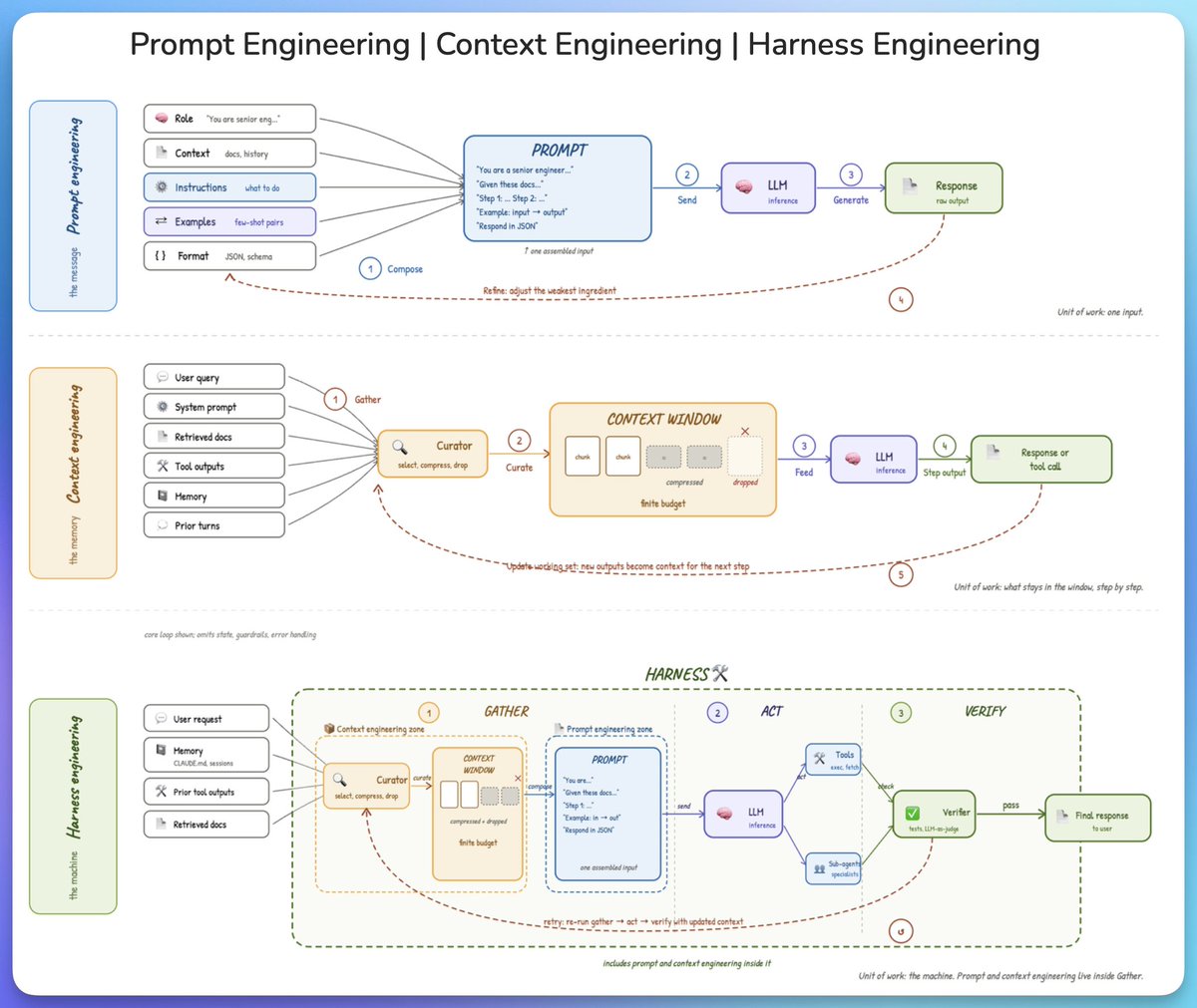
The biggest AI skill in 2026 won’t be prompt engineering.
It’ll be designing the system around the model.
This diagram perfectly shows the evolution:
🔹 Prompt Engineering
→ Better instructions
🔹 Context Engineering
→ Better information flow
🔹 Harness Engineering
→ Better autonomous systems
The shift is massive.
Old AI apps:
“Here’s my prompt.”
Modern AI systems:
• memory management
• retrieval pipelines
• tool orchestration
• verification loops
• retries & evaluators
• context compression
• multi-agent execution
In other words:
AI is moving from
📝 single prompts
to
⚙️ full-stack cognitive architectures.
One underrated insight here:
The context window is now the new CPU cache.
What stays inside it determines:
• accuracy
• latency
• cost
• reasoning quality
• hallucination rate
And Harness Engineering ties everything together:
Gather → Curate → Act → Verify → Retry
That’s how production-grade AI agents are actually built.
The future AI engineer won’t just “talk to models.”
They’ll architect intelligent systems around them. 🚀
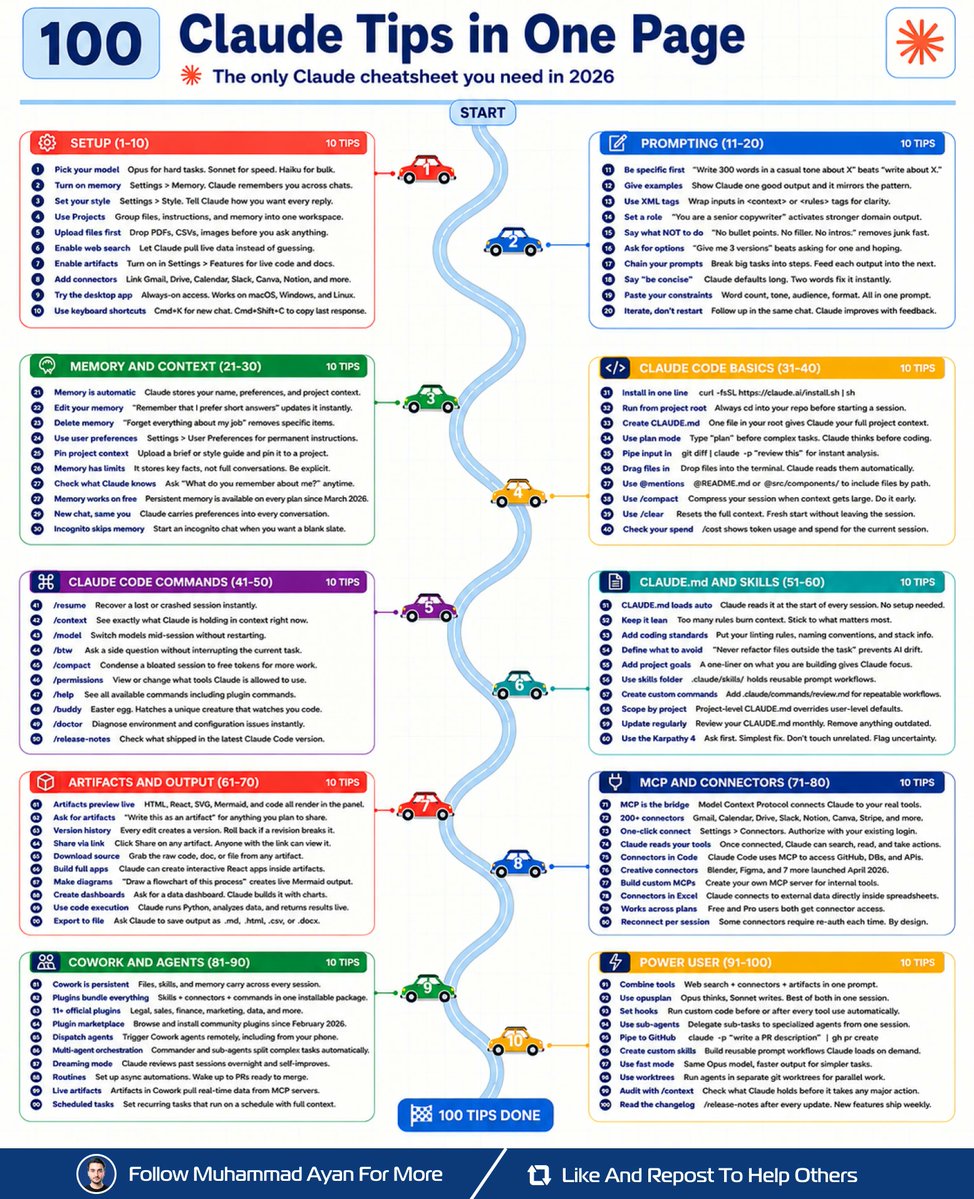
I spent 6 months collecting every
Claude trick I know.
Then I put all 100 on one page.
Here's what's inside:
𝟭. Setup (Tips 1-10)
↳ Pick Opus for hard tasks,
Sonnet for speed
↳ Turn on memory, artifacts,
web search
↳ Link Gmail, Drive, Slack, Notion
↳ Keyboard shortcuts save more time
than people realize
𝟮. Prompting (Tips 11-20)
↳ Specific beats vague every time
↳ XML tags changed my output quality
overnight
↳ Tell Claude what NOT to do
𝟯. Memory and Context (Tips 21-30)
↳ Edit and delete memory anytime
↳ Pin a style guide to a project
and never re-explain it
↳ Incognito starts fresh
This is where it gets interesting.
𝟰. Claude Code (Tips 31-40)
↳ curl -fsSL | sh installs it
↳ Plan mode thinks before coding
↳ Pipe git diff for instant reviews
↳ @ mentions pull in specific files
𝟱. Commands (Tips 41-50)
↳ /resume recovers crashed sessions
↳ /compact clears bloated context
↳ /model switches without restarting
↳ /buddy. Just try it.
𝟲. CLAUDE. md (Tips 51-60)
↳ Loads automatically every session
↳ Coding standards go here once
↳ Custom commands live in
.claude/commands/
𝟳. Artifacts (Tips 61-70)
↳ Full React apps inside Claude
↳ Live dashboards with charts
↳ Export to .md, .html, .docx
𝟴. MCP and Connectors (Tips 71-80)
↳ 200+ connectors exist
↳ One click to set up
↳ Free and Pro both get access
𝟵. Cowork and Agents (Tips 81-90)
↳ Persistent memory across sessions
↳ Multi-agent orchestration
↳ Routines run while I sleep
𝟭𝟬. Power User (Tips 91-100)
↳ Web search + connectors + artifacts
in a single prompt
↳ Sub-agents handle delegation
↳ /context before any major move
I could have split this into 10 posts.
But the whole point was one page,
zero fluff, no hunting across
10 different carousels.
Follow Muhammad Ayan ♻️ Repost to help others.
You keep hitting Claude's limit by 2 pm. Every day.
These 21 habits make it last all day:
(even if you're on the $20 plan)
1. Convert files before uploading.
☑ One PDF page = 1,500–3,000 tokens
☑ Paste text into doc .new → download as .md file
☑ 15-page PDF → 2,000 clean tokens
2. Plan in Chat. Build in Cowork.
☑ File creation & analysis eats more of your limit
☑ Think in the cheap product (Claude Chat)
☑ Build in the expensive one (Claude Cowork)
3. Say "ask me questions" instead.
☑ 500-word prompt costs 500 tokens every reread
☑ Let AskUserQuestion pull the context
☑ Clicking options costs almost nothing
4. Speak, don't type.
☑ Install Wispr Flow .ai (free)
☑ Voice = more context in one shot
☑ Fewer messages = fewer rereads
5. Fix the broken section only.
☑ Don't ask for a full redo
☑ "Only redo section 2."
☑ Targeted edits = fewer tokens burned
6. Edit your prompt, never correct it.
☑ "Actually, change…" = another full reread
☑ Hit edit on the original instead
☑ One clean prompt beats five corrections
7. New topic = new chat.
☑ Message 30 re-reads 29 exchanges first
☑ Long chats are token furnaces
☑ Restart before it eats your day
8. Use Sonnet for the simple stuff.
☑ Save Opus for deep work
☑ Match the model to the task
☑ Stop paying Opus prices for easy jobs
9. Use Projects for recurring files.
☑ Same PDF in 5 chats = 5 full reads
☑ Upload once → it gets cached
☑ Every future chat references it free
10. Turn off Memory. Set Preferences.
☑ Every fresh chat wastes 3–5 setup messages
☑ Settings → General → Personal preferences
☑ One setup, permanent savings
11. Spread your sessions.
☑ Claude runs a rolling 5-hour window
☑ Burn it all by noon = wasted capacity
☑ Split into morning, afternoon, evening
The other 12 habits here: https://t.co/Yu24rPQI5o
(save this to make your $20 plan last all day)
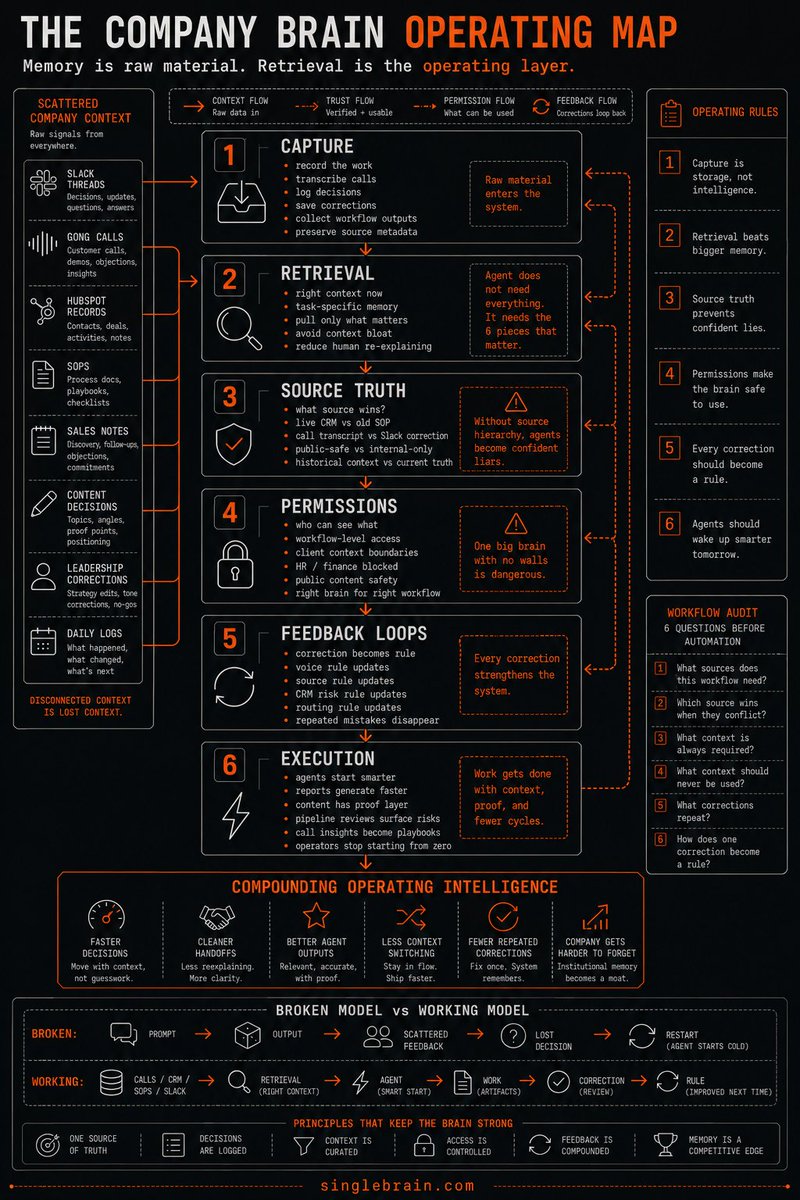
Every company is missing the same layer:
A company brain.
Right now, the memory of the business is scattered across calls, docs, Slack threads, dashboards, SOPs, and people's heads.
That's the part people miss when they talk about a company brain.
The value isn't a giant folder of company knowledge. Every company already has that.
The real advantage is the intelligence layer that sits between all that context and the work your team needs done.
This is the layer every AI-native company will need:
Stanford just proved Claude agrees with you 49% more than a human would
The fix is the LLM Council from Andrei Karpathy.
Five different advisers debate your decision inside one Claude chat:
> contrarian (looks only for what will fail
> first-principles thinker
> expansionist (finds the upside)
> outsider (knows nothing about your industry)
> executor (Monday-morning next step)
a chairman reads it all and gives you the final call.
Everyone is talking about MCP.
Almost nobody is talking about the architecture patterns that make AI agents production-ready. ⚡
If you’re building serious AI systems in 2026, these 5 MCP server patterns matter more than prompts:
Tool Servers
AI takes actions through APIs, databases, workflows, browsers, automation tools.
Resource Servers
Inject structured context into agents:
docs, files, vector DBs, internal knowledge.
Prompt Servers
Turn prompts into reusable infrastructure:
versioned, parameterized, maintainable.
Gateway Servers
Central control layer for:
routing, auth, observability, rate limits, orchestration.
Proxy / Bridge Servers
Connect old enterprise systems with modern AI agents without rebuilding everything.
The real shift:
We’re moving from:
“AI chatbot apps”
to:
“AI operating systems.”
The next generation of AI engineers won’t just write prompts.
They’ll design modular agent infrastructure. 🚀
Bookmark this before MCP becomes standard everywhere.
Anthropic quietly solved the hardest part of Claude Code:
Setup.
One plugin now configures hooks, skills, MCP servers, subagents, and automations by itself.
Most users have no idea it exists.
One command: /plugin install claude-code-setup@claude-plugins-official
A Google Cloud engineer just built a full app with Claude from scratch with zero errors 😭
24 minutes. completely free. worth more than any $500 vibe-coding course
here's what he covers:
- the 14% you lose to CLAUDE.md before typing a word
> going from zero to deployed app in one session
> Claude replacing an entire engineering team
> no coding background needed to start
if you've been using Claude for months and never left the chat window, you skipped the most important 30 minutes of the entire experience
that's exactly why I put together a guide on Claude rules most people have no idea exist
instead of another show tonight, watch this
make sure to bookmark it before it gets lost in your feed
the guide is in the article below
A normal American student just bought an iPad and Mac Mini for $2,200. Connected them to his MacBook.
Three computers on one desk - dorm roommates thought he was mining crypto.
He just set up the automation and went to sleep.
In the morning the system had already processed hundreds of leads, written personalized emails to each one and filled the CRM without a single touch.
The team that did this before him- cost $7,000 a month
He paid $2,200 once.
There are 360 million companies in the world and 310 of them still pay people for what a machine does better.
And only 100,000 people on the planet know how to use AI and set this up.
Anthropic's head of security:
"90% of our code is written by Claude. If yours is too and nobody's reviewing it, you're shipping bugs you'll never notice."
In 28 minutes he shows the exact security setup Anthropic uses internally to protect their own projects.
Watch the full interview, then save the config below 👇
The $20 billion ING bond veteran just exposed the ultimate trap in modern asset allocation.
One word: Fragility.
It's the entire reason your diversification fails when you need it most, and the reason the 60/40 model is structurally broken.
73 minutes from Alfonso Peccatiello.
Three things click after this one:
1/ The negative correlation property between bonds and stocks only exists when core inflation is predictably below 3%. Above that, bonds completely fail as a portfolio diversifier.
2/ Volatility in highly leveraged short-term trades forces a cascade of stop-losses among marginal buyers, putting the very base of the fixed income pyramid under constant strain.
3/ True macro risk parity requires an explicitly leveraged defensive framework -- using futures to free up raw capital so you can scale entirely non-correlated streams of return.
Interview 1 of 1 and fully free..
After this, "bonds are safe" stops being an excuse.
You'll see where the pyramid breaks before it does.
Bookmark & check it today.
Anthropic engineers finally showed how they actually use Claude Code internally
31 minutes of internal workflow that most Claude users will never see on their own
here's what they cover:
> how to set up project context files the right way
> custom commands that save hours of repeated work
> hooks that make Claude behave exactly how you need
> subagents and how to actually spec them properly
"your agent isn't the problem, your spec is"
the people who understand how Claude Code actually works inside Anthropic are shipping things everyone else thinks requires a whole team
that's exactly why I put together a breakdown of Claude features most people have never discovered
you can find it below
NVIDIA QUIETLY DROPPED A $249 BOX THAT REPLACES YOUR $200/MONTH OPENAI SUBSCRIPTION WITH $2 IN ELECTRICITY
it's called the jetson orin nano super. smaller than a wallet, runs at 25 watts, does 70 trillion ai operations per second. runs llama 3, mistral, gemma and deepseek locally with no api fees and no data leaving your house
a developer running automations and coding assistants pays $200 a month to openai. the same workload on this box costs $2 a month in electricity and breaks even in 10 weeks
install ollama with one command. change one line in your code. point it at localhost instead of openai. everything else works identically
7 billion parameter models handle 80% of what people use chatgpt for. summarization, drafting, coding, document q&a, automation pipelines. total monthly cost drops from $200 to $22
cloud subscriptions keep getting more expensive and rate limits keep getting tighter. the people who set this up in 2025 are going to look very smart in 2027
bookmark this and read the article below






![MRB_AI24's tweet photo. 80+ AI tools that replace months of work with minutes.
1. 𝐑𝐞𝐬𝐞𝐚𝐫𝐜𝐡
- ChatGPT
- Copilot
- Gemini
- Abacus
- Perplexity
2. 𝐈𝐦𝐚𝐠𝐞
- Fotor
- Dalle 3
- Stability AI
- Midjourney
- Microsoft Designer
3. 𝐂𝐨𝐩𝐲𝐖𝐫𝐢𝐭𝐢𝐧𝐠
- Rytr
- Copy AI
- Writesonic
- Adcreative AI
4. 𝐖𝐫𝐢𝐭𝐢𝐧𝐠
- Jasper
- HIX AI
- Jenny AI
- Textblaze
- Quillbot
5. 𝐖𝐞𝐛𝐬𝐢𝐭𝐞
- 10Web
- Durable
- Framer
- Style AI
6. 𝐕𝐢𝐝𝐞𝐨
- Klap
- Opus
- Eightify
- InVideo
- HeyGen
- Runway
- ImgCreator AI
- Morphstudio .xyz
7. 𝐌𝐞𝐞𝐭𝐢𝐧𝐠
- Tldv
- Otter
- Noty AI
- Fireflies
8. 𝐒𝐄𝐎
- VidIQ
- Seona AI
- BlogSEO
- Keywrds ai
9. 𝐂𝐡𝐚𝐭𝐛𝐨𝐭
- Droxy
- Chatbase
- Mutual info
- Chatsimple
10. 𝐏𝐫𝐞𝐬𝐞𝐧𝐭𝐚𝐭𝐢𝐨𝐧
- Decktopus
- Slides AI
- Gamma AI
- Designs AI
- Beautiful AI
11. 𝐀𝐮𝐭𝐨𝐦𝐚𝐭𝐢𝐨𝐧
- Make
- Zapier
- Xembly
- Bardeen
12. 𝐏𝐫𝐨𝐦𝐩𝐭𝐬
- FlowGPT
- Alicent AI
- PromptBox
- Promptbase
- Snack Prompt
13. 𝐔𝐈/𝐔𝐗
- Figma
- Uizard
- UiMagic
- Photoshop
14. 𝐃𝐞𝐬𝐢𝐠𝐧
- Canva
- Flair AI
- Designify
- Clipdrop
- Autodraw
- Magician design
15. 𝐋𝐨𝐠𝐨 𝐆𝐞𝐧𝐞𝐫𝐚𝐭𝐨𝐫
- Looka
- Designs AI
- Brandmark
- Stockimg AI
- Namecheap
16. 𝐀𝐮𝐝𝐢𝐨
- Lovo ai
- Eleven labs
- Songburst AI
- Adobe Podcast
17. 𝐏𝐫𝐨𝐝𝐮𝐜𝐭𝐢���𝐢𝐭𝐲
- Merlin
- Tinywow
- Notion AI
- Adobe Sensei
- Personal AI
18. 𝐒𝐨𝐜𝐢𝐚𝐥 𝐦𝐞𝐝𝐢𝐚 𝐦𝐚𝐧𝐚𝐠𝐞𝐦𝐞𝐧𝐭
- Tapilo
- Typefully
- Hypefury
- TweetHunter
[Bookmark this post🔖]
Smart creators use smart tools — follow @MRB_AI24
for more 🪄👇](https://pbs.twimg.com/media/HJeWAata4AArJx9.jpg)