LlamaGuard Proof is now live.
Built on the SAVE framework developed by LlamaRisk, it turns financial data into structured, cryptographically signed attestations, anchored onchain and independently verified.
Access Proof ↓
$ETH doesn’t need bankless
> it needs to stay true to its goal aka CROPS
> ship fast (kohaku, FV)
> be private
The price will take care of itself
The most contrarion trade in crypto is the most r/r optimised
Bullish
Ethereum L1 just woke up.
4 years at 30M gas. Then 36M to 60M (in 3 months). Glamsterdam takes us to 200M this year.
30M to 200M = 6.7x in 12 months.
Closing in on 100 TPS this yr.
10,000 TPS by 2030 was a crazy aggressive hypothetical and amazingly...we're on track?
Ethereum is back.
WHEN CODE IS LAW: ARBITRUM FREEZING FUNDS FROM DPRK’S HACK
Not your keys, not your multisig.
In an incident, somewhat foreseeable, Arbitrum’s Security Council managed to freeze the stolen ETH loot from the LayerZero hack.
Decentralisation puritanists are in rage.
But this should not come as a surprise to anyone, because Security Council powers are very publicly documented up front, and when you voluntarily choose to use the Arbitrum network, you subject yourself to those powers.
👉ALMOST PERMISSIONLESS LEDGER
The mechanism by which Arbitrum froze the stolen ETH was a targeted, atomic emergency upgrade performed by the Security Council on the Ethereum mainnet. Using its designated emergency powers, the 9-of-12-member council temporarily upgraded the Delayed Inbox contract (the L1 entry point for L1-to-L2 messages) to add a new function called sendUnsignedTransactionOverride.
This function allowed the council to forge a cross-chain message that impersonated the Kelp DAO exploiter's exact Arbitrum One address. The forged L1→L2 message executed a native ETH transfer on Arbitrum, moving the entire 30,766 ETH balance from the hacker’s wallet directly to a governance-controlled frozen intermediary wallet (0x0000000000000000000000000000000000000DA0), which can only be moved by a subsequent full Arbitrum DAO vote. Immediately after the transfer succeeded, the council reverted the Inbox contract to its original implementation in the same atomic transaction, leaving no persistent changes to the protocol or any other user balances, contracts, or chain state.
👉DAMNED IF YOU, DAMNED IF YOU DON’T
The Security Council had the power. Had they not used this power, having the chance, turning a blind eye to rescue the funds, most people would not have felt just.
The main question, of course, is: if the Arbitrum Security Council managed to freeze this hack, why did they not freeze funds from previous hacks, or will they freeze funds from future hacks??
This is pretty much the same argument Circle vs Tether have had about hacks. Circle freezes funds only on a court order, while Tether is more proactive. We saw this in Drift’s exploit a few weeks ago, and now Drift is suing Circle because the so-called decentralised exchange needs a centralised stablecoin to wipe their insecure ass.
Who is the world police going to be?
👉CODE IS LAW
Anyone who wants the rest of their money back from this hack is free to petition the courts of Russia and Cambodia, as the funds will eventually be laundered into real assets there. It’s not lawless; this is your local law, and you are free to go do so.
They will say no. If you lack sufficient coercive violence to compel the local oligarchs, you have nothing. There is no international law. If you do not like the local law, then the code is law.
This is how the world works.
👉NO KINGS
This will leave us only with the question, should your ass be wiped in the future, the likes of the Arbitrum Security Council. Who will coerce its members to their bidding, with what law and what monopoly of violence?
It’s going to get ugly, as most people are sorry losers who would rather blame others for their own mistakes and lose their money by doing stupid stuff. That’s why we need to make the threshold high, really high. So that when an incident happens, you would need to coerce so many people that it’s not practical, even for the mightiest nation-states. The practicality limit is the real threshold of decentralisation.
This is why DPRK swaps their funds to the Ethereum mainnet and Bitcoin as fast as possible. Those blockchains are backed by so large social networks that you would need to convince, with a threat of violence and lack of freedom, thousands of people before you would get your way. You can go around the world suing people, maybe get a few of them in jail here and there.
To get a transaction reverted on Ethereum would cost you billions of dollars in lawsuits and decades of calendar pages. You would be dead of old age before you get there, unless the Ethereum community as a whole deems the cause worthy.
This is what is credible neutrality. It’s not the job of a blockchain or an Internet connection provider to dole out justice by interfering on behalf of some particular unhappy party.
👉A BRIDGE TO NOWHERE
This is why all security councils, no matter how just, have a target on their backs and always have. This is why it’s good to keep quiet about who the members are. Not because they would be particularly bad people, but because the world is full of sorry losers. Like we saw with Drift - always willing to blame someone else.
The only way to the future is to eliminate the security councils. Make everything more decentralised. Make it so that layer twos are subject to the same massive decentralisation which is backing Ethereum today.
We have the technology to do it today. We could live in a LayerZero-free world.
It’s not deployed for Ethereum yet.
I covered it in the earlier post https://t.co/y2XGYwAni2, and @zklumi https://t.co/XSN32pd5LA offered his realistic, pessimistic timeline for how long it will take the Ethereum community to get there.
It will still take years unless the timeline is expedited.
Until then, we will have security councils.
FIN
Financial LLMs represent the greatest opportunity in finance today.
There is a tremendous amount of work left to be done in refining the data, infra, and methods used to train them.
From payments to perps, our team is leveraging years of experience in applying language models to finance to develop data and infrastructure capable of changing how humans transact every day.
HyperLLM-4b is a promising first step toward a world where LLMs can develop financial strategies, orchestrate algorithms, and make far-reaching decisions about markets that are too large in scope for human analysts to see.
This is an open source research effort, and will continue that way as we scale HyperLLM to hundreds of billions of parameters.
I hope you enjoy the writeup 👇
Following this week's rsETH incident involving @KelpDAO and @LayerZero_Core, a proposal has been put forward for Mantle to contribute a loan facility to @aave's coordinated relief effort.
The loan would form part of a wider coordinated framework, structured to minimize disruption across the broader ecosystem and contribute to a measured path forward for users affected.
DeFi United, as one.
Full details below: https://t.co/PjMnWkoxwE
Welcome to the Ethereum Economic Zone (EEZ), a framework for synchronously composable rollups.
What does that mean?
One deployment. Shared liquidity. Single transactions across L1 & L2. Identity verified anywhere. Smart wallets connected everywhere. No additional trust assumptions.
This means L2s that are as credibly neutral, economically aligned, and publicly governed as the base layer itself.
EEZ furthers Ethereum as the leading decentralized economy.
Bridges have been the single biggest category of DeFi losses cumulatively.
$2-3 billion in hacks since 2021.
Unfortunately, much of the story of how we scaled DeFi over the past several year was through bridges.
I'd estimate 35% of DeFi TVL today has some third-party non-native bridge dependency today (e.g. a Kelp + L0 style architecture).
We adopted third-party bridges for two reasons: 1) we needed to scale via L2s because Ethereum L1 wasn't scaling and 2) L2 native bridges mostly sucked due to pre-zk optimistic rollup tech (e.g. 7 day withdrawal windows).
Then we pretended the added complexity and dependencies didn't materially increase risk to DeFi.
And so we adopted daisy chained assets like L2 rsETH as practically the risk equivalent to ETH on L1. And we wove this risk into the system.
We'll learn from this. We'll price risk more effectively. DeFi will adapt.
But this is a painful setback and there will be more to come if we don't minimize bridge dependencies.
Scaling the L1 is a security priority.
We can't build DeFi on rickety bridges.
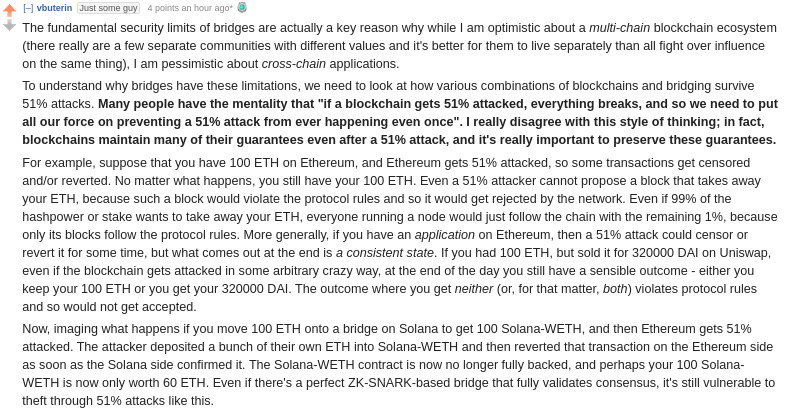
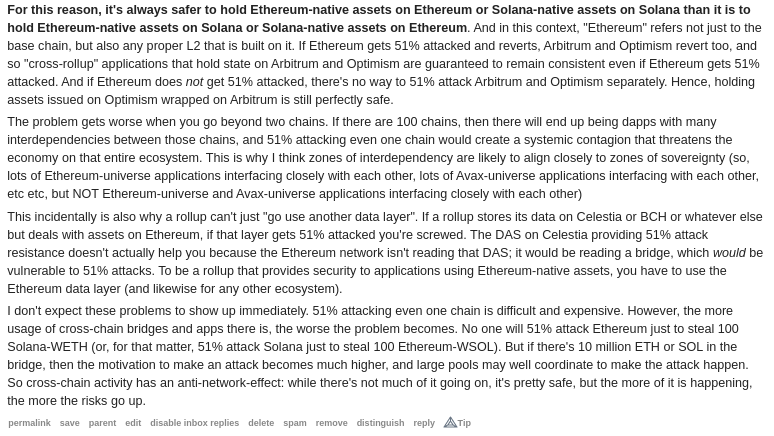
My argument for why the future will be *multi-chain*, but it will not be *cross-chain*: there are fundamental limits to the security of bridges that hop across multiple "zones of sovereignty". From https://t.co/3g1GUvuA3A:
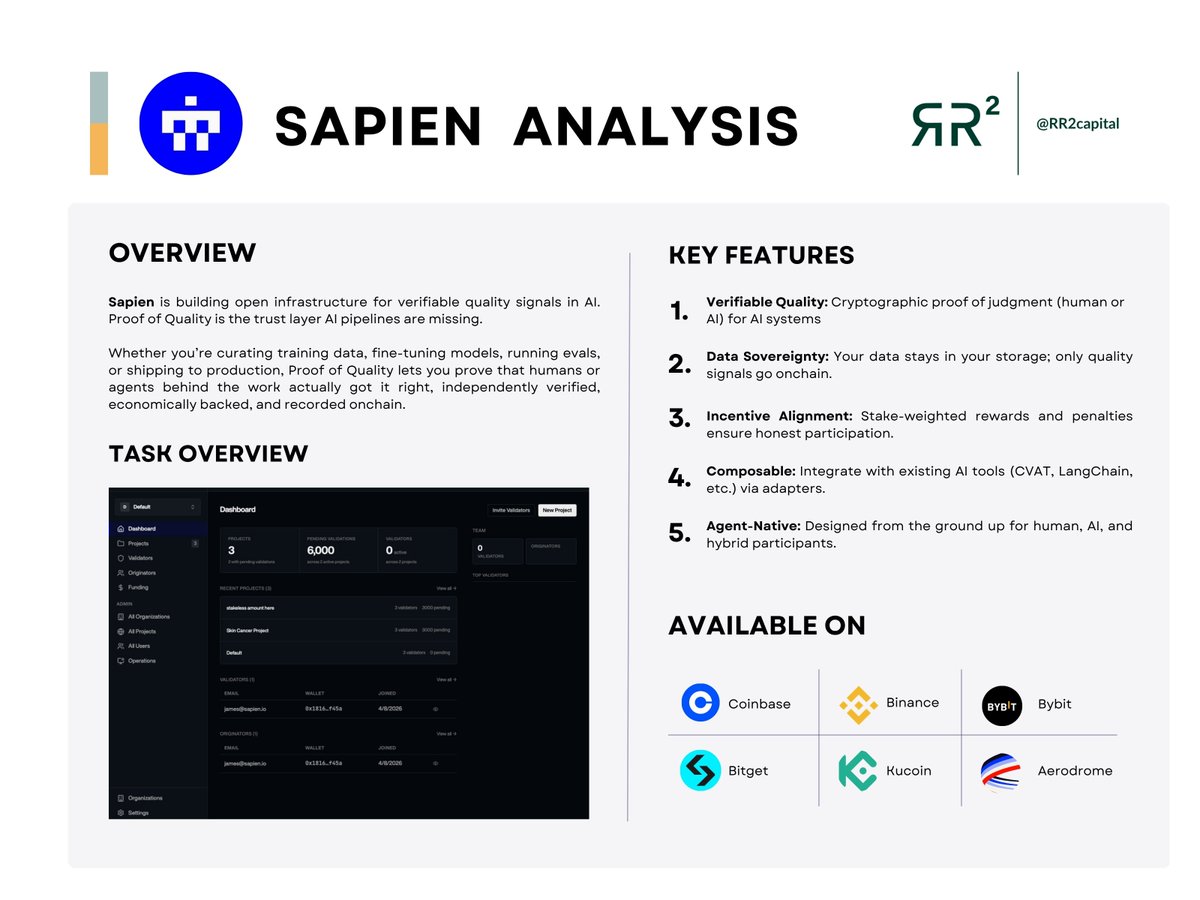
The AI data labeling market is projected to hit $17B by 2030 and most of it still runs on trust with no on chain verification.
Solid move by @BuildOnSapien with their Proof of Quality protocol, bringing verifiable attestations to human and AI outputs without ever touching the underlying data.
With the recent Royal Assent of Bill C-15, Canada is moving forward on a framework for stablecoins. The Department of Finance has begun the development of regulations to support safe, reliable digital payment options for Canadians.
Palantir CEO Alex Karp just named who wins the AI era.
Not the people who mastered the system.
The people who could never follow it.
Karp: “We’re in a non-playbook world, and the playbook’s not that valuable.”
For decades, the global economy ran on compliance.
Read the manual. Follow the procedure. Execute like the person next to you.
AI just automated the manual.
If your entire value was executing the playbook, you are now losing to something that does it perfectly, instantly, and for free.
Karp understood this before most people had the vocabulary for it.
Karp: “If you’re a dyslexic, you can’t follow the playbook, so you invent new and generative things.”
Neurodivergent people spent their entire lives inside a system built for a brain they do not have.
The front door was locked.
So they found other doors. Built new ones. Attacked problems from angles nobody else tried because the standard path was never theirs.
That is not a disadvantage.
That is decades of forced preparation for the exact world we just entered.
The front door is now locked for everyone.
The people who spent their lives perfecting the rules are scrambling.
The people who spent their lives ignoring them already know how to move.
The system spent a century punishing the exact people it needed most.
It measured compliance and called it intelligence.
It filtered out the builders. The ones who could not sit still. The ones who could not memorize a curriculum designed for someone else’s mind.
And called them broken.
They were not broken.
They were just early.