Aujourd'hui, on lance Well en France 🇫🇷
Un assistant IA qui prépare l'administratif de ton entreprise, directement sur WhatsApp.
Être entrepreneur en France, c'est aussi avoir un deuxième métier à plein temps : gérer l'administratif.
Et ça ressemble souvent à ça :
📥 245 emails à gérer entre clients, fournisseurs, URSSAF, impôts, banque et comptable
🤝 56 engagements pris en réunion : relances, devis, rappels, rendez-vous
🔐 37 outils entre lesquels jongler : Qonto, Pennylane, Stripe, HubSpot, Google Agenda, impots.gouv, URSSAF…
📚 10 400 pages de lois et de règlements que nul n'est censé ignorer :
Code du travail, Code général des impôts, Livre des procédures fiscales, CIBS, Code de commerce, Code de la sécurité sociale
Et tout ça avant même de commencer à travailler sur ton vrai métier.
C'est exactement pour ça qu'on a créé Well.
Pas de nouveau logiciel à apprendre.
Pas de tableau de bord à consulter.
Juste un message à envoyer.
☀️ Avec Well, tu prends ton café, tu envoies un message et tu reprends le contrôle de ta journée.
Toi, tu fais ton métier.
Well prépare le reste.
Essaie Well aujourd'hui 👇
https://t.co/oHTMypIYfT
@prantikmedhii Yes, it moves. Review got faster when the checks moved before the human: the author runs one command that repairs the derived files and runs the CI checks for that diff, and the PR arrives with a verdict (GREEN, WIDE, RED). The human reads a PR that is already checked.
People keep asking how a team of 9 ships 7,000 PRs a month with coding agents.
There is no secret tool, and it was not easy. Features per month went from 7 (Nov 2025) to 261 (Oct 2026). A feature is what took an engineer 2 to 6 weeks before AI.
What changed was the system around the model. We hit a glass ceiling every few months. Here is how we cracked each one 🧵
An old decision record is more dangerous to an agent than a missing one. It looks just as official, and the agent will cite it.
Every decision needs a status: active, or superseded by which one.
The Well cube, in metal:
- Three black-and-white renders on our design page
- Front, corner and face
- Each one comes with the 8 mm STEP file to download
Four CI levers we measured, then did not build:
- More young-generation memory for Node: −0.4 % in paired runs, under the noise, and +1.3 GB per VM
- A Turbo cache for PRs: 27–69 % of jobs rebuild the package the PR changes, so about 0.60 € a day, with a stale-build risk
- Skipping the rerun-after-preemption job: 97 % of its runs rerun nothing, but no event field says which ones in advance
- Cutting idle runners: every pool fell to 0 free runners once a preemption hit
- The bar to build: 2 € a day saved, measured
- Costs are Google list costs; promo credits cover that bill today
- Measured by Bastien Blanc
All of it is Bastien Blanc's work. The next target is the median, still 15 to 19 min.
What is your p90 since agents arrived? I'll answer here within 48 hours.
Agents keep pushing while a PR waits for CI.
Our slow runs (p90) went from 22 min in late September to 38 min in mid-October, then back to 21 min. The median barely moved.
What moved it, week by week, and what did not 🧵
@valentinchrt Funny thing: design is where it showed first. Once our designers shipped their own code, the job moved from pixels to written rules: tokens, states, the why behind each choice. Agents apply them on every PR. The decision is the deliverable now.
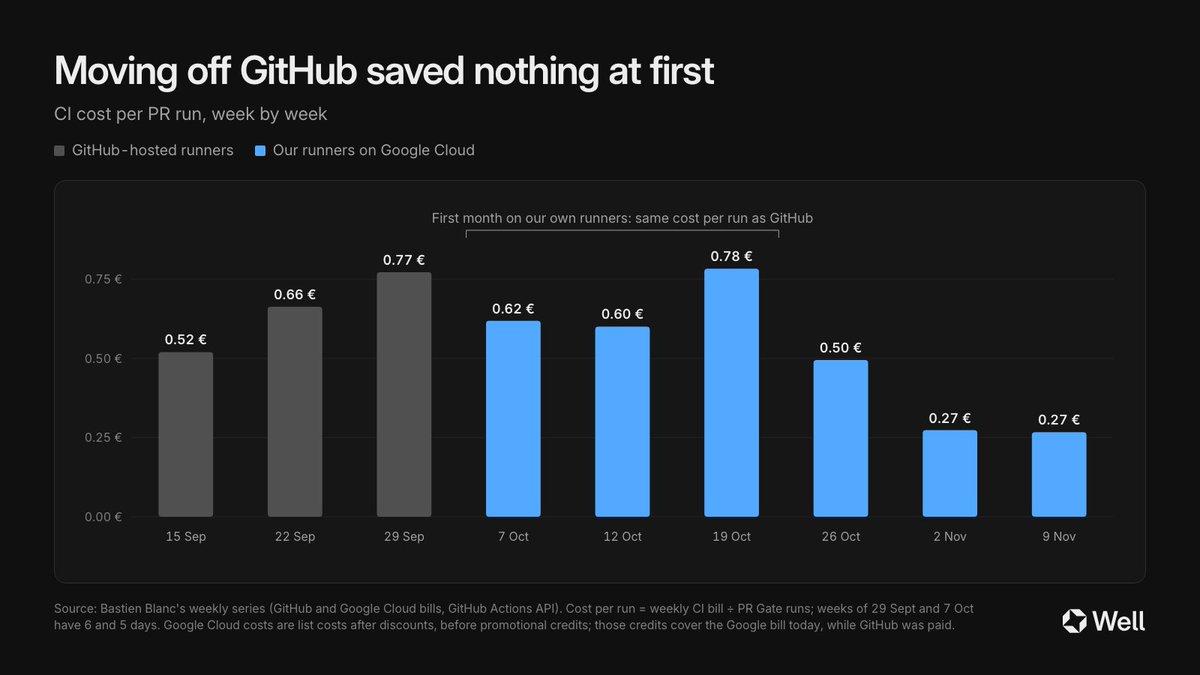
We did exactly this: our own runners, straight on Google Cloud, Spot VMs, open-source orchestration (GARM).
First month: 0.60 to 0.78 € per PR run. GitHub's runners had cost us 0.65 €.
The drop to 0.27 € came after, from six weeks of measured tuning by Bastien: machine and region picked by Spot price, build once, shards, less egress.
Google's bill runs on promo credits for now; GitHub was paid.
Sandboxes/CI Runners are the biggest expense for fully agentic development outside of tokens. I just saw our CI bill grow an order of magnitude trying to make CI fast across all the PRs over the past month. It’s unsustainable.
So I looked into the data (prepared by astra). My assumption is that anyone offering sandboxes/runners is just stacking their margin on whatever compute they use under the hood. You can see how this clearly works in the below figure. Fully productized runners are the most expensive by 2 orders of magnitude compared to the DIY version.
What is interesting is all these sandbox/runner products are likely using either OSS firecracker or containerd, with a proprietary orchestrator on top. And maybe some other pretty product stuff too that these companies like to think differentiate them (it doesn’t).
But look at the data below. You can save a ton of money if you self solve orchestration and go direct with cloud providers. Or bring your own hardware.
So it really comes down to orchestration. Is that worth this crazy premium Blacksmith and GitHub actions charge?
No. You can build your own; dare I say even vibe code it. Sure there are likely a lot of interesting lessons that companies learn by operating these systems over time that you won’t be able to vibe code yourself. But those things are not worth the 50x premium you might be paying for a company to “learn” this at scale, on your dollar. Moreover, you simplify a ton by building it to be single tenant, and in your VPC.
So go build your own orchestrator. Or stop doing CI. The result is the same: stop paying these companies 10s of thousands of dollars for a commodity.
This is possible now thanks to AI. At some point most companies will wake up and do this because the costs are not sustainable.
@camharris_ Agreed for the reversible calls: we log those too, and nobody rereads them. The log earns its keep on the few that aren't reversible, like pricing, the data model or who we sell to. Those are the ones someone tries to reopen.